App Development for Startups: A Founder's Guide

Founder & CEO, Buttercloud

For a startup founder, your idea is the spark. But transforming that idea into a successful business requires engineering a high-valuation technical asset, not just commissioning a pile of code.
Too many founders make a critical error: they treat development as a simple transaction. They seek the cheapest quote, believing they are merely buying features. This approach almost universally leads to a disposable prototype riddled with technical debt—a fatal flaw when investors begin their technical due diligence.
The strategic mindset must shift. The question is not, “Who can build my app for the least amount of money?” It must be, “Who can partner with me to engineer a defensible, high-valuation asset?” This re-framing changes everything. It elevates a one-off project into a core pillar of your business strategy.
Transforming Your Idea Into a High-Valuation Asset
The path from a napkin sketch to a scalable product that commands investor attention is not a single leap. It is a structured progression through three key phases:
-
The Idea: Your foundational vision—raw, unrefined potential ready to be shaped into a competitive product.
-
The Investor-Ready MVP: This is far more than a basic prototype. It’s a Minimum Viable Product engineered from day one with audit-ready code. This is the formidable foundation upon which your entire company will be built.
-
The Scalable Product: The mature application, architected to handle explosive growth, integrate new features seamlessly, and maintain rock-solid performance and security.
Navigating these stages demands more than a typical outsourced dev shop. You require a partner who functions as a senior technical partner and guide through critical technical decisions, not an opaque firm that delivers a black box of code.
Building a Defensible Advantage from Day One
A defensible advantage is your product’s strategic, engineered edge. It is a barrier to competition derived directly from superior architecture and quality engineering, making your product exceptionally difficult to replicate. Investors find this deeply compelling.
That kind of defensibility cannot be retrofitted. It must be constructed from the very first line of code.
A durable competitive edge is built with a relentless focus on quality. Every choice—from the technology stack to the database schema—is a strategic move that enhances your product’s defensibility and your company’s valuation.
The market opportunity is immense. The global mobile app market is projected to reach $750-$800 billion by 2025 and could accelerate toward $1.1 trillion by 2034. This growth is fueled by increasing user engagement and time spent within applications. You can learn more about these application development trends and their market implications.
By selecting a partner who understands the imperative of investor-ready code, you are positioning your startup to capture a meaningful share of that market. You are not just building an app; you are engineering a valuable, scalable asset.
How Do You Architect an Investor-Ready MVP?
The most critical phase of app development occurs long before a single line of code is written: the Product Design & Discovery phase. This is where your abstract idea is translated into a concrete, investable blueprint.
This is not a feature-listing exercise. It is a meticulous process of designing a product with a competitive advantage engineered into its core. We transition your vision from a concept into a set of engineering-ready documents that a development team can execute with precision.
Consider it the antithesis of the “black box” agency model. The objective is to bring you into the process, mentoring you through the pivotal decisions that will define your product’s trajectory.
From Founder Insights to a Technical Blueprint
How do we systematically de-risk your project and transform your vision into a buildable plan? Through a series of key steps that instill clarity and purpose.
-
User Stories: We deconstruct high-level goals into discrete user actions. A vague objective like “users can connect” becomes, “As a new user, I want to sign up with my email so I can create my profile.” This forces a relentless focus on delivering tangible user value from day one.
-
Wireframes & Prototypes: These serve as the architectural schematics for your application. We map user flows and screen layouts without the distraction of visual design elements, allowing for rapid, low-cost iteration of the core user experience.
-
Technical Specification Document: This is the master plan for your application. It details the technology stack, database architecture, APIs, and critical non-functional requirements like security and scalability. It is the roadmap the engineering team will follow with exactitude.
With a robust blueprint in hand, the focus shifts to the build. You can learn how to build an MVP that gets real traction by concentrating on market validation and early customer feedback.
Engineering an Asset, Not a Prototype
Many founders fall into the trap of building a “quick-and-dirty” prototype to achieve a fast launch. This is a profound strategic miscalculation. A flimsy application accumulates technical debt from day one, creating a liability that will crumble under real-world load and fail investor due diligence.
The purpose of an MVP is not to build a flimsy, feature-stripped product. It is to construct a strong, lean foundation—an investable asset—that validates your core hypothesis while being engineered for growth. Every component must be production-grade.
This discipline is what we term audit-ready engineering. When a venture capital firm’s technical team examines your codebase, they must find a professionally architected asset, not a tangled mess of demo code. Achieving this directly increases your company’s valuation and validates you as a founder who can execute.
This journey—from a raw idea to a scalable product that commands a high valuation—is a strategic process.
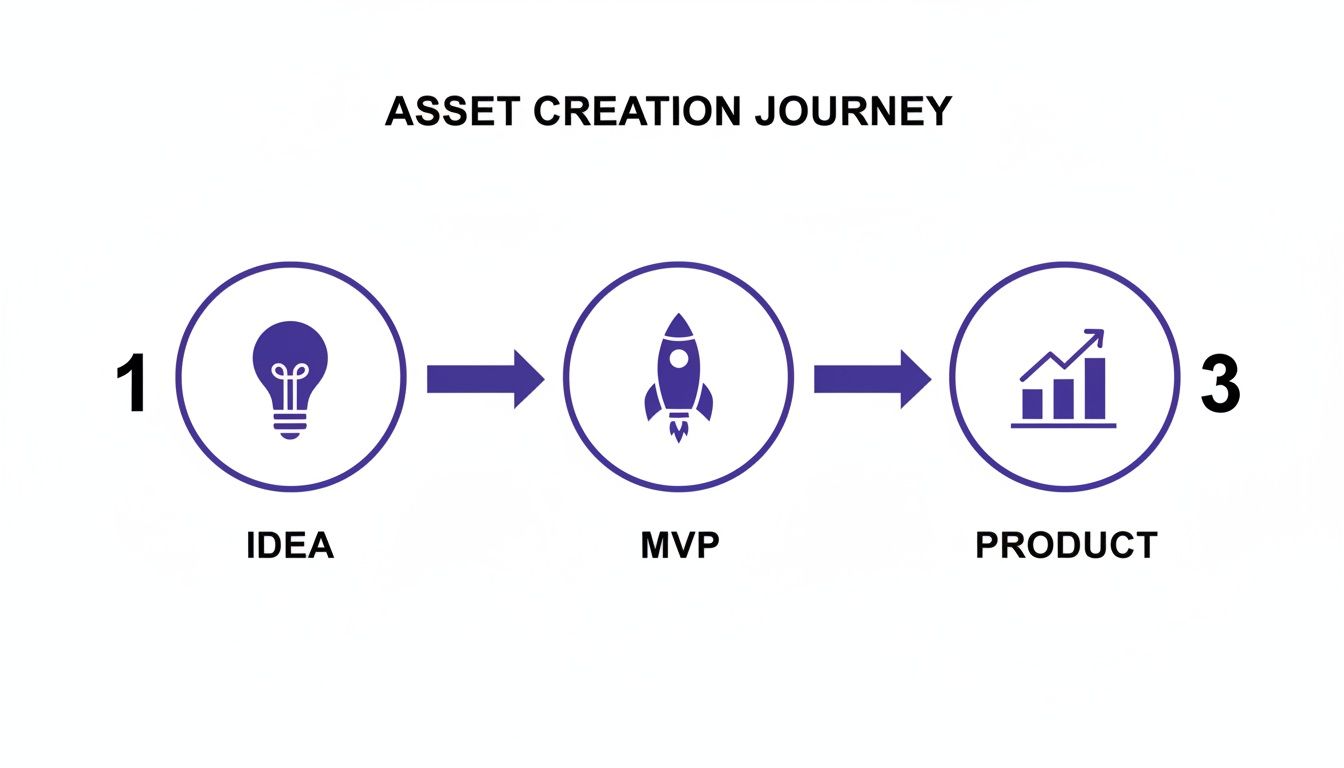
The MVP is your launchpad, engineered not just for today but for a long and successful flight. By prioritizing quality, you build a competitive edge that competitors can’t easily copy and provides investors with the confidence to commit capital. It is a disciplined approach with compounding returns.
What Are the Real Financials of Building Your App?
Let’s discuss capital. For a founder, comprehending the true cost of app development is not a mere accounting exercise—it is a fundamental test of strategic acumen.
Too many founders view a development quote as a price tag for a feature list. This is a dangerously myopic perspective. This budget must be understood for what it is: a capital investment into a core business asset.
These figures are not an expense. They represent the fuel being invested into creating a defensible advantage competitors can’t easily copy, an investor-ready product, and a durable foundation for growth. A cheap build invariably produces a worthless asset crippled by technical debt. A strategic investment, conversely, creates a high-valuation asset that will pass due diligence with ease.
Decoding Cost and Timeline Benchmarks
The critical question: “How much does an app cost?” The direct answer is, it depends. There is no single price. The cost is a direct function of your app’s complexity, the platforms you target, and the caliber of engineering you demand.
Building a simple MVP to test one core hypothesis is an entirely different undertaking than launching a complex, two-sided marketplace. The key is to align your budget with your strategic objectives, not a feature wish list.
Based on industry data for 2026, the range is substantial. A simple mobile app MVP might require an investment of $10,000 to $30,000 over 2-4 months. However, for well-funded startups aiming for a serious market entry—requiring production-grade engineering—initial builds commonly fall between $80,000 and $250,000. You can explore this in more depth in this analysis of software development costs.
To provide a more concrete framework, we have outlined common benchmarks.
Startup App Development Cost and Timeline Benchmarks for 2026
This table breaks down typical investment levels and timelines for different startup scopes. Use it as a guide to budget for the right product at the right stage.
Application Tier
Typical Cost Range
Development Timeline
Best For
Lean MVP
$10,000 – $40,000
2-4 Months
Founders testing a core assumption with a single, well-defined feature set.
Investor-Ready MVP
$80,000 – $150,000
4-7 Months
Startups needing audit-ready code, a strong UI/UX, and foundational scalability for a seed round.
Complex Platform
$150,000 – $300,000+
7-12+ Months
Businesses requiring advanced features like AI, multi-tenancy, or enterprise integrations.
These are benchmarks. The final investment will be determined by the specific strategic choices made throughout the development lifecycle.
Key Factors That Influence Your Budget
Every decision carries a cost. Here are the primary drivers that will impact your budget:
-
Feature Complexity: A simple content-delivery app is orders of magnitude less complex than a real-time social platform with video streaming and AI-powered recommendations. Each complex feature adds significant engineering hours.
-
Platform Choice: Building a native app for both iOS and Android from scratch effectively means funding two separate development projects. Cross-platform tools can reduce this cost but often introduce trade-offs in performance and long-term scalability.
-
Engineering Standards: This is the most overlooked factor. Partnering with a low-cost firm often means junior developers and systemic shortcuts that create crippling technical debt. Investing in senior-level, audit-ready engineering requires more capital upfront but prevents catastrophic failure—and failed due diligence—later.
A realistic budget is not a number; it is a strategic plan. It aligns your product ambitions with your capital, forcing prioritization of what truly matters for creating an investable asset.
Mastering these financial realities is the first step toward making informed, strategic decisions. To connect your feature ideas to a more concrete financial model, explore our interactive MVP cost estimator and observe how different choices impact the investment required.
When you approach your finances with the same rigor as your product vision, you circumvent the common traps that terminate promising startups prematurely.
Using AI to Accelerate Your Technical Roadmap
Let us be direct: artificial intelligence is no longer a futuristic concept. It is a standard tool in modern software engineering, granting savvy founders a significant competitive advantage. For you, strategically leveraging AI is not about chasing trends; it is about building a smarter, faster, and more valuable company from its inception.
Consider AI a force multiplier for your engineering team, enabling a lean, elite crew to achieve what once required a large division of engineers. This is not merely about cost savings; it is about accelerating the velocity and quality of your build—critical factors in a race to market.
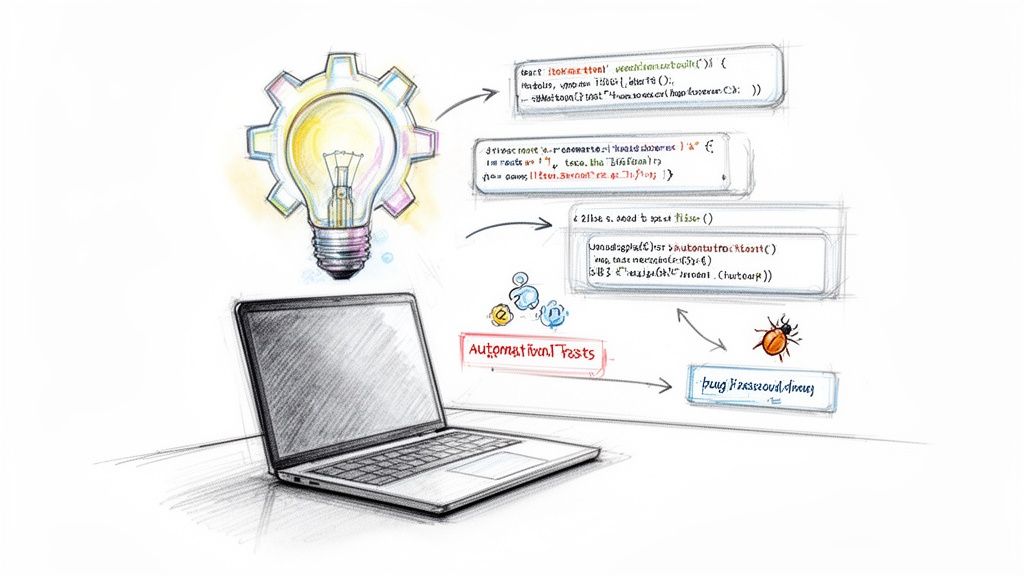
This is not a forecast; it is the current reality. 84% of developers are already using or planning to use AI tools in their development process, and 51% of professional developers reach for them daily, according to the 2025 Stack Overflow Developer Survey. The financial data corroborates this shift. GitHub Copilot, the leader in this domain, reported 4.7 million paid subscribers, up 75% year over year, in Microsoft’s FY26 Q2 results.
From Code Generation to Smarter Features
The most immediate benefit of AI is a dramatic increase in team efficiency. Tools like GitHub Copilot function as an expert pair programmer, available 24/7, fundamentally altering the development workflow.
Here is how this manifests in practice:
-
Accelerated Code Generation: Engineers can articulate needs in plain English, and the AI generates clean, functional code in seconds. This eliminates boilerplate work, allowing senior talent to focus on the complex, proprietary logic that defines your product’s competitive edge.
-
Real-Time Bug Fixing: AI assistants identify potential errors and recommend fixes during the coding process. This proactive approach to quality supports audit-ready engineering from day one, preventing the accumulation of technical debt that sinks many startups.
-
Enhanced Learning and Onboarding: When a developer encounters a new library or framework, AI tools provide immediate examples and context. This flattens the learning curve, making the entire team more adaptable and productive.
AI does not replace engineers. It augments them. It gives a small, high-performance team the capacity to out-build and outmaneuver larger, slower competitors.
Building AI-Powered Features That Drive Value
Beyond accelerating development, AI enables you to integrate intelligence directly into your product. This is where you can create differentiated user experiences that are exceptionally difficult to replicate.
For example, an e-commerce app can use AI to deliver product recommendations that are far more sophisticated than simple purchase history analysis. A productivity tool could leverage natural language processing to automatically summarize meeting notes and generate action items.
These are not gimmicks. They are core features that solve real user problems, increasing product stickiness and customer value.
By embracing AI in both your development process and your product features, you are not merely keeping pace. You are building a smarter, more defensible, and ultimately more valuable technical asset designed for long-term success.
How Do You Choose Your Technical Leadership?
Following the initial spark of an idea, selecting who will build your application is the most critical decision you will make as a founder. This is not about hiring a coder; it is about appointing the architect of your startup’s future.
A misstep here results in a fragile, unscalable product that VCs will not fund. The correct choice, however, leads to the creation of a high-valuation asset. For a founder, this decision presents three primary paths, each with distinct strategic trade-offs.
The Full-Time CTO Route
Onboarding a full-time CTO as a co-founder appears to be the ideal scenario. It provides a dedicated partner, fully invested in the vision and immersed in the technology daily. This profound alignment is incredibly powerful.
However, for most early-stage startups, this is a formidable challenge. A top-tier CTO commands a substantial salary and, more critically, significant equity—two resources in scarce supply. Furthermore, identifying an individual who combines executive strategy, hands-on engineering prowess, and the requisite startup DNA is exceptionally rare.
The Traditional Outsourcing Gamble
At the opposite end of the spectrum lies the conventional “dev shop” or outsourcing firm. They promise a rapid, low-cost path to a finished app. You provide a specification document, they return a quote, and their team operates within a black box.
This is a trap many founders inadvertently enter. While it appears cost-effective, you are sacrificing a strategic partner for a transactional vendor. Their primary incentive is to complete the project and move to the next client, which often leads to cut corners. The result is poor code quality, massive technical debt, and a product that breaks under scale—the antithesis of an audit-ready asset.
The objective is not to avoid all external expertise. It is to avoid the lack of ownership. A true partner mentors you and engineers for longevity. A typical firm delivers a disposable product.
The Fractional CTO Partnership
This is the strategic middle ground. A Fractional CTO provides the C-suite strategic thinking of a full-time technology leader without the commensurate cost or equity dilution. Think of this individual as your dedicated “Mentor-Architect.”
This is a hands-on, high-touch partnership. A seasoned expert designs your architecture, guides the engineering process, and ensures every technical decision aligns with the singular goal of building an investable product. It is the ideal model for founders who require elite strategic leadership to prepare for due diligence but are not yet positioned to hire a full-time executive. This is precisely the function of Fractional CTO services.
To clarify the distinctions, let’s analyze how these models compare.
A Comparison of Technical Leadership Models for Startups
Here is a side-by-side analysis of the primary leadership options, designed to help you align your choice with your startup’s stage and strategic goals.
Model
Best For
Strategic Value
Cost Structure
Full-Time CTO
Well-funded startups with proven market fit needing deep, long-term technical ownership.
High (but only if you find the right person).
Very High (Salary + Equity).
Outsourcing Firm
Founders needing a simple, non-core app where speed is the only priority and quality isn’t a long-term concern.
Low.
Low upfront, but high long-term costs from technical debt.
Fractional CTO
Founders building an investor-ready MVP who need elite guidance without the full-time overhead.
High.
Moderate (Retainer or project-based).
Ultimately, your choice of technical leadership is a strategic decision with long-term consequences for your startup. For founders focused on app development for startups, the Fractional CTO model often represents the optimal balance of world-class expertise and capital efficiency, ensuring your product is engineered for a high valuation from day one.
Building for Scale and Investor Confidence
You have launched. Your MVP is live, and users are signing up. What happens when you secure a feature in TechCrunch and a massive influx of users hits your application simultaneously? Does it perform, or does it collapse?
An MVP that cannot handle success is a technical liability. It will destroy your momentum and deter investors. Effective app development for a startup is not just about shipping a product; it is about engineering an asset that can grow with your business.
This requires a focus on stability, security, and audit-readiness from day one. This is where a professional DevOps and managed infrastructure practice ceases to be a “nice-to-have” and becomes a strategic advantage. Instead of fragile, manual updates, you gain automated deployment, testing, and monitoring that ensure your application remains stable, no matter how quickly you scale.
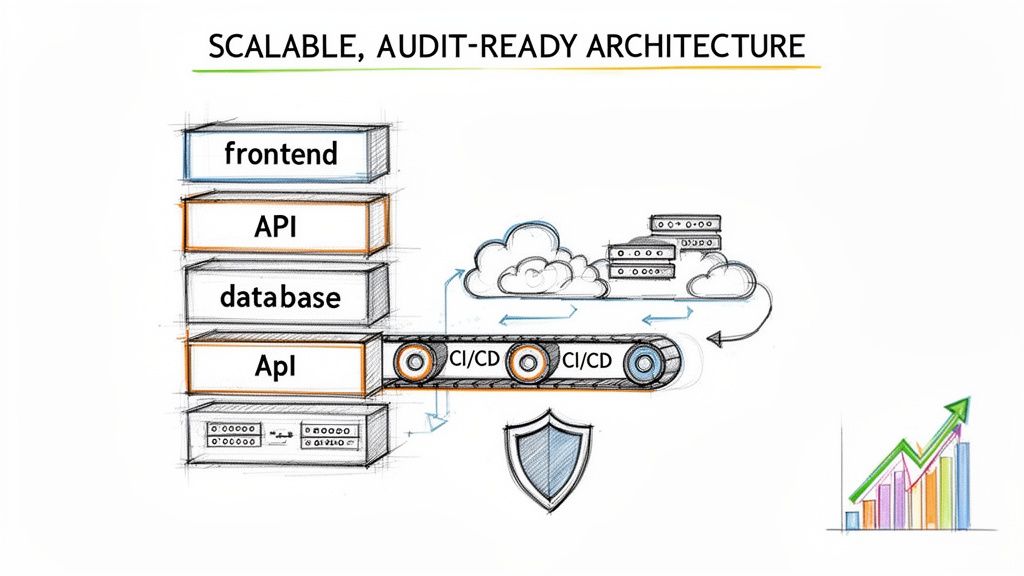
This is the fundamental difference between a brittle prototype and a genuine, investor-ready technical asset. One gets you started; the other gets you funded.
Eliminating Technical Debt at the Root
Technical debt is the invisible tax levied on every engineering shortcut, poorly written line of code, and suboptimal architectural choice made during early development. It renders your app slow, buggy, and nightmarish to update. For a startup, it is a silent killer.
A core principle of building an investable company is to eliminate technical debt at its source. This means every component of your build—from the code to the cloud infrastructure—is designed to pass a rigorous VC technical due diligence process.
An audit-ready approach is not a buzzword; it is a commitment to key disciplines:
-
Automated Testing: Building a comprehensive suite of tests (unit, integration, and end-to-end) that execute automatically. This is your safety net, ensuring new features do not break existing functionality.
-
CI/CD Pipelines: Continuous Integration and Continuous Deployment (CI/CD) automates your release process. It automates building, testing, and deploying code, resulting in faster, more reliable releases with fewer human errors.
-
Clean Architecture: Employing proven design patterns ensures your codebase remains organized and maintainable. Your next engineering hire will be able to contribute productively immediately, rather than spending a month deciphering spaghetti code.
This is not a pursuit of perfection. It is a strategic imperative for survival, enabling your team to move quickly without being hindered by past mistakes.
Designing for Security and Compliance
In an environment rife with data breaches and privacy concerns, security cannot be an afterthought. It must be woven into the fabric of your product. Be assured, investors and potential enterprise customers will scrutinize your security posture before considering a partnership.
Building a secure application requires a multi-layered defense strategy:
-
Infrastructure Hardening: This involves securing your cloud services, minimizing attack surfaces, and implementing strict access controls.
-
Data Encryption: Sensitive user data must be protected everywhere—both in transit across networks and at rest within your databases.
-
Regular Security Audits: Do not wait for an attack. Proactively scan for vulnerabilities and engage experts for penetration testing to identify weaknesses before they can be exploited.
For startups targeting enterprise clients, demonstrating robust security is a significant competitive advantage. Understanding the requirements for certifications, as detailed in guides on SOC 2 compliance for startups, is non-negotiable for closing high-value contracts.
By engineering for stability, security, and scale from the outset, you are not just building a product. You are building a trustworthy, high-valuation technical asset that provides the foundation to win your market.
Straight Talk on Startup App Development
Launching a new application is a minefield of difficult questions. We understand. Here are direct, authoritative answers to the most significant questions we hear from founders, all oriented toward building a company that investors will compete to fund.
How Much Should My MVP Really Cost?
This is the central question. The direct answer: it depends. The cost is inextricably linked to the complexity of your idea and the caliber of the engineering you procure.
A lean MVP, built solely to test a single core hypothesis, might fall in the $10,000 to $40,000 range. However, if your objective is to attract serious investor interest, you require what we call an investor-ready MVP. This necessitates a polished user experience and robust, production-grade code. For this level of quality, you should budget between $80,000 and $150,000.
A word of warning: if a quote seems too good to be true, it is. Unrealistically low prices are a major red flag, almost always indicating junior developers, systemic shortcuts, and a mountain of technical debt that will disqualify you during VC due diligence.
Is It Better to Build for iOS, Android, or Both?
The correct strategy here depends on two factors: your target audience and your capital. If you have clear data that your initial user base resides on a single platform—for instance, creative professionals who are predominantly iOS users—then launching with a single native app is the most strategic move. It delivers optimal performance and user experience. Attempting to build for both platforms simultaneously is equivalent to funding two separate product developments from day one.
Cross-platform tools like React Native can extend a budget, but they often introduce performance trade-offs and long-term maintenance complexities. A skilled Fractional CTO will help you evaluate these options to ensure your decision serves your long-term strategy, not just your initial budget.
Can I Hire a Cheaper Offshore Team to Build My App?
While fiscally tempting, this is one of the riskiest wagers a founder can make. The “anti-outsourcing model” exists for a reason. Large, mass-market development shops often operate as a black box: you provide capital, and code is eventually returned, but with a complete absence of strategic mentorship.
You do not just need a code writer; you need a technical partner who is invested in your business’s success. A boutique partner who thinks like both mentor and architect focuses on building an asset—audit-ready engineering that creates a technical moat around your business. This directly increases your company’s valuation. A transactional offshore relationship, in contrast, typically yields a disposable product.
What Is a Fractional CTO and Why Do I Need One?
A Fractional CTO is akin to having an elite, executive-level technical co-founder on your team, but without sacrificing a large equity stake or incurring a massive full-time salary. It is the ideal model for early-stage founders who require top-tier guidance on pivotal, company-defining decisions: your technology architecture, your toolchain, and how to hire your tech team.
Your Fractional CTO ensures that every line of code and every technical choice advances your business objectives. They prepare you for the intense technical due diligence that VCs will conduct and mentor you throughout the process. It represents the ideal synthesis of high-level strategy and in-the-trenches partnership for building an investable company.
Ready to turn your idea into a high-valuation technical asset? Buttercloud is the boutique engineering partner and Founders Academy that guides founders from idea to investor-ready MVP and beyond. Schedule your strategic consultation.
Have a product idea to talk through?
We'll show you how we'd approach it — no pressure, just a real conversation.
Book a Discovery Call