Build an MVP That Wins Over Investors in 2026

Let’s get one thing straight about your Minimum Viable Product. If you think an MVP is just a clunky, disposable prototype you’ll throw away in a few months, you’re setting yourself up for failure.
This isn’t just about building software; it’s about engineering the foundational technical asset of your startup. Your very first product must be investor-ready from day one—engineered to pass rigorous technical due diligence and powerful enough to prove your market with real users.
Your MVP Is a Technical Asset, Not a Prototype
Forget the old-school advice to build an MVP as cheaply and quickly as humanly possible. That’s a one-way ticket to a mountain of technical debt, a failed investor audit, and a complete rewrite that will cost you far more in the long run.
In today’s market, your first product is the most tangible proof you have. It showcases your team’s skill and your idea’s true potential. Think of it as building a technical moat from the very beginning.
When you present a well-engineered MVP, you’re signaling to investors that you’re building a serious, scalable business—not just fiddling with a fleeting idea. A solid MVP becomes a core part of your company’s valuation. It’s an asset that grows in value, not a liability you have to fix.
An MVP is no longer about being ‘Viable’ in a technical sense; it’s about being ‘Valuable’ in a business sense. Founders must shift from asking “Does it work?” to “Does it create an investable asset?”
This distinction changes everything. A prototype is designed to be thrown away. A technical asset is designed to be built upon. Every line of code, every architectural choice, and every design decision should contribute to a stable, secure, and scalable foundation. We call this audit-ready engineering.
Prototype Mindset vs. Investor-Ready MVP
Getting this difference right is the first step toward building a product that actually secures funding and wins over customers. One path leads to painful rewrites and a loss of credibility; the other builds a higher valuation and puts you on the fast track to scale.
The table below breaks down these two clashing mindsets.
Attribute
Traditional Prototype Mindset
Investor-Ready MVP (Buttercloud Approach)
Primary Goal
Test an idea quickly and cheaply
Validate a market and build a valuable technical asset
Code Quality
Disposable, “duct-tape” code
Clean, documented, and test-covered
Architecture
Unplanned, built for a single purpose
Scalable, designed for future growth
Investor Perception
A risky experiment needing a total rebuild
A de-risked, investable foundation
Technical Debt
Accepted and accumulated from day one
Eliminated at the root and managed strategically
Outcome
A demo that requires a complete overhaul
A v1.0 that can be scaled into a full product
One approach gives you a demo. The other gives you a business.
Proving Traction Where It Counts
A production-grade MVP isn’t just about good engineering—it’s a tool for survival.
The data doesn’t lie. Startups that prioritize and launch a high-quality MVP within the first 90 days are three times more likely to secure pre-seed funding. In the current market, over 85% of early-stage investors won’t even take a meeting without seeing a functional product with real usage metrics.
This isn’t a “nice-to-have” anymore. It’s the table stakes. By getting a solid product into the hands of actual users, you avoid the #1 startup killer: building something nobody wants. You can find more insights on how a production-grade MVP accelerates your funding journey at Copywing.com.
Ultimately, deciding to build an investor-ready MVP is the first real test you’ll face as a founder. It determines whether you start your journey on solid rock or shifting sand. By treating your MVP as the first and most important asset in your company’s portfolio, you set a standard of excellence that will define your business for years to come.
Translating Your Big Idea Into a Lean Blueprint
Before you write a single line of code, the success of your MVP boils down to one thing: focus. I’ve seen countless founders fall into the trap of believing more features equal more value. It’s almost always the opposite.
The real skill is in ruthless prioritization. It’s about translating your grand vision into a lean, executable blueprint that proves your core hypothesis with surgical precision. This is the Product Design & Discovery phase, where we de-risk the entire project.
We aren’t trying to build less; we’re trying to build the right thing first. That means finding the single, most critical user journey that delivers immediate value and gives you the clearest signal that you’re onto something. Everything else is just noise.
If you want to test the waters before even committing to an MVP, you can often get early feedback by building a simple landing page to validate your idea.
The Art of Strategic Scoping
Strategic scoping isn’t a guessing game; it’s a structured process. It all starts with discovery sessions where we dissect your idea and map it directly to a real user’s world. We’re hunting for that sweet spot where a high-value problem meets a simple, elegant solution.
Here’s what that looks like in practice:
-
Problem-First Discovery: We relentlessly question every assumption. Who is the exact user? What is their most painful, unmet need? We force ourselves to articulate the problem so clearly that the solution starts to feel obvious.
-
User Journey Mapping: We don’t just make a list of features. Instead, we map out the A-to-Z path a user takes to solve their core problem. This narrative approach is what separates the true “must-haves” from the “nice-to-haves.”
-
Feature Prioritization: Using a framework like MoSCoW (Must-have, Should-have, Could-have, Won’t-have), we get brutally honest about every feature. The “Must-haves” for your V1 should tell one cohesive story.
This process is what turns a rough concept into a genuine asset.
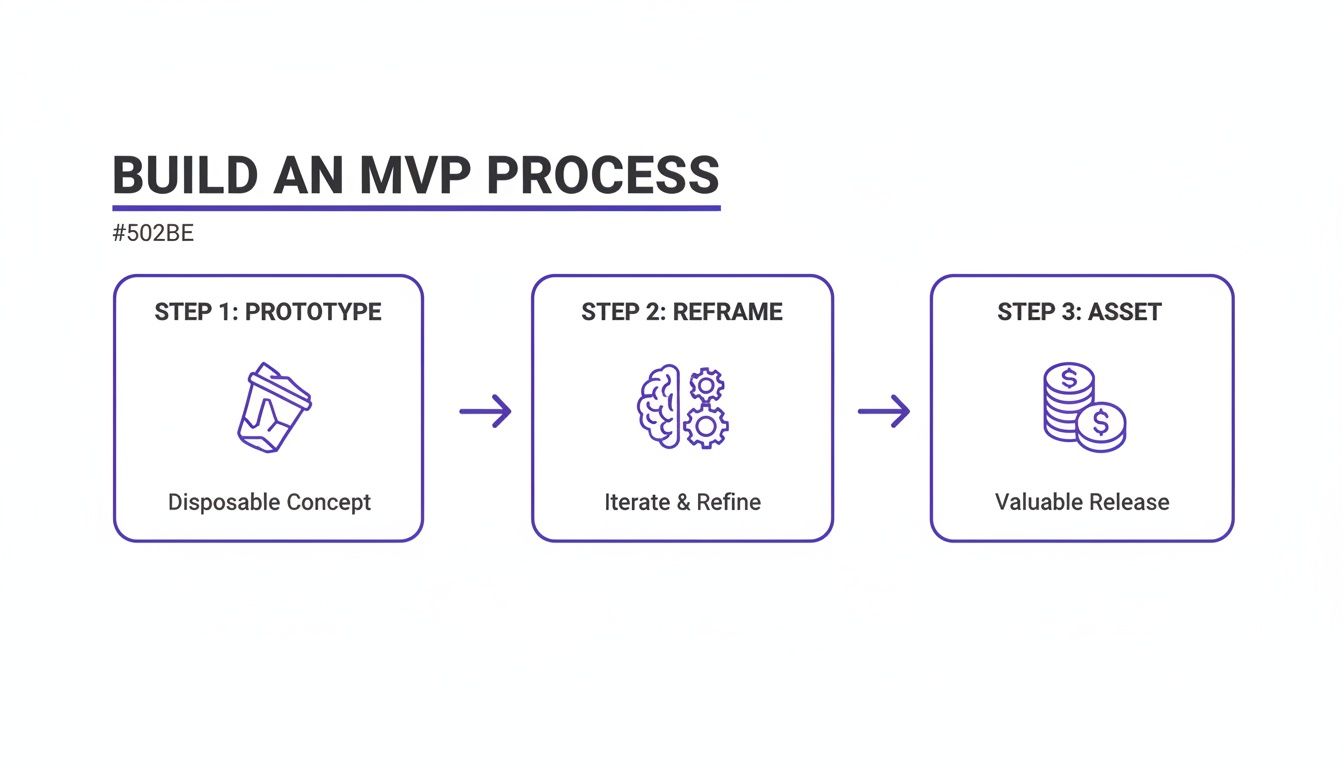
That middle step, “Reframe,” is where the magic happens. It’s the intentional act of refining your idea before the build starts, turning a disposable prototype into something with real value.
From User Flow to Wireframe
Once you’ve nailed down that prioritized user journey, it’s time to create the architectural plans for your product: user flows and wireframes. These aren’t just design exercises; they are critical communication tools that get founders, designers, and engineers all on the same page.
A user flow is basically a simple diagram showing the path a user takes to get something done in your app. Think of it as the story of your product in action, screen by screen.
From that flow, we build wireframes. These are just the black-and-white, low-fidelity skeletons of your app’s screens. The entire point is to define structure and function, not to get bogged down in aesthetics.
A wireframe forces you to answer the hard questions about information hierarchy and user interaction before you get distracted by colors and fonts. It’s the skeleton of your application; the visual design is the skin you apply later.
Here’s an easy way to think about it: the user journey is the plot, the user flow is the scene-by-scene outline, and the wireframes are the storyboards.
By the end of this blueprinting phase, you’ll have a clear, documented plan that your entire team can follow. This is your best defense against “feature creep” and the only way to ensure you build an MVP that is truly minimum, viable, and—most importantly—valuable.
Choosing a Tech Stack That Balances Speed and Scale
Tech stack. Just those two words can make a founder break out in a cold sweat. It’s one of the first big decisions you’ll make, and it feels like everything is riding on it. I’ve seen more founders get completely paralyzed here than almost anywhere else.
Let’s be clear: this isn’t just some geeky engineering choice. It’s a core business decision that defines how fast you can move today and whether you can grow tomorrow. Get it wrong, and you’re painting yourself into a corner. But get it right? It becomes your secret weapon.
The real goal is to be pragmatic. You need to build something solid enough to impress investors and validate your idea, but you can’t get bogged down building a fortress for a war you might not even fight.
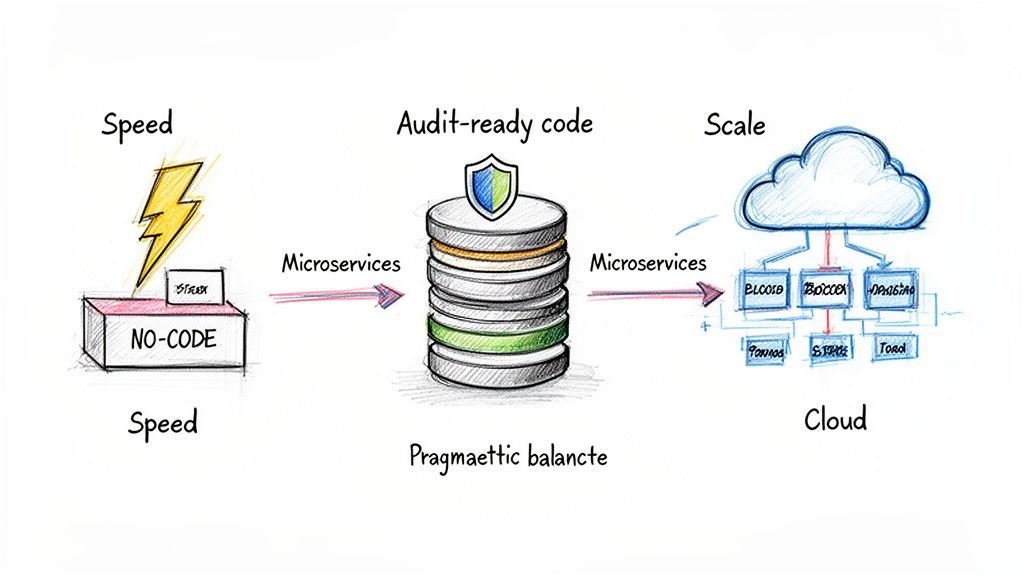
Monolith vs. Microservices for Your MVP
One of the first debates that pops up is monolith vs. microservices. For an early-stage MVP, the answer is almost always a well-structured monolith. Don’t let anyone tell you otherwise.
Think of a monolith as a single, unified codebase where everything is connected. It’s way faster to develop, much simpler to deploy, and a breeze to test. When getting to market is your number one job, these things are gold.
Trying to build a complicated web of microservices before you even have a real product is a rookie mistake—a classic case of optimizing way too early.
Sure, microservices—where you break the app into tiny, independent services—are amazing for scaling massive operations. But they bring a ton of overhead. You’ll spend more time wrangling deployments and making sure all the little pieces are talking to each other than you will actually building features your first users care about.
My rule of thumb for founders: Start with a clean, modular monolith. Build it with clear separations between different parts of the app. This gives you the speed you need now, with the option to peel off a piece into a microservice later, once you have product-market fit and a real reason to scale.
Native vs. Web Should Be a Business Decision
Next up: should you build a native mobile app (iOS/Android) or just stick with a web app? This isn’t a tech question; it’s a question about your users. Where are they, and what do they need?
-
Native App Development: Go native if your core experience absolutely depends on phone features. Think camera access, GPS, offline mode, or heavy use of push notifications. Ride-sharing apps, photo editors, and fitness trackers are perfect examples. You’ll get the best performance and a slick user experience.
-
Web Apps (and PWAs): A web app is, without a doubt, the fastest way to reach everyone on any device. If your product is mostly about content or data—like a SaaS dashboard or an online marketplace—a sharp, responsive web app is the smartest way to build an mvp. Progressive Web Apps (PWAs) can even give you an app-like feel with some offline perks.
Getting this right from the start is a huge deal. We actually built a tool to help founders with this exact decision. If you’re stuck, check out our Tech Stack Recommender for some personalized guidance.
The Role of No-Code in Validating Your Idea
The boom in no-code and low-code tools has completely changed the game for early-stage validation. These platforms let you test ideas and find your market without writing a single line of code. It’s a massive shortcut.
We’re talking about shrinking MVP timelines down to just 2-4 weeks and saving up to 80% compared to a traditional build. This isn’t just a tiny trend, either. A whopping 58% of product managers now rely on no-code for fast prototyping. It’s a market that’s on track to hit $187 billion by 2030.
With the right oversight (like from a Fractional CTO), a no-code MVP can be a brilliant first move. The key is planning a clear migration path so you don’t get locked into one platform forever. To see how this is all playing out, you can read the full research on top MVP development trends at gainhq.com.
Ultimately, every tech choice you make is a trade-off. Your job as a founder is to pick the trade-offs that get you to market quickly with a product that works, without sabotaging your long-term vision.
Budgeting for an Investor-Ready MVP
Alright, let’s talk about the one question every founder has: “How much is this MVP actually going to cost me?” Forget vague estimates and fuzzy numbers. Budgeting for your first product isn’t just another line item on a spreadsheet; it’s the first major investment you’ll make in your company’s core asset.
The final price tag really boils down to three things: how complex your features are, how polished the design needs to be, and how many other systems you need to plug into. A simple SaaS dashboard and a product built on complex AI are two entirely different beasts with vastly different costs. Understanding what drives that cost is the first step to building a budget that isn’t a work of fiction.
Your Team Is Your Biggest Cost—And Your Biggest Risk
Here’s where I see most founders get it wrong. They obsess over tech stacks, but the single biggest driver of your budget isn’t the technology—it’s the people you hire to build it. This is where miscalculations can be absolutely brutal.
You’ve really got two main paths: hiring your own in-house team or bringing on a boutique engineering partner. Let’s get real about what each one actually costs you.
-
The In-House Gamble: That full-time engineer’s salary looks manageable on paper, right? But that’s just the tip of the iceberg. You need to factor in recruiter fees, benefits, payroll taxes, new hardware, and—most importantly—the massive amount of your own time you’ll sink into tech team hiring, sourcing, interviewing, and getting them up to speed.
-
The Boutique Partner Play: Working with a firm like Buttercloud means you get an entire, cohesive team from day one. We’re talking strategic leadership, design, and senior-level engineering, all for a single project fee. Think of it as our Anti-Outsourcing Model—you get the dedicated mentorship of a full-time team without the long-term financial drag and hiring headaches.
The most expensive mistake a founder can make is hiring the wrong person. A bad hire doesn’t just cost a salary. It burns months of precious runway and almost always leaves you with a mountain of technical debt that demands a complete, and very expensive, rewrite.
A top-tier partner completely de-risks this. You’re not just getting code; you’re getting a “Mentor-Architect” who guides the entire project, ensuring what you build is a truly investable asset from the get-go.
So, What’s the Real Number?
Let’s put some concrete figures on the table. In 2026, a well-built MVP can run anywhere from $18,000 for a straightforward app to over $70,000 for something with more intricate features.
But if you’re building with advanced tech, you’re playing a different game. AI-powered MVPs, the kind designed to create a deep competitive moat, are a bigger upfront investment, often in the $140,000 to $300,000 range over a 3-6 month build. It’s a higher initial check, but these products are engineered for massive returns right out of the gate. As recent industry analysis shows, this pricing reflects the sophisticated engineering and polished UX needed to compete, and our production-grade approach is built for 62% higher success odds. You can discover more insights about AI MVP development pricing on Sainam.tech.
To get a clearer sense of where your idea fits, start by mapping out your core features. You can get a tailored estimate by using our interactive MVP cost estimator to plan your budget. The tool is designed to show you exactly how your scope decisions directly affect the bottom line.
In the end, your MVP budget is a reflection of your ambition. You can build a cheap prototype that might get you a few demo meetings, or you can make a strategic investment in an audit-ready asset that becomes the foundation of your company’s valuation. The choice you make right now will define your entire trajectory.
Measuring the Metrics That Matter to Investors
Look, an MVP without users is just a fancy science project. It’s a bunch of well-written code sitting on a server, its value purely theoretical. The real work begins when you push it live, get it into the hands of actual people, and start collecting the data that tells your story. This is where you stop building and start proving.
But a launch isn’t some big, flashy firework show. It’s a quiet, controlled release meant to attract the right kind of early adopters—the ones whose feedback is worth more than gold. After that, your whole world shifts. It becomes all about the numbers that investors actually care about. Forget the vanity stuff; we’re hunting for the hard data that screams product-market fit.
From Code to Customer: The Lean Launch Strategy
Let’s get one thing straight: the goal of your MVP launch is not to go viral. It’s to learn. A targeted, phased rollout lets you gather top-tier feedback and make quick changes without the chaos of a massive, unforgiving audience.
The whole game here is to find and talk to a small, very specific slice of your ideal user base. You’re not looking for just anyone. You want the people who feel the pain your product solves most acutely. They’ll be more forgiving of a few rough edges and are way more likely to give you the nitty-gritty feedback you need to iterate.
A solid lean launch usually breaks down into a few key moves:
-
Find Your People: Pinpoint the online communities, niche forums, or private groups where your target users are already hanging out.
-
Reach Out Personally: Don’t just blast a generic message. Craft personalized invitations. Explain what you’re building and why their specific input would be so valuable to you.
-
Create a Feedback Hotline: Make it dead simple for them to report bugs, suggest features, or just share their thoughts. A dedicated Slack channel, a simple feedback form, or even your direct email can work wonders.
This strategy turns your first users from passive critics into active partners in building your product.
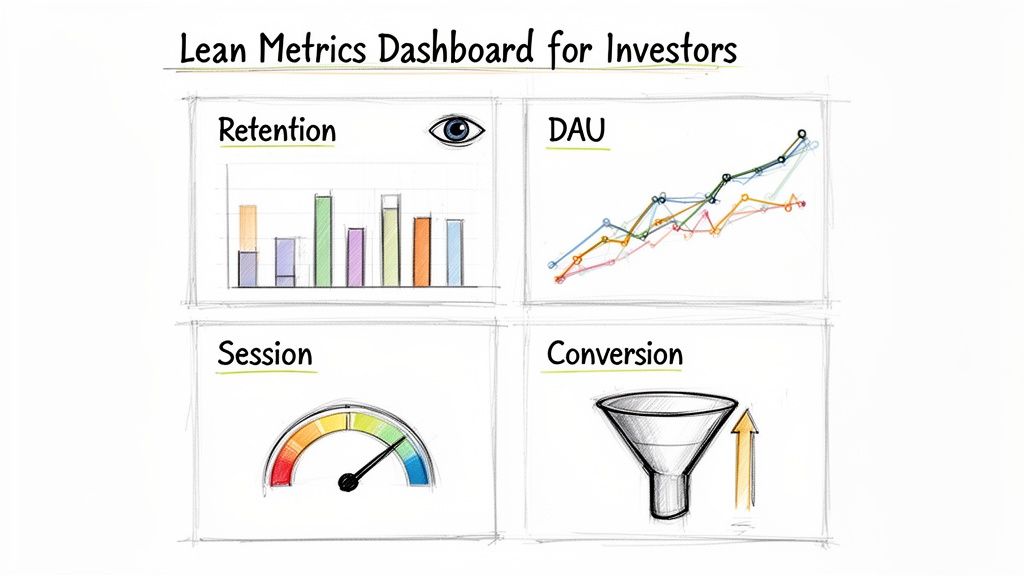
The Investor Dashboard: Key KPIs
Once you’ve got users, it’s time to track the metrics that prove you have a real business on your hands. VCs have seen it all. They’re immune to big download numbers that don’t mean anything. They want to see the vital signs of your business.
Investors don’t fund ideas; they fund evidence. The data you collect from your MVP is the most powerful evidence you have. It must tell a clear story of user engagement, retention, and growth potential.
Pour your energy into this core set of KPIs.
-
User Retention Cohorts: This is the king of all metrics. It shows the percentage of users from a specific week or month who are still active one, two, or three months later. High retention is the clearest possible signal that you’ve built something people actually want.
-
Session Duration and Frequency: Are users just popping in and out, or are they spending real time with your core features? Seeing session duration climb over time is a great sign that your product is getting stickier and more valuable.
-
Daily vs. Monthly Active Users (DAU/MAU): The DAU/MAU ratio is a classic indicator of product health. It tells you what portion of your monthly users engage with your product every single day. A high ratio suggests your product is becoming a daily habit.
-
Early Conversion Signals: Even if your MVP has no price tag, you can still track “conversion” signals. This could be the percentage of users who complete a key task, invite a teammate, or use an advanced feature. Think of these as a proxy for their future willingness to pay.
When you build an MVP, you’re really building a data-generating machine. The quality of that machine—your code, your architecture, your UX—directly impacts the quality of the data you get back. Walking into a pitch with clean, compelling data from an audit-ready product is how you turn a great idea into a funded company.
Founder FAQs: The Mentor-Architect’s Advice
As a Fractional CTO, I’m in the trenches with startup founders day in and day out. I’ve been there for the back-of-the-napkin sketch all the way through to the first funding round. And you know what? The same make-or-break questions come up every single time.
This isn’t some theoretical playbook. This is the real-world, battle-tested advice you need to navigate the tricky path to launching an MVP that investors will actually take seriously. These aren’t just tech questions—they’re the strategic decisions that will set the course for your entire company.
How Long Should It Really Take to Build an Investor-Ready MVP?
Let’s cut to the chase. For a properly scoped, production-grade MVP, you need to budget 3-4 months. That’s the realistic timeline.
This window gives you enough time for thorough Product Design & Discovery, solid engineering, and testing—without racking up a mountain of technical debt that will bury you later.
Trying to cram it into less than three months? You’re cutting corners, plain and simple. You’ll probably skip vital user discovery, rush the architecture, and ship buggy, untested code. Those shortcuts always come back to bite you, leading to expensive rewrites and killing investor confidence before you even get started.
On the flip side, if you’re creeping past the four-month mark, it’s a huge red flag. Your “M” in MVP is probably MIA. You’ve fallen into the feature creep trap and lost sight of the core problem you’re supposed to be solving. The 3-4 month window is the sweet spot. It balances the need for speed with the quality engineering required to build an MVP that can survive the intense scrutiny of technical due diligence.
Is It Better to Hire a Freelancer or Partner With an Agency?
This one’s a biggie. While a great freelancer is perfect for a specific, well-defined task, building an entire MVP is a completely different ballgame. It requires a single, cohesive vision that spans strategy, design, and engineering.
A boutique agency like Buttercloud gives you that integrated, high-octane team from day one. You aren’t just hiring a few coders; you’re bringing on a strategic partner. This Fractional CTO approach guarantees your tech roadmap, business goals, and investor story are all locked in sync. It’s a level of collaboration that a scattered team of individual freelancers just can’t match.
The Anti-Outsourcing Model isn’t about delegating tasks; it’s about embedding a senior technical mind into your founding team. It’s the difference between being “served” and being mentored toward building a high-valuation technical asset.
This partnership model de-risks the whole venture. It closes the communication gaps and prevents the architectural blunders that so often sink projects patched together with separate contractors.
What’s the Biggest Mistake Founders Make?
I see this one constantly. The single biggest mistake is building a “solution in search of a problem.” So many founders fall head-over-heels for their own idea, assume they know what users need, and get lost in adding feature after feature before they’ve even proven the core concept.
That’s the fastest way to burn through your cash and your motivation.
A successful MVP is all about ruthless focus. Its only job is to solve one critical pain point for one specific type of user, and to do it beautifully. Once you nail that, you’ve earned the right to build more.
Your first product shouldn’t be a massive, sprawling platform. It should be a sharp, precise tool. Success isn’t measured by the number of features you launch, but by how deeply you solve that first, validated problem. If you’re wrestling with the basics of what an MVP should be, the detailed guide What Is a Minimum Viable Product? A Founder’s Guide to Building for Mobile is an excellent resource for getting these fundamentals right. Master the art of focus, and you’re on your way to building something people will actually pay for.
At Buttercloud, we don’t just build software—we engineer the investor-ready technical assets that become the foundation of your business. If you’re a founder ready to turn your vision into a scalable, high-valuation product, let’s talk. Start your journey with us at https://www.buttercloud.com.
Have a product idea to talk through?
We'll show you how we'd approach it — no pressure, just a real conversation.
Book a Discovery Call