Cloud Migration Consulting for Scalable Growth

Think of Cloud Migration Consulting Services as less of an IT expense and more of a strategic partnership with a master architect for your startup’s entire technical future. It’s not just about moving your data from Point A to Point B. It’s about designing a cloud foundation that’s built for a high valuation and headache-free growth, helping you engineer an ‘investor-ready’ system from the get-go.
A Founder’s Architectural Blueprint for the Cloud
As a founder, you’re essentially building a skyscraper. You can always hire a construction crew to pour concrete and put up beams, but what happens without a master architect’s blueprint? The foundation is weak, the structure can’t scale past a few floors, and it will eventually fail under pressure.
Cloud migration consulting is that architectural blueprint for your technology.
This isn’t about simply “lifting and shifting” to the cloud. It’s about strategically engineering your product’s guts to function as a high-valuation technical asset. A great consultant’s job is to make sure your MVP is built not as a fragile prototype, but as the rock-solid groundwork for what could become a billion-dollar platform.
“A cloud migration consultant is the difference between building a temporary shelter and architecting a fortress. One gets you through the night; the other secures your future and attracts investment.”
This strategic approach is catching on, and fast. The global cloud migration services market is projected to explode from USD 21.66 billion in 2025 to USD 234.28 billion by 2035. You can dig into the numbers yourself in this report on cloud migration trends from Precedence Research.
For founders, that surge signals a huge opportunity: build investor-ready infrastructure now to avoid the crippling technical debt that sinks countless startups during due diligence.
The Mentor-Architect vs. The IT Vendor
So, what’s the real difference between a true cloud architect and a typical IT vendor?
A commodity IT vendor or a large-scale outsourcing firm will often just “lift and shift” your app. They take your existing code and infrastructure and plop it onto a cloud server, frequently copying over all the existing flaws and inefficiencies. It’s the anti-outsourcing model in reverse—a black box that delivers a low-value outcome.
In contrast, a boutique partner acting as your “Mentor-Architect” is gunning for a totally different result. Their goal isn’t just a successful move; it’s a fundamental re-engineering that directly increases your company valuation.
Here’s a look at how these two paths typically play out for a startup.
On-Premise vs. Expert Cloud Migration Outcomes for Startups
This table breaks down the common trajectory of managing infrastructure in-house versus partnering with a boutique cloud migration expert. Notice the stark difference in the end game: valuation and scalability.
Aspect
Typical DIY / On-Premise Approach
Expert Cloud Migration Consulting Outcome
Initial Build
Focus on speed, often leading to a “duct tape and prayers” MVP. Technical debt accumulates from day one.
Infrastructure is engineered for security, scalability, and performance from the start, treating the MVP as an investable asset.
Scalability
“We’ll cross that bridge when we come to it.” The system often breaks during the first major traffic spike, requiring costly emergency fixes.
A scalable architecture is designed from the beginning, allowing for seamless growth without panic-inducing re-writes.
Due Diligence
Technical due diligence becomes a nightmare. Investors find a fragile, undocumented system, killing the deal or slashing the valuation.
The system is audit-ready and well-documented. It passes technical DD with flying colors, reinforcing investor confidence and valuation.
Team Focus
Engineers spend a significant amount of time on “server janitor” tasks, distracting from core product innovation.
The team is freed from infrastructure management to focus 100% on building features that customers love and pay for.
Long-Term Valuation
The company is valued primarily on its user base and revenue, with technology seen as a liability or a cost center.
Technology becomes a core asset and a competitive advantage (“technical moat”), significantly increasing the company’s overall valuation.
The takeaway is clear. One path leads to constant firefighting and a system that devalues your hard work. The other builds a resilient, valuable asset that investors are excited to back.
A specialist partner helps your startup:
-
Build an Audit-Ready Foundation: Your tech is built from the ground up to sail through rigorous VC technical due diligence, wiping out the “technical debt” surprises that kill funding rounds.
-
Create a Technical Moat: The cloud architecture itself becomes a competitive advantage. It’s designed for elite performance, security, and scale that your competitors can’t just copy overnight.
-
Achieve Strategic Alignment: Every single technical choice—from which cloud provider to use to how you design a CI/CD pipeline—is tied directly back to your business goals. Your tech actively pushes your growth, it doesn’t hold it back.
Ultimately, working with a cloud migration consultant is one of a founder’s first big moves from just having an “idea” to owning a scalable, investable, and resilient technical asset. It’s the expert oversight that ensures your skyscraper can actually reach the clouds without crumbling under its own weight.
The Five Phases of a Strategic Cloud Migration
Let’s get one thing straight: a proper cloud migration isn’t a weekend project where you just copy-paste some files. It’s a deliberate, architectural process. For a founder, thinking about it this way is crucial. It stops being a technical headache and becomes a strategic play that directly builds your company’s valuation.
Each step is about removing risk and turning your tech stack into an asset that investors will actually want to bet on.
Here’s a breakdown of the five phases that top-tier cloud migration consulting services will walk you through, ensuring your product is built to last and ready to scale.
Phase 1: Assessment and Discovery
First things first, you have to know what you’re working with. This phase is essentially an architectural audit. Before a single line of code gets moved, a consultant needs to map out your entire technical landscape.
Think of it like a structural survey before you renovate a house—you need to find the load-bearing walls and dodgy wiring before you start knocking things down.
This isn’t just a quick inventory. It’s a deep dive that includes:
-
Codebase Analysis: Auditing your app to see if it’s ready for the cloud. This is where we spot technical debt and flag parts of the code that need to be refactored to work as a scalable, modern product.
-
Dependency Mapping: Uncovering all the hidden connections between your apps, databases, and third-party services. If you miss even one, you’re setting yourself up for a chain reaction of failures after the move.
-
Security and Compliance Review: Looking at your current security setup and seeing how it stacks up against the strict demands of the cloud—and getting you ready for the inevitable investor due diligence.
Phase 2: Strategy and Roadmap
Once you have a crystal-clear picture of your current setup, it’s time to draw the blueprint for where you’re going. This isn’t just about picking a cloud provider like AWS or Google Cloud. It’s about making sure every technical choice supports your business goals.
A solid strategy turns your infrastructure into what we call a “Technical Moat”—a real competitive advantage.
The roadmap lays out the what, when, and how. It prioritizes which parts of your system move first, sets a real-world timeline, and helps you choose the right cloud model (public, hybrid, or multi-cloud) for your product’s current stage. This plan is your north star, preventing the budget blowouts and endless delays that plague so many DIY attempts.
The journey from a fragile, self-managed setup to a robust, investor-ready architecture looks something like this:
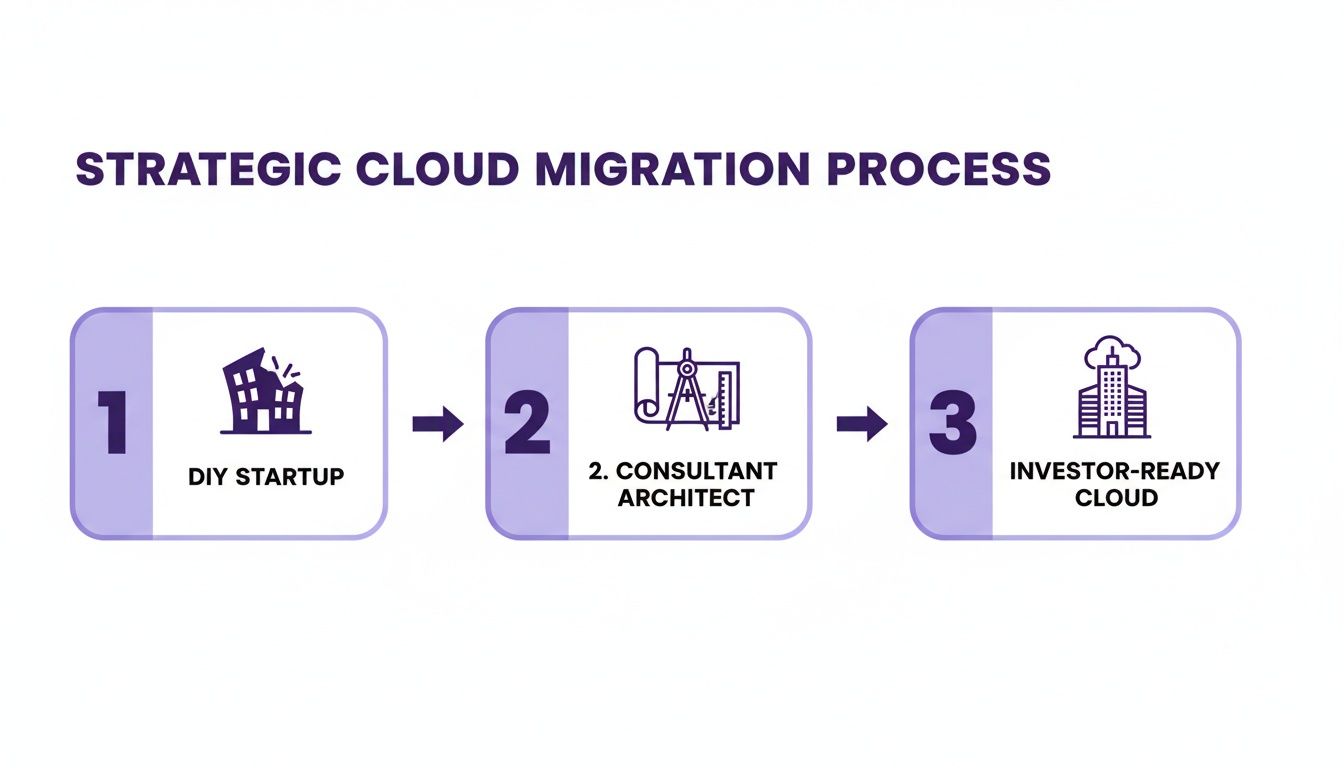
You can see how an expert’s blueprint transforms a shaky startup into a solid, scalable asset ready for investment.
Phase 3: Migration Execution
This is where the plan becomes reality. It’s the technical “lift,” where experienced engineers get their hands dirty and start moving your applications and data, guided by the roadmap. The whole process is handled with surgical precision to keep downtime to an absolute minimum.
During this phase, consultants often handle incredibly specific challenges, like complex workload migrations like Kafka from VMs to Kubernetes, which requires deep, specialized knowledge. Depending on the app, this could be a simple “lift-and-shift” or a full re-architecture of your core product to really tap into the power of the cloud.
Phase 4: Validation and Testing
Okay, your tech is now in the cloud. But the job isn’t done. Not even close. This phase is all about hardcore validation to make sure everything works just as it should—or even better. This is the quality assurance that proves your new foundation is solid.
Testing hits several key areas:
-
Performance Testing: Is your application actually running faster and more efficiently? We prove it.
-
Security Validation: We run penetration tests and vulnerability scans to confirm the new environment is locked down tight.
-
Functional Testing: We verify that every user-facing feature and backend process is working flawlessly, without any weird bugs.
A migration without a serious validation phase is just a gamble. It’s like building a skyscraper but skipping the final inspection. No serious founder should ever take that risk.
Phase 5: Optimization and Governance
The final phase never really ends. The cloud isn’t a “set it and forget it” kind of deal. This is all about continuous improvement and control, making sure your infrastructure stays cost-effective, secure, and performant as you grow.
This means setting up governance policies, creating cost-monitoring alerts (so you don’t get any nasty surprises on your bill), and constantly fine-tuning resources to match real-world demand.
A good partner or Fractional CTO will build these systems for you, giving you the long-term oversight needed to manage your cloud spend like a pro. This is how your tech asset keeps growing in value over time.
Choosing Your Cloud Model: Public, Hybrid, or Multi-Cloud
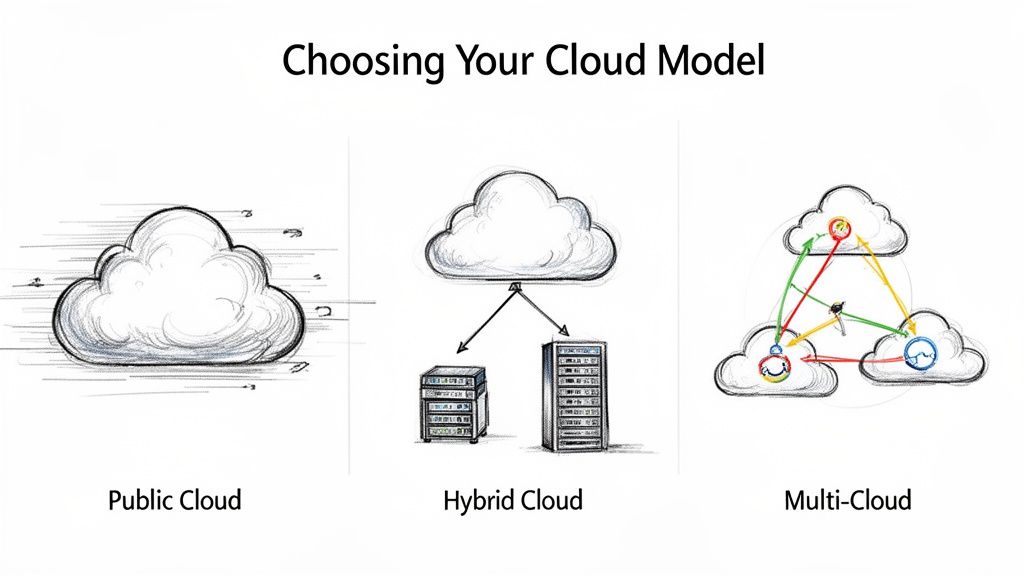
Picking a cloud model isn’t just an IT task you hand off to an engineer. For a founder, this is a core business decision. It’s the architectural blueprint that will define your product’s performance, how fast you can scale, and what your costs will look like down the road.
Get this right, and you’ve built a technical asset that fuels your growth. Get it wrong, and you’re stuck wrestling with an architecture that actively works against you.
Expert cloud migration consulting services can be your guide through this maze, making sure your choice is a perfect fit for your business goals—whether you’re building an investor-ready MVP or a mature, scalable product. Let’s break down the three main models from a founder’s point of view.
The Public Cloud: The Startup’s Launchpad
The public cloud is home to the big players like Amazon Web Services (AWS) and Google Cloud Platform (GCP). For the vast majority of startups, this is the default starting point, and for good reason. Think of it as the ultimate utility service: you get immediate access to world-class computing, storage, and a whole menu of services, all on a pay-as-you-go basis.
For a founder trying to get an MVP out the door, the public cloud is a game-changer:
-
Unmatched Elasticity: You can go from a handful of beta testers to millions of users without ever having to buy a server. This is exactly what you need to handle those unpredictable traffic spikes after a big launch or PR hit.
-
Speed to Market: Forget waiting weeks for hardware. You can spin up development environments and deploy your product in minutes. For a startup, that speed is your most valuable currency.
-
Cost Efficiency: You completely avoid spending a huge chunk of your seed money on physical servers. Your costs scale directly with your usage, which is a massive help in protecting your runway.
For an MVP, the name of the game is validating your idea and finding product-market fit as fast as possible. The public cloud is really the only environment that gives you the speed and flexibility to do this without burning precious capital on infrastructure.
The Hybrid Cloud: The Sophisticated Scaling Strategy
As your startup grows up, your needs get more complicated. The hybrid cloud is a more advanced setup that mixes a private cloud (or your own on-premise servers) with a public one. Let’s be clear: this is not for your day-one MVP. It’s a strategic play for scale-ups with very specific, demanding workloads.
This model lets you run things that need incredibly low latency—like real-time data processing or IoT device management—on local hardware, while still using the public cloud’s endless scale for backend analytics, data storage, and your user-facing web apps.
This practical approach is why hybrid cloud is the fastest-growing segment in the market, projected to advance at an 18.35% CAGR. While public cloud still holds the top spot in market share, the rapid adoption of hybrid shows how cloud strategies are getting smarter and more nuanced. You can dive deeper into this trend in this market intelligence report on cloud services.
Multi-Cloud: The Path to Ultimate Resilience
Finally, there’s multi-cloud. This is the strategy of using services from more than one public cloud provider at the same time—for example, using AWS for your core computing and GCP for its powerful data analytics tools. The main reasons to do this are building resilience and avoiding getting locked into a single vendor.
By spreading your workloads across different clouds, you build an architecture that can survive a major outage from one provider. It also gives you leverage, letting you pick the absolute best tool for each job and negotiate better pricing.
While it definitely adds another layer of operational complexity, it offers the highest degree of flexibility and risk mitigation for platforms that simply cannot go down. A good boutique partner can help you architect this in a way that’s manageable, turning your infrastructure into a real competitive advantage.
Cloud Deployment Model Comparison for Startups
Choosing between these models can feel overwhelming. To make it clearer, here’s a simple table to help you map each model to your startup’s current stage and goals.
Model
Best For
Key Advantage
Consideration for Founders
Public Cloud
MVPs, early-stage startups, and products with variable traffic.
Speed & Agility. Launch quickly with minimal upfront cost.
Focus on cost management as you scale. Unchecked usage can get expensive.
Hybrid Cloud
Scale-ups with specific performance or compliance needs (e.g., IoT, FinTech).
Flexibility. Combines the security of private with the scale of public.
Higher operational complexity. You’ll need specialized talent to manage it.
Multi-Cloud
Mature, mission-critical platforms where uptime is non-negotiable.
Resilience. Mitigates vendor risk and allows for best-in-class features.
The most complex to manage. Requires a solid cloud strategy and governance.
Ultimately, the right choice depends entirely on your product, your market, and your long-term vision. The public cloud is the perfect launchpad, but as you grow, your strategy might evolve to embrace a hybrid or multi-cloud approach to build a more resilient and powerful platform.
How a Consultant Solves the Cloud Talent Gap
Let’s be real. For an early-stage startup, moving to the cloud isn’t just a tech problem—it’s a people problem. And it’s a massive one.
Trying to hire elite, senior-level cloud engineers is one of the biggest, most painful hurdles a founder can face. It’s not just hard; it can be a company-killer before you even get off the ground.
This is where you need to flip the script. Bringing in cloud migration consulting services isn’t just another expense. It’s your secret weapon to solve this talent crisis. Partnering with a sharp boutique firm or a Fractional CTO gives you an almost unfair advantage, letting you sidestep a brutal hiring market and get top-tier architectural brainpower, instantly.
Think of it as having a technical co-pilot, taking a huge amount of risk off the table right when your venture is most vulnerable.
Sidestepping the Talent Scarcity Trap
The market for cloud talent is a shark tank. There’s a serious talent shortage, which stalls projects and opens up glaring security holes. Even as the market is set to explode from USD 12.92 billion in 2025 to USD 48.86 billion by 2031, this scarcity hits startups the hardest. As you can see from these global cloud migration services market insights, if you’re a non-technical founder without expert help, you risk getting lapped by competitors who nail their cloud setup.
For a founder, trying to hire a full-time, world-class cloud architect usually looks like this:
-
A Six-Month Search: That’s half a year you don’t have, burned just trying to find the right person.
-
Insane Salaries: Senior cloud talent commands salaries that can bleed a startup’s runway dry before a single line of code is shipped.
-
The High Cost of a Bad Hire: If you’re not deeply technical yourself, how do you properly vet candidates? A mis-hire here is a catastrophically expensive mistake.
A consultant or Fractional CTO lets you bypass that entire mess. You get the A-player on your team from day one, paying only for the high-level strategy you need, exactly when you need it.
This isn’t just outsourcing; it’s talent arbitrage. You’re getting the output of a $300k/year hire for a fraction of the cost and zero recruiting headaches. That’s cash you can pour straight back into your product.
Mitigating the Startup-Killing Risks of Inexperience
Trying to DIY a cloud migration—or letting a junior team lead the charge—is like betting your entire company on a single coin flip. The consequences aren’t just small bumps in the road; they are genuine, startup-killing threats that can sink you before you ever find product-market fit.
A boutique partner or Fractional CTO is your shield, protecting you from the three most common ways inexperienced tech decisions kill startups:
-
Nightmare Security Holes: Inexperienced teams almost always leave a door unlocked. A consultant builds a secure-by-default foundation, making sure your infrastructure is solid enough to pass investor due diligence and keep user data locked down from the start.
-
Runaway Cloud Bills: The cloud’s “pay-as-you-go” model can be a trap. One poorly configured service can silently chew through your entire bankroll. An expert puts strict cost controls in place, with alerts and smart strategies to keep your spending predictable.
-
Hitting a Brick Wall at Scale: Without a senior architect, teams often build for today, creating a system that will crumble the second you get traction. A consultant designs for the future, ensuring your MVP can handle hockey-stick growth without a total, time-sucking rewrite. This forward-looking approach is a key part of our DevOps for startups philosophy.
Ultimately, working with a cloud consultant is a strategic play for stability and speed. It gives you the senior leadership to make sure your technology is a high-valuation asset, not a liability. You get the architectural wisdom to build a real technical moat, giving you a sharp edge in a market that punishes mistakes and rewards getting it right the first time.
The Founder’s Checklist for Selecting a Cloud Migration Partner
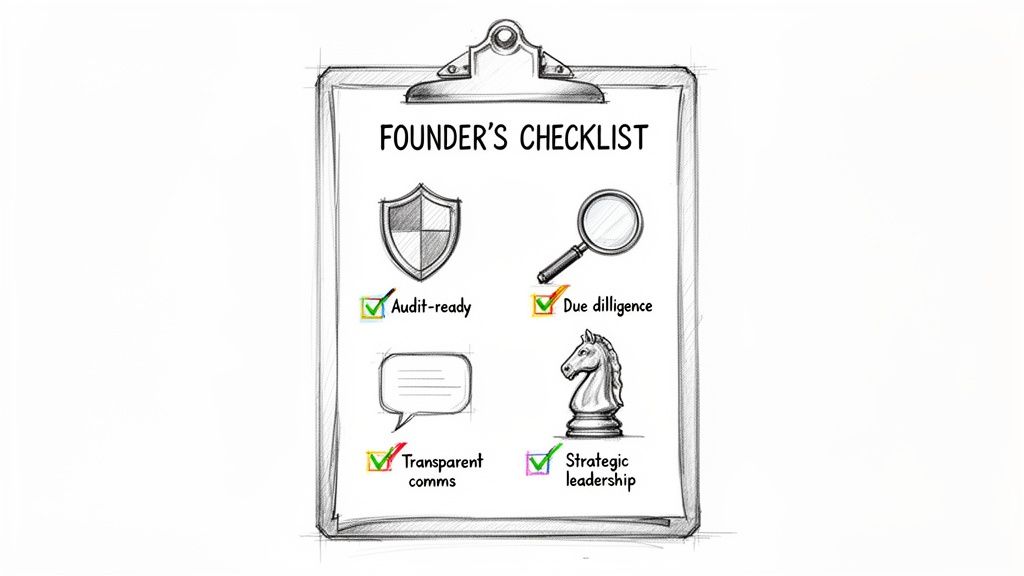
Choosing a partner to handle your cloud migration is one of the biggest bets you’ll make as a founder. This isn’t just hiring some folks to move data around; it’s picking the architect for your company’s entire technical future.
The right partner builds a high-valuation asset. The wrong one can drown you in technical debt that sinks a funding round before it even starts.
The market is full of commodity dev shops and giant outsourcing firms promising a quick, cheap migration. These “black box” vendors often hand you a fragile system that cracks the moment you put any real pressure on it. A true engineering partner, on the other hand, acts like a mentor and an architect—their goal is to build a durable, investable business. This checklist will help you spot the difference.
Audit-Ready Engineering and Due Diligence Expertise
Here’s the single most important question you can ask: “Does this partner build for the investor?” A team that only talks about moving servers isn’t thinking about your exit or your next round. You need a partner who gets that every single line of code is either a financial asset or a liability.
Look for real, provable experience in:
-
Building for Technical Due Diligence: Ask them to walk you through their process for creating an “audit-ready” codebase. A top-tier partner will immediately start talking about documentation, clean code, security hardening, and building a system that a third-party auditor can easily pick apart and verify.
-
Creating “Technical Moats”: A technical moat is an architectural edge that’s tough for your competitors to copy. Your partner should be able to clearly explain how their architectural decisions create these moats, whether it’s through superior performance, stronger security, or proprietary workflows.
-
Eliminating Technical Debt: Ask them how they prevent and manage technical debt right from day one. A weak answer is about fixing it later. A strong answer describes a development process built from the ground up to avoid it entirely.
Your tech stack will be interrogated during any serious funding discussion. A partner who hasn’t prepared clients for that grilling isn’t a strategic partner; they’re a liability waiting to happen.
The Anti-Outsourcing Communication Model
The biggest red flag for any founder is a partner who operates like a black box. You hand over your requirements, they vanish for a few weeks, and then pop back up with a finished product (and a fresh list of problems). That’s the exact opposite of the high-touch, transparent partnership you need.
A genuine engineering partner works as an extension of your own team. Their entire model should be built on:
-
Radical Transparency: You need total visibility into their work. That means access to their project management tools, their code repositories, and regular, direct conversations with the actual engineers doing the work.
-
A Mentorship Mindset: The right partner doesn’t just work for you; they mentor you. They teach you the strategic side of technical decisions, helping you become a more effective leader who can speak the language of engineering and architecture.
-
Strategic Leadership and Governance: A real partner gives you more than just code. They bring high-level strategic guidance to the table, essentially acting as a Fractional CTO to help you build your roadmap and make smart decisions. A key part of this is helping you figure out when and how to hire a full-time leader, which is central to how we see a Virtual CTO partnership.
Questions Every Founder Must Ask a Potential Partner
To slice through the sales pitches, you need to ask sharp, specific questions that get to the heart of a firm’s real philosophy. A commodity vendor will get flustered; a strategic partner will have solid, authoritative answers.
Here are the questions that separate the architects from the order-takers:
-
“Can you show me a sanitized example of documentation you’ve prepared for a client’s technical due diligence?” This tests whether they actually practice what they preach.
-
“How do you measure and report on technical debt during a project?” This reveals if they have a formal process or are just giving you lip service.
-
“Describe a time you advised a founder against a technical decision they wanted. What was the situation and the outcome?” This shows if they have the guts to be a true advisor, not just a “yes-man.”
-
“What is your communication cadence? Who from my team will have direct access to your engineers and architects?” This will instantly expose any “black box” tendencies.
-
“Beyond the migration, how do you help founders prepare to build and manage their own internal engineering teams?” This shows if their goal is to make you reliant on them forever or to empower you for long-term success.
Choosing your cloud migration consulting services partner is a decision that will echo for years. Use this checklist to find a firm that aligns with your true ambition—not just to build an app, but to engineer a high-valuation company.
Your Top Cloud Migration Questions, Answered
Thinking about moving to the cloud? You’ve probably got a ton of questions. It’s a big move, and for a startup founder, getting it right is everything. Let’s cut through the noise and get you the straight answers you need to make smart, high-valuation decisions.
Getting these details right is critical, especially when you start talking with cloud migration consulting services.
When Is the Right Time to Engage a Cloud Migration Consultant?
Honestly? The absolute best time to bring in a cloud partner is before you’ve even written a single line of code for your MVP.
I know, that sounds early. But getting an expert involved during your Product Design & Discovery phase means your architecture is built to be cloud-native and “investor-ready” from day one. It’s the difference between building on a solid foundation versus patching up a shaky one later.
But life happens. Most founders we talk to come looking for help at two other make-or-break moments:
-
Your MVP Is Taking Off: Congrats, your product works! The problem is, it’s starting to creak and groan under the weight of new users. Bringing in a consultant right now is crucial to re-architect for scale without killing your momentum.
-
You’re Prepping for a Funding Round: You know that technical due diligence is just around the corner. A partner can help you bulletproof your system, clean up your documentation, and frame your tech as a core asset—not a liability that sinks the deal.
Wait too long, and you’ll end up paying to fix problems that were completely avoidable. The earlier you build for scale and security, the stronger your company’s valuation.
What Are the Biggest Risks of a DIY Cloud Migration?
Going it alone on a cloud migration is one of the riskiest bets a founder can make. It might feel like you’re saving money, but without a senior architect’s eye, you’re leaving your company wide open to a few quiet, startup-killing threats.
The main ones we see are:
-
Catastrophic Security Flubs: A single misconfigured permission or an accidentally public data bucket can lead to a devastating data breach. These rookie mistakes happen all the time, and they can obliterate user trust (and your brand) overnight.
-
Runaway Cloud Bills: Cloud billing is famously tricky. One misconfigured service can quietly chew through your entire runway in a matter of weeks. An expert puts cost controls and monitoring in place from the get-go, so your spend stays predictable.
-
Building a House of Cards: An architecture designed for a few dozen users will always hit a wall. Always. This forces you into a costly, time-sucking rewrite right when you should be focused on growth. It’s a classic startup-killer.
A failed migration isn’t just a technical problem; it’s a business failure. It burns cash, spooks investors, and gives your competitors a wide-open lane.
How Much Do These Consulting Services Cost for a Startup?
You have to reframe this question. It’s not an expense; it’s a direct investment in your company’s valuation. You aren’t just paying for a service—you’re buying risk mitigation and creating a tangible asset.
Be very skeptical of partners offering cheap, fixed-project fees. This usually points to a “black box” approach where they prioritize getting it done fast over getting it done right. You’ll inevitably pay for the technical debt they create down the road.
A real engineering partner, like a Fractional CTO, usually works on a retainer or a model based on the value they deliver. This setup means their success is tied directly to yours. The investment you make in their guidance is designed to prevent much, much bigger losses—from a failed migration, a security breach, or a botched due diligence that kills your funding round. Saving just one of those deals can deliver a 10-100x return on your consulting investment.
How Is a Cloud Consultant Different from a DevOps Engineer?
This is a huge one, and it’s vital for founders to get it. Hiring a DevOps engineer is tactical. Partnering with a cloud consultant is strategic.
A DevOps engineer executes tasks inside a strategy someone else has already defined. They’re the ones building the deployment pipelines, managing the servers, and automating all the things.
A cloud migration consultant, particularly one acting as a Fractional CTO, is the one who sets that strategy in the first place.
They design the entire system with your business goals, company valuation, and investor audits as the guiding principles. They make the big-picture calls: Which cloud provider makes sense? What security posture do we need? How do we build this to handle today’s traffic and scale for the future? The consultant then oversees the execution, making sure it all tracks back to that strategic vision.
Think of it like this: hiring only a DevOps engineer without that senior oversight is like hiring a master bricklayer to design a skyscraper. You’ll get incredible technical work, but you won’t have the architectural blueprint needed to build something valuable and lasting.
Ready to build your startup’s technical foundation the right way? Buttercloud acts as the boutique engineering partner and Fractional CTO for founders, turning ideas into investor-ready technical assets. We architect for valuation, not just for function.
Have a product idea to talk through?
We'll show you how we'd approach it — no pressure, just a real conversation.
Book a Discovery Call