How to Hire App Developers: A Founder's Guide

Founder & CEO, Buttercloud
Let’s get one thing straight. When you decide to hire app developers, you’re not just looking for a coder. You’re searching for a strategic partner who will build the very foundation of your company’s value.
This is one of the most critical, high-stakes decisions a founder makes. Get it right, and you build an investor-ready asset. Get it wrong, and you’re just lighting money on fire.
Should You Hire Developers or Engineering Partners?
For a startup founder, this isn’t just about turning your big idea into a working app. It’s about building the core of your business. A poorly engineered product can saddle you with crippling technical debt, get you laughed out of an investor meeting, and make scaling a nightmare.
So, the question isn’t, “Who can build my app?”
The real question is, “Who can engineer me a high-valuation technical asset?” This single shift in mindset changes everything. You’re not just buying a service; you’re making a core investment in your company’s future. It’s a decision that directly impacts your stability, scalability, and what you’re ultimately worth.
The Prototype Trap vs. Investor-Ready Engineering
Too many founders walk right into the “prototype trap.” They chase the fastest, cheapest path to something they can show off. The result? A fragile codebase that looks pretty on the surface but is a ticking time bomb underneath.
The moral of the story is that there are teams that do really good work, but a huge part of the problem is trying to translate a vision through a time, space, or language barrier. In the end, many founders pay twice: once for the cheap prototype, and again to have it completely rebuilt from scratch.
An investor-ready MVP is a different beast entirely. It’s built with surgical precision from day one. It’s not just for a demo; it’s designed to be a durable, defensible asset that holds up under scrutiny. For founders navigating this complex landscape, a comprehensive guide for hiring developers for startups can be an invaluable resource. This approach is all about:
-
Audit-Ready Code: Think clean, well-documented code that can survive the intense scrutiny of a VC’s technical due diligence.
-
Scalable Architecture: A solid foundation that can handle growth without forcing you into a costly and painful rebuild later on.
-
Minimal Technical Debt: No shortcuts. This is about ensuring your technology remains a powerful asset, not a growing liability.
Choosing Your Engineering Path
The path you choose—a freelancer, a big-box agency, or an in-house team—will have a massive impact on these outcomes. Each option comes with its own set of trade-offs in control, quality, cost, and how well they align with your vision.
You have to look past the sticker price and truly understand how each choice affects your long-term goals. If you want to dive deeper into our philosophy on this, you can check out our approach to strategic app development. This guide will give you the framework to make that call with confidence.
So, you have a killer app idea. The next big question is: who’s going to build it?
This isn’t just a simple hiring decision. It’s a choice that will define your MVP’s quality, how fast you get to market, and whether you catch the eye of investors.
As a founder, you’re standing at a critical fork in the road. Are you building a quick-and-dirty prototype that you’ll have to throw away, or are you creating a high-valuation technical asset from day one? The hiring model you pick is what makes all the difference.
This decision tree shows the two very different paths your code can take.
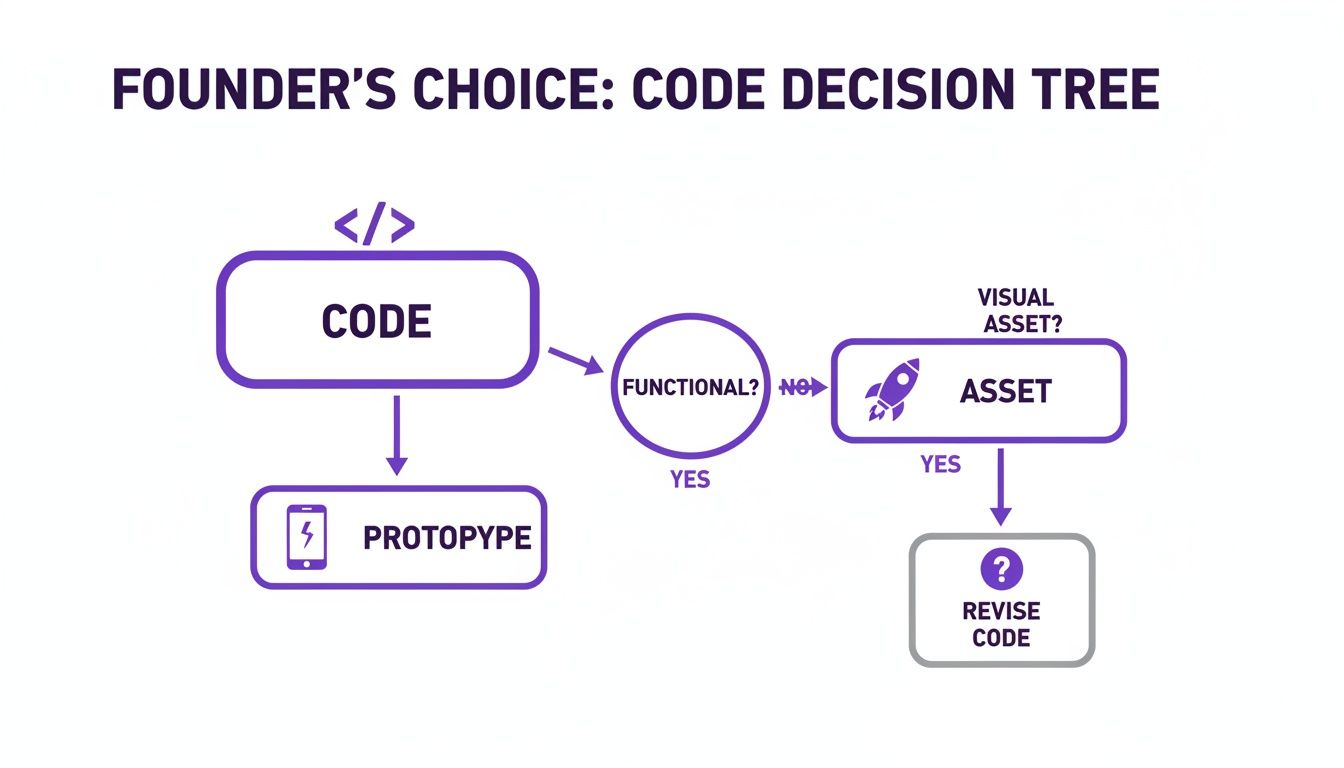
Both paths start with writing code, but the process and the end result couldn’t be more different. One leads to a dead end, the other to a scalable, investor-ready foundation.
Choosing Your Build Partner: Freelancers, Agencies, and In-House Teams
Let’s break down the most common routes founders take and the very real pros and cons we’ve seen play out time and time again.
The Freelancer Gamble: Speed at a Hidden Cost
Hiring a freelance developer is usually the first thought for an early-stage founder. It seems fast, flexible, and affordable. The freelance market is massive, projected to top $14 billion by 2029, because startups crave that agility.
But this path is full of traps that can wreck your product before it even launches.
While you can find freelance mobile developers in the US for around $61 an hour, and even cheaper global talent for $25–$50, that initial savings can be deceptive. You can dig into more rate data in this insightful article from ChopDawg.com.
The real cost isn’t on the invoice. It’s the technical debt, the quality control nightmares, and the lack of architectural vision. We’ve had countless founders come to us with a “finished” MVP built by a freelancer, only for us to discover a tangled mess of undocumented code that’s impossible to build on.
That initial “deal” is suddenly erased by the cost of a complete rewrite.
A freelancer is fantastic for a specific, well-defined task inside a bigger, well-managed project. They are not a substitute for a technical co-founder or an engineering partner who owns your core architecture.
Traditional Agencies: The Black Box Problem
The next stop for many founders is a traditional dev agency. They promise a managed team, a project manager, and a seemingly stress-free experience. It’s more structured than a freelancer, for sure, but it brings a new, sneaky problem: the “black box.”
You hand over your requirements, and eventually, code comes out the other side. But what happens in between? Your communication is often filtered through a non-technical project manager, and you have zero direct contact with the engineers actually building your app.
This means you have almost no control over quality and miss out on the deep, collaborative sparring that forges a great product.
Worse, many big agencies lock you into their proprietary frameworks. Your code isn’t really yours. When it’s time to bring development in-house or switch partners, you find out you’re stuck.
The In-House Team: The Gold Standard (With a Catch)
Building your own in-house engineering team is the dream, right? It’s the gold standard for long-term ownership and having a team that lives and breathes your product. They’re fully invested and can iterate at lightning speed—once they’re up and running.
For a pre-seed or seed-stage startup, though, this is usually a fantasy.
Let’s get real about the hurdles:
-
Time: Finding, vetting, and hiring just one good senior developer can take months. A whole team? You could be looking at a year. In startup time, that’s an eternity.
-
Cost: It’s not just salaries. Think benefits, equity, recruitment fees, and equipment. That’s a massive cash burn before you’ve written a single line of your MVP.
-
Leadership: If you don’t have a technical co-founder or a Fractional CTO, who’s leading this team? An inexperienced group without strong technical direction can easily build themselves into a corner with costly mistakes you won’t see until it’s too late.
Hiring Model Comparison for Startup Founders
Choosing a hiring model involves weighing trade-offs between speed, cost, quality, and control. Here’s a tactical breakdown to help you decide which path aligns with your startup’s goals.
Metric
Freelancers
Traditional Agency
In-House Team
Boutique Partner (Buttercloud)
Speed to MVP
Fast for small tasks, slow for a full product
Medium to slow
Very slow
Very fast
Initial Cost
Low
High
Very high
Medium
Code Quality & Scalability
Low to medium (high variability)
Medium (often boilerplate)
High (with right leadership)
Very high (built for scale)
Founder Control & Visibility
High (but you manage everything)
Low (the “black box”)
Very high
High (collaborative partnership)
Long-Term Scalability
Low (often requires a rewrite)
Low (vendor lock-in)
High
Very high
Strategic Guidance
None
Limited to project management
Depends on senior hires
High (product & tech strategy)
Ultimately, each model has its place. But for a founder building an investor-ready MVP, the goal isn’t just to get something built. It’s to build the right thing the right way, creating a solid foundation that increases your company’s valuation from day one. Choosing a partner who gets that is your first and most important step.
Vetting for Product Fit and Future Value

Let’s get one thing straight. When you hire an app developer, a bad hire is so much more than a financial drain. They inject technical debt and architectural flaws deep into your product’s DNA, the kind of flaws that can absolutely kill your startup during an investor’s technical due diligence.
That cheap hire today could cost you a funding round tomorrow.
This is why your vetting process has to go way beyond just glancing at a GitHub profile for green squares. You’re not hiring a code monkey; you’re choosing an architect for your company’s single most valuable asset. The goal here is to find the people who build value, not just tick off tickets.
Product Fit: The Non-Technical Vetting That Matters Most
Technical skill is just table stakes. The real game-changer is product sense—an engineer’s innate ability to think like a founder. Do they actually understand the why behind a new feature? Can they connect a line of code to a business goal?
This is the massive gulf between a freelancer who needs a perfectly detailed spec sheet and a true engineering partner who will push back and challenge your assumptions to make the product better. An engineer with great product sense is your first line of defense against building the wrong thing entirely.
To see if they have it, your interview questions need to get out of the weeds of technical trivia. Try asking things like this:
-
“Our top competitor just launched this feature. How would you approach building it, and more importantly, should we even build it?”
-
“We have a choice: launch a feature with 80% polish in two weeks, or 100% polish in six weeks. What’s your recommendation and why?”
-
“Tell me about a time you pushed back on a request from a founder or product manager. What was the situation, and how did it turn out?”
Listen closely to their answers. Do they jump straight into technical jargon, or do they start by asking about user impact, market position, and our strategic goals? After you’ve picked a hiring model, the next step is diving deep into vetting, and a solid technical assessment test playbook is a great tool for confirming both skills and that crucial product mindset.
An engineer who asks “Why are we building this?” is infinitely more valuable than one who only asks “What do you want me to build?” The first is a partner; the second is a task-taker.
Beyond Coding Challenges: The Paid Discovery Project
Generic coding challenges are a broken way to hire. They test for a developer’s ability to memorize algorithms, not their real-world skill in solving messy, ambiguous business problems. They tell you nothing about how someone communicates, collaborates, or takes feedback.
There’s a much, much better way: the paid discovery project.
This isn’t a “test”; it’s the start of a real working relationship. You define a small, self-contained, but real piece of your project. Think of something that delivers actual value but can be wrapped up in a week or two—like building out a single, complex API endpoint or a small proof-of-concept for a core feature.
Here’s why this is the ultimate vetting tool:
-
It Simulates Reality: You see exactly how they work within your actual codebase, with your team’s communication style, and against your project’s unique hurdles.
-
It Reveals Soft Skills: How do they ask for help? How do they report progress? What happens when they hit a wall?
-
It Shows Problem-Solving in Action: You’re not just seeing if they can solve a problem, but how. Is their code clean? Well-documented? Built to last?
-
It Respects Their Time: Paying for their work shows you value their expertise from day one. It sets a professional, partnership-oriented tone right from the start.
Vetting for Architecture and Scalability
Your MVP’s architecture is its DNA. A shoddy foundation built by an inexperienced developer creates what I call a “technical moat” in reverse—it traps you. It makes it impossible to scale or pivot without a complete and crushingly expensive rewrite.
You absolutely have to vet for architectural foresight. This is how you spot a senior-level architect versus a junior-level thinker, even if they have the same number of years on their resume.
Ask questions that probe their long-term vision:
-
“Our MVP will launch to 1,000 users, but we’re planning for 100,000 within a year. What architectural decisions would you make today to handle that growth without over-engineering from the start?”
-
“Talk me through the trade-offs between a monolithic and a microservices architecture for our specific product.”
-
“How would you design the database schema for our core user and organization model to allow for future flexibility in roles and permissions?”
You’re listening for words like “trade-offs,” “assumptions,” and “flexibility.” A great engineer knows there’s no single “right” answer. There are only solutions that are right for a specific context, scale, and set of business goals. They build for today while planning for tomorrow. This is how you find a developer who builds valuation, not just features.
So, you’re trying to figure out your MVP budget.
Most founders kick things off by asking, “How much does an app cost?” It seems like the logical first question, but it frames the whole thing wrong—like you’re buying a car off a lot.
A much better question is, “What’s the investment required to build a technical asset that actually increases my company’s valuation?” See the difference? We’ve shifted from cost to investment. From an expense on a spreadsheet to a core part of your company’s value.
When you hire app developers, your budget isn’t just a number. It’s the strategic lever that determines the quality of your foundation, your shot at scaling, and whether you’ll survive an investor’s technical due diligence.
What Actually Goes Into the Cost of an MVP?
The price tag on an MVP isn’t a mystery. It boils down to a few key drivers, and understanding them is the first step toward a realistic budget.
-
Platform Complexity: Are you building for iOS, Android, or the web? A native iOS app is a different beast than a cross-platform web app. Tackling multiple platforms at once? Your investment will naturally be higher.
-
Feature Scope: There’s a world of difference between an MVP with simple user login and a few screens, and a platform that needs real-time data, AI, or a bunch of complex third-party APIs. Every single feature adds to the workload.
-
Who You Hire: This is the big one. As we’ve covered, the cost here can swing wildly. A freelancer from an offshore marketplace might have a tempting hourly rate, but a premier engineering partner charges more because they deliver a fundamentally different—and more valuable—outcome.
Here in 2026, the range for developer costs is huge, which is why your sourcing strategy is so critical. For a simple MVP, you might see numbers in the $10,000–$50,000 range. For something more mid-range, it could be $25,000–$75,000. And with specialized skills like AI integration commanding a premium, those numbers can climb fast. A breakdown of app development costs can give you a deeper look, but the real takeaway is that the right partner helps you map every dollar spent directly to your company’s valuation, sidestepping the market volatility.
The most expensive app is the one you have to build twice. Chasing the lowest bidder often means paying once for a fragile prototype and then paying again for a complete, ground-up rewrite when it fails to scale or pass due diligence.
The Hidden—and Deadly—Costs of “Cheap” Development
Look, the siren song of cheap development is alluring, especially when you’re a founder watching every penny. But it’s a trap. That low sticker price hides a mountain of downstream costs that can absolutely sink a startup.
The biggest danger is technical debt. Think of it as a tax you pay later for taking shortcuts now. It shows up as buggy code, painfully slow performance, and an architecture so tangled that adding a simple new feature takes weeks instead of days. This is exactly what an investor’s technical team is hunting for during due diligence. A report full of technical debt can kill a funding round on the spot.
This leads directly to the next gut punch: refactoring and rewrites. The “finished” MVP you get from a cheap developer is often just a barely-working prototype. The code is a mess—undocumented, unstable, and impossible to build on. We’ve seen founders spend more money fixing a broken product than it would have cost to just build it right the first time with an experienced team.
Want to get a better feel for what a real, production-grade MVP requires? Play around with our interactive MVP cost estimator to model a few different scenarios.
Your Budget Is a Valuation Strategy
A true engineering partner changes this entire conversation. At Buttercloud, we don’t just hand out quotes; we build investment models. We start with your business goals—your valuation targets, your market goals—and work backward to engineer the technical asset that gets you there.
With this approach, every dollar is tied to a specific, strategic outcome:
-
Audit-Ready Architecture: We build from day one knowing your code will be put under a microscope by VCs. It’s clean, documented, and ready for inspection.
-
Scalable Infrastructure: Your MVP is built on a foundation that can handle success. No panicky, expensive overhauls the moment you get a surge of users.
-
Strategic Roadmapping: With Fractional CTO oversight, your budget goes toward features that actually drive user value and prove your business model—not just cool tech for the sake of it.
Your budget isn’t a cost center. It’s the seed capital for the most important asset your business will ever own. Invest it wisely.
How Do You Onboard and Scale Your Engineering Team?
So, you’ve hired an engineer. The contract is signed. High-five. But let’s be real—the work is just getting started. This is where the potential you hired needs to be turned into actual product velocity, and fast.
Bad onboarding is a silent killer for startups. It’s where momentum dies and top-tier talent ends up sitting on their hands or, even worse, building the wrong thing. Good onboarding isn’t a welcome packet and a company email. It’s a deliberate strategy to get your new hire deeply connected to the business vision so they can build with purpose from day one.
You’re not just hiring for execution; you’re cultivating a culture of ownership.
The Founder’s Brief: Your Essential Alignment Tool
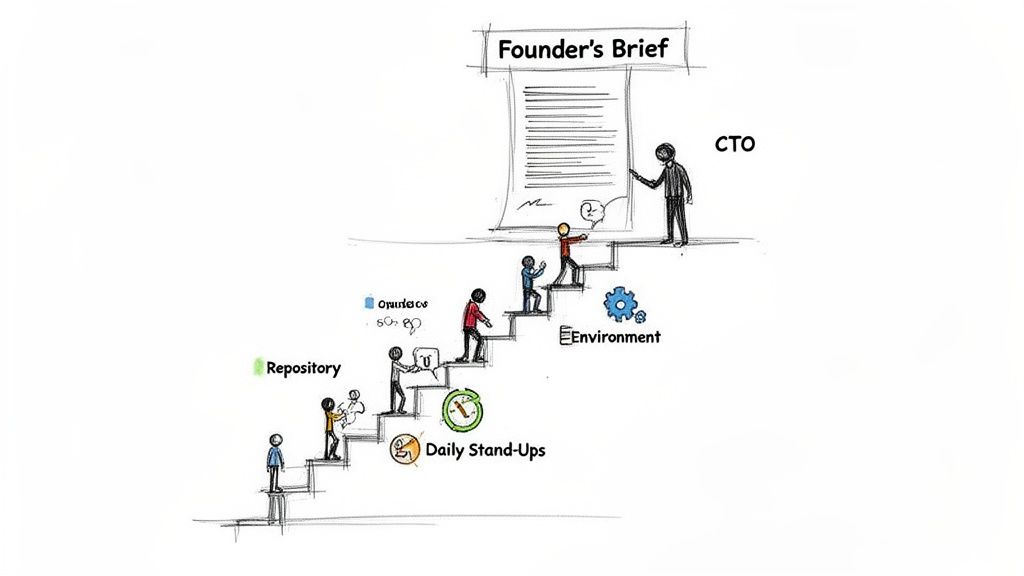
Before a single line of code gets written, you need to sync your new engineer with your brain. This doesn’t mean handing them a 50-page business plan they’ll never read. We’re talking about a “Founder’s Brief”—a short, powerful document they can digest in under an hour.
Think of it as your secret weapon for creating instant alignment. This brief bridges the chasm between your grand vision and their technical execution.
It’s a living doc that should nail these points:
-
Product Vision: What’s the end game? What problem are we really solving, and what does winning look like a year from now?
-
Business Goals: What metrics are we obsessed with right now? Is it all about user acquisition? Engagement? Or are we just trying to prove a specific feature for the next funding round?
-
Competitive Landscape: Who are we up against? What do they do well, and more importantly, what are their technical weaknesses that we can exploit?
-
The “Why”: Why this product? Why now? What’s our unique angle that makes us different?
This context transforms them from just a pair of hands into a strategic partner. They’ll start thinking about how every database decision or API design impacts the actual business.
Technical Onboarding for Immediate Impact
Once the vision is locked in, the technical side of onboarding needs to be ridiculously smooth. The goal? Remove every ounce of friction so your new hire is productive in hours, not days. Nothing is more demoralizing (or expensive) than watching a new engineer burn their first week just trying to get their laptop set up.
Your technical onboarding checklist needs to be ruthlessly efficient:
-
Instant Access: The moment they start, they need keys to the kingdom. We’re talking source code repos (GitHub, GitLab), project boards (Jira, Trello), and comms channels (Slack). No waiting.
-
Automated Setup: Give them a script or crystal-clear instructions to get their local development environment running with a single command. If there’s any guesswork here, your process is broken.
-
Communication Cadence: Set the rhythm from the get-go. Daily stand-ups are non-negotiable. Schedule weekly demos to show off progress and regular retrospectives to talk about what’s working and what’s not.
A new engineer’s first day should end with a small, successful code commit to the repository. This simple act builds confidence, tests the entire toolchain, and establishes a pattern of momentum from the very beginning.
Scaling With Fractional CTO Guidance
Going from one developer to a few is where things get tricky. The architecture that worked for a solo coder starts to creak and groan under the weight of a team. Without strong technical leadership, you’re on a fast track to a chaotic, debt-ridden codebase.
This is precisely when a Fractional CTO becomes your MVP. They act as the architectural guardian for your startup, making sure your technical foundation is solid, secure, and ready for what’s next.
Their guidance is critical for:
-
Maintaining Architectural Integrity: They establish the coding standards and design patterns that stop developers from accidentally stepping on each other’s toes.
-
Overseeing Infrastructure and Security: As you scale, a Fractional CTO ensures your infrastructure can handle the load and stays secure and audit-ready.
-
Mentoring the Team: They help level-up your junior and mid-level developers, guiding their growth while keeping the product aligned with a long-term technical strategy.
Scaling an engineering team is a delicate dance. But with a killer onboarding process and the right strategic oversight, you can grow your team without slowing down, ensuring your tech becomes your most valuable asset.
Answering Your Toughest Questions About Hiring Developers
Trying to hire an engineer when you’re not one yourself can feel like walking into a minefield. The jargon, the cost, the risk—it’s enough to make any founder’s head spin. Let’s cut through the noise and tackle the questions we hear from founders every single day.
Make no mistake, this is a battlefield. The mobile app development market was valued at $195.7 billion in 2023 and is on track to explode to $606.1 billion by 2032. That frenzy is fueling insane demand for good engineers. Hiring can drag on for 25 to 45 days for top talent, and even longer if you need someone with specialized skills.
You can see the full research on this competitive landscape on the Giraffe Software blog. In this environment, hesitation isn’t just a delay; it’s a window of opportunity slamming shut.
What’s The Real Difference Between A Freelancer And An Agency?
So, the classic showdown: freelancer or agency?
Hiring a freelancer is like hiring a solo artist. You get one person, and you’re the manager, the project lead, and the quality control department all rolled into one. It’s flexible, for sure. But it puts all the weight of project management and architectural vision squarely on your shoulders. It’s a ton of oversight.
An agency is the packaged deal. You get a whole team, complete with project managers and a pre-defined process. But that convenience comes at a premium. More importantly, it can feel like a “black box” where you have little to no direct contact with the engineers actually building your product. Critical context gets lost in translation. This is why we operate on the “anti-outsourcing model,” providing a high-touch partnership where the founder is mentored, not just served.
How Do I Vet An Engineer If I’m Not Technical?
This is the big one, and the fear is real. But you don’t need to learn to code overnight to solve it. You just need to change the game. Stop focusing on how they code and start obsessing over what they’ve built and the results they drove.
Don’t throw abstract algorithm puzzles at them. Ask them to walk you through a past project. A great engineer can explain the ‘why’ behind their technical choices in plain English and connect them back to the business goals.
Here’s a simple playbook that works:
-
Demand Case Studies: Look for projects that talk about business outcomes, not just a laundry list of features. Did they increase user retention? Did they reduce server costs? That’s what matters.
-
Run a Paid Discovery Project: This is the ultimate litmus test. Give them a small, real-world task on a paid basis. It will tell you more about their problem-solving skills, communication, and code quality than any interview ever could.
-
Bring in a Fractional CTO: Find a trusted technical advisor who can run the vetting process for you. They can evaluate candidates against an expert standard for architecture, scalability, and clean code.
Should I Build For IOS Or Android First?
Forget the tech for a second. The real question is: where are your users?
Before you write a single line of code, you have to know which digital ecosystem your customers live in. Building for the wrong platform first is one of the most common—and expensive—ways startups burn through their runway.
If your budget is tight (and whose isn’t?), the smart play is to pick one and go deep. Build a native app for your dominant user platform. Alternatively, you can use a cross-platform solution like React Native or Flutter to get an MVP into the market faster and validate your idea before doubling your development costs.
What Is Technical Debt And Why Should I Care?
Think of technical debt as a loan you take out against your codebase. Every time you choose a quick, easy shortcut instead of the proper, more time-consuming solution, you’re taking on debt. And just like financial debt, the interest compounds.
For a startup, this isn’t some abstract programming concept—it’s an existential threat.
A mountain of technical debt makes your app slow, buggy, and a nightmare to update or scale. Even worse, it’s a giant red flag for investors. A codebase riddled with debt can absolutely tank your valuation or even sink a funding round during technical due diligence. This isn’t just about code; it’s about your company’s future.
At Buttercloud, we don’t just write code; we engineer high-valuation technical assets. We partner with founders to build investor-ready MVPs and scalable platforms, eliminating technical debt from day one. If you’re ready to build a product that serves as the foundation for a high-growth business, let’s connect.
Have a product idea to talk through?
We'll show you how we'd approach it — no pressure, just a real conversation.
Book a Discovery Call