
From Fragile Idea to Investor-Ready Asset: A Founder's Guide to MVP Development

Let's establish a critical distinction. Building an MVP is not about slapping together the cheapest, most disposable version of your idea. It’s about engineering the first investable version of your core technical asset—a foundation robust enough to pass investor due diligence and establish a competitive technical moat from day one.
From Prototype to High-Valuation Asset
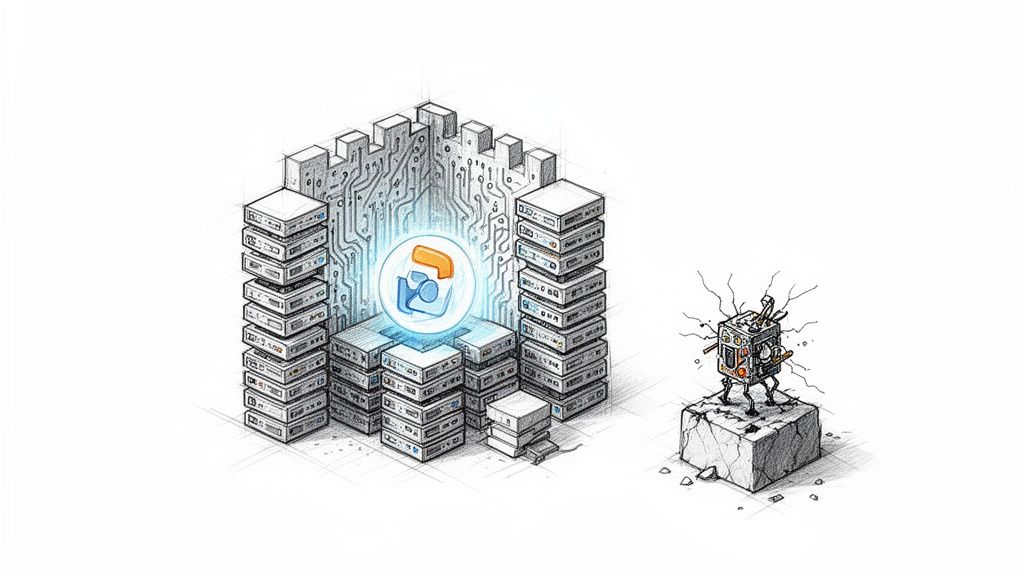
The "fail fast" mantra has been dangerously misinterpreted. I’ve seen it repeatedly: founders use it as an excuse to commission throwaway code, a fragile prototype held together with digital duct tape merely to test a concept.
This is a strategic dead end. The moment you achieve real traction, that house of cards collapses under the weight of new users, feature requests, and investor scrutiny. What follows is a costly, momentum-killing rewrite that no founder can afford.
The most successful founders we partner with treat their first product not as a test, but as the cornerstone of their company's valuation. It's the difference between showing a VC a slick demo and handing them an auditable, scalable asset they can confidently invest in.
Adopting the Investor-Ready MVP Mindset
An investor-ready MVP is born from an entirely different philosophy. It prioritizes solid architecture, audit-ready code, and scalability from the very first line. This isn’t about over-engineering; it’s about making deliberate, strategic choices that prevent catastrophic failure down the road.
This shift in mindset directly impacts whether you get funded or fold. In the brutal world of startups, a staggering 90% fail. A significant portion—34%, to be exact—fail because they never found product-market fit. A disciplined MVP process becomes your lifeline against this statistic.
The data confirms this. Teams that adopt this lean, asset-focused approach see 40% higher success rates in securing Series A funding. Why? Because investors reward evidence of a scalable foundation, not just a clever idea. It’s a market set to grow from $288 million to over $541 million by 2031, and the victors will be those who engineer their businesses correctly from the start.
The difference in approach is stark. It’s about thinking like an architect and a business owner from day one.
Attribute | Typical Prototype | Investor-Ready MVP |
|---|---|---|
Primary Goal | Validate an idea quickly | Validate an idea and build a core asset |
Code Quality | "Good enough for a demo" | Clean, documented, and audit-ready |
Scalability | Not a consideration; built to be thrown away | Planned from the start for user growth |
Technical Debt | High; shortcuts are the standard | Low; focused on reducing technical debt proactively |
Investor Perception | A "project" or "demo" | A "technical asset" with tangible value |
Outcome on Traction | Requires a total rewrite, killing momentum | Scales with demand, accelerating momentum |
Ultimately, one path leads to a painful rewrite and a discounted valuation, while the other builds a defensible asset that increases it.
What Defines a Technical Moat?
Think of a "technical moat" as your product’s competitive advantage, engineered directly into its DNA. It’s the reason your business is defensible long after your initial idea is public knowledge.
Here's what that looks like in practice:
Audit-Ready Codebase: Your code is clean, well-documented, and structured to pass the rigorous technical due diligence that every serious investor performs.
Scalable Architecture: The system is designed to handle growth without requiring a complete overhaul. It anticipates future user loads and feature complexity from the get-go.
Elimination of Technical Debt: Every shortcut taken to launch faster creates "debt" that you must repay later, with interest. A strong moat is built by avoiding this debt from day one.
“The biggest mistake founders make with their MVP is treating it as a disposable prototype. When they get traction and need to scale or pass due diligence, they’re forced into a complete, costly rewrite that kills their momentum. Start with an asset-building mindset from day one.”
This guide is about abandoning that flawed prototype model. We will walk through a founder-first playbook for engineering a production-grade MVP that increases your startup's valuation and establishes the foundation for sustainable growth.
Choosing Your Investor-Ready Tech Stack
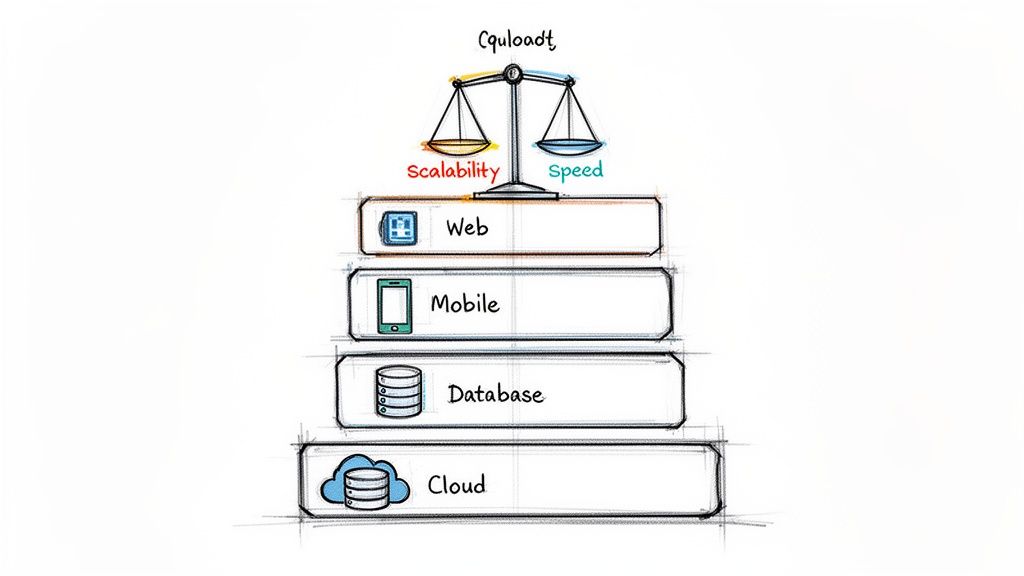
Let's discuss the tech stack. This is not merely a list of programming languages; it is the architectural foundation of your business. The choices made here will dictate your product’s performance, scalability, and your ability to hire elite engineering talent for years to come.
And yes, it absolutely impacts investor confidence. A shaky tech foundation is a significant red flag during technical due diligence, often leading to valuation discounts, hiring challenges, and a product that cannot keep pace with its own success.
The goal is not to select the trendiest framework. It is to make a strategic decision based on your business objectives and user base. We are here to engineer technical moats, not just apps, and that begins with an architecture designed to impress investors.
First Principles: Where Do Your Users Exist?
Before we mention "React" or "Python," you must answer one fundamental question: where will your first 1,000 users find and engage with your product? This is the single most critical factor.
Are you building a B2B SaaS tool for professionals at their desks? A web-first approach is the logical choice. Is it a consumer app for users on the move? A superior native mobile experience is non-negotiable.
An error here results in a perfectly engineered product for an empty room—a costly mistake we have witnessed too many times.
Once you know the platform, you can evaluate any technology against the "three T's":
Talent: How large and accessible is the developer pool? A niche language might seem performant, but if you cannot find skilled engineers to build and maintain it, you have engineered your own prison.
Tooling: Is there a rich ecosystem of libraries, active support communities, and robust documentation? A mature ecosystem accelerates development and problem-solving.
Testing: How mature are the testing frameworks? An investor-ready product requires automated, rigorous testing, which is only possible with a mature stack.
Choosing a tech stack based on hype is a rookie move. The right choice is a trade-off between performance, development speed, and the reality of hiring good engineers. Treat it like a business decision, not a technical beauty contest.
This disciplined approach ensures your MVP development for startups is built on solid ground, prepared for the rigorous questions investors will ask.
Native, Cross-Platform, or Web: The Core Trade-Offs
The "web vs. mobile" decision is a primary fork in the road. Each path has profound implications for your budget, user experience, and time-to-market. Let's analyze the real-world trade-offs.
1. Native Mobile (iOS/Android)
This is the premier option, delivering maximum performance, security, and full access to device hardware like cameras, GPS, and native push notifications.
Best For: Consumer applications where a fluid, high-performance user experience is the primary competitive advantage. Think high-end games, media editing, or any product requiring deep hardware integration.
The Catch: It is the most expensive and time-consuming route. You are engineering and maintaining two distinct codebases—one for iOS (typically Swift) and one for Android (typically Kotlin).
2. Web App (Especially a PWA)
Modern web applications can mimic a native feel but operate within a browser, offering incredible reach from a single codebase.
Best For: B2B SaaS, internal tools, and marketplaces where users are predominantly on laptops or desktops.
The Catch: Performance will not match native standards, and access to device hardware is limited. Offline capabilities are improving but are not yet on par with a true native app.
3. Cross-Platform (React Native, Flutter)
These frameworks represent a popular middle ground, allowing you to write code once and deploy it to both iOS and Android, which can be a significant advantage for startups.
Best For: Content-driven apps, simple e-commerce, or social applications where a presence on both platforms is required quickly and efficiently.
The Catch: Performance is a step below native. You can also encounter limitations where a specific feature requires writing native code, partially negating the "write once" promise.
Ultimately, this choice depends on what is most critical for your product. If you remain undecided, we have engineered a tool to guide you. Use our tech stack recommender for a tailored analysis based on your product concept.
Staffing Your MVP Development
Your tech stack is the blueprint; your team is the force that materializes it. This is one of the most critical decisions you will make as a founder. The right team engineers a high-valuation technical asset. The wrong one produces a fragile prototype that burns cash and kills momentum.
This is not just about finding individuals who can code. It's about securing the right blend of engineering discipline, strategic thinking, and what we call an "asset-first" mindset. For most startups, this decision involves three main paths: hiring an in-house team, engaging a boutique engineering partner, or onboarding a Fractional CTO.
The In-House Team Conundrum
Building an in-house team from day one appears ideal. It offers full control, a team dedicated to your mission, and the initial seeds of your company culture.
However, for an early-stage startup, the reality is often brutal. Sourcing, vetting, and hiring elite engineers is a full-time job. The process can drag on for months, consuming your most precious resource: time.
Furthermore, a brilliant coder is not automatically a skilled architect. Your first hires are not just writing code; they are making foundational architectural decisions that will define your product for years. A misstep here can lead to a system that is impossible to scale, drowning in technical debt from the first sprint. This model can succeed, but it is a high-risk, high-cost gamble.
The Anti-Outsourcing Model: A Boutique Partnership
Then there is the world of "outsourcing." The term often brings to mind mass-market, "black box" firms where you submit requirements and hope for quality code in return. This model is optimized for volume, not value, and is a direct path to the disposable prototype we aim to avoid.
We champion an "anti-outsourcing" model: a high-touch partnership with a boutique engineering firm. This is not about delegating your vision. It is about embedding a senior-level technical team that serves as both mentor and architect.
A true partner doesn't just "build your app." They engineer your technical asset alongside you, mentoring you through the process and ensuring every decision increases your company's valuation. It’s the difference between being a client and being a co-builder.
This approach provides immediate access to a complete, high-performance team—architects, senior engineers, and DevOps specialists—without the lengthy hiring process. Most importantly, it delivers the strategic leadership required to build an investor-ready asset from the outset.
When to Engage a Fractional CTO
What if you require the strategic guidance of a Chief Technology Officer but cannot yet justify a full-time executive salary? This is the precise scenario for which the Fractional CTO (vCTO) role was designed. A vCTO is a seasoned technology leader who provides executive-level oversight on a part-time basis.
You should seriously consider this model if:
You are a non-technical founder: You need a trusted expert to translate business goals into a technical roadmap and vet engineering talent.
Your team lacks senior leadership: Your developers are skilled but require architectural direction and mentorship to build a truly scalable and secure system.
You are preparing to fundraise: You need an expert to prepare your technology for due diligence, articulate its value to investors, and confirm you possess an auditable, defensible asset.
A Fractional CTO serves as the bridge between your grand vision and its flawless execution. If this aligns with your situation, you can learn more about what a virtual CTO can do for your startup and determine if it is the right strategic move for your current stage.
The Elite Engineering Workflow in Action
Engineering a high-valuation MVP is an entirely different discipline. Forget the buzzwords and messy Trello boards. To build an asset that commands investor attention, you need an engineering workflow as robust and disciplined as the code it produces.
This is not a process where we disappear for three months and emerge with a product. It is a tactical playbook designed to keep you—the founder—in the driver's seat, learning and making critical decisions at every stage.
The real work begins long before the first line of code. Following our Product Design & Discovery phase, we translate user journeys and business goals into a concrete development roadmap. This is not a wish list; it is a granular plan where every feature is directly tied to a success metric you have approved. We define what "winning" looks like before the race starts.
Iterative Sprints with a Founder-Centric Loop
We structure development into short, focused sprints, typically one or two weeks in duration. Each sprint is a concentrated effort to build and deliver a small, testable piece of your product. This creates a predictable rhythm and ensures you see constant, tangible progress. More importantly, it allows us to integrate your feedback early and often, preventing costly misalignments.
The key to our process is the founder-centric feedback loop. At the end of every sprint, you receive more than an email with a link. You get a live demonstration and a seat at the review table. Here, we present our work, walk you through the technical trade-offs we made, and explain precisely how they align with your business objectives.
This constant, high-touch communication is everything. It transforms the development process from a black box into a true partnership, ensuring the product we build is the asset you actually envisioned.
This is not just about transparency; it is about empowerment. You will understand the "why" behind the "what," enabling you to make smarter strategic decisions as we build.
Automation and Audit-Readiness with a CI/CD Pipeline
To maintain velocity without sacrificing quality, we establish a robust Continuous Integration and Continuous Deployment (CI/CD) pipeline from day one. Consider it an automated quality control and delivery system for your entire product.
Continuous Integration (CI): Every time a developer commits new code, it is automatically merged and tested against the entire system. This catches bugs and conflicts instantly, not weeks later when they have become a tangled mess.
Continuous Deployment (CD): Once code passes all automated tests, it can be deployed to a staging environment—or even production—with a single click. This eliminates slow, error-prone manual releases.
For an investor-ready MVP, this level of automation is not a luxury; it is a requirement. It is your proof that, at any moment, you possess a stable, tested, and deployable product. This is a massive advantage during technical due diligence.
No matter which staffing model you choose, this disciplined workflow is the engine that drives a successful build.
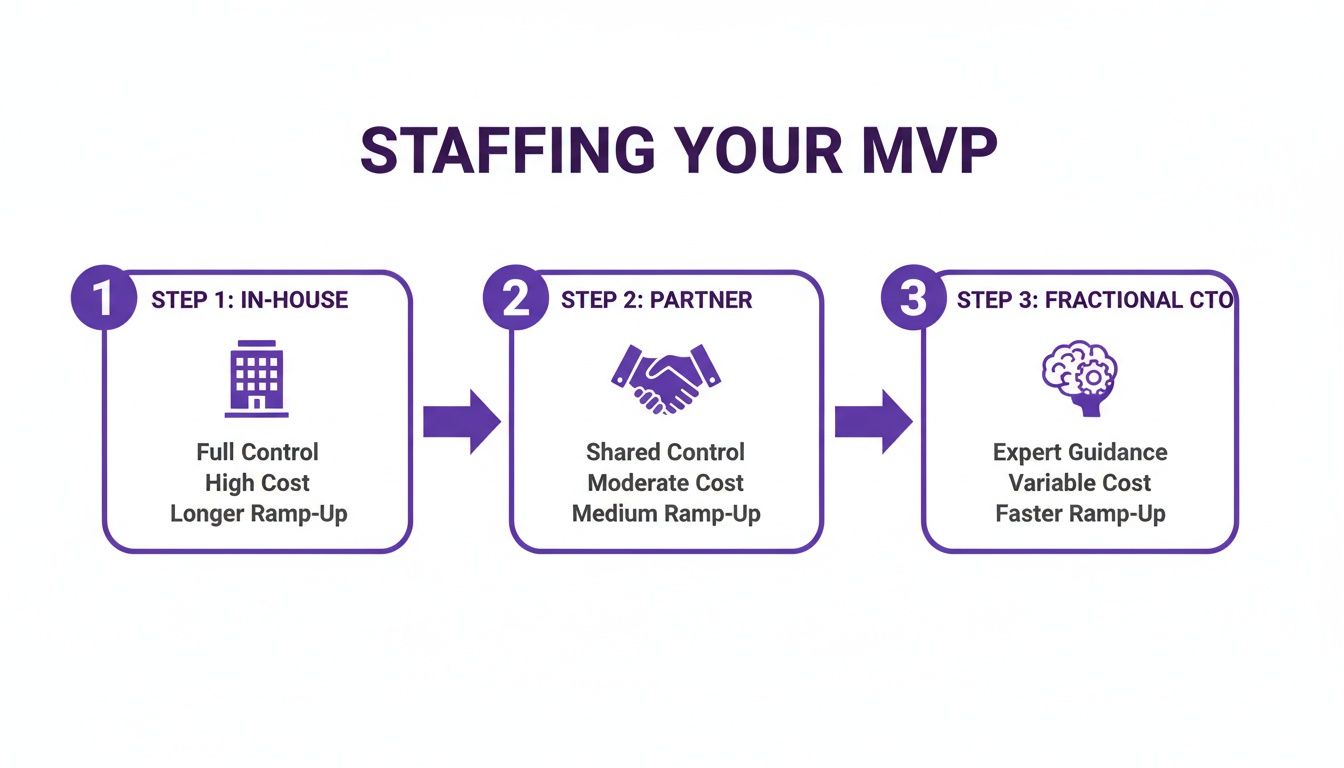
Whether you’re building in-house, working with a partner, or being guided by a Fractional CTO, the underlying process needs to be professional-grade from the start.
Quality Assurance That Goes Beyond Bug Hunting
A production-grade QA process is about far more than finding typos. It is about hardening your product for the real world. Our multi-layered approach is focused on building a defensible, audit-ready asset.
We combine automated and manual testing, conduct performance load tests to simulate real-world user traffic, and—most critically—integrate security vulnerability scans. We engineer with an "audit-ready" mindset, meaning compliance and security are not afterthoughts; they are integral to the workflow. This ensures your MVP is prepared for the intense scrutiny of investors and future enterprise clients.
Speed is your greatest advantage, and this workflow is engineered to maximize it. Data shows that MVPs developed in 3-6 months have a 68% two-year survival rate, far exceeding the 35% for those stuck in year-long development cycles. We also see AI tools reducing manual coding by up to 40%, freeing senior architects to focus on strategy.
This efficiency means a full-featured MVP can be market-ready in just 8-12 weeks. Costs for simple apps often start in the $15,000-$50,000 range and can scale to $300,000+ for complex SaaS platforms. The key is to budget 15-20% annually for maintenance and another 20-30% for iterations. This is how you avoid the crippling technical debt that sinks so many startups. You can dig into the full MVP development findings on intelmarketresearch.com. A disciplined approach here isn't just good practice; it's a hallmark of founders who win.
Preparing for Technical Due Diligence
You have achieved it. Your pitch deck is resonating, VCs are responding, and meetings are scheduled. This is the moment. But before any term sheet is signed, one final, formidable hurdle remains: technical due diligence.
This is not a cursory glance at your code. It is a deep inspection of your entire technology stack. VCs engage their experts to identify red flags, hidden risks, or any indication that your polished MVP is a house of cards built on technical debt.
Pass this, and you can significantly increase your valuation. Fail, and a promising deal can evaporate overnight.
What VCs Actually Scrutinize
Investors and their technical teams require evidence of discipline. They need proof that you have built more than a demo—they are looking for a solid foundation that can scale into a real business. They are hunting for anything that signals "expensive to fix later."
We see them focus on three areas every single time:
Clean Documentation and Healthy Code: Is your codebase logically organized or a chaotic mess? They will examine architecture diagrams, coding standards, and documentation that enables a new developer to onboard efficiently.
Auditable Infrastructure and Security: How is the product hosted? Expect them to scrutinize your cloud configuration, access controls, data encryption protocols, and disaster recovery plans. A "we'll address security later" posture is an instant deal-breaker.
Scalability and Performance: Can your application handle 10x its current traffic? They will probe your architecture for bottlenecks to determine if you can scale without a complete rebuild.
An investor isn't just funding your current product; they're funding its future. Technical due diligence is their way of ensuring that future isn't built on a foundation of sand. Your job is to prove you've built on solid rock.
Assembling Your Due Diligence Data Room
Do not wait to be asked. Proactively assemble a "data room"—a secure, organized repository of all the technical documentation they will request. This demonstrates professionalism and preparedness.
Your data room must include:
Technical Architecture Diagrams: A high-level map illustrating the connections between your frontend, backend, databases, and third-party services.
Code Repository Access: Provide read-only access to your Git repository. Ensure your commit history is clean and your README files are current and genuinely useful.
Infrastructure and DevOps Docs: Detail your CI/CD pipeline, deployment processes, and cloud infrastructure. Include information on your monitoring and alerting systems.
Security and Compliance Policies: Document your security protocols, data handling procedures, and any compliance standards you adhere to.
Regarding compliance, demonstrating awareness puts you far ahead. For many B2B SaaS companies, SOC 2 is the critical standard. Familiarizing yourself with SOC 2 compliance for startups shows investors you are building for the long term.
Proving Value Through Key Metrics
Beyond the code, investors require hard data demonstrating that your technology is driving the business forward. This means your MVP must be instrumented to track the metrics that matter. Be prepared to present clean, reliable numbers on:
Customer Acquisition Cost (CAC): The cost to acquire each new user.
Lifetime Value (LTV): The total revenue expected from a single customer.
Churn Rate: The percentage of users who discontinue service each month.
This data transforms your MVP from a technology project into a value-generating engine. There's a reason the market for MVP development for startups is exploding. Projections show it growing from $288 million to $541 million by 2031, and startups using a lean approach report a 40% higher funding success rate.
These numbers are your leverage. Do not treat your MVP as a side project—it is a core asset driving your valuation. As the market accelerates, proving you have built a solid, data-backed asset is everything. You can learn more about this acceleration by reading the full analysis on Digital Journal. Mastering due diligence is the final, critical step.
Frequently Asked Questions About MVP Development
If you are building a startup, you have questions about your MVP. After years as a trusted technical partner for founders, I have heard nearly all of them.
Let’s be direct. Here are authoritative answers to the most common questions, all centered on one objective: engineering a product that is investor-ready and built for a high valuation.
How Much Should an Investor-Ready MVP Cost?
This is the primary question. While there is no single answer, we can provide ranges. A well-engineered mobile or web application will likely fall between $25,000 and $75,000. A more complex system, such as a full-fledged SaaS platform, could easily exceed $150,000.
However, the crucial mindset shift is this: this is not an "expense." It is an investment in a core business asset. The cost reflects the senior-level engineering, scalable architecture, and security hardening that VCs will scrutinize during due diligence. This expenditure directly increases your startup's valuation—it’s a strategic investment, not a line item.
How Long Does It Take to Build a Proper MVP?
For a well-scoped, investor-ready MVP, plan for a timeline of three to six months. Any timeline significantly outside this window should be a red flag.
Under 3 months? This almost certainly means corners are being cut on architecture, testing, or documentation. You are building a mountain of technical debt that will inevitably surface.
Over 6 months? Your scope is likely too broad. You are no longer building a focused MVP; you are attempting to build the entire product. This exhausts capital and, more critically, delays the real-world market feedback you need.
The objective is to launch a high-quality product that delivers core value, quickly. This enables you to iterate from a position of strength, not desperation.
The most common and fatal mistake is treating the MVP as a disposable prototype. Founders focus on making something that just 'works' for a demo, using cheap shortcuts that accumulate massive technical debt. When they get traction and need to scale or pass due diligence, they're forced into a complete, costly rewrite that kills their momentum. Start with an asset-building mindset from day one.
Should I Build for iOS, Android, or Web First?
This is not a technical question; it is a customer question. Before any code is written, you must answer: Where do your customers live digitally?
Web App: This is almost always the correct first step for B2B SaaS, internal tools, or any product used primarily at a desk.
Native Mobile: Building a consumer social app? Or a product where a flawless user experience is your competitive advantage? Native is a requirement. For the US market, an iOS-first strategy is a common and battle-tested approach.
Do not guess. Base this decision on real user research. Selecting the wrong platform is one of the fastest ways to burn through your runway.
Ready to move beyond the prototype and engineer a high-valuation technical asset? Buttercloud is a boutique engineering. We guide founders through the lifecycle of turning an Idea → Investor-Ready MVP → Scalable Product. We don't just build apps; we engineer the foundation for your business's future. Learn more about our founder-centric approach at Buttercloud.