
Unlock MVP Development for Startups: A Guide to Building Investor-Ready Technical Assets

When we talk about MVP development, we're not talking about building a disposable prototype. We're engineering the first, most critical foundation for a high-valuation company. It’s the strategic process of building the core version of your product—just enough to validate your model with early adopters, gather hard data, and prove to investors you can execute.
The goal is to create a technical asset, not a throwaway experiment.
Building an Investor-Ready MVP, Not a Prototype
Let’s be direct—most startups fail. It’s a brutal reality, but up to 90% of new ventures simply don't make it. A staggering 34% of those failures are directly because of a bad product-market fit, the exact problem a well-executed MVP is engineered to solve.
This stat alone shows why you can't afford to get this step wrong. Your MVP is your first line of defense against building a product nobody wants.
This guide isn't about building a cheap app to check a box. It’s a playbook for crafting the foundational code that will become your company's core asset and drive its valuation.
The Prototype Trap and Your Technical Moat
So many founders fall into the "prototype trap." They commission a quick-and-dirty version of their idea just to have something shiny to show investors. This almost always backfires.
These prototypes are built on shaky ground, riddled with technical debt. They're impossible to scale and become a massive red flag for any investor who performs technical due diligence.
An investor-ready MVP is different. It’s engineered from day one as a scalable, high-valuation asset. We call this your "Technical Moat"—a well-architected codebase that acts as a genuine competitive advantage. It’s clean, documented, and built to pass the rigorous technical audits that precede serious funding. This directly boosts your company’s valuation.
For startups in complex fields like finance, this isn't optional. A practical guide to FinTech software development highlights just how critical a robust, secure architecture is from the very beginning.
An investor doesn't fund a prototype; they invest in a scalable foundation. Your MVP's code quality is a direct reflection of your ability to execute and build long-term value.
Why Audit-Ready Engineering Matters
Picture this: you're in a late-stage meeting with a top-tier VC. They love your pitch. Then, they bring in their technical team to audit your codebase. What are they going to find?
A prototype-grade MVP will reveal messy code, zero automated tests, and an architecture that can't handle growth. That signals immense risk. It will either kill the deal on the spot or lead to a major down-round to cover the "rebuild cost."
An investor-ready MVP, on the other hand, demonstrates foresight and operational excellence. It proves you are a founder who builds for longevity.
The strategic difference between a throwaway prototype and a production-grade MVP is night and day. One is a liability; the other is a core asset.
Traditional Prototype vs. Investor-Ready MVP
Attribute | Traditional Prototype | Investor-Ready MVP (The Buttercloud Way) |
|---|---|---|
Primary Goal | Visualize an idea quickly | Validate a business model with real users |
Code Quality | Disposable, high technical debt | Clean, documented, and audit-ready |
Architecture | Not designed for scale | Scalable foundation for future growth |
Long-Term Value | A liability requiring a total rebuild | A core technical asset that increases valuation |
Investor Perception | Seen as a high-risk, amateur effort | Perceived as a de-risked, professional investment |
The distinction couldn't be clearer. One path leads to expensive rebuilds and missed opportunities. The other sets you on a direct course for sustainable growth and successful funding rounds.
This is how you de-risk the venture for yourself and for your future partners. It isn't about cutting corners; it's about making the right investments in your technical foundation from day one.
Crafting Your Strategic Blueprint: Product Design & Discovery
Let's talk about the single most important phase of building a product—the part that happens long before a developer ever touches a keyboard. This is the Product Design & Discovery phase, and frankly, it’s where most startup battles are won or lost.
Too many founders get caught up in the excitement of their idea and sprint straight into building it. They skip the hard part: figuring out if anyone will actually pay for it.
This rush to build is the number one reason startups die. It’s a classic, tragic story that plays out all the time. You have a brilliant idea, you pour your heart and soul into building it, and then... crickets. You built the wrong product.
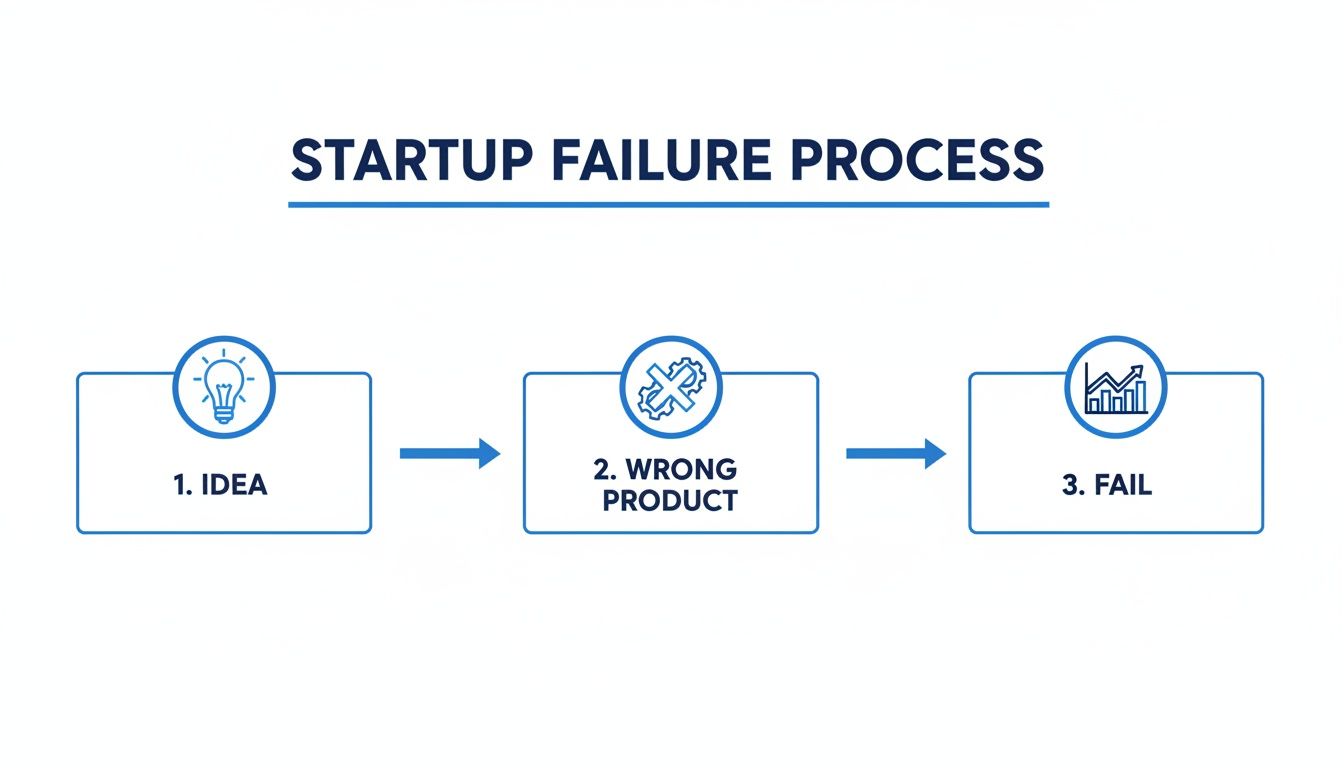
Look familiar? This diagram shows the direct path from a raw idea to a failed company. The discovery phase is your insurance policy against becoming another statistic.
Defining Your Core Problem
Every great product is built on a painful, specific problem. Your first job is to stop pitching your solution and fall completely in love with the problem itself.
You need to answer one question with brutal honesty: What is the single, critical problem my target user faces that I can solve better than anyone else? Getting to that answer means getting out of the building and into your customer’s world.
A founder’s most dangerous assumption is that they already know what users want. The discovery process is designed to systematically replace those assumptions with hard evidence.
This isn't about validating your grand, five-year vision all at once. It’s about finding the one core hypothesis that, if wrong, sinks the entire ship. That's the problem your MVP absolutely has to solve.
Conducting Effective User Discovery
You can't learn about your users from behind a screen. Real discovery means having actual, qualitative conversations with the people you think you’re building for. Your goal is not to sell them; it's to listen.
Key Techniques for User Discovery:
Problem-Focused Interviews: Don't ask, "Would you use my cool new app?" That's a leading question that gets you useless answers. Instead, dig into their current reality. Ask things like, "Tell me about the last time you tried to do X. What was the most frustrating part?"
User Personas: Create 1-2 detailed personas for your ideal first customers. These aren't just demographic checklists. They capture real goals, motivations, and, most importantly, pain points. This gives your team a real person to build for, not just a vague idea.
Journey Mapping: Map out the exact steps your persona takes today to solve their problem without your product. Where do they get stuck? Where do they waste time? This map will literally show you where your MVP can create the most value.
Prioritizing the "Minimum" in Your MVP
Once you truly understand the user's pain, you can start defining what "Minimum" actually means for your Viable Product. The goal here isn’t to build a watered-down version of your dream product. It's to build a sharp, focused tool that is amazing at solving that one core problem.
This is where a simple impact/effort matrix becomes your best friend. For every feature you're considering, ask two questions:
Impact: How much does this feature help solve the core problem we identified?
Effort: How much time and complexity will it take to build this?
The features that fall into the "high-impact, low-effort" box are your MVP. Everything else can wait. This ruthless focus ensures you get the most validated learning for every single dollar and hour you invest.
By the way, if you want a better sense of how these choices impact your budget, you can play around with our MVP cost estimator tool for a clearer picture.
This strategic blueprint—built on real user data and sharp prioritization—is the bedrock of any successful MVP development for startups. It’s what turns your idea from a wild guess into a calculated plan for building something people will actually use and, eventually, pay for.
Engineering Your Tech and Sprinting to Launch
Alright, you’ve got your strategic blueprint. Now it's time to roll up our sleeves and start building. This is where your idea goes from a plan on paper to a real, functioning product.
The decisions we make here are critical. They’ll shape how your product scales, how secure it is, and ultimately, how much your company is worth in the eyes of investors. We're not just "coding an app"—we're engineering a rock-solid technical asset that’s ready for VC due diligence from the moment it's born.
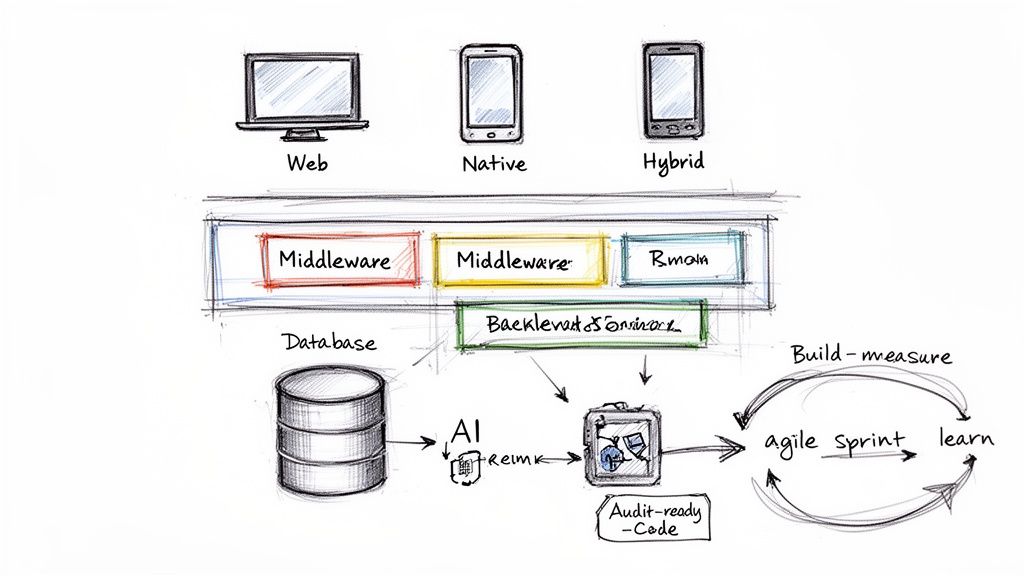
Building Your Technical Moat
Think of your MVP's architecture as its skeleton. A flimsy one will buckle the second you start to grow. A strong one, however, gives you a sturdy frame to build a massive company on. The first big call is picking the right tech stack.
Native Mobile (iOS/Android): Go native when you need raw performance and a premium feel. If your app relies on advanced phone features (like the camera or background processing) and you want that slick, integrated user experience, this is your path.
Modern Web (React/Next.js): Need to get to market fast and be on every device from day one? A web-based MVP is usually the answer. It's perfect for B2B SaaS or any product where you don't need to be in an app store right away.
Hybrid Approaches: Frameworks like React Native can seem like a good middle ground, but they often come with performance hits. We only really recommend this route when the compromises it forces make sense for the product's core job.
There’s no magic bullet here. The right choice is a strategic one, based entirely on the problem you're solving for your customers.
Why We Swear by the Anti-Outsourcing Model
So many founders see development as a commodity. They shop around for the cheapest "dev shop" they can find, and frankly, it's a fast track to disaster. Most outsourcing firms are a black box—you send them specs, they send back code, and you have no idea what’s happening in between.
We built our process around the Anti-Outsourcing Model. This is a transparent, hands-on partnership. We don't just work for you; we mentor you.
You aren't just handing off a task; you're teaming up with a mentor-architect. We embed with your team, pulling you into the development sprint so every technical choice is directly tied to a business goal.
This approach crushes the risk of building the wrong thing, or worse, building the right thing the wrong way. It guarantees your codebase is clean, easy to understand, and an investable asset—which is what building an investor-ready MVP is all about.
AI Isn't an Add-On, It's Your Advantage
In today's market, you can't just sprinkle AI on top later. It has to be baked in from the start. Just look at the venture capital world—the data is crystal clear. In Q1 2026 alone, over 53% of the $115 billion in global funding went to AI-enabled startups. That's a mind-boggling $59.6 billion.
At the same time, tools like AI coding assistants are giving developers a productivity boost of up to 55%, which means MVPs get built way faster. You can read more about how AI is reshaping the MVP process and what it means for founders.
An AI-powered MVP isn't a "nice-to-have" anymore. It's the new table stakes. Integrating AI from day one gives you a serious competitive edge, whether it's automating your own workflows or delivering a crazy-personalized experience for your users.
Building Audit-Ready Code from Day One
Technical debt is the silent startup killer. It’s what happens when you cut corners to hit a deadline—untested code, zero documentation, and an architecture that's a tangled mess. That kind of MVP might work for a demo, but it's a time bomb that will explode the second you try to scale or face a technical due diligence audit.
Our entire process is built around creating audit-ready code from the very first line. Here's what that looks like in practice:
Clean, Documented Code: We write code that other humans can actually read and work with.
Automated Testing: We build a safety net of tests to catch bugs and keep the product stable.
Continuous Integration/Deployment (CI/CD): The build and deployment process is automated, so shipping updates is fast and reliable.
This isn't about being slow or rigid; it's about being a pro. It makes sure your MVP is a powerful asset that fuels your growth and wows investors, not a liability that holds you back. This is how you run rapid build-measure-learn cycles without wrecking your product's long-term health.
Assembling Your A-Team for Development
Let's be blunt: the single most important decision you'll make as a founder is choosing who builds your product. This isn't just about hiring a few coders. It's about finding the architects who will build the very foundation of your company's value.
The team you pick to bring your MVP to life will directly impact its quality, its ability to scale, and how it’s viewed by the investors you’re trying to impress. Get this wrong, and you’ll burn through your runway with nothing but a pile of technical debt to show for it.
The Founder’s Secret Weapon: The Fractional CTO
For most early-stage startups, hiring a full-time, C-suite CTO is a non-starter. The six-figure salary and hefty equity package can cripple a lean budget before you even get going. But this leaves a massive leadership gap right where you need it most—at the architectural level.
This is where the Fractional CTO model is an absolute game-changer. A Fractional CTO is a seasoned tech leader who provides that crucial high-level oversight. They help you define the technical roadmap and make sure your MVP is built to pass investor due diligence, all without the full-time executive price tag.
Think of them as your mentor-architect. They don't get stuck in the weeds of daily coding. Their job is to provide the strategic leadership that stops your team from making those catastrophic, million-dollar mistakes that can sink a company years down the line.
Why We Champion the "Anti-Outsourcing" Model
The old-school outsourcing model is a nightmare for startups. It treats your product like a commodity, creating a "black box" where you throw requirements in and just hope for the best. This is the exact opposite of the transparent, hands-on partnership you need to build a real technical asset.
We believe in an "Anti-Outsourcing" philosophy. This is a mentorship-driven approach where our team becomes a dedicated extension of yours. You’re not just another client; you're a founder we're invested in mentoring. We pull you into the process, making sure you understand the why behind every technical decision and trade-off.
The goal is to completely erase the gap between the founder and the engineering team. When your technical partner is also your mentor, the product becomes a true reflection of a unified vision, not just a checked-off task list.
This kind of collaboration is all about de-risking the entire venture. It ensures the final product isn't just what you asked for, but what your business actually needs to win in the market and scale successfully. It's about building your technical moat, together.
Demystifying the Team Models
Choosing the right team structure is just as critical as the technology you use. Each model has its own set of trade-offs, and what works for one startup could be a disaster for another. You need to weigh the pros and cons based on your budget, timeline, and how much hands-on control you want.
Here's a look at the most common ways founders assemble their MVP teams.
MVP Team Composition Models
Model | Pros | Cons | Best For |
|---|---|---|---|
In-House Team | Full control; Deep product knowledge; Aligned incentives. | Very expensive; Slow to hire and build; High overhead. | Well-funded startups with a clear, validated product direction and a long runway. |
Freelancers | Cost-effective for specific tasks; Flexible hiring. | Inconsistent quality; Lack of team cohesion; Hard to manage. | Founders on a tight budget needing to augment an existing team for small, isolated tasks. |
Traditional Outsourcing | Lower hourly rates; Access to a large talent pool. | "Black box" development; Communication barriers; Poor alignment. | Non-core, simple projects where quality and strategic input are not critical. |
Agency/Studio Partner | Speed and expertise; Predictable outcomes; Access to a full team. | Higher upfront investment; Less direct control than in-house. | Founders who need to move fast, de-risk development, and get a high-quality, investor-ready product. |
Fractional CTO + Devs | Strategic leadership; Cost-efficient; High-quality architecture. | Requires managing separate developers; The CTO is not full-time. | Founders who need elite technical guidance but want to manage the day-to-day build with a smaller team or freelancers. |
Ultimately, there's no single "right" answer. The best model for you depends entirely on where you are in your journey. An agency partner offers a turnkey solution for speed and quality, while a Fractional CTO model gives you top-tier strategy with more flexibility on the execution side.
Let's Talk Real Numbers: The Cost of an Investor-Ready MVP
Okay, let's get down to brass tacks. Building a high-quality MVP is a serious investment. But it’s nothing compared to the cost of a failed launch, a bad investor meeting, or having to rebuild your entire product from scratch. With the app market projected to rocket from $583 billion to $1.3 trillion by 2030, the pressure to get your product right the first time has never been greater.
Right now, a whopping 78% of venture-backed startups are building mobile-first MVPs, which tells you exactly where users and investors are focused.
To meet this demand, top-tier development agencies and studios often charge between $15,000-$20,000 per week for a full squad of senior talent. This kind of focused effort typically gets a production-grade, investor-ready MVP built in just 8-12 weeks. Some firms also offer fixed-price engagements starting around $50,000, giving founders that all-important budget predictability. You can dive deeper into how MVP development costs are structured to see what you should expect from a top partner.
These numbers aren't just for writing code. You're investing in a predictable, high-quality outcome that's engineered for long-term growth and valuation. You're paying for precision, audit-ready engineering, and strategic mentorship—the things that truly matter.
Executing the Launch and Ensuring Investor Readiness
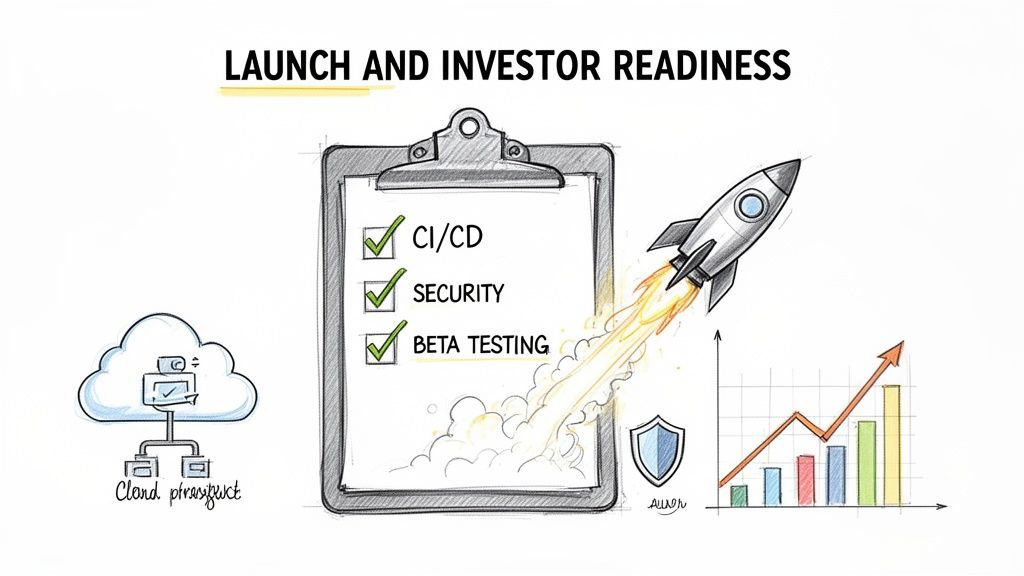
The moment of truth isn't when the last line of code is written. It's when you launch. This final phase is what separates a truly well-engineered product from a project that just collects dust on a server. It’s all about nailing the deployment and getting your entire venture ready for the intense scrutiny of investors.
This is where smart DevOps and a founder-led launch strategy come together to turn your MVP from a piece of software into a scalable, investor-ready business.
Boutique DevOps and Audit-Ready Infrastructure
For a startup, DevOps isn't some technical buzzword; it's a business accelerator. Think of it as the engine that keeps your platform stable, secure, and ready for whatever’s next—whether that's a sudden user surge from a TechCrunch mention or a deep-dive technical audit from a VC.
This is exactly why we build infrastructure that is audit-ready from day one. It starts with a solid, managed cloud environment that can grow with you. But more importantly, it means putting a Continuous Integration/Continuous Deployment (CI/CD) pipeline in place. This automated process makes code deployments fast, reliable, and consistent, turning what used to be a high-risk, all-hands-on-deck event into a routine, low-stress operation.
A clean CI/CD pipeline is absolutely non-negotiable. It proves your startup has operational maturity and can iterate quickly on user feedback—a key sign of life that investors are always watching for.
The Founder’s Pre-Launch Checklist
A successful launch is a planned mission, not a hopeful accident. Before you flip the switch, you need a disciplined process to gather that last bit of validation and ensure everything goes smoothly.
Here’s your pre-flight checklist for a strategic go-live:
Strategic Beta Testing: Forget a massive, open beta. Instead, hand-pick a small, curated group of your ideal users—the very people whose problem you’re trying to solve. Give them early access and treat their feedback like gold. This isn't a marketing push; it's about finding the last few critical flaws in a controlled setting.
Get Analytics and Monitoring Live: Make sure your analytics tools are plugged in and tracking the core user actions. You absolutely need to measure activation, engagement, and retention from the very first user. This data is the lifeblood of your post-launch strategy.
Set Up Your Feedback Loop: Create a dead-simple channel for users to report bugs or request features. A simple feedback widget or a dedicated Discord channel works great. The goal is to make it effortless for your first evangelists to help you make the product better.
Your MVP launch isn't a grand unveiling. It's a calculated intelligence-gathering mission. The objective is to learn as much as possible, as quickly as possible, with the smallest possible group of real users.
Translating Technical Wins into Investor Confidence
Okay, let's tie it all together. Every technical decision you've made—from choosing a scalable architecture to implementing CI/CD—feeds directly into your story for investors. They don't just fund ideas; they fund execution and de-risked opportunities. To really drive the point home, a solid business case template can be invaluable for showing how these technical wins translate to business value.
When you walk into that pitch meeting, your MVP is Exhibit A.
The technical due diligence process is where so many startups stumble. VCs bring in their own experts to tear down your codebase, architecture, and deployment process. Our "audit-ready engineering" approach is designed specifically to ace this test. Clean, documented code and a secure, automated infrastructure prove you’ve built a real asset, not just a house of cards. This level of preparation is a huge piece of the puzzle we cover when discussing how to navigate the seed funding stage for startups.
Interpreting Early Metrics for Your Roadmap
Once you launch, you're going to get a flood of data. The trick is to ignore the vanity numbers and focus on the metrics that signal you’re on the right track toward product-market fit.
Activation Rate: What percentage of people who sign up actually complete that key "aha!" moment action?
User Retention: Are they coming back? Day 1, Day 7, and Day 30 retention rates are the strongest signals of a sticky product.
Qualitative Feedback: What are your beta testers actually saying? A handful of powerful quotes about how your product saved them time or solved a major headache are worth more than a thousand signups.
These early signals are what guide your roadmap. Instead of guessing what to build next, you'll be making decisions based on real user behavior. This shows investors you have a repeatable process for growth, proving that your MVP development for startups was the foundation for a real, scalable company.
Common Questions About MVP Development
As a founder, you're living in a world of high-stakes decisions. When it comes to building your MVP, a few key questions pop up over and over again. I hear them constantly.
Let's cut through the noise and get you some straight answers so you can move forward with confidence.
How “Minimum” Should My Minimum Viable Product Be?
This is the big one. Your MVP isn't about the minimum number of features. It's about the minimum feature set needed to solve one, critical problem for a specific user and prove your core idea has legs. The whole point is to maximize learning while minimizing the time and money you burn on engineering.
Think of it like a scalpel, not a Swiss Army knife.
A bloated MVP that does five things poorly is a death sentence. It’s far, far better to build something that does one thing perfectly. Prove people need that one thing before you even think about adding more.
What Is the Difference Between a Prototype, PoC, and an MVP?
This distinction trips up so many founders, and getting it wrong is costly. They sound similar, but their purpose, audience, and what’s under the hood are worlds apart.
Proof of Concept (PoC): This is a pure tech experiment. It answers one question and one question only: “Can we actually build this?” It’s almost always for internal eyes only, just to see if a specific technical challenge is even possible to overcome.
Prototype: This is all about the look and feel. It’s a visual, interactive mockup that answers the question: “What will this be like to use?” You use prototypes to get early feedback on the user experience, but there’s no real engine running underneath. It’s a facade.
Minimum Viable Product (MVP): This is the real deal—a functional, live product that solves a real problem for actual users. It answers the ultimate business question: “Will people use this and, eventually, pay for this?” Your MVP is your first asset in the market, built to gather real-world data and become the foundation of your future product.
While PoCs and prototypes are internal science projects, your MVP is an external, investable asset. If you confuse them, you'll end up with throwaway tech right when you need a solid foundation.
Can I Build an MVP Myself Using No-Code Tools?
No-code platforms like Bubble or Webflow are fantastic for building prototypes and clickable demos. If you're a non-technical founder, they can be an amazing first step to get your idea out of your head and into something people can see and react to.
But when it comes to building a true, investor-ready MVP, they almost always hit a hard wall.
If your big idea hinges on any kind of proprietary logic, complex workflows, or a unique user experience, a no-code solution will quickly run out of road. You sacrifice scalability, security, and the ability to build a real technical moat around your business. This path usually ends with a complete, expensive rebuild from scratch, which burns through your most precious resources: time and money.
For a serious tech business, custom engineering isn't a luxury; it's a foundational strategic investment.
How Do I Avoid Accruing Massive Technical Debt With My MVP?
Simple: you make it a priority from day one. This means killing the old "move fast and break things" mantra. A much better one is "move fast and build things right." The secret is to partner with an elite engineering team that treats audit-ready code as non-negotiable from the very first line.
This isn't about moving slowly; it's about being smart. It means making strategic architectural choices that won't corner you later, writing clean and well-documented code, and building in automated testing. It’s a balancing act between speed and quality.
A Fractional CTO is a game-changer here. They provide that senior-level oversight to make sure the quick decisions you make today don’t become the expensive problems that sink you tomorrow.
Ready to move beyond theory and build an MVP that gets investors excited? At Buttercloud, we don't just write code; we partner with founders to engineer high-valuation technical assets. Let's talk about turning your vision into an investor-ready reality. Explore our approach.