Startup Tech Stack: Boost Valuation

Founder & CEO, Buttercloud
You are in one of two situations.
Either you are a non-technical founder getting drowned in opinions. One developer wants Python. Another insists on Node. A third says no-code first, rebuild later. Everyone sounds confident, and none of them will carry the cost of a bad decision with you.
Or you are a technical founder who can build, but now you need to choose what deserves to become your company’s long-term foundation. That is a different job. You are no longer picking tools for convenience. You are making capital allocation decisions.
A startup tech stack is not a shopping list. It is the operating system for your business. It affects launch speed, hiring, product reliability, security posture, technical diligence, and how investors judge execution risk. Founders who treat the stack as a tactical coding choice pay for it twice. First in delays. Then in refactoring.
Why Is Your Tech Stack More Than Just Code?
The first stack decision feels technical. It is financial.
If you choose a stack your team can ship with, maintain, and defend under scrutiny, you create an asset. If you choose a stack because someone on X called it modern, you create a liability that sits until customers arrive or diligence starts.
That is why I push founders to stop asking, “What language should we use?” and start asking, “What architecture helps this company move fast without poisoning the next round?” That shift matters. Investors do not fund code aesthetics. They fund execution capacity and risk-adjusted upside.
Your stack shapes investor perception
A clean startup tech stack signals discipline. It tells investors your team can make constrained, sensible decisions. It tells acquirers the codebase will not collapse when the founding engineers leave. It tells senior hires they are joining a company with engineering judgment.
A messy stack signals the opposite. Too many tools, weak boundaries, no obvious defaults, and hand-rolled infrastructure in the wrong places all create drag. The product may work. The business gets discounted.
AI changed the pace of stack decisions
The environment also changed fast. In 2025, 90% of product teams use ChatGPT regularly, ahead of Gmail at 76% and Slack at 71%, which marks a major shift in how teams build and operate (Lenny’s Newsletter). That matters because founders can now build production-capable MVPs faster, with smaller teams, and with fewer excuses for weak execution.
AI has compressed the timeline between idea and product. It has not removed the need for architecture. If anything, it raised the standard. You can ship faster now. Investors know it. Customers expect it. Your stack has to support that speed without turning into debt.
Key takeaway: Your startup tech stack is a valuation decision disguised as an engineering decision.
Deconstructing the Modern Startup Tech Stack
Most founders hear “tech stack” and imagine a pile of tools. That is too vague to be useful.
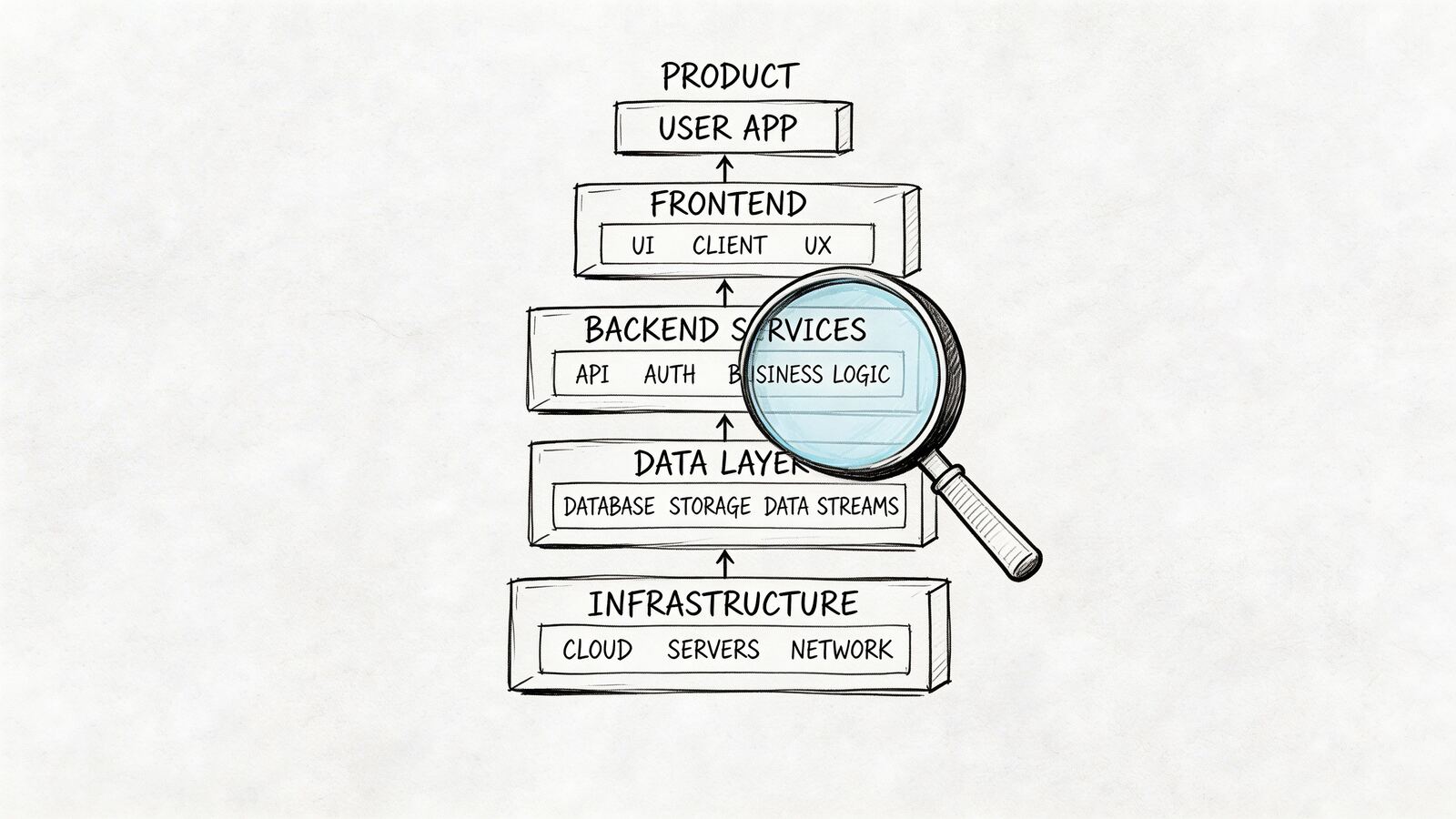
Think of your product like a commercial building. Users see the lobby and offices. They do not see the steel, wiring, or backup systems. But those hidden layers determine whether the building feels premium and whether it stays standing.
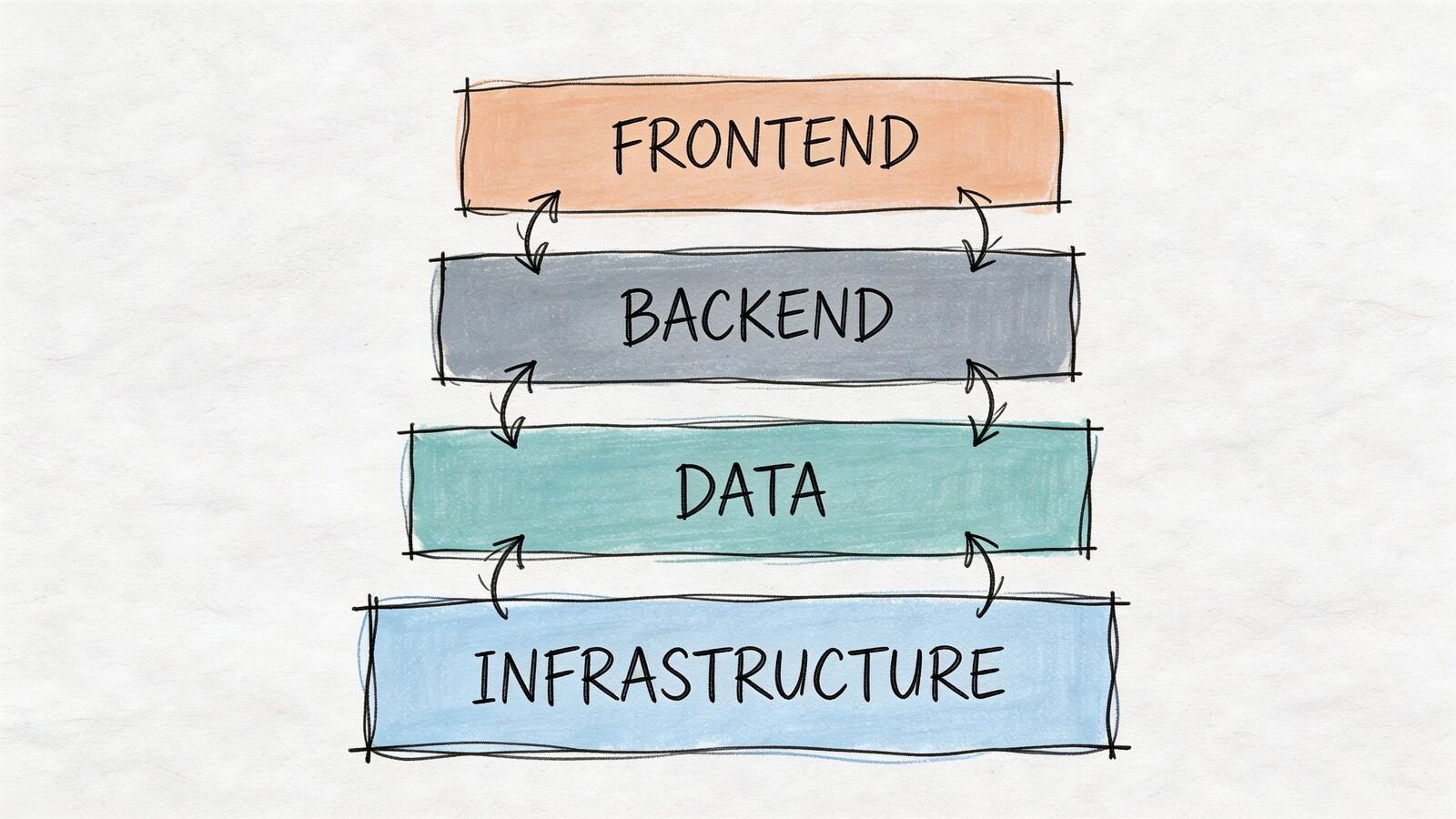
Presentation layer
This is the frontend. It is what customers touch.
Your website, web app, mobile app, dashboards, onboarding flows, and forms all live here. If the frontend is clumsy, users blame the product. They do not care that your backend is elegant.
For most startups, this layer should optimize for:
-
Clarity: Users should understand what to do immediately.
-
Responsiveness: Actions should feel fast and predictable.
-
Iteration speed: Product changes should not require a full rewrite.
React and Next.js remain sensible defaults because they support rich product interfaces and are easy to hire for.
Logic layer
This is the backend. It handles business rules.
When a user signs up, pays, uploads data, triggers a workflow, or requests a report, the backend makes that happen. This is the structural engineering of your product. Weak choices here create outages, weird bugs, and painful rewrites.
Some startups stay monolithic early, and that is the right move. Others split services too soon and create operational chaos. If you are trying to understand when systems should separate, these microservices architecture patterns are worth reviewing before someone turns your MVP into a distributed mess.
Data layer
This is your database and related storage.
It is where customer records, transactions, permissions, product data, and application state live. A founder who ignores the data layer discovers its importance during analytics requests, enterprise customer questions, or the first security review.
The data layer must answer three practical questions:
-
Can it model the business cleanly
-
Can it enforce access rules
-
Can it support future reporting and product features
Foundation layer
This is infrastructure and DevOps.
Hosting, deployments, environments, backups, CI/CD, monitoring, secrets management, and access control all belong here. Founders underestimate this layer because users rarely see it. Investors and enterprise buyers care about it a lot.
Here is a simple mental model:
Layer
What it does
Founder concern
Frontend
Delivers the product experience
Adoption and conversion
Backend
Runs the business logic
Reliability and feature velocity
Data
Stores and organizes core records
Reporting, security, and future product depth
Infrastructure
Keeps everything deployable and stable
Scale, uptime, and due diligence
If you want a quick starting point before talking to engineers, Buttercloud’s tech stack recommender is one practical way to narrow options by product type, team size, and launch goals.
The Five Pillars of a Valuation-Driven Stack
A serious founder should evaluate every startup tech stack against five pillars. Not ten. Not a giant spreadsheet that creates fake certainty. Five.
Speed to market
Your first version needs to get into users’ hands fast. That does not mean hacking together a demo that becomes impossible to extend.
Speed-to-market means choosing tools your team knows, with enough maturity to support real product development. A familiar stack with strong libraries beats a clever stack that slows every decision. The point is not novelty. The point is validated learning.
I would rather see a founder launch on a conventional stack in weeks than spend months debating edge-case performance they do not yet need.
Scalability and performance
Scalability is not about sounding advanced. It is about avoiding product embarrassment.
Your stack should handle growing usage without forcing a redesign every time the company wins. That means clear application boundaries, sane database design, and infrastructure choices that support deployment consistency.
Do not confuse “premature scaling” with “architectural discipline.” You do not need to build Netflix on day one. You do need a stack that can absorb growth without becoming fragile.
Total cost of ownership
Founders compare tools by monthly sticker price. That is amateur math.
The true cost of a stack includes:
-
Engineering time
-
Maintenance burden
-
Vendor lock-in
-
Hiring difficulty
-
Migration pain
-
Security overhead
A cheaper tool that burns senior engineering time is not cheap. A managed service that removes a chunk of operational risk may be the smarter financial decision, even if the invoice looks higher.
Many startups get trapped here. They save money in the build phase and lose far more later in cleanup.
Maintainability and talent pool
Every stack decision is also a hiring decision.
If you choose niche tools, fewer engineers can maintain them. If one person on your team understands the architecture, your company carries key-person risk. If onboarding new hires takes too long, your execution slows when you need to accelerate.
That is why I keep recommending mainstream technologies for early-stage startups. React. Next.js. Node.js or Python. PostgreSQL. Common cloud platforms. These are not boring because they lack capability. They are powerful because they reduce friction across hiring, debugging, and product iteration.
Practical rule: If your stack needs a long explanation before a strong engineer says yes to the job, it is probably hurting you.
Security and compliance
This pillar gets ignored until it becomes urgent. Then it controls the roadmap.
Security is not a later-stage concern. If your startup handles customer data, payments, health information, internal business workflows, or anything enterprise-facing, security starts at architecture. So does compliance.
Bad stack decisions show up here fast. Weak tenant isolation. Improvised auth. No deployment controls. No audit trail. No secrets discipline. No environment separation. Those are not “engineering details.” They are reasons a buyer, investor, or enterprise customer loses confidence.
A founder-level scorecard
Use this simple lens when evaluating a stack option:
Pillar
Strong signal
Weak signal
Speed
Team can ship immediately
Team must learn too much first
Scalability
Clear path for growth
Rewrite likely after initial traction
Cost
Operational burden is predictable
Hidden maintenance everywhere
Maintainability
Easy to hire and onboard for
Knowledge trapped with a few people
Security
Access control and environments are intentional
Compliance and hardening are afterthoughts
A valuation-driven stack is not the fanciest one. It is the one that protects velocity while preserving trust.
Matching Your Stack to Your Startup Model
A founder closes a seed round, hires a small engineering team, and copies the stack of a famous startup they admire. Six months later, releases are slower, infrastructure costs are climbing, and no one can explain why the system is already harder to change. That is what happens when stack choices follow imitation instead of business model.
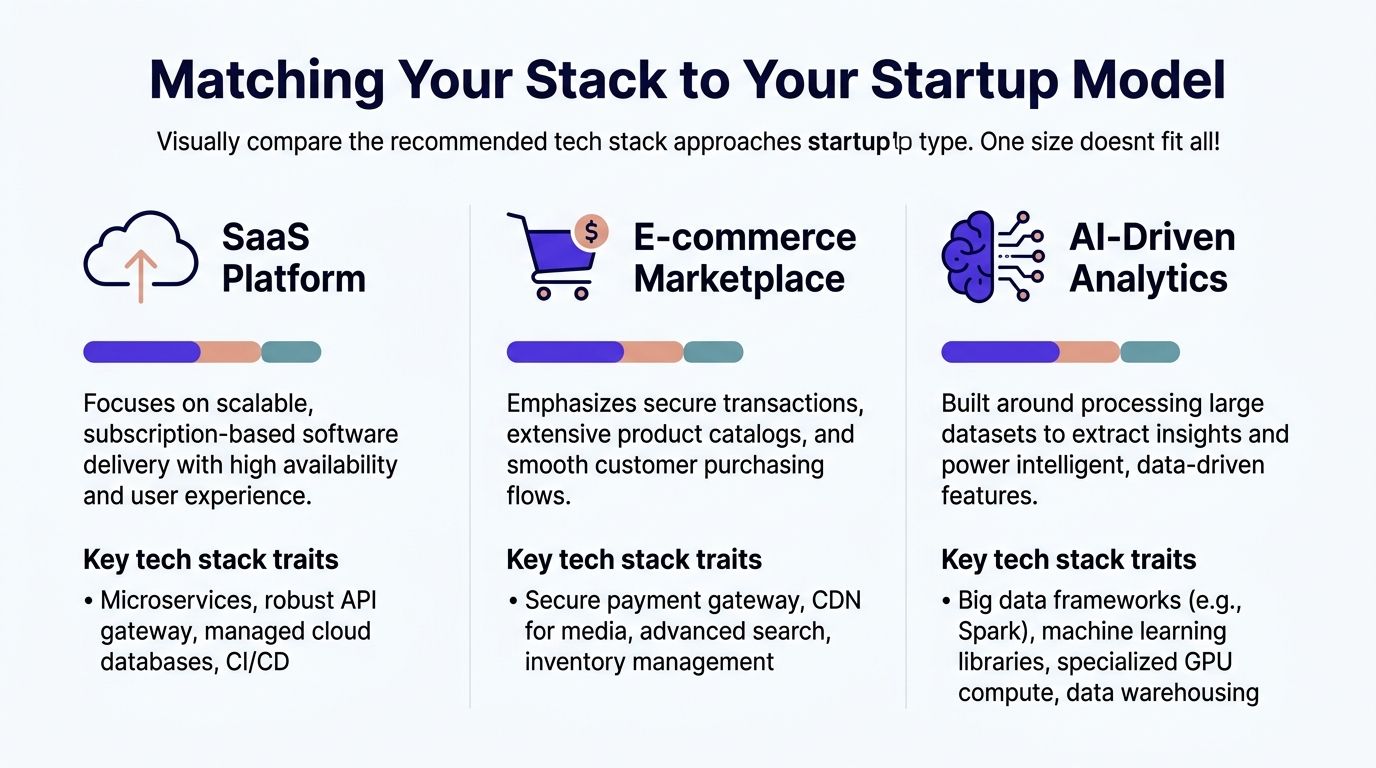
Your stack should match the way the company makes money, the way the product creates complexity, and the way investors will assess technical risk. A B2B SaaS company, a consumer app, a marketplace, and an AI product should not make the same architectural bets at the same stage.
B2B multi-tenant SaaS
I tell founders to stay disciplined here.
For most early B2B SaaS companies, start with React or Next.js on the frontend, Node.js or Python on the backend, and PostgreSQL as the system of record. Deploy on simple managed infrastructure early if it helps the team ship faster, then add more operational control as enterprise requirements show up. If you need help setting that up cleanly, a DevOps as a service partner can keep delivery tight without forcing premature platform complexity.
PostgreSQL is the right default because it handles transactional workloads well, supports mature access controls, and gives you a credible path from MVP to enterprise accounts. Features like row-level security in PostgreSQL matter for multi-tenant products because customer data separation has to be designed into the application, not patched in later.
Investors read this stack as disciplined. Buyers read it as low drama. Engineers read it as hireable.
Consumer apps
Consumer products win on speed of learning.
Use React or Next.js for web, and go native on mobile if product experience depends on performance, platform behavior, or polished interaction design. On the backend, Node.js or Python is usually enough. The wrong move is building distributed systems before you have retention.
Start with a monolith. Keep analytics, experimentation, and release velocity tight. Your valuation upside comes from traction and engagement, not from showing off architecture.
Transactional marketplaces
Marketplaces create operational complexity early. You are not just building screens and APIs. You are coordinating supply, demand, trust, payments, exceptions, and bad behavior.
A practical starting point looks like this:
-
Frontend: React or Next.js
-
Backend: Node.js or Python
-
Database: PostgreSQL
-
Caching: Redis
-
Search, queues, and event-driven components: Add them only after real product pressure appears
Founders also get pulled into expensive side quests here. Payments, identity, messaging, notifications, and workflow automation can consume months if you build everything yourself. That is why sharp founders make selective buy decisions. For communication-heavy products, this guide on build vs. buy decisions for agent email is a useful example of how to evaluate the tradeoff.
AI-enabled products
AI products need a stack that separates product value from model dependency.
Use React or Next.js plus Node.js or Python for the application layer. Keep PostgreSQL as the relational source of truth. Add retrieval, vector storage, model routing, and evaluation systems only if AI is central to the product, not just a feature bolted onto an ordinary workflow.
The key decision is architectural control. If the product breaks every time a model changes, pricing shifts, or latency spikes, you do not have an AI company with defensible technical value. You have a thin wrapper with margin risk.
Evolve on purpose
Strong startups do not start with sprawl. They start with a coherent core, then expand only when the business model demands it.
Airbnb is a useful example of that progression. It began on Ruby on Rails to ship quickly, then described how its frontend architecture evolved as the product and organization grew in Airbnb Engineering posts on its early Rails stack and its move toward a unified web framework. Netflix followed a similar pattern of deliberate evolution, building around Java-based services and then expanding its platform as streaming scale and operational demands increased, which the company has documented across the Netflix TechBlog.
The lesson is simple. Choose a stack that fits the company you are building now, with a clear path to the company you intend to become. That is how you protect speed today without discounting valuation later.
How Do You Architect for Due Diligence and Investor Confidence?
Most startup tech stack advice stops at frameworks. That is not enough.
Investors do not just inspect what you built with. They inspect how you built it. A strong set of tools implemented carelessly still fails technical diligence. An ordinary set of tools implemented with discipline often passes.
Audit-ready engineering starts early
Founders assume compliance and hardening belong after product-market fit. That is backwards for any company with serious growth intent.
An important but underserved angle is production-grade security and compliance from MVP inception. Non-compliance derails 30-40% of early-stage startups during investor due diligence, and startups that ignore this face 2-3x higher refactoring costs post-Series A (Hirefraction).
That is why “we’ll clean it up later” is a dangerous sentence. Later is when the company is fundraising, signing larger customers, or replacing unstable systems under pressure.
What investors want to see
They want evidence that engineering is managed, not improvised.
A credible setup usually includes:
-
CI/CD pipelines so releases are repeatable
-
Automated testing so core flows do not break unexpectedly
-
Environment separation between development, staging, and production
-
Documentation for architecture, decisions, and key workflows
-
Access control for team members and systems
-
Security hardening around secrets, auth, and data handling
None of that is glamorous. All of it affects valuation because it lowers execution risk.
Compliance is part of product strategy
If you plan to sell into regulated markets or operate across regions, your infrastructure and data model need to support that reality from the start. Rules like NCA, PDPL, and GDPR do not care that your team is small.
A founder should ask:
-
Can we prove who accessed what
-
Can we isolate tenant data cleanly
-
Can we deploy and roll back safely
-
Can we explain our architecture to a third-party reviewer
If the answer is no, the issue is not legal paperwork. The issue is architecture quality.
For startups that need help operationalizing this, DevOps as a service is one model for putting release discipline, environment management, and security hardening in place without building a full internal platform team too early.
Investor confidence comes from visible engineering discipline. Not from a flashy framework choice.
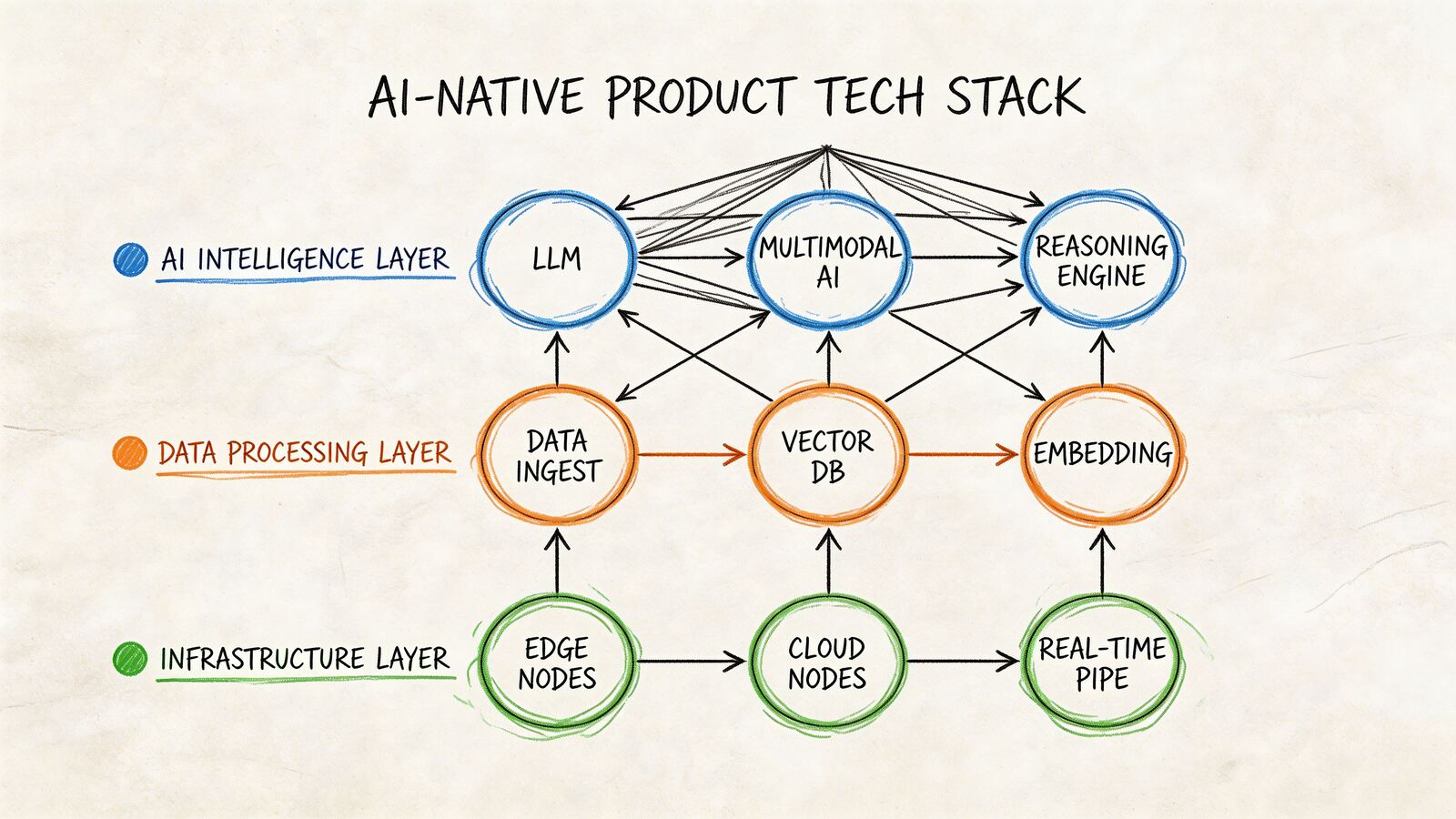
How Do You Build Your Stack for an AI-Native Product?
An AI-native product needs more than an API wrapper and a polished chat box.
The moment your product makes decisions, generates answers, or retrieves business-critical knowledge, architecture quality becomes the product. If the system is unreliable, users do not blame the model. They blame your company.
RAG should be the default pattern for serious AI products
If your product answers questions using company data, customer records, documentation, research, or proprietary content, Retrieval-Augmented Generation (RAG) should be the starting point.
RAG reduces LLM hallucination rates from a typical 20-30% to under 5% by grounding outputs in external knowledge. It uses vector databases such as Pinecone and embedding models that can achieve 85-95% retrieval accuracy on standard datasets (Codebridge).
That is a massive product difference. It changes the user experience from “interesting but unreliable” to “useful enough to trust.”
What the AI stack needs
A founder building an AI-native application should think in layers.
Application layer
This is still your normal product surface. React or Next.js for the frontend. Node.js or Python for APIs and orchestration. Authentication. Billing. User roles. Core workflow logic.
Do not let the AI components distort basic product engineering. The app needs ordinary software discipline.
Knowledge layer
This includes:
-
Document ingestion
-
Embedding generation
-
Chunking and indexing
-
Vector storage
-
Retrieval logic
If this layer is sloppy, the model will produce polished nonsense. Most “AI quality” complaints stem from data pipeline issues.
Intelligence layer
Prompts, model calls, tool use, and response assembly live in this layer.
The winning products do not call a model. They control context carefully. They constrain output where needed. They decide when retrieval is required and when it is not.
Build for traceability, not just output
A founder should be able to answer four questions about any AI response:
-
What information was retrieved
-
Why that information was selected
-
Which model generated the response
-
How quality is evaluated over time
If your team cannot answer those questions, you do not yet have a production AI system. You have a demo.
A practical AI-native default
For many early AI startups, a sound setup looks like this:
Layer
Recommended approach
User experience
React or Next.js
Application backend
Python or Node.js
System of record
PostgreSQL
Retrieval layer
Vector database plus document pipeline
Model orchestration
Controlled prompts and structured workflows
Quality control
Evaluations, logging, and retrieval inspection
Advice I give founders often: Treat data quality and retrieval logic as part of the product, not as plumbing behind the product.
That mindset creates defensibility. Anyone can rent model access. Fewer teams can build trustworthy AI behavior around proprietary workflows and clean retrieval systems.
Your Next Steps with a Strategic Technical Partner
A founder usually feels the cost of stack decisions at the worst possible moment. The product is gaining traction, an enterprise buyer asks hard security questions, or an investor starts technical diligence. What looked like a fast MVP now reads like avoidable risk.
That is the point of treating your stack as a financial asset, not a developer preference. Every early architecture decision affects speed, hiring cost, auditability, and buyer confidence. Those factors shape valuation.
What founders should do next
Start with the business case, then force the technical plan to support it.
Ask:
-
What are we building
-
Who are we selling to
-
What must this product support over the next stage of growth
-
Which diligence questions are likely to come up
-
Which parts of the stack create advantage, and which should stay boring
Those answers cut through framework debates fast. They also prevent a common founder mistake. Teams often overinvest in fashionable tools and underinvest in the systems investors care about, clear architecture, predictable delivery, clean data boundaries, and evidence that the product can scale without a rewrite.
Where a fractional CTO changes the outcome
Early-stage companies rarely need a full-time CTO on day one. They do need senior technical judgment tied to business outcomes.
A strong fractional CTO turns stack selection into an operating plan. That includes architecture, hiring sequence, vendor choices, delivery standards, security posture, and the technical narrative you will eventually present in diligence.
The right fractional CTO will:
-
Run discovery before code starts
-
Set stack defaults that fit the company model
-
Define what should be built versus bought
-
Shape the MVP into an asset an investor can evaluate
-
Install engineering discipline early
-
Prepare the company for diligence and scale
That work raises the quality of every later decision. It protects burn. It also improves investor perception because the company looks intentional, not improvised.
What a good engagement looks like
A serious technical partnership follows a clear sequence.
Discovery and product design
Define the business model, user flows, compliance exposure, data structure, and launch priorities. Good discovery prevents expensive rework and keeps the architecture tied to revenue goals.
MVP architecture
Choose the startup tech stack deliberately. Set boundaries for environments, authentication, data ownership, deployment, and the likely path from MVP to a production system that can survive diligence.
Build and release discipline
Put testing, CI/CD, documentation, and monitoring in place early. A founder should be able to explain how code reaches production, who approves changes, and how the team catches failures before customers do.
Team planning
Decide what stays with a partner, what moves in-house, and which hires come next. That keeps the org chart aligned with the product roadmap and avoids costly hiring before the system architecture is stable.
A founder does not need to become an engineer. A founder needs to make sure the company is building technical assets that strengthen enterprise value.
Want a starting point before that conversation? Our free Tech Stack Recommender walks through your product type, priorities, and team setup to suggest a baseline infrastructure, frontend, and backend.
If you are making early architecture decisions and want senior technical guidance before you lock yourself into the wrong path, Buttercloud works with founders from discovery through investor-ready MVPs, fractional CTO oversight, and audit-ready infrastructure planning.
Have a product idea to talk through?
We'll show you how we'd approach it — no pressure, just a real conversation.
Book a Discovery Call