Web Application Development: A Founder's Guide

Founder & CEO, Buttercloud
Let’s be direct. Stop viewing web application development as a line item expense. It is not a cost center.
For a founder, this is the engineering of your company’s single most valuable asset. You aren’t just building an app; you are architecting a technical moat—an investable asset designed to pass rigorous venture capital due diligence and command a higher valuation.
Building Your Technical Moat from Day One
The founder’s journey from a napkin sketch to a market-leading product is a marathon, not a sprint. Many fall into the trap of the traditional outsourcing model, treating development as a transaction: you provide specifications, and a black-box firm delivers code.
For any high-growth startup, this model is a strategic failure. It fundamentally misunderstands the objective. Your codebase is not a deliverable; it is an investable asset that must appreciate in value.
A well-architected web application is the foundation of your company’s future. It must be engineered from day one to be “audit-ready,” meaning it is robust enough to withstand the intense technical scrutiny that precedes any serious funding round or acquisition.
This approach is about eliminating technical debt at its root, ensuring your technology does not become a liability that requires a painful, expensive rewrite a year or two down the line.
At Buttercloud, we guide founders through a precise lifecycle: Idea → Investor-Ready MVP → Scalable Product. Consider us a “Mentor-Architect,” helping you transform your vision into a high-valuation technical asset.
Achieving this requires a mental shift. Every technical decision, from architectural patterns to infrastructure security, must align with your long-term business objectives.
This guide will pull back the curtain on that process. We will break down:
-
The Founder’s Journey: How to map the transition from idea to blueprint, build an MVP that attracts investors, and prepare for scale.
-
Strategic Decisions: Choosing the right tech stack and architecture—the decisions that directly impact your velocity, costs, and ability to innovate.
-
Operational Excellence: Using boutique DevOps and security to ensure your product remains stable, secure, and ready for audit.
-
Partnership Models: How to select a true engineering partner—not just a vendor—who can provide strategic leadership for your roadmap and tech team hiring.
This is not a guide about web development. It is about building a durable competitive advantage and a company engineered for longevity.
Let’s begin engineering your moat.
Mapping Your Journey Through the Development Lifecycle
Turning an idea into an investable company does not happen by accident. It is a deliberate journey, and like any journey, it requires a map. Founders who understand this sidestep expensive errors and build valuable assets, not just projects.
Think of it as a methodical progression from a raw concept to a resilient, scalable product. This roadmap ensures your vision becomes a functional, investable technical asset built for the long term.
This is the path we follow to engineer a startup idea into a scalable technical asset.
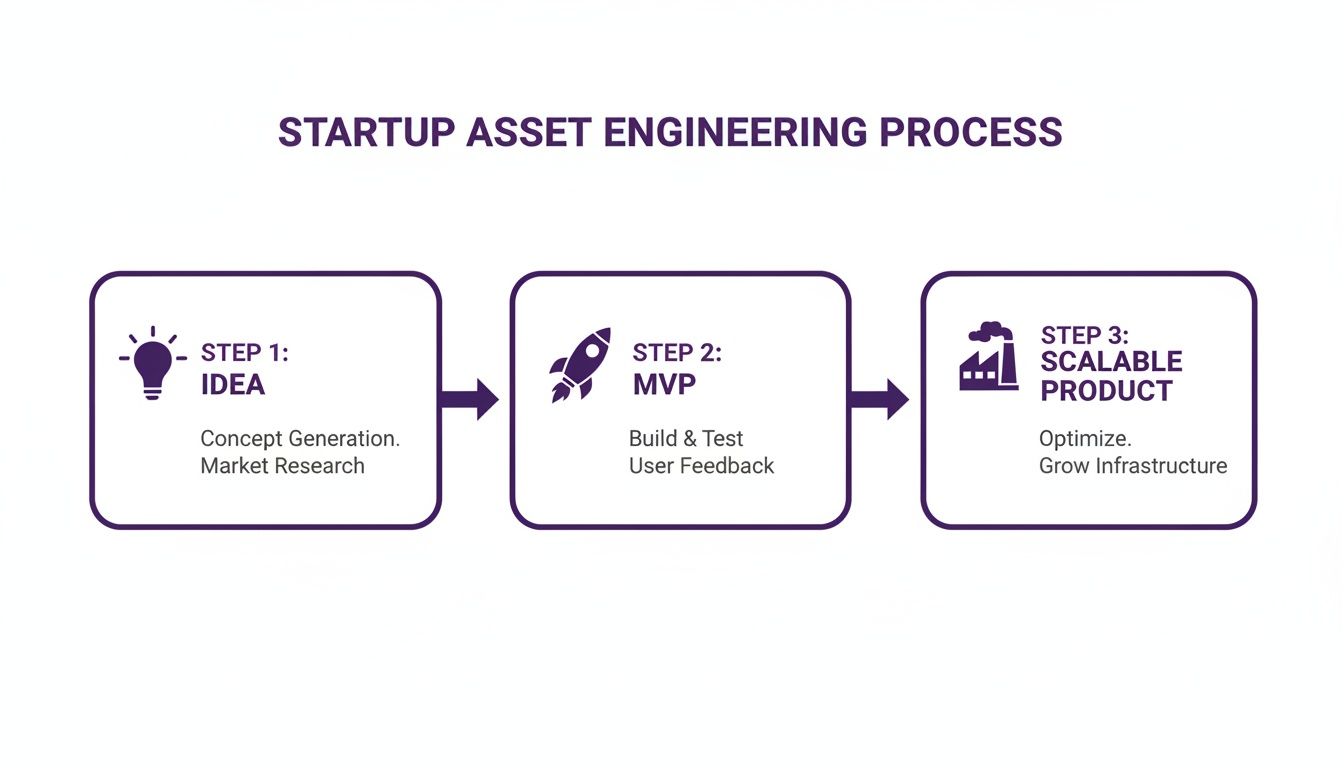
Each stage builds upon the last, creating value that compounds over time. Let’s break it down.
Phase 1: Product Design and Discovery
Before a single line of code is written, a blueprint is required. This is the Product Design and Discovery phase, where your idea is refined and mapped into a concrete, user-centric plan that defines its competitive advantage.
This is more than creating mockups. It is about defining the core of your product and its market differentiation.
Key activities in this phase include:
-
User Persona & Journey Mapping: Gaining a precise understanding of your target user, their pain points, and how your application delivers a superior solution.
-
Feature Prioritization: This is critical. We separate the absolute must-have features for your Minimum Viable Product (MVP) from secondary “nice-to-haves” to maintain scope and budget discipline.
-
Technical Architecture & Feasibility: A high-level assessment of the technology required to execute the vision. This ensures the plan is both ambitious and technically viable.
This upfront diligence mitigates the primary risk for startups: building a product nobody wants. It ensures your product is not only technically sound but also commercially viable.
Phase 2: Investor-Ready MVP Development
Now, we build. The MVP is where your blueprint becomes a tangible asset that users can interact with. A critical distinction must be made here. Too many founders are sold on building a quick-and-dirty prototype that must be discarded later—a strategic error that creates a deep well of technical debt.
An investor-ready MVP is fundamentally different from a prototype. It is the foundation of a skyscraper, not a temporary structure. The code is architected to scale, pass technical due diligence, and serve as the core of your future product.
When building an MVP as an investable asset, the focus is on:
-
Clean, Maintainable Code: This means writing well-documented code that is easy for a future engineering team to inherit and build upon. It’s building for longevity, not just for launch.
-
Scalable Architecture: We choose a foundation engineered for growth, so you do not face a complete, costly rewrite as soon as you gain traction.
-
Automated Testing: Tests are integrated from the beginning to ensure the application remains stable and reliable as new features are added.
With this approach, your MVP launch is not a finish line—it is the starting block for a scalable business. The initial investment in elite engineering pays dividends by accelerating future development and increasing your company’s valuation.
Phase 3: Scaling & Infrastructure
Your MVP is live and has demonstrated market demand. The game now shifts to scaling. This phase is about preparing your web application to handle increased users, traffic, and features without compromising performance or security.
We are transitioning from a controlled launch to a robust, production-grade system. This transition is fueled by a massive global workforce—developers are expected to produce a staggering 256 billion lines of code in 2024 alone. You can find more on the latest web development trends at Hostinger.com.
To prepare for this growth, we implement boutique DevOps and managed infrastructure. These are not afterthoughts; they are essential for stability and earning trust with users and investors.
-
Boutique DevOps: Think of this as creating automated pipelines (CI/CD) for testing and deploying code. It allows for rapid, reliable feature releases without system downtime.
-
Managed Infrastructure: We establish a cloud environment that automatically scales to meet traffic demands, ensuring high performance without paying for unused capacity.
-
Audit-Ready Security: This involves hardening your application against threats, protecting user data, and preparing for the security audits that serious investors or enterprise clients will require.
This final stage ensures your early success does not become the cause of your failure. A stable, secure, and scalable product is the ultimate technical moat.
Choosing Your Technology Stack and Architecture
Selecting the technology for your web application is a foundational decision that will either enable a smooth trajectory or create future roadblocks. This is not merely about choosing programming languages; it is about laying the architectural groundwork for your entire business.
Your choices here dictate development velocity, scaling costs, and your ability to innovate without requiring a complete teardown.
As a founder, particularly a non-technical one, the objective is not to become a coding expert. It is to understand the strategic trade-offs. You need to be equipped to have intelligent conversations with your engineers and ensure their technical choices align with your business goals.
What Exactly Is a Tech Stack?
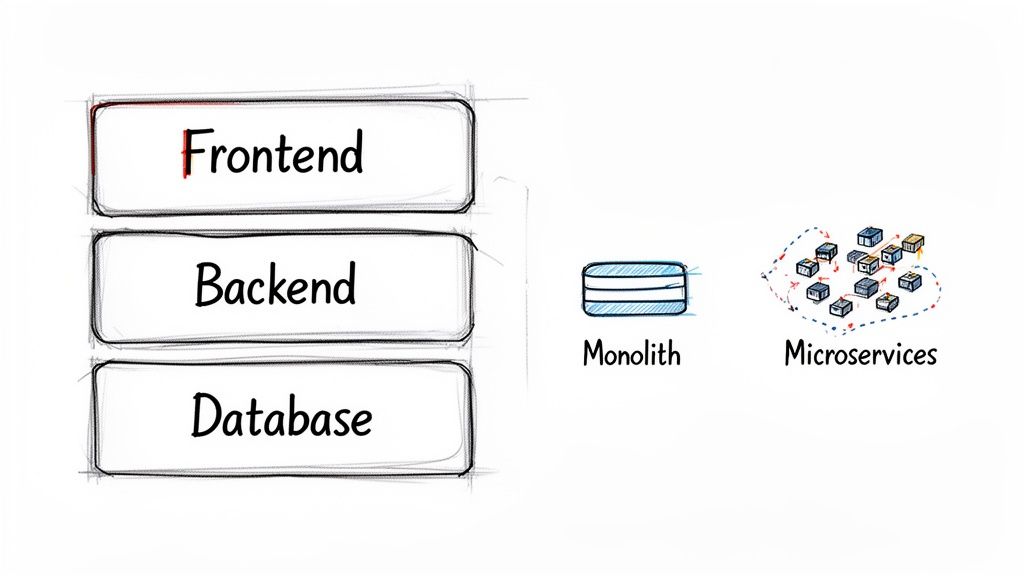
A tech stack is comprised of core layers that must work in concert.
-
Frontend (The User Experience): This is everything your users see and interact with—the interface, the layout, the forms. It is built with technologies like React, used by 43% of developers to create fluid, interactive experiences. This is what makes your app feel intuitive.
-
Backend (The Core Logic): This is the engine under the hood—the server, application logic, and database working in unison. It handles everything from user authentication to processing transactions.
-
Database (The Data Store): This is where all critical information is stored, organized, and retrieved. All user data, product catalogs, and transaction histories reside here. It must be fast, reliable, and secure.
The demand for great web applications is why the market is expected to hit $104.31 billion by 2030. Technologies like JavaScript are the bedrock, with 62.3% of all developers using it. You can dig into more web development statistics at Esparkinfo.com to see the trends for yourself.
Architectural Patterns: Monolith vs. Microservices
Beyond specific tools, you must decide on an architectural pattern. This is your application’s blueprint. The two primary models are the Monolith and Microservices.
A monolith is an all-in-one system, where all components are tightly coupled. Microservices are a collection of small, independent services, each performing a specific function and communicating with the others.
This is a critical business decision, not just an engineering debate. It impacts your team’s structure, release velocity, and long-term maintenance costs. A monolith may accelerate an MVP, but microservices are often the superior choice for a complex platform designed for longevity.
If you’re trying to figure out which path makes sense for your startup, our Tech Stack Recommender tool can give you some tailored guidance.
Strategic Comparison of Web Application Architectures
To make an informed decision, you must understand the real-world trade-offs. This table breaks down what each approach means for your startup, helping you align your tech with your business roadmap.
Factor
Monolithic Architecture (The ‘All-in-One’ Approach)
Microservices Architecture (The ‘Building Blocks’ Approach)
Speed to MVP
Faster. A single codebase enables rapid initial development, ideal for validating an idea.
Slower. Requires more upfront planning and infrastructure to orchestrate inter-service communication.
Scalability
Challenging. The entire application must be scaled, even if only a small component is under heavy load. This is inefficient.
Superior. Individual services can be scaled independently, which is far more efficient and cost-effective.
Technology Flexibility
Limited. You are largely locked into your initial technology choices. Replacing a component can require a major rewrite.
High. Each service can use the optimal tool for its specific job, allowing for the adoption of new, superior technologies over time.
Team Structure
Works well for a small, cohesive team that can manage a single large codebase.
Ideal for larger organizations. Small, autonomous teams can “own” specific services, accelerating development.
Long-Term Maintenance
Can become difficult to manage. A bug in one area can compromise the entire system, making updates risky and slow.
Easier to maintain. Individual services can be updated or replaced without impacting the rest of the application.
Ultimately, this is about future-proofing your business. The right stack and architecture create a “technical moat”—a competitive advantage baked into your product that enables faster innovation and seamless technical due diligence.
Implementing Audit-Ready DevOps and Security
As a founder, it’s tempting to defer concerns like server uptime and security hardening. This is a critical mistake.
When engineering a web application, operations are not a minor detail. They are the foundation that keeps your product online, your user data secure, and your company prepared for the technical due diligence that precedes any serious investment.
This is where boutique DevOps and managed infrastructure come in. Forget the buzzwords. This is your strategic playbook for building a stable, automated, and secure foundation for growth from day one.
DevOps for Startups Explained
At its core, DevOps closes the gap between product development (Dev) and reliable operation (Ops). For a startup, this means automation that enables rapid feature delivery without compromising stability.
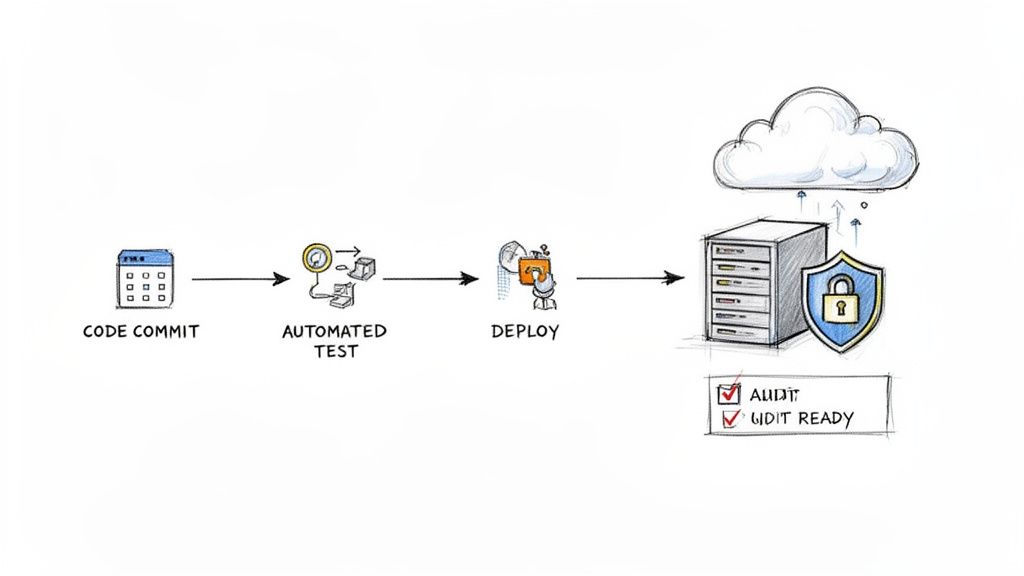
The heart of this process is the CI/CD pipeline (Continuous Integration/Continuous Deployment).
Think of it as an automated assembly line for code. When a developer commits a change, the pipeline initiates automatically. It runs tests, scans for security vulnerabilities, and, upon passing all checks, deploys the update to users. This synthesis of velocity and reliability is a powerful competitive advantage.
Why does this matter?
-
Accelerate Feature Delivery: You can release updates and fix bugs multiple times a day, not just monthly. This allows you to respond immediately to user feedback.
-
Enhance Stability: Automated testing identifies issues long before they reach customers, resulting in fewer crashes and improved uptime.
-
Scale Efficiently: A smart pipeline integrates with your cloud infrastructure (like AWS or Google Cloud) to manage resources dynamically, so you only pay for what you use.
We dive deeper into how this kind of automation creates a truly resilient technical asset in our guide on DevOps as a Service for startups.
Building an Audit-Ready Security Posture
In the startup world, being “audit-ready” means your engineering practices are so clean and well-documented that they can withstand the intense scrutiny of VCs or an acquirer. Security is a massive piece of this. You are not just protecting data; you are building trust.
Being ‘audit-ready’ from day one isn’t a nice-to-have; it’s a core strategy for increasing company valuation. It demonstrates operational maturity and proves your technical asset is built on a secure, professional foundation, not just a proof-of-concept.
Achieving this requires more than just a firewall. It means integrating security into every step of your development process, a practice known as DevSecOps.
This is what that looks like in practice:
-
Automated Security Scanning: We integrate tools directly into the CI/CD pipeline to scan your code for known vulnerabilities before deployment.
-
Infrastructure Hardening: This involves configuring cloud servers and databases to adhere to the “principle of least privilege,” ensuring each component has only the minimum access necessary.
-
Data Encryption: All sensitive user data must be encrypted, both when stored (at rest) and when being transmitted (in transit).
-
Regular Audits and Pen Testing: Proactively engaging external experts to attempt to breach your system identifies weaknesses before malicious actors do.
A holistic approach to integrating security is non-negotiable. You can get the full rundown in this excellent guide to Security for DevOps. By making your web application audit-ready from the start, you transform your technology from a potential liability into a verified asset that accelerates funding and growth.
Understanding Web Application Development Costs and Timelines
Inevitably, every founder arrives at two questions: “How much will this cost?” and “How long will it take?” The only honest answer is, “it depends.” A true engineering partner, however, should be able to deconstruct what it depends on.
Forget generic price lists. You must understand the drivers behind the cost. The investment required to build a web application is a direct function of time and complexity. A simple marketing website is one thing. An investor-ready, scalable technical asset is another matter entirely.
The Key Drivers of Cost and Timeline
Think of building your application like commissioning a high-performance vehicle, not buying a standard car. Both are vehicles, but the engineering, materials, and specialized talent for the former are in a different class. Your web application is the same.
A few core variables drive the real investment:
-
Feature Complexity: A basic user login is straightforward. Real-time chat, complex data visualizations, or an AI-powered recommendation engine add significant engineering hours.
-
Technology Choices: A microservices architecture requires more upfront planning than a monolith. This initial investment, however, often pays significant dividends in long-term scalability and flexibility.
-
Team Structure and Expertise: A senior engineering team commands a higher rate. However, they build faster, write cleaner code, and prevent the expensive refactoring that often follows projects led by junior developers.
-
Security & Compliance Requirements: Building a HIPAA compliant application or one that must pass stringent security audits requires specialized, meticulous work that adds to the project’s scope.
A cheap MVP is the most expensive mistake a founder can make. A “throwaway” prototype built in weeks may feel like progress, but it is a dead end. The moment you need to scale or pass investor due diligence, you face a complete and costly rewrite.
Investing in quality engineering from day one is not a luxury. It is a strategic imperative to prevent catastrophic technical debt and protect your company’s valuation.
Budgeting for an Investor-Ready MVP
Let’s move from the abstract to the concrete. To aid your financial planning, we can provide illustrative cost ranges. These are not quotes; they are strategic guideposts. The final number is always determined after a detailed discovery phase translates your vision into a precise technical blueprint.
The table below offers a high-level view of potential investment ranges for building a production-grade, investor-ready MVP. This is not a prototype; it is an asset engineered for scalability, security, and due diligence from the start.
Illustrative MVP Development Cost Tiers
MVP Tier
Typical Scope
Estimated Cost Range
Tier 1: Core MVP
Single-user role, core CRUD functionality (Create, Read, Update, Delete), basic user authentication, and a simple administrative dashboard.
$75,000 - $150,000
Tier 2: Advanced MVP
Multiple user roles with different permissions, third-party API integrations (e.g., payments, maps), and more complex business logic.
$150,000 - $300,000
Tier 3: Platform MVP
Real-time features (e.g., chat, notifications), advanced data processing or analytics, and a multi-tenant architecture for a SaaS product.
$300,000+
Selecting the right tier is not just about affordability. It is about aligning your initial product scope with your market validation strategy. The goal is to build the leanest version of your product that delivers its core value proposition, validates your business model, and provides a rock-solid foundation for future growth.
Finding the Right Technical Partner
This decision is one of the most critical you will make as a founder. Your choice of engineering partner will directly impact your timeline, budget, code quality, and ultimately, your company’s valuation.
This is not about hiring a vendor. It is about selecting a strategic ally for a high-stakes journey.
You will encounter two distinct types of firms. First, the mass-market outsourcing agencies—the “black box” model. You submit requirements, and code is returned later. It is an opaque, transactional model that treats the founder as a client to be served, not a partner to be mentored.
The alternative is the high-touch, boutique partnership: the “anti-outsourcing” model. It is built on transparency, education, and a shared focus on engineering a high-valuation technical asset. Instead of a project manager, you gain a “Mentor-Architect” who guides you through critical decisions and ensures every line of code serves your business goals.
The real difference isn’t just the quality of the code; it’s the quality of the partnership. A true partner invests in your understanding, empowering you to make smarter strategic calls about your product and your business.
From Vendor to Mentor-Architect
When evaluating a potential partner, look beyond their portfolio and examine their philosophy. Do they speak of building “investor-ready code”? Do they have a clear mission to eliminate technical debt at its source?
These are not marketing terms. They are signals that a firm understands the founder’s journey and the pressure of venture capital due diligence.
Look for a partner that prioritizes:
-
Mentorship Over Service: They should be eager to teach you the “why” behind their technical decisions, not just deliver the “what.”
-
Production-Grade Portfolio: Do not be distracted by attractive UIs. Ask to see the real, scalable applications they have built and guided through significant growth.
-
A Clear Philosophy on Technical Debt: They must be able to articulate how they prevent it and why a greater upfront investment in quality engineering is critical for your long-term valuation.
The Role of the Fractional CTO
For many founders, especially those from non-technical backgrounds, a Fractional CTO is a game-changer. This is a senior technical leader who joins your team part-time to provide the executive-level strategic guidance you need.
They do not just oversee code; they help you architect the entire technical function of your business, from your product roadmap to tech team hiring.
This strategic leadership is more crucial than ever. The low-code/no-code market, already valued at $28.75 billion in 2024, is projected to reach $264 billion by 2032. While this creates opportunities for rapid prototyping, it also introduces complexity.
A Fractional CTO provides the sophisticated leadership required to decide when to leverage a low-code tool versus when to invest in custom engineering to build a durable competitive advantage. You can dig into these market dynamics in this IBM report on application development trends.
A great Fractional CTO is your guide. They build your technical roadmap, mentor your team, and ensure you are always audit-ready for your next funding round. This transforms web application development from a cost center into a strategic, value-creating engine.
A Founder’s FAQ on Web App Development
When beginning the journey of building a product, many questions arise. Securing direct, business-focused answers is what separates a smooth launch from a turbulent one.
Let’s address the most common questions we hear from founders, with a focus on what drives company value.
What’s the Real Difference Between a Website and a Web App?
A website is a digital brochure. It is primarily presentational—displaying static information.
A web application is a tool. It is interactive. Users log in, perform actions, manipulate data, and solve problems. It is the engine of your business. A simple marketing site is a website; a platform like Salesforce is a web application.
For a founder, this distinction is paramount. The web app is your product—the functional, high-valuation technical asset at the core of your company.
How Long Does It Actually Take to Build an Investor-Ready MVP?
A properly engineered, investor-ready MVP will typically take 3 to 6 months to build.
This timeline depends on the complexity of your concept and the maturity of your product design. A simple prototype can be assembled in weeks, but this is often a throwaway experiment.
An MVP built to be a scalable, audit-ready asset requires meticulous planning, automated testing, and a secure foundation from the start. The objective is not just speed; it is speed without accruing technical debt that will cost you far more in the future.
Should We Build a Web App or a Native Mobile App First?
For the vast majority of startups, beginning with a web application is the most strategic first move.
Why? It is platform-agnostic. Anyone with a web browser on any device can access it, providing the widest possible audience for initial market validation.
This approach results in faster development and a lower initial investment. Once you have achieved product-market fit, you can strategically invest in native mobile apps for a premium, device-specific experience.
What Is Technical Debt and Why Should I Lose Sleep Over It?
Technical debt is the future cost incurred by taking shortcuts today. It is the rework necessitated by choosing a quick, easy fix over the correct, more robust solution.
Like financial debt, it quietly accrues “interest,” making every new feature slower and more expensive to build, and increasing the likelihood of bugs.
As a founder, this must be a primary concern. High technical debt can halt your ability to scale, deter investors during due diligence, and severely depress your company’s valuation. It is the silent factor that can turn your most valuable asset into your greatest liability.
Ready to turn your idea into a high-valuation technical asset? Buttercloud is the boutique engineering partner that guides founders through the entire lifecycle, from an investor-ready MVP to a scalable product. Let’s start engineering your technical moat. Schedule a consultation with us today.
Have a product idea to talk through?
We'll show you how we'd approach it — no pressure, just a real conversation.
Book a Discovery Call