What App Development Cost Calculators Miss

Founder & CEO, Buttercloud

An app development cost calculator might spit out a number in seconds, but those tools mislead serious startup founders. The real investment to engineer an investor-ready MVP—one that passes technical due diligence and increases your company’s valuation—is a strategic decision, typically landing in the $30,000 to $75,000+ range for elite-quality engineering.
Why Do Online Cost Calculators Mislead Founders?
Let’s be direct: those generic app development cost calculators are marketing tools, not financial planning instruments for a high-growth startup. They’re designed to give you a quick, feel-good number by boiling a complex engineering project down to a simplistic web form.
The number they generate completely ignores the very things that create a high-valuation technical asset. We’re talking about the non-negotiables for any founder seeking venture capital.
A cheap prototype might get your idea onto a screen, but an investor-ready MVP gets you through technical due diligence. The difference is the chasm between a hobby project and a scalable, high-valuation business.
This distinction is everything. A real budget isn’t born from automated guesswork; it’s forged through strategic conversations and a deep Product Design & Discovery process, guided by senior architects.
The Illusion of Simplicity
These calculators work by assigning arbitrary price tags to a checklist of features. You’ll see things like “User Login,” “Push Notifications,” and “Admin Panel,” but this approach is dangerously simplistic and lacks all critical context.
-
It Ignores Architecture: The estimate has no concept of whether the code is scalable, secure, or built to handle growth. It’s just a feature list.
-
It Overlooks Quality: There’s no checkbox for audit-ready engineering—the kind that survives the intense scrutiny of VC technical due diligence and increases company valuation.
-
It Neglects Strategic Depth: A calculator can’t factor in the user-centric design that gives you a competitive advantage or a backend engineered as a defensible barrier to entry.
This is precisely why we champion the anti-outsourcing model at Buttercloud. We provide a transparent, high-touch partnership where the founder is mentored, not just “served.” The goal isn’t just to build an app; it’s to engineer a high-valuation technical asset from day one.
A quick calculator quote might feel like a win, but it sets you up with a flimsy foundation. An investor-ready budget, on the other hand, accounts for the real-world factors that make a product valuable and defensible.
This table breaks down the massive gap between a generic online quote and the reality of planning for a fundable MVP.
Online Calculator Estimate vs Investor-Ready MVP Budget
Factor
Online Calculator Output
Investor-Ready Reality
Foundation
A simple feature checklist.
A strategic roadmap mapping business goals to a technical plan.
Engineering Quality
Assumes basic, functional code.
Requires audit-ready engineering built for scalability and security.
User Experience (UX)
Treats UX as just another feature.
Involves deep research and user-centric design to define a competitive advantage.
Backend Strategy
A generic backend with no strategic depth.
A backend engineered as a lasting competitive edge that protects your business.
Strategic Oversight
None. It’s an automated form.
Guided by a senior architect or Fractional CTO from day one.
True Cost
A lowball number that ignores hidden costs.
A comprehensive budget covering discovery, design, engineering, and testing.
As you can see, the calculator’s output is just a surface-level guess. An investor-ready budget is a comprehensive plan for building a durable business asset.
From Guesswork to a Real Budget
Think about it this way: even official tools for complex services, like an Azure Virtual Machine Pricing Calculator, require a deep understanding of the platform to produce an accurate forecast. An app, with its countless variables in design, engineering, and strategy, is infinitely more complex.
Building a true budget for your MVP is a bespoke process. It requires the guidance of a senior architect or a Fractional CTO who can translate your business goals into a concrete technical roadmap. This is how you move from a vague idea to a fundable plan.
It’s about boutique precision—focusing on quality over volume, acting as a senior technical partner for a select group of founders.
What Are the Core Cost Drivers of Your App?
So, you’ve plugged your big idea into an app development cost calculator and got a number. Is that your budget? Not even close.
To arrive at a real number, you have to stop thinking about a simple feature checklist and start thinking like a CTO. A real project budget isn’t just a list of features; it’s a web of strategic decisions. Every choice you make creates a ripple effect, impacting not just the final price tag, but the performance and long-term value of your app.
Getting a handle on these core drivers is your first real step toward building a financial plan for an investor-ready MVP. It’s the language of strategic product building.
This infographic breaks down the difference between what a calculator sees and what a real engineering budget actually includes.
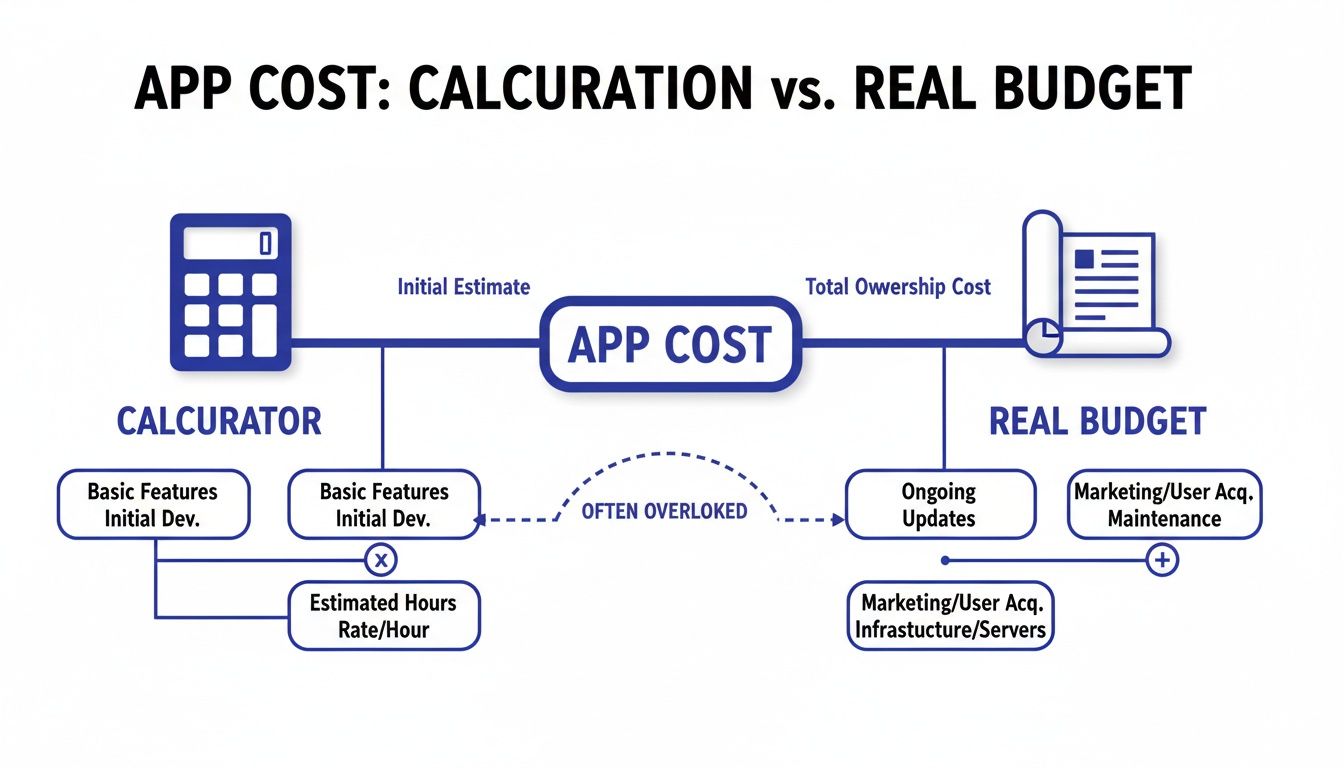
The key takeaway? A calculator spits out a price for features. A real budget accounts for the deep engineering and strategic work that makes those features valuable and scalable.
Platform Choice and Its Strategic Trade-Offs
One of the first, and biggest, decisions you’ll make is your platform. This isn’t just a techy detail—it’s a core business strategy that directly shapes your user acquisition, performance, and long-term maintenance costs.
-
Native iOS & Android: This is the top-shelf approach, delivering elite performance, full access to device hardware, and a flawless user experience. If you’re building a flagship product where speed and polish are non-negotiable, this is your path. It’s the cornerstone of native app development. The trade-off? You’re maintaining two separate codebases, which means a higher upfront investment.
-
Cross-Platform (e.g., React Native): This lets you build for both iOS and Android from a single codebase, which can significantly reduce initial development time and cost. It’s a fantastic strategy for many MVPs, but it can come with performance quirks and dependencies. You need an expert architect to navigate these potential hurdles.
-
Web App (PWA): A Progressive Web App gives you the widest reach, since it’s accessible through a browser on any device. It’s the quickest and most cost-effective way to get an idea out there and validate it. The catch is you sacrifice the deep integration and snappy performance of a native app.
Your choice here dictates the kind of engineering talent you need and fundamentally sets the bar for your product’s user experience. A Fractional CTO can be invaluable in ensuring this decision aligns with your business longevity, not just your initial budget.
Feature Complexity: The Difference Between Functional and Formidable
An online calculator sees “user login” and assigns it a flat cost. A senior architect, on the other hand, sees a whole spectrum of possibilities with wildly different price tags. This is exactly where most founders get their budget wrong.
A feature’s true cost is determined by its depth, security, and scalability—not its name on a list. A simple login is a prototype feature; a multi-factor authentication system integrated with social logins and built to enterprise security standards is an investable asset.
Think about the difference between these:
-
Static vs. Dynamic Profiles: Is a user profile just a page showing a name and email? Or is it a dynamic dashboard pulling in real-time data from other services, displaying analytics, and letting users customize their view? The second one is an entirely different engineering challenge.
-
Basic vs. Advanced Search: A simple keyword search is one thing. An intelligent search engine with filters, auto-suggestions, and relevance ranking based on user behavior? That’s a massive engineering effort.
Each layer of complexity adds engineering hours, demands more intense testing, and requires a much more sophisticated backend. This depth is what separates a product that just works from one that builds infrastructure that holds up under real due diligence—a real, defensible advantage baked right into your investor-ready code.
The Foundational Costs That Calculators Ignore
Finally, we get to the foundational pillars that support every single feature but are completely invisible to a calculator. These are the non-negotiables that make your product stable, secure, and ready for an investor’s tough questions.
-
Expert Product Design (UI/UX): This isn’t about making your app “look pretty.” It’s the strategic product design process of mapping user journeys, creating intuitive workflows that define your competitive advantage, and building a design system that makes future development faster. Bad UX is a top reason apps fail. Great UX is a multiplier on engagement and retention.
-
Backend Infrastructure: This is your app’s engine. An investor-ready backend is built for scale from day one. Our boutique DevOps and managed infrastructure ensure it remains stable, secure, and audit-ready as you scale. A cheap, clunky backend will fall apart under pressure and force a costly rewrite down the line.
-
Third-Party API Integrations: Connecting to services for payments (Stripe), communications (Twilio), or mapping (Google Maps) is rarely a simple plug-and-play task. It takes careful engineering to handle authentication, keep data in sync, and manage errors, adding real time and cost to your project.
These core drivers—Platform, Complexity, and Foundation—are exactly what we break down during our Product Design & Discovery track. It’s a high-touch process that turns your vision into a detailed blueprint, giving you the clarity needed to build a true financial roadmap for your startup.
Real-World MVP Cost Breakdowns for Founders
Talking about cost drivers in theory is one thing, but as a founder, you need real numbers to build a financial plan. It’s time to move from abstract ideas to what a realistic investment looks like for common types of startup apps.
This isn’t about hunting for the cheapest price tag. It’s about understanding what it truly costs to engineer a high-quality technical asset that investors will take seriously. Those online cost calculators? They gloss over the details. Let’s pull back the curtain and look at what it actually takes to build an investor-ready MVP, phase by phase.
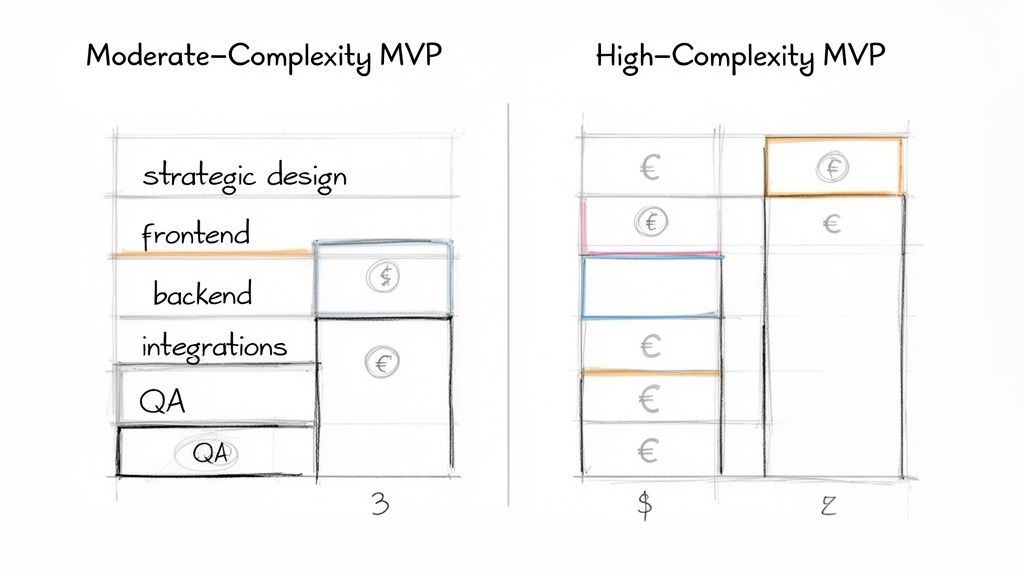
Scenario 1: Moderate-Complexity MVP
Let’s imagine a specialized fitness tracking app. It needs to do more than count steps—it has to offer something unique, connect with health services, and feel amazing to use. This isn’t just a simple prototype; it’s a defensible product built to capture a specific corner of the market.
For a project like this, the budget is a direct investment in quality and future growth. A moderate-complexity app—the sweet spot for most startup founders—typically lands in the $30,000 to $75,000 range and takes about 3-5 months to engineer correctly as part of our MVP Development track.
Let’s look at a real-world example. A fitness MVP we’ve engineered breaks down like this:
-
Custom strategic design: $10,000
-
Cross-platform development (iOS & Android): $38,000
-
Backend and database infrastructure: $12,000
-
Connecting to Apple Health & Google Fit: $5,000
-
Comprehensive testing for a bug-free launch: $5,000
This brought the total investment to $70,000 over 16 weeks. Here’s where that money goes:
-
Product Design & Discovery: This is where we map out user journeys, create wireframes, and build a high-fidelity interactive prototype. It’s about defining the “why” before a single line of code gets written.
-
Frontend Development (React Native): We build the part of the app users see and touch, for both iOS and Android, from one codebase. This includes the custom UI, state management, and hooking everything up to the backend.
-
Backend Engineering: This is the engine. We build the secure and scalable server, database, and API that makes the whole thing work, managing all the user data and business logic.
-
API Integrations: This is the technical plumbing needed to securely connect with external services, like the health data platforms that are crucial for a fitness app.
-
Quality Assurance & Testing: We put the app through its paces with rigorous manual and automated testing across different devices to hunt down and fix bugs, ensuring it’s stable and reliable at launch.
Scenario 2: High-Complexity MVP
Now let’s elevate the discussion. Think about an on-demand service marketplace, like an app connecting homeowners with local plumbers. This is far more complex because you’re managing two completely different types of users (providers and customers), real-time logistics, secure payments, and a trustworthy review system.
An on-demand marketplace isn’t just an app; it’s a multi-sided business ecosystem. The engineering has to support complex interactions, trust mechanisms, and real-time data flow, which is a major technical undertaking.
The investment for this kind of MVP jumps significantly, often falling between $90,000 to $200,000+. That complexity ripples through every single stage of the project.
Here’s a look at where that extra investment goes:
-
Strategic Design: This becomes far more intensive. You’re designing for at least two different user experiences (the provider and the customer), plus a powerful admin panel for you to manage the whole platform.
-
Frontend Development: You’re essentially building two app interfaces in one. Each side has its own unique logic and user flow, which adds considerable work.
-
Backend Engineering: The backend has to do some heavy lifting. We’re talking real-time location tracking, smart matching algorithms, dynamic pricing, and a secure system for splitting payments.
-
Third-Party Integrations: This often means juggling multiple complex APIs for payment gateways like Stripe Connect, mapping services for routing, and communication tools like Twilio for SMS alerts.
-
QA & Security Audits: Testing becomes exponentially more difficult. You have to cover intricate scenarios, payment failures, and edge cases for both user types. A full security audit isn’t optional here; it’s essential for building an investable asset.
These breakdowns show exactly why a one-click app development cost calculator can be so misleading. It can’t grasp the strategic depth, architectural choices, and audit-ready engineering that turn an idea into a valuable asset.
To get a clearer picture of what your specific idea might cost, a real conversation is always the best next step. If you’re curious, you can get a preliminary ballpark figure with our tailored MVP cost estimator.
What Hidden Costs Will No Calculator Mention?
So you plugged your features into an online calculator and got a number. Great. But that number only gets you to launch day. For a serious founder, launch day isn’t the finish line—it’s the starting gate.
The estimate from a calculator stops precisely where your most important long-term costs begin. This is where the conversation has to shift from just building an app to building a real, durable company. Your budget needs to account for the costs that keep your product alive, secure, and valuable long after the first version goes live.
The True Cost of Technical Debt
The single most dangerous hidden cost is technical debt. Think of it as a high-interest loan on your codebase, taken out by opting for cheap, fast, or poorly planned development. A simple calculator has no way to measure this, but it can single-handedly cripple a startup.
Technical debt isn’t some abstract concept for engineers to worry about; it’s a direct drain on your cash flow. It shows up as persistent bugs that frustrate users, slow performance that sends customers to your competitors, and gaping security holes that put your entire business at risk.
Eventually, that debt comes due. We’ve seen it happen more times than we can count: a founder lands a term sheet for their Series A, but the investor’s technical due diligence uncovers a codebase so tangled and fragile that it can’t possibly scale.
The verdict is almost always the same: a complete, and very expensive, rewrite is required before the deal can close. The thousands you thought you “saved” upfront on a cheap build suddenly become a six-figure emergency that puts your funding—and your company—in jeopardy.
Audit-ready engineering isn’t a luxury; it’s an insurance policy against this exact nightmare. It’s about building a technical foundation that acts as an asset, increasing your company’s valuation, not a liability that tanks it. This approach eliminates technical debt at the root.
Ongoing Operational and Maintenance Costs
Once your app is out in the wild, a whole new set of bills start rolling in. These are the non-negotiables for running a professional, reliable service that both users and investors can trust.
A basic calculator doesn’t factor these in, but your budget absolutely must:
-
Server & Infrastructure Hosting: Your app needs a place to live online. This means cloud servers, databases, and file storage. As your user base grows, so do these monthly bills from providers like AWS or Google Cloud.
-
Security Monitoring & Compliance: Keeping user data safe isn’t optional. This involves continuous monitoring for threats, patching vulnerabilities, and staying compliant with regulations like NCA and PDPL. A failure here can lead to massive fines, a total loss of user trust, and ultimately, business failure.
-
Continuous Maintenance: Operating systems get updated. The third-party APIs you rely on will change. New bugs will always be discovered. You need to budget for ongoing maintenance—typically 15-20% of the initial development cost, per year—just to keep the lights on and the app running smoothly.
-
Third-Party Service Fees: Your app will likely depend on other services to function. Costs for payment gateways (Stripe), email providers (SendGrid), or mapping services (Google Maps Platform) scale with usage and become a permanent line item in your operating expenses.
The Cost of Technical Leadership
Finally, who’s making the big-picture decisions to navigate all this? A calculator can’t price leadership, but going without it is one of the most expensive mistakes a founder can make. Without an experienced technical guide, you’re flying blind.
This is where a Fractional CTO provides enormous value. A Fractional CTO isn’t just another developer; they’re a senior partner who aligns your tech strategy with your business goals. They’re the ones who will:
-
Make smart architectural choices to keep technical debt to a minimum.
-
Build a realistic, long-term financial model for your technology.
-
Navigate the tricky worlds of security and compliance to protect your bottom line.
-
Help you prepare for—and pass—rigorous investor due diligence.
Ignoring these hidden costs is a recipe for disaster. An app development cost calculator gives you an answer for building a list of features. A strategic partner helps you build a budget for a company.
Optimizing Your Budget Without Sacrificing Quality
An app development cost calculator will spit out a number, but that’s just the start. A smart founder knows the real game is about getting maximum value, not just the lowest price.
True cost optimization isn’t about a race to the bottom on hourly rates. It’s about making clever trade-offs that protect your product for the long haul. For an MVP you plan to show investors, cheaping out on quality is a fatal mistake you can’t afford to make.
This means you need to rethink “cost-cutting.” Forget slashing the budget. The real goal is to spend your capital with boutique precision, making sure every dollar builds an audit-ready technical asset that will stand up to scrutiny. This is where getting smart about talent sourcing becomes a founder’s secret weapon.
The Myth of the Lowest Hourly Rate
The global talent market is tempting, isn’t it? Why pay a premium for developers in San Francisco when you can find someone overseas for a fraction of the cost? I’ve seen this line of thinking sink startups. It’s a dangerously simplistic view that almost never pans out.
The lowest hourly rate rarely equals the best value, especially when your product needs to pass investor due diligence.
Think about the hidden costs and day-to-day headaches:
-
Communication Overhead: A simple misunderstanding because of a language barrier can easily burn through days of engineering time, forcing you to pay for the same feature twice.
-
Time Zone Friction: When your team is 12 hours ahead, a quick question turns into a 24-hour delay. Do that a few times, and your entire timeline is shot.
-
Quality Control Gaps: Trying to manage code quality, security, and architecture from halfway around the world is a full-time job in itself. Those initial savings get eaten up by the extra oversight you’ll need.
A cheap build almost always leaves you with a tangled mess of technical debt. And that debt always comes due, usually when you’re scrambling to impress investors and need a full, expensive rewrite.
Leveraging Global Talent Strategically
So, instead of chasing the cheapest option, the smart move is to find the sweet spot where quality, communication, and cost all intersect. Finding elite talent in different parts of the world is still a powerful tool for founders, as developer rates vary wildly by region.
Let’s say you’re building an investor-ready MVP with a budget of $75,000. By choosing a top-tier partner in a region like Eastern Europe instead of the US, you could see 30-40% savings without compromising on production-grade quality. You can discover more insights on 2026 development rates at codiant.com to see how the numbers break down.
This data points to a clear middle ground for founders who refuse to settle for anything less than excellence.
The goal isn’t to find the cheapest vendor; it’s to find a strategic partner who delivers elite engineering at a sustainable investment level. This is the essence of the anti-outsourcing model—a high-touch partnership where quality is paramount.
When you partner with a firm that curates world-class talent from these cost-effective regions, you truly get the best of both worlds: audit-ready engineering without the eye-watering price tag of Silicon Valley or the quality gamble of a low-cost firm.
This approach changes your budget from a line item expense into a strategic investment. You end up building a solid technical foundation with high-quality code, all guided by senior architects, within a budget that actually works for a startup. The result? A far superior product and a much stronger story to tell when you walk into that investor meeting.
Building Your Investor-Ready Technical Roadmap
An app development cost calculator gives you a number. A strategic partner gives you a plan. Let’s be direct—the number is a guess, but the plan is what gets you funded.
If you’re a serious founder, it’s time to graduate from automated web forms. The real work begins with a process designed not just to build an app, but to build a high-valuation company.
A reliable cost estimate isn’t where you start. It’s the final output of a deep, collaborative Product Design & Discovery process. This is where we pressure-test your vision, refine it, and translate it into a technical blueprint that aligns with your business goals.
From Idea to Investable Asset
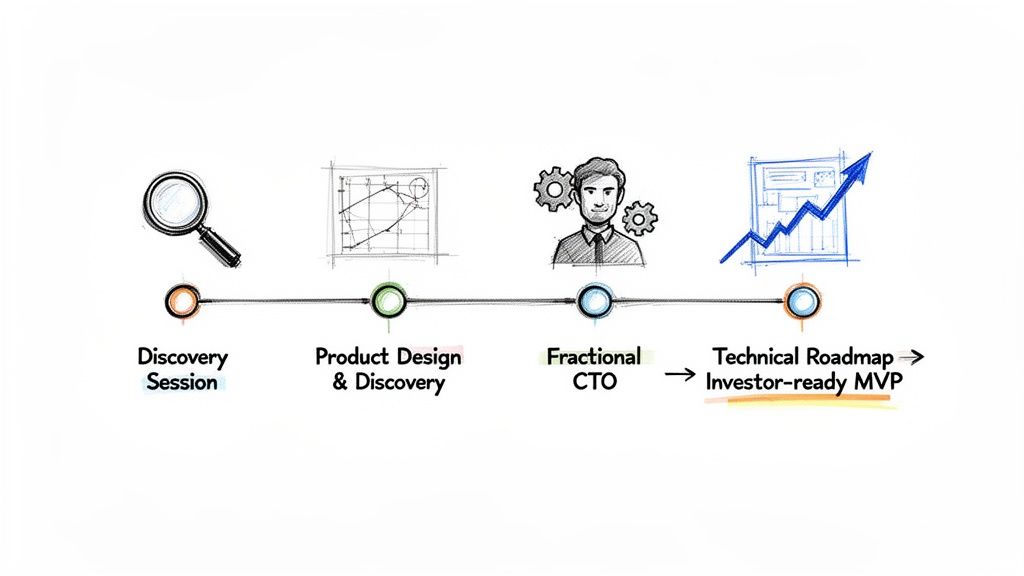
Turning your concept into something investors will fight over involves two critical steps. This is the boutique lifecycle we guide our founders through, ensuring every decision adds to your company’s valuation from day one. It’s the core of our anti-outsourcing model.
-
Initiate a Product Design & Discovery Session: This is your first real move. We work directly with you to deconstruct your idea, map out user journeys, and define the core architecture. The outcome isn’t just a pile of documents; it’s a detailed blueprint that serves as the foundation for an accurate budget and your audit-ready engineering plan.
-
Engage a Fractional CTO: With that blueprint in hand, a Fractional CTO steps in to build your strategic technical roadmap. They align the engineering milestones with your business objectives, making sure the development process creates a technical moat—not just a collection of features. You can learn more about this in our guide to MVP development for startups.
This structured approach transforms your development budget from a simple expense into a strategic investment. It’s about making sure your technical foundation is solid enough to pass any VC’s rigorous due diligence and, more importantly, to support your future growth.
At Buttercloud, we don’t just “serve” clients; we mentor founders. We partner with a select group of entrepreneurs to engineer high-valuation technical assets that earn investor confidence. This isn’t about getting a quote; it’s about building your company.
Our commitment is to boutique precision and a transparent partnership. We provide the senior architectural guidance you need to navigate the complicated journey from a raw idea to a truly scalable product. The result is more than just an app—it’s an investable asset built to win.
Frequently Asked Questions
Let’s tackle the tough questions we hear all the time from founders. As senior partners and lead architects, we want to get you past the smoke and mirrors of online calculators and focus on what it really takes to build a valuable company.
How Much Does a Simple MVP Cost in 2026?
For a properly engineered MVP—one with clean code, a solid foundation, and core features done right—you should plan for an investment in the $30,000 to $50,000 range. This isn’t for a quick prototype; it’s an investment in a stable, professional asset that can actually grow with you.
If you see quotes far below this, a major red flag should go up. Those bargain-bin prices almost always mean you’re trading quality for speed, leading to a mountain of technical debt, a poor user experience, and an inevitable, expensive rewrite down the road. That’s the exact opposite of what serious investors want to fund.
Can I Build an App for $10,000?
Technically, yes, you can get something built for $10,000 using offshore freelancers. But let’s be crystal clear: what you’ll get is a fragile prototype, not an investor-ready technical asset. This is a distinction that can make or break your startup.
An app built for $10,000 is a liability, not an asset. It’s built for a demo, not for growth, security, or passing the intense scrutiny of a VC firm’s technical due diligence.
These kinds of products are almost universally built on shaky ground. They lack a scalable architecture, have serious security vulnerabilities, and are written with messy code that makes future development a nightmare. Good luck getting a second meeting with an investor with that.
What Is the Biggest Hidden Cost in App Development?
Hands down, it’s technical debt. This is the long-term price you pay for taking shortcuts on engineering quality upfront. It’s like building a house on a shoddy foundation—it looks fine at first, but then the cracks start to show.
This “debt” shows up as persistent bugs, painfully slow performance, and security issues that stop your growth dead in its tracks. And it always comes due at the worst possible time, usually when you’re trying to raise your Series A and investors discover you need a complete do-over before they’ll write a check. Investing in audit-ready engineering from day one is your best insurance policy against this.
Why Is a Discovery Phase Necessary?
The Product Design & Discovery phase is where we stop guessing and start planning. It’s the most important step you can take to de-risk your entire project before anyone writes a single line of code. It’s how you turn a big idea into a concrete technical and product roadmap.
This is the process that defines what you’re actually building, maps out how users will interact with it, and establishes the core architecture. It helps you prepare for the kind of tough questions you’ll face during investor meetings, which are often covered in resources like Your Ultimate Technical Due Diligence Checklist.
Skipping this step is the #1 reason projects go over budget and off the rails. A proper discovery phase is the only way to get a budget you can actually count on.
Want a real number before that conversation, not just the theory? Our free MVP Cost Calculator walks through your project’s actual requirements and gives you a directional estimate — priced from the same numbers as our full pricing calculator, not a generic industry average.
Ready to move beyond hypotheticals and build a real, investor-ready technical asset? Buttercloud acts as a dedicated Mentor-Architect for a select group of founders. Schedule a consultation with our senior architects to start building your high-valuation company today.
Have a product idea to talk through?
We'll show you how we'd approach it — no pressure, just a real conversation.
Book a Discovery Call