Building Elite App Development Teams

Founder & CEO, Buttercloud
Let’s be direct: building your first development team is not about hiring coders. For a founder, the mission is to engineer a strategic asset that passes rigorous technical due diligence and increases company valuation.
Forget the old playbook of simply shipping features. In 2026, the most successful founders build a defensible edge competitors can’t easily copy by assembling a precise mix of core team members, strategic leadership, and specialized partners. This is about speed, audit-ready engineering, and building a product that can withstand investor scrutiny.
The New Mandate for Building App Development Teams
The way you structure your development team directly impacts your startup’s trajectory and, more importantly, its valuation. The objective has shifted entirely. You are not just building a product; you are engineering an investable asset.
This requires a fundamental change in how you approach team building. You are not “getting help”; you are architecting a core pillar of your business designed to perform under the immense pressure of growth and due diligence.
This modern approach prioritizes quality over volume. A lean, expert-led team that produces clean, audit-ready code is infinitely more valuable than a large team drowning in technical debt. Every decision—from the first line of code to the choice of an engineering partner—must be made with one objective: creating a high-valuation technical asset.
Build for Valuation, Not Just Features
The global app development market continues its explosive growth, projected to climb from $264.96 billion in 2025 to $305.18 billion in 2026. This intense competition means there is no room for error.
Founders must partner with seasoned engineering teams capable of building production-grade solutions from day one. This is what transforms your technology from a potential liability into a core asset when investors begin their deep-dive analysis.
A team built for valuation operates on a different plane. They focus on:
-
Proprietary Systems: Creating proprietary logic and a defensible architecture that competitors cannot easily replicate.
-
Audit-Ready Engineering: Writing clean, well-documented, and scalable code designed to pass any technical due diligence process.
-
Strategic Leadership: Integrating senior-level guidance, often through a Fractional CTO, to ensure the product roadmap and business goals are perfectly aligned.
The single greatest error a founder can make is treating their development team as a cost center. An elite team is a value multiplier. They do not just write code; they build the very asset investors are acquiring.
Assembling the Right Team for the Right Stage
Your team’s composition will evolve, but its starting point is critical. The goal is a precise blend of talent that optimizes for speed, expertise, and capital efficiency.
Instead of immediately hiring a full-time, in-house team, many successful founders adopt a hybrid model. This typically involves a small core of internal leadership (the founder) paired with a boutique engineering partner who provides the deep expertise required for an investor-ready MVP.
This “anti-outsourcing” approach delivers the mentorship and transparency unavailable from mass-market, black-box firms. The right partner guides you through the entire Product Design & Discovery process. To execute this correctly, you must build high-performing teams designed to win from the outset.
Ultimately, the right structure is not about filling roles. It is about securing the exact expertise you need, precisely when you need it, at every stage of your journey from idea to scalable product.
What Roles Does Your Startup Actually Need?
Stop hiring for roles you think you need. Building your first app development team is about surgical precision, not filling a generic org chart. Your objective is to assemble a small, high-impact strike force.
Too many founders err by hiring based on vague job titles, resulting in a bloated payroll and a misaligned team. In the early stages, you need a handful of experts who can operate with focus while wearing multiple hats, all dedicated to turning your vision into a product that commands market value.
The Vision Architect: Product Manager
The Product Manager is the custodian of the “what” and the “why.” They are the critical link between your business vision and the technical execution. This role is not about managing a Jira board; it is about embodying the product vision, obsessing over user behavior, and ruthlessly prioritizing what gets built.
A great startup PM is anchored in data and user feedback, using both to shape the roadmap. They are your safeguard against building beautiful but useless features. Their job is to ensure the engineering team is building the right thing that solves a real problem and establishes a competitive advantage.
Founder’s Litmus Test: “Our main competitor just launched a feature on our six-month roadmap. With limited resources, walk me through your process for deciding how, or if, we should respond.”
The Master Builder: Lead Engineer
If the Product Manager owns the “what,” the Lead Engineer owns the “how.” This role is far more than your most skilled coder. They are the architect of your entire tech stack, making foundational decisions on frameworks, infrastructure, and standards. These choices determine whether you are building a technical asset or a ticking time bomb of tech debt.
In a startup, your Lead Engineer is your primary defense against a future rewrite. They should be obsessed with writing clean, scalable code and mentoring others to uphold the same standard. This individual thinks in systems, not tickets, ensuring the foundation built today can support the growth planned for tomorrow.
Founder’s Litmus Test: “Describe a time you chose a ‘slower’ or more complex technical solution over a ‘quicker’ one. What was the business justification, and how did you articulate the trade-off to non-technical stakeholders?”
The User’s Champion: UI/UX Designer
A polished user interface (UI) and an intuitive user experience (UX) are no longer optional—they are a core part of your competitive moat. Your UI/UX Designer is the advocate for your customer, focused on crafting a product that feels effortless, intuitive, and even delightful.
This is not about making things “look pretty.” A startup-focused designer is a problem-solver who uses wireframes, prototypes, and user testing to diagnose and fix issues before a single line of code is written. This saves a staggering amount of wasted engineering time and ensures you are building something people will actually use.
Founder’s Litmus Test: “Our analytics show 30% of new users drop off during onboarding. What are the first three steps you would take to diagnose and solve this?”
The magic happens when these three roles synchronize. When the ‘what’ (Product), the ‘how’ (Engineering), and the ‘feel’ (Design) are perfectly aligned, you get more than a functional app. You get a product that is defensible, valuable, and ready to scale.
Choosing Your Engineering Model: The Anti-Outsourcing Mandate
Selecting your engineering path—in-house, freelance, or a partner firm—is a defining decision every founder makes. This choice extends beyond your burn rate; it is a strategic move that directly impacts your company’s long-term value, and investors will scrutinize it.
Many founders are tempted by the perceived low cost of freelance marketplaces or traditional outsourcing. This is often a trap. Initial savings are quickly erased by the high cost of remediating the technical debt they create—a hidden “interest” that can silently kill your product and render it un-investable.
The Anti-Outsourcing Philosophy
At Buttercloud, we operate on an “anti-outsourcing” model. This is the critical distinction between a black-box vendor who delivers code and a boutique engineering partner who is invested in your success. A vendor relationship is transactional; a partnership is transformational.
Consider the black-box firm: they take your specifications and disappear, only to reappear with a “finished” product. You have zero visibility into their process, architecture, or code quality. For a startup, this is a monumental risk. You are betting your company’s future on work you cannot see.
A true partner acts as a mentor-architect. They embed with your team, provide complete transparency, and guide you through the complex journey from idea to a high-valuation technical asset. The goal is not just to build an app; it is to build your capacity as a founder.
This decision tree helps map your initial thoughts on who you need, whether it’s a founder-led role, a specific engineer, or a designer.
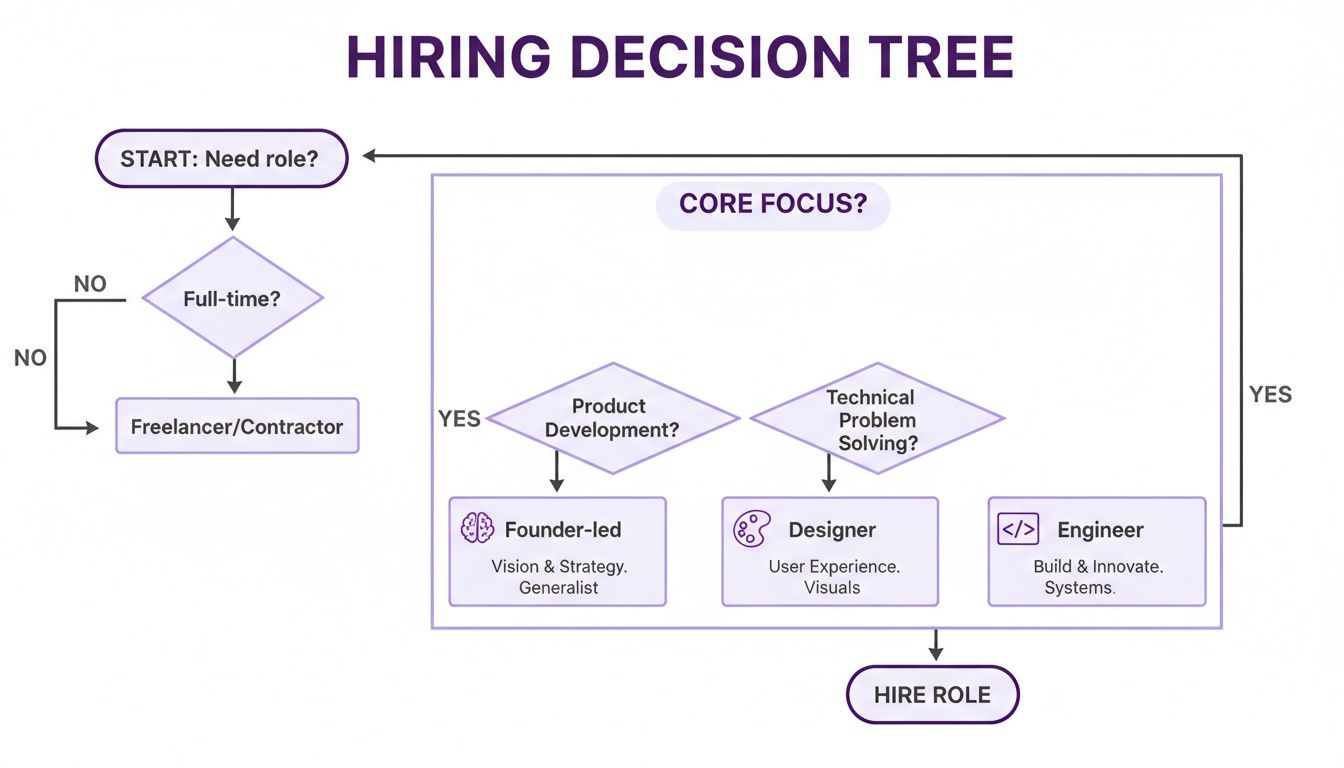
The flowchart reinforces a critical point: always define the need before considering the hiring model. It is about securing the right talent for the job at hand.
Team Model Comparison for Founders
Investors do not just evaluate your product; they conduct rigorous technical due diligence to assess the true quality of your underlying asset. The engineering model you choose has a direct impact on that audit’s outcome.
Below is a breakdown of the three main options, focused on the metrics that matter when you are across the table from a VC.
Metric
In-House Team
Freelance Model
Boutique Partner (e.g., Buttercloud)
Speed to MVP
Slow (Hiring is time-consuming)
Variable (Dependent on individual)
Fast (Ready-to-deploy expert team)
Code Quality
Variable (Depends on hiring success)
Inconsistent (High risk of tech debt)
Excellent (Audit-ready engineering)
Founder Mentorship
None (You are the leader)
Minimal to None
Core Offering (Fractional CTO included)
Cost-to-Valuation Ratio
High initial cost, long-term asset
Low initial cost, high risk of devaluation
Optimized investment for valuation increase
Scalability
Scalable, but slow to build
Difficult to scale reliably
Built for scale from day one
Let’s dissect a few of these.
Code Quality & Technical Debt
Cheap outsourcing almost invariably means cutting corners, resulting in code that is poorly documented, impossible to scale, and riddled with bugs. This is a massive red flag for investors, who see it as a future expense and a drag on valuation. A partner focused on audit-ready engineering builds your codebase as an investable asset from day one, eliminating technical debt at its source.
Founder Mentorship
Freelancers and large vendors are task-takers, not mentors. For a non-technical founder, this leaves you making critical technical decisions without expert guidance. A partner model integrates this mentorship, often acting as a Fractional CTO to help you own the roadmap and command your investor meetings.
Speed to an Investor-Ready MVP
A freelancer might ship a feature quickly, but is it the right feature? And is the code a dead end? True speed is not just velocity; it is about building the right thing, the right way, the first time. This is where a partner excels, blending product discovery with elite engineering to ensure your MVP is not a throwaway prototype but the solid foundation for a scalable business.
Ultimately, choosing your engineering model is an investment decision. The cheapest option on paper often becomes the most expensive when your startup fails its first tech due diligence audit, forcing a painful and costly rewrite. Building your app development teams with a laser focus on creating a high-valuation asset from the start is the only way to win.
How Do You Integrate Strategic Leadership with a Fractional CTO?
Founders face a classic catch-22: you need senior tech leadership to avoid critical architectural missteps, but you cannot justify the six-figure salary and significant equity of a full-time Chief Technology Officer.
Hiring an executive that early can decimate your runway. Yet, operating without strategic oversight is a recipe for technical chaos, expensive rewrites, and a product that investors will not fund.
This is precisely where a Fractional CTO provides a solution—and why it has become a founder’s strategic weapon.
View it less as hiring a consultant and more as gaining an ongoing senior partner. A high-caliber Fractional CTO provides the executive strategy, architectural guidance, and technical roadmap that anchors your engineering team to business goals. They ensure you are building an investable asset, not just a collection of features.

Beyond Code: The Strategic Value of a Fractional CTO
A Fractional CTO’s primary function is not to write code. Their value is in providing the leadership that prevents the catastrophic errors that sink early-stage companies. They operate at the crucial intersection of business vision and technical execution.
For non-technical founders, they de-risk the entire venture.
Here is what that looks like in practice:
-
Architectural Guardrails: They make the big-picture decisions on your tech stack, ensuring it can scale and will not become a dead end in two years. This is future-proofing your asset.
-
Technical Roadmap Development: They translate your business plan into a clear, milestone-driven technical roadmap. This becomes a powerful tool for investor conversations.
-
Tech Team Hiring and Mentorship: A Fractional CTO knows how to identify and hire A-player technical talent, asking the tough questions you wouldn’t think to ask. They also mentor your existing engineers, elevating the quality bar for the entire team.
For a deeper dive, A Practical Guide to CTO Duties and Responsibilities is an excellent resource. It outlines the full scope of what this leadership level provides, even on a fractional basis.
Preparing for Due Diligence and Investor Meetings
One of the most immediate benefits of a Fractional CTO is how it instantly makes your startup more investable. They know exactly what VCs look for during technical due diligence and will proactively prepare your code, processes, and documentation to pass with flying colors.
The moment an investor asks, “Who is leading your technology?” your answer will define their confidence. “Our Fractional CTO from a trusted engineering partner” is an infinitely stronger response than “I’m figuring it out as I go.”
This is not a theoretical boost. A Fractional CTO delivers tangible assets that directly support your fundraising narrative.
Key Deliverables of a Fractional CTO
A true partnership with a Fractional CTO should produce concrete, high-value outputs that fortify your company. You should expect:
Deliverable
Founder Benefit
Investor-Ready Technical Roadmap
A documented plan showing how tech milestones support business growth. Perfect for your pitch deck.
Due Diligence Readiness Report
An audit of your code, security, and infrastructure that fixes red flags before investors find them.
Architectural Decision Records (ADRs)
Simple documents explaining why key tech decisions were made, proving strategic foresight.
Hiring Scorecards & Interview Plans
Structured tools to help you build your internal team with discipline and hire the absolute best people.
For many founders, this type of strategic partnership is the bridge from a great idea to a fundable company. As you navigate these complexities, you can learn more about how a virtual CTO can provide the strategic leadership you need to win.
This model provides the critical expertise to ensure your app development teams are not just building a product—they are engineering a high-valuation company.
How Do You Build an Investor-Ready Engineering Culture?
The code your team writes is only part of what an investor acquires. They understand the real asset lies in the processes and habits behind the code. Your engineering culture signals whether they are investing in a scalable asset or a ticking time bomb.
An investor-ready culture has nothing to do with ping-pong tables. It is about building a system that consistently produces clean, auditable, and high-valuation technology.
This is how you build your Technical Moats. We are not talking about clever features, but ingrained practices that make your engineering engine defensible and transparent. A solid culture ensures that as you grow, your codebase becomes an appreciating asset, ready to pass the intense scrutiny of VC technical due diligence.
From Code to Capital: Your DevOps Philosophy
Too many founders view DevOps as a job title or a set of tools. It is a mindset. It is about creating a reliable, secure, and automated pipeline from a developer’s laptop to your users. For an investor, this signals operational maturity and lower risk.
The core of this philosophy is Continuous Integration and Continuous Deployment (CI/CD). This is your first line of defense against the technical debt that cripples startups. It is a set of automated practices for testing and releasing code, ensuring every update is stable and does not break existing functionality.
A rock-solid CI/CD pipeline requires:
-
Automated Testing: Every time a developer commits code, a full suite of tests must run automatically to catch bugs early.
-
Code Quality Gates: The system must act as a gatekeeper, blocking any code that fails to meet quality and security standards. No exceptions.
-
One-Click Deployments: Pushing new features to production should be a predictable, stress-free event—not a frantic emergency.
If your engineers are manually deploying code, it is a massive red flag for any investor. It signals risk, inefficiency, and an inability to scale. Your goal is a “push-button” system where releases are routine, not heroic.
The Human Element in an AI-Driven World
The impact of AI on development is undeniable. In 2026, it is ubiquitous. Recent data shows a staggering 84% of developers already use or plan to use AI coding assistants. And they see real results—70% report spending less time on tasks.
But here is the critical caveat: that same report found 46% of developers do not fully trust the code AI generates. For a deeper analysis, check the latest stats on how AI is impacting app development on base44.com.
This is where culture is make-or-break. An investor-ready team uses AI as a powerful assistant, not a replacement for expert judgment. Your senior engineers must enforce a culture of critical review.
This requires clear ground rules:
-
AI for Acceleration, Humans for Architecture: Use AI for boilerplate code, basic tests, or suggesting solutions. But a senior engineer must always make the final architectural decisions.
-
Mandatory Code Reviews: All AI-generated code—every line—must be rigorously reviewed by a human for security vulnerabilities, performance bottlenecks, and adherence to standards.
-
Avoiding AI-Generated Debt: Without oversight, AI can create subtle but significant technical debt. Your team must be trained to identify and remediate it immediately.
A team that blindly trusts AI is just building the next generation of technical debt faster than ever. A mature culture uses AI to make its best people even better while maintaining uncompromising quality.
Documentation as a Valuation Multiplier
Most engineers would rather do anything than write documentation. But a founder must see documentation for what it is: a direct valuation multiplier.
During due diligence, investors do not just use your live app. They analyze how it is built, how it runs, and how quickly a new team could become productive. Clear documentation proves that your company’s knowledge is not trapped in one person’s head.
Your team must treat these three types of documentation as non-negotiable deliverables:
-
Architectural Decision Records (ADRs): Simple text files explaining the why behind key technical decisions, demonstrating strategic foresight.
-
Onboarding Guides: A new engineer must be able to get a development environment running in hours, not days. A clear “readme” and setup guide is essential.
-
API Documentation: If you have an API, its documentation must be flawless. It is the only way other developers or partners will integrate with your product.
Ultimately, building an investor-ready engineering culture is a matter of discipline. For a closer look at these practices, our guide on modern web application development is an excellent next step. By focusing on automation, intelligent AI use, and rigorous documentation, your team will build a technical asset designed to scale, pass due diligence, and command a higher valuation.
Founder Questions About App Development Teams
Every founder I advise is grappling with the same high-stakes questions about building their first engineering team. Your runway, product, and future valuation are on the line.
Let’s address the most common questions with direct, actionable answers.
How Much Does It Cost To Hire An App Development Team?
This is the primary question, and the answer depends entirely on the model you choose. The cheapest route is almost never the most valuable.
A full-time, in-house US team can cost $500,000+ annually in salaries alone, before benefits and overhead. Freelancers may seem cheaper at $50-$200+ per hour, but you become a full-time project manager dealing with inconsistent quality and management overhead.
A boutique partner like Buttercloud offers a predictable cost for a high-quality, investor-ready product without the long-term fixed costs of salaries. But the real question is not price; it is the investment-to-valuation ratio.
A cheap build is like taking out a high-interest loan against your technology. You will pay dearly for that “technical debt” when a VC’s due diligence team discovers it. A well-engineered product from a dedicated partner is a strategic multiplier that directly increases your company’s valuation.
What Is The Ideal Team Structure For An MVP?
For an MVP, you do not need an army; you need special forces. The mission is to build an investor-ready asset, not a throwaway prototype. The optimal structure is lean, expert-led, and obsessed with speed and quality.
At Buttercloud, our elite MVP unit includes:
-
Fractional CTO: Your strategic commander, responsible for architecture, the technical roadmap, and high-level decisions.
-
Senior Engineer(s): One or two elite engineers who write clean, scalable, audit-ready code from day one.
-
UI/UX Designer: Ensures the product is intuitive and visually polished from the start.
-
Product Manager: This is typically you, the founder, steering the vision and defining the “what” and “why.”
This small, senior-heavy team avoids the bloat and slow decision-making of larger, more junior teams. It is focused on creating a rock-solid foundation you can confidently build upon after securing your next funding round.
How Do I Manage A Technical Team As A Non-Technical Founder?
Your job is not to manage code; it is to communicate your vision and hold the team accountable for business outcomes. Trying to micromanage technical tasks is a fast track to frustration.
Instead, execute on these three principles:
-
Find a Trusted Technical Partner: Your most critical decision is securing a technical leader you trust, whether through a Fractional CTO service or a boutique firm. They will be your translator, turning business goals into an actionable technical plan.
-
Manage Outcomes, Not Activities: Use a tool like Jira to track progress against user stories and business milestones—not lines of code. Your primary question should always be, “Is this advancing us toward our next goal?”
-
Demand Plain English: A great technical partner explains progress and problems in simple business terms. They should be able to break down complex trade-offs based on their business impact, enabling you to make informed decisions without a computer science degree.
By focusing on the “what” and empowering your technical lead to own the “how,” you can lead with confidence and build a product that excites investors.
Building your app development team is laying the very foundation of your company. Buttercloud acts as the boutique engineering partner that guides you from Idea → Investor-Ready MVP → Scalable Product, ensuring your technical foundation is an asset that drives valuation. Learn how we can engineer your success.
Have a product idea to talk through?
We'll show you how we'd approach it — no pressure, just a real conversation.
Book a Discovery Call