
Business Consultants for Startups: A Founder's Guide for 2026

What is a business consultant for a startup? Think of them not as a vendor, but as a mentor-architect—a seasoned expert who provides strategic guidance on the journey from an idea scribbled on a napkin to a scalable, high-valuation technical asset.
An elite consultant acts as a force multiplier. They bring specialized knowledge in critical areas like product design, investor-ready MVP development, or go-to-market strategy, helping you accelerate growth and sidestep common, catastrophic mistakes.
Why Elite Startups Hire Business Consultants
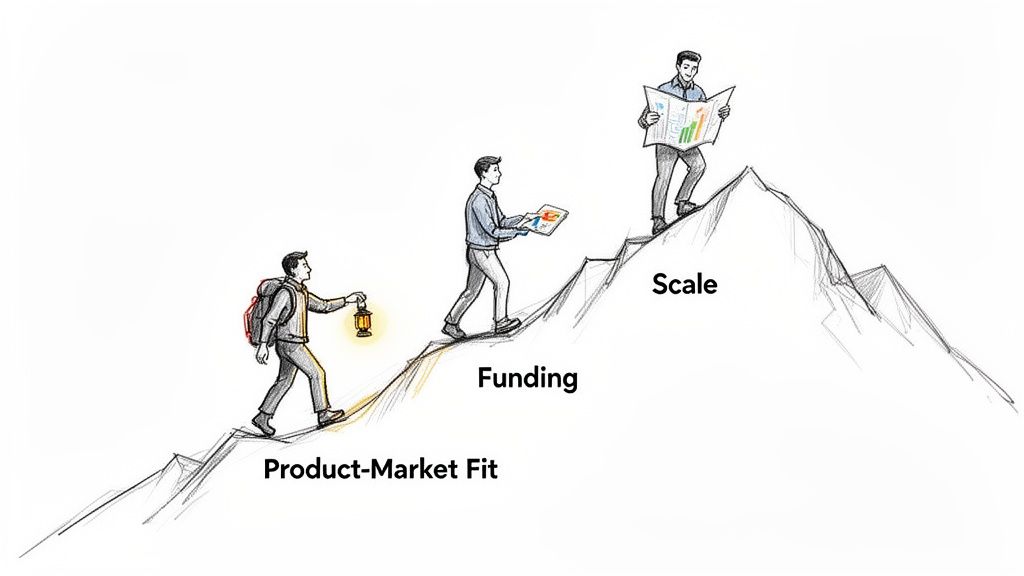
For any ambitious founder, the path from a great idea to a high-valuation exit is fraught with peril. It’s a relentless climb through the fog of product-market fit, fundraising, and scaling without implosion.
This is precisely why the sharpest startups view consultants not as a luxury, but as an integral part of their core strategy.
Picture a consultant as a sherpa who has navigated this same treacherous mountain a dozen times. They know where the hidden crevasses lie, which trails lead to dead ends, and the most direct route to the summit. They bring authoritative frameworks and foresight that a founder, deep in the weeds of building a product, can easily miss.
Moving From Hustle to Structured Execution
The initial "hustle and grind" phase is fueled by passion, and it is essential. But it is not scalable. Hustle alone will not secure your next funding round or build a defensible business.
A business consultant's primary function is to help you engineer the operational scaffolding required for durable growth. They channel that chaotic early-stage energy into a focused, repeatable plan—the kind that builds investor confidence and prevents operational failure.
This pivot from chaotic energy to strategic execution is a make-or-break moment. You must build repeatable processes for everything from sales and marketing to tech team hiring and workforce management. A significant reason savvy founders engage expert guidance is to master complex topics like understanding Why is workforce management crucial for start-ups. This shift builds your business on a rock-solid foundation, ready for any challenge.
A consultant's true value isn't just in providing answers; it's in asking the right questions that force founders to build a resilient, high-valuation business from day one.
In the high-stakes game of building a startup, these outside experts are no longer a nice-to-have. The global management consultancy market is set to hit a staggering $250 billion by 2026, driven by founders seeking to navigate this exact territory.
Startups that engage strategic consultants early often report scaling 2-3x faster than those who go it alone, a trend reflected in recent consulting statistics. Ultimately, hiring a consultant is about bringing on a strategic partner obsessed with turning your vision into a fundable, durable company.
The Spectrum of Startup Consultants and Their Services
Deciding you need a "business consultant" is a start, but it's akin to saying you need a "doctor." Do you require a neurosurgeon or a podiatrist? Both are experts, but engaging the wrong specialist is a rapid way to burn capital and destroy momentum.
You would not ask your race car's engine builder to design its aerodynamics. Building a startup requires the same level of specialization.
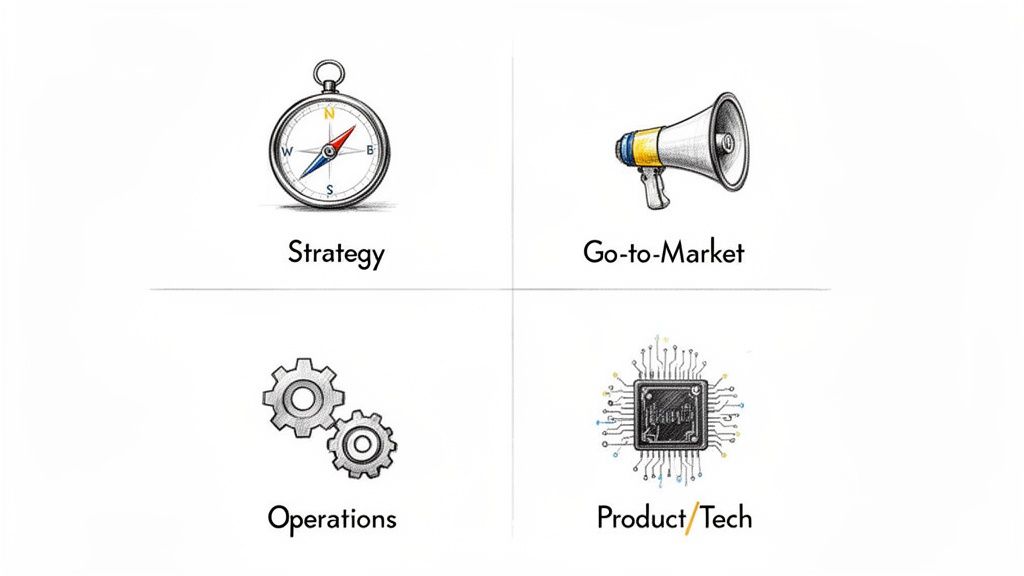
To succeed, you must map the expert to the problem. We segment this into four key domains, each answering a fundamental question about your business.
Strategy Consultants: Nailing the “What” and “Why”
Before a single line of code is written or a logo is designed, you need a robust blueprint. This is the domain of strategy consultants. They operate at the 30,000-foot view, pressure-testing your core thesis to ensure it is built on solid ground.
They are the architects of your business model, focusing on the foundational questions that determine long-term viability.
A great strategy consultant will help you:
Validate the Core Idea: They execute market research and feasibility studies to prove there’s a real, painful problem your startup can solve for a specific, addressable market.
Develop the Business Model: They map precisely how you'll create value for customers and, crucially, how you'll capture that value through defensible revenue streams.
Create the Fundraising Narrative: This is critical. They help you construct a compelling story, backed by a solid financial model, that presents an unmissable opportunity to investors.
Go-to-Market Consultants: Figuring Out the “Who” and “How”
A brilliant product with no path to customers is not a business—it's a science project. Go-to-Market (GTM) consultants are the specialists who engineer the bridge between your product and the people who will pay for it.
They answer two critical questions: who is your ideal customer, and how are you going to reach them, repeatedly and efficiently?
Your GTM strategy isn't just a marketing plan; it's the operational playbook for landing your first 10, 100, and 1,000 customers without burning through your entire seed round. A GTM consultant designs this playbook.
For instance, a GTM expert will help you define your Ideal Customer Profile (ICP), map the customer's journey from awareness to purchase, and select the right acquisition channels—whether that’s SEO, paid media, or building a direct sales force.
Operations and Technical Consultants
While strategy and GTM focus on the macro-level vision, operations and technical consultants are masters of execution. They are the architects of "how."
Operations Consultants (Building the 'How to Scale'): These experts build the internal engine of your company. They design the systems for hiring, finance, and day-to-day processes that enable growth without chaos. They create your hiring playbook or set up your first auditable financial reporting system.
Product/Tech Consultants (Architecting the 'How to Build'): This is where we at Buttercloud operate. A true engineering partner, often a Fractional CTO, is the one who translates your business vision into a tangible, investor-ready technical asset. They don't just "build an app." They engineer a technical moat—a defensible technological advantage that becomes a cornerstone of your company's valuation. Their entire focus is on shipping audit-ready code that sails through VC technical due diligence, ensuring you're building value, not technical debt.
The Critical Role of the Technical Consultant
While a business consultant helps define your startup's "what" and "why," your company's long-term value is often forged by a different kind of expert: the technical consultant. They are the master architects of the "how." Their role is to transform your business strategy into a rock-solid, scalable, and investor-ready technical asset.
This is far more than outsourced coding. A true technical partner, whether an engineering partner or a Fractional CTO, operates as a strategic leader. They don't simply take an order to "build an app." They engineer its very foundation to withstand the intense pressure of scaling and the laser-focused scrutiny of VC due diligence.
The Architect Versus the Day Laborer
Consider this analogy: a business consultant is the urban planner who zones land for a skyscraper, defining its purpose, location, and financial viability. The technical consultant, however, is the structural engineer who designs the foundation, ensuring the building can soar 100 stories without crumbling.
Hiring a generic development shop is like hiring a crew with hammers and hoping for a skyscraper. An elite engineering partner is the mentor-architect who provides the actual blueprint, ensuring every beam and bolt contributes to the structure's integrity and value.
This distinction is paramount. One path leaves you with a prototype that is superficially appealing but riddled with hidden technical debt—a massive liability that will sink your valuation. The other path engineers a technical moat from day one, building a defensible advantage directly into your codebase. You can explore how this strategic oversight functions through the role of a virtual CTO for your startup.
Building Investor-Ready Code from Day One
The consulting industry is not static. By 2026, the sector has been transformed, with AI now driving a remarkable 78% of growth for UK consultants. For founders, this means specialized partners like Fractional CTOs are more critical than ever for building investor-ready MVPs that are free of technical debt and fortified by modern security and DevOps practices. As recent consulting industry trend analysis reveals, boutique precision experts are seizing market share by delivering high-speed, focused expertise in software engineering.
A dedicated engineering partner operates with a single mission: delivering audit-ready engineering. This means every component of your product is meticulously designed to pass the rigorous technical due diligence that venture capitalists require.
This approach delivers several massive advantages:
Eliminates Technical Debt: Instead of expedient but messy fixes that necessitate expensive rewrites, your code is engineered for longevity and scale.
Increases Company Valuation: A clean, well-documented, and secure codebase is not a "nice-to-have"; it's a major asset that investors assign a tangible dollar value to.
Ensures Scalability: Your architecture is designed from inception to handle growth, preventing the dreaded crashes and performance nightmares as your user base explodes.
Ultimately, engaging the right technical business consultants is non-negotiable for founders serious about building an enduring, high-valuation company—not just a flash-in-the-pan product.
When to Hire a Consultant and How to Engage Them
Timing is everything. Engage a consultant too early, and you burn precious capital. Wait too long, and a critical window of opportunity may close permanently. The optimal moment?
It is almost always at a major inflection point—a moment where your current team confronts a high-stakes problem without the specialized skill set to solve it. For many non-technical founders, that first crucial challenge is determining how to translate their idea into a finished product.
This decision tree illustrates the common paths founders navigate.
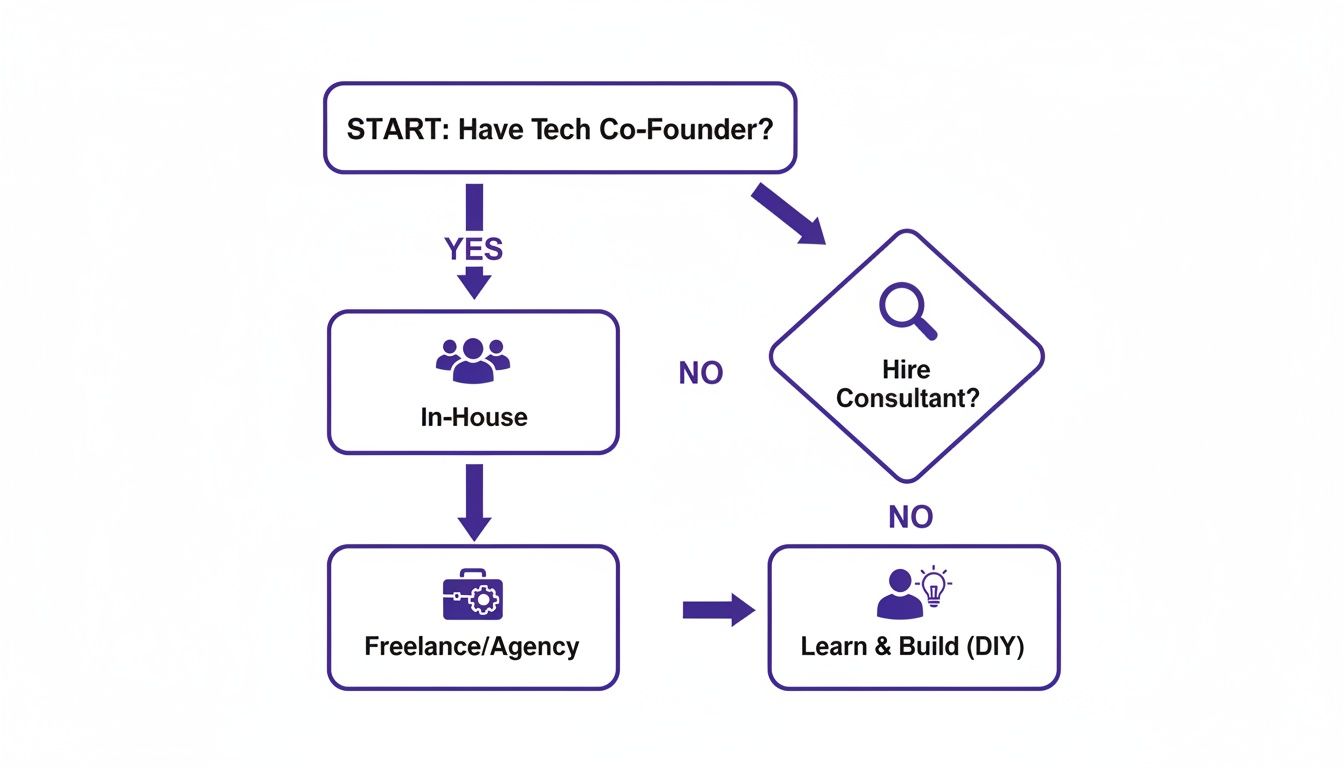
As you can see, if a technical co-founder is not part of your initial team, engaging a consultant—such as a Fractional CTO—is a highly strategic move before committing to building a full-time engineering team.
Trigger Points by Startup Stage
Your need for external expertise evolves as your startup matures. Each stage presents its own "boss-level" challenges perfectly suited for a specialist to address.
Pre-Seed Stage: The focus is on validation. Is your idea a "nice-to-have" or a "must-have"? A strategy consultant can help you secure a definitive market answer before you invest a single dollar in code.
Seed Stage: You are building your Minimum Viable Product (MVP) and strategizing customer acquisition. This is the sweet spot for an engineering partner to architect an investor-ready product and for a GTM professional to map the path to your first 100 customers. If you are in this phase, our guide on how to build a successful MVP is essential reading.
Series A Stage: The game has changed. The objective is now rapid scaling. An operations consultant can build repeatable systems for tech team hiring and finance, while a technical advisor ensures your platform architecture remains stable as you experience exponential traffic growth.
A consultant's value is maximized when they are engaged to solve a specific, high-impact problem that is blocking the company from reaching its next major milestone—be it closing a funding round, launching a product, or scaling user acquisition.
Choosing the Right Engagement Model
How you partner with a consultant is as important as when. The traditional model of protracted, open-ended consulting projects is obsolete. The market for digital transformation consulting is projected to exceed $380 billion in 2026, with a significant 38% surge in growth driven by demand for sprint-based models that tie fees to measurable outcomes.
This shift is a game-changer for startups, providing access to elite expertise without an enterprise-level budget. Let’s break down the common engagement models.
Consultant Engagement Models Compared
The choice of how to work with a consultant is not one-size-fits-all. It depends on your immediate objectives, your budget, and the level of hands-on execution required. This table outlines the most common models to help you select the right fit.
Model | Best For | Typical Cost Structure | Key Benefit |
|---|---|---|---|
Project-Based | A single, defined goal like a pitch deck, financial model, or market research report. | Fixed fee for the entire project. | Clear scope, predictable cost, and a concrete deliverable. |
Retainer | Ongoing, consistent support and strategic advice without a full-time commitment. | Monthly fee for a set number of hours or general access. | Continuous access to an expert for guidance and course correction. |
Fractional | Gaining C-suite leadership (e.g., Fractional CTO, CMO, or CFO) on a part-time basis. | Monthly fee, often higher than a retainer but less than a full-time salary. | Executive-level expertise and execution without the full-time cost. |
Ultimately, the best model is the one that directly addresses your most pressing bottleneck. Whether you need a one-off project to reach the next milestone or a fractional leader to guide you through a growth phase, structuring the engagement correctly ensures maximum return on investment.
Selecting the Right Consultant for Your Startup
Let's be unequivocally clear: hiring a business consultant is not a transactional purchase. You are not merely bringing someone in to complete a task. You are selecting a mentor-architect—a true strategic partner who will be in the trenches with you throughout the founder's journey.
The right choice can pour jet fuel on your vision. The wrong one will burn through your runway with alarming speed.
Your vetting process must be as rigorous as if you were choosing a co-founder. Do not be swayed by polished LinkedIn profiles or slick sales pitches. Hunt for evidence of tangible impact. A great consultant's track record is defined by outcomes, not a list of past clients. They must be able to articulate precisely how they moved the needle on valuation, fundraising, or market share.
Your Due Diligence Checklist
Before initiating contact, conduct your own due diligence. A top-tier consultant leaves a clear digital footprint of their expertise and validated claims. Use this checklist to filter out the theorists and identify the practitioners.
Industry and Stage Fit: Have they actually worked with startups in your niche? And critically, at your exact stage (pre-seed, seed, Series A)? The challenges of a pre-seed SaaS founder are worlds apart from those of a Series A fintech company.
Outcome-Focused Testimonials: Dig for case studies or reviews that specify results. "Helped us with our pitch deck" is a weak signal. "Their insights were the key to closing our $2M seed round" is the signal you're looking for.
A "Mentor-Architect" Vibe: Read their blog; watch their videos. Do they sound like they are teaching and mentoring, or simply selling a pre-packaged solution? You want a partner who will educate you on the how, not just deliver a finished report.
The goal is to find someone who will tell you what you need to hear, not just what you want to hear. Their real value lies in challenging your assumptions and pushing you forward, even when the feedback is difficult.
Killer Interview Questions to Ask
Once a consultant passes your initial screening, the interview is where you separate the true experts from the pretenders. These questions are designed to cut through jargon and reveal how an individual truly thinks and operates.
"Tell me about a time you told a founder their core idea was broken. What was the situation, how did you deliver the news, and what was the outcome?" This reveals their integrity, tact, and ability to navigate difficult but essential conversations.
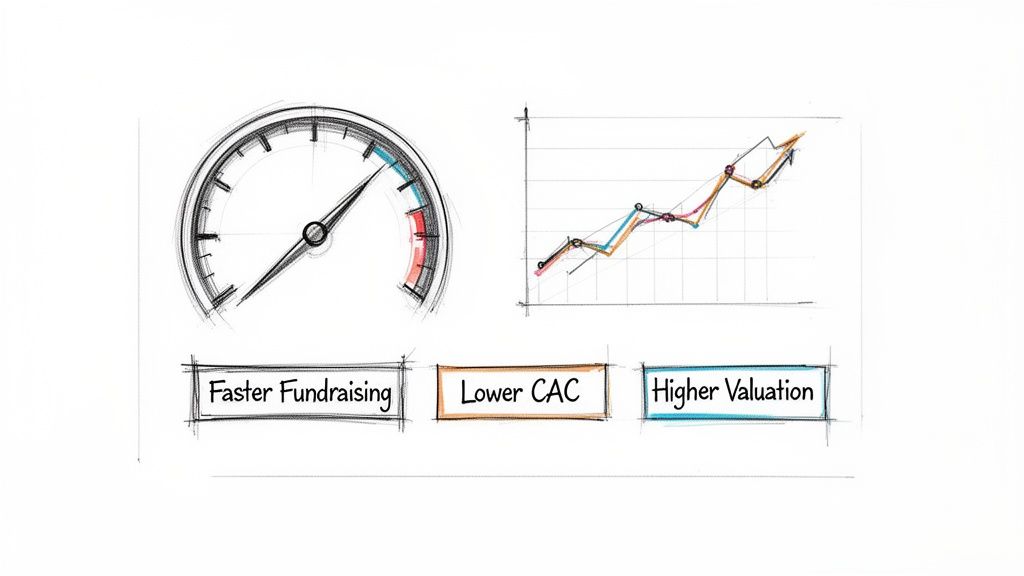
"How will you measure your direct impact on our company's valuation?" This forces them to connect their work directly to the ultimate metric for investors. A great consultant, whether for business or tech, will have a clear answer—be it through a faster fundraising cycle, lower customer acquisition costs, or the creation of investor-ready code.
"Let's discuss our specific challenge. Walk me through what the first 90 days of our partnership would look like in practice." This is the ultimate test. It reveals their ability to translate abstract strategy into a concrete, day-by-day plan of execution.
Measuring the ROI of Your Consulting Engagement
Let's be direct. Hiring a business consultant is not an operating expense—it is a direct investment in your startup's future valuation. But if you fail to measure the return on that investment, you are simply throwing capital at a problem and hoping for a positive outcome.
To secure buy-in from your board and investors, you must connect every dollar of consulting spend to clear, tangible results. It is the only way to justify the investment.
This requires moving beyond vague feelings of "progress" and zeroing in on the metrics that actually drive value. You must evaluate both quantitative results and strategic advancements to see the full picture.
Defining What Success Looks Like
Before any work begins, you and your consultant must agree on the specific KPIs that will define success. This is not optional; it is the foundation of a healthy, productive partnership. Using a framework like a SaaS Return On Investment Template can provide a solid starting point.
Identify the core problem you are hiring them to solve, then attach measurable goals to it. These KPIs must become your North Star, reviewed regularly to ensure alignment and progress.
An elite consultant doesn't just deliver work; they deliver measurable results that directly contribute to company valuation. If they can't define how their work increases your worth, they're the wrong partner.
The Hard Numbers vs. The Strategic Leaps
A robust ROI framework tracks two distinct types of value: the cold, hard data and the less tangible, but equally critical, strategic gains. One fits neatly into a spreadsheet; the other manifests in your ability to execute faster and more intelligently.
Quantitative ROI (The Hard Numbers):
Faster Fundraising Cycle: Did you close your seed round in 4 months instead of the typical 7? That is a quantifiable victory.
Reduced Customer Acquisition Cost (CAC): Did a new GTM strategy cut your CAC by 20%? That is capital returned directly to your runway.
Increased Technical Asset Valuation: Did your Fractional CTO build an MVP that passed due diligence, adding $500k to your pre-money valuation? That is a massive return.
Improved Sales Velocity: Did a new sales process shorten your cycle from 90 to 60 days? That is revenue realized faster.
Qualitative ROI (The Strategic Gains):
Increased Founder Clarity and Confidence: You now possess a validated roadmap, enabling you to lead with conviction rather than second-guessing every decision.
Improved Team Morale and Focus: Your team is no longer directionless. They are unified and energized, executing against a clear, common objective.
Stronger Investor Narrative: You can enter any pitch with a compelling story backed by a bulletproof operational and technical plan.
Ultimately, measuring ROI is what transforms a consulting engagement from a line-item expense into a powerful strategic investment that propels your startup forward.
The Big Questions About Startup Consultants
When considering bringing in a consultant, a few questions invariably arise. Let's cut through the noise and provide direct, authoritative answers.
So, What's This Going to Cost Me?
This is, understandably, the first question. The answer: it varies significantly. A one-off, project-based engagement, such as a deep-dive market research report, could command a fixed fee anywhere from $10,000 to $30,000. For ongoing strategic leadership from a senior-level expert, like a Fractional CTO, you are more likely looking at a monthly retainer between $5,000 and $15,000+.
The crucial mindset shift is to focus on value, not price. A great consultant who helps you sidestep a $100,000 technical blunder or shaves three months off your fundraising timeline provides a return that far exceeds their cost. The goal is to tie their work directly to measurable business outcomes.
Can I Just Hire a Consultant Instead of a Full-Time Employee?
Yes. In fact, for most early-stage startups, it is the most intelligent, capital-efficient decision you can make. It grants you access to elite expertise without the significant overhead of a full-time salary, benefits, and equity package.
Think of a fractional role as C-suite expertise on demand. You get the strategic horsepower of a veteran executive to fill a critical skills gap, but only for the "slice" of time you actually need.
This is especially true for technical leadership. A Fractional CTO can architect your investor-ready MVP and define your initial technical roadmap. This ensures your product is built on a solid, scalable foundation long before you have the budget for a full-time executive. An elite partner will even help you with tech team hiring, guiding you to find their full-time replacement when the time is right.
Wait, What's the Difference Between a Consultant and an Advisor?
This is a critical distinction, and confusing the two can be a costly mistake. The difference is simple: an advisor guides, while a consultant does.
An advisor is a mentor. They offer high-level feedback, provide access to their network, and share wisdom, typically in exchange for a small amount of equity. An advisor might suggest you explore a new market.
A consultant is a hands-on executor. They are paid to roll up their sleeves and deliver a specific outcome. A consultant will take the advisor's suggestion and actually build the go-to-market plan, define the target customers, and help you execute the strategy.
In the technology realm, an advisor might offer an opinion on your tech stack. A technical consultant or Fractional CTO, by contrast, will get in the trenches to architect the system, manage development, and ensure your codebase is a valuable asset that can pass any investor's due diligence.
At Buttercloud, we are the dedicated engineering partners and mentor-architects for founders. We move beyond simply giving advice to actively engineering the high-valuation technical assets that secure investment. If you need to turn your big idea into a product that gets funded, learn more about how we can help.