
Chief Technical Officer Definition: Startup Success
You’re probably here because the phrase chief technical officer definition feels too vague for the decision sitting in front of you.
You may be a founder with a prototype in Figma, a few contractors on Slack, and a backlog of technical questions that now affect hiring, budget, investor credibility, and delivery risk. At that stage, a CTO isn’t just a person who “handles tech.” A CTO is the executive function that turns product ambition into a technical asset a company can finance, scale, and defend.
Most founders wait too long to define that role properly. They hire for coding capacity when they really need technical judgment. Then the codebase grows, dependencies multiply, and every product decision starts carrying valuation consequences.
What a Chief Technical Officer Really Means for a Founder
A founder usually feels the need for a CTO at the same moment the company stops being a simple product idea. The prototype exists, investors start asking how the product will scale, and every technical shortcut begins to affect hiring plans, delivery dates, and margin. At that point, the CTO is no longer a title definition problem. It is a company value problem.
A Chief Technical Officer is the senior executive responsible for technical direction and the business consequences of technical decisions. In a startup, that responsibility reaches far beyond supervising engineers. It includes deciding where the company should build proprietary advantage, where it should use existing tools, and how to turn product ambition into systems that can survive growth, diligence, and customer pressure.
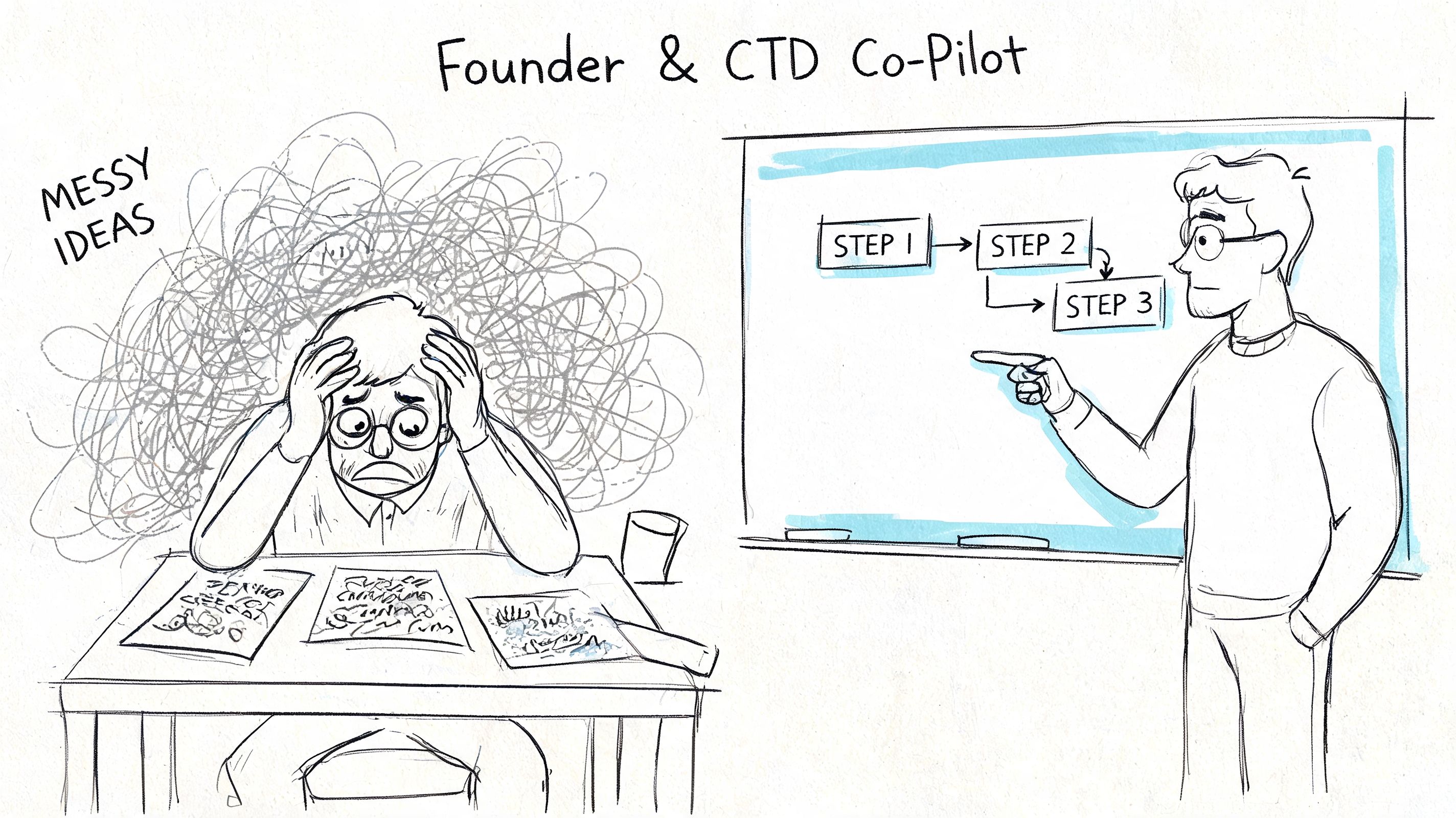
Founders often misread the role because early technical work looks tactical. Somebody writes code, ships features, fixes bugs, and keeps the app running. Those tasks matter, but they do not define the CTO function. Ultimately, the job is to make technical choices that increase enterprise value and reduce avoidable risk.
That changes how a founder should evaluate the role.
A real CTO does two things at once:
Protects downside risk: prevents architecture, vendor, security, and hiring decisions that create expensive liabilities later.
Builds future value: shapes the product and platform so the business can ship faster, defend its margins, and support a stronger story in fundraising.
That is why useful frameworks for modern Chief Technology Officer duties focus on direction, judgment, and execution discipline, not just coding range.
My practical rule is simple. If a technical decision affects fundraising confidence, customer trust, delivery speed, gross margin, or future product flexibility, it sits in the CTO lane.
In startup reality, the CTO role is the function that converts a market thesis into software the company can build, sell, and scale. That includes choices such as:
Build versus buy: where custom software creates durable advantage and where third-party tools are the smarter financial decision
Architecture timing: what needs to be designed for scale now, and what can stay intentionally lightweight
Technical sequencing: which shortcuts are acceptable for speed, and which ones will later slow sales, hiring, or expansion
Team design: whether the next constraint is stronger engineering management, deeper product engineering, or senior technical strategy
Founders do not need a ceremonial technologist. They need someone who can see the second-order effects of technical decisions before those decisions show up as missed milestones, weak diligence answers, or a discount in valuation.
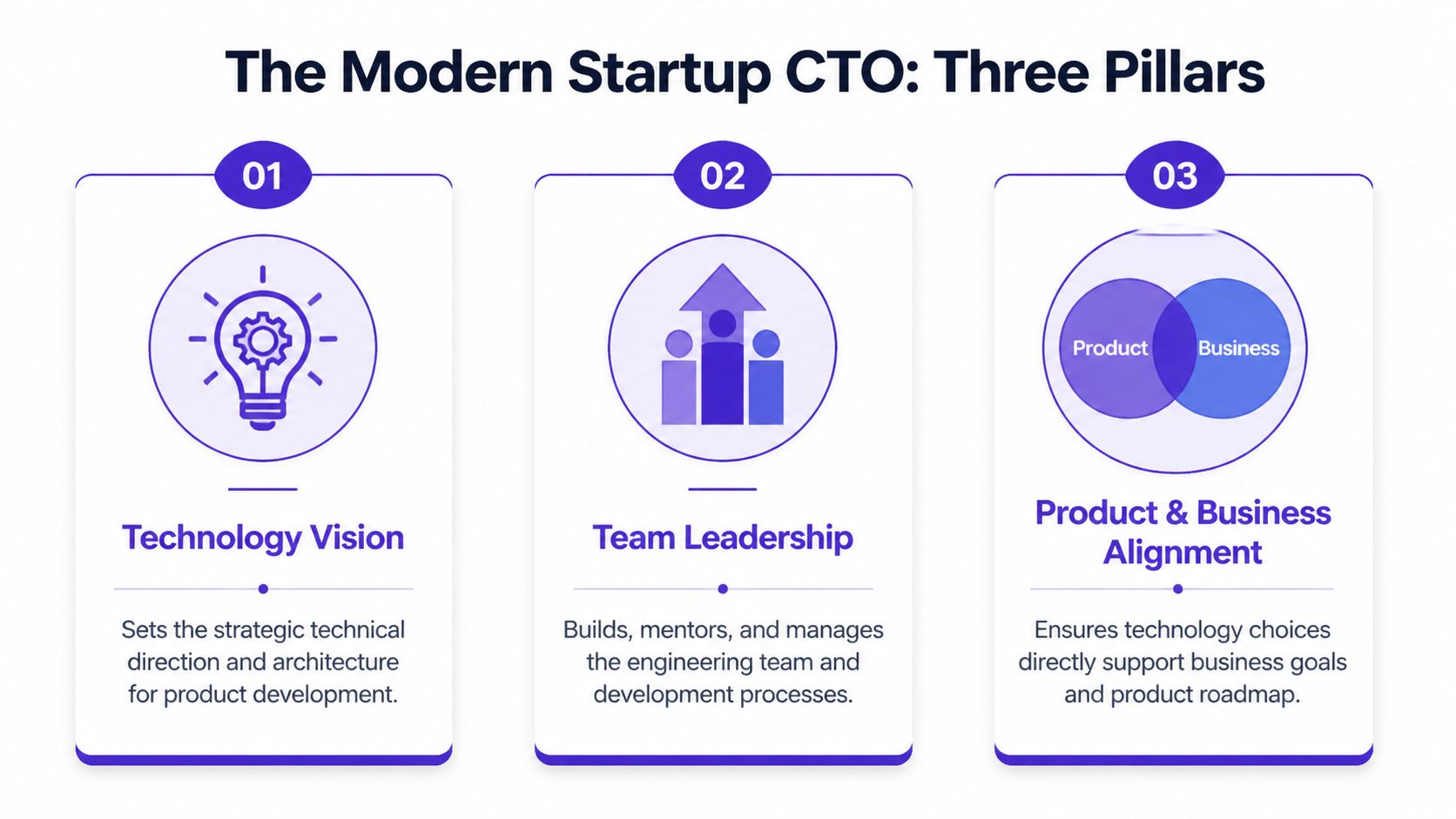
The Modern Startup CTO Defined by Three Pillars
A startup CTO should be understood through three pillars. Not as a bloated job description, and not as a list of frameworks they’ve memorized.
The useful definition is output-based. What does this person make true for the business?
The visionary
The first pillar is technology vision. This isn’t trend-chasing. It’s the discipline of matching the product roadmap to a believable technical direction.
A strong CTO decides what the system should become over the next stretch of company growth. They don’t just ask, “Can we ship this feature?” They ask whether today’s decision makes the next version of the business easier or harder to build.
Typical outputs from this pillar include:
a technical roadmap tied to business milestones
clear decisions on platform direction
choices about where the company should develop proprietary advantage
If your startup is building a workflow-heavy SaaS product, for example, the CTO should know where custom logic matters and where Stripe, Auth0, Firebase, PostHog, or a managed search layer can reduce distraction.
The architect
The second pillar is architecture. Valuation starts to become tangible here.
An architect-level CTO designs systems that are stable enough for real customers and clean enough for future due diligence. That doesn’t mean overbuilding. It means building the parts that matter correctly.
A startup doesn’t need enterprise ceremony. It needs architecture that survives success.
This pillar usually shows up in decisions around service boundaries, data design, CI/CD, security posture, observability, and the standards engineers follow when no one is watching.
A founder should expect the CTO to answer questions like:
What can remain simple right now?
What must be hardened before revenue concentration grows?
Which parts of the stack create a technical moat?
The leader
The third pillar is leadership. A CTO who can diagram systems but can’t shape engineering behavior will bottleneck the company.
Leadership means setting standards, mentoring people, and creating operating habits that produce reliable output. It also means deciding when process helps and when it suffocates a small team.
If you want a practical companion resource on the execution side, Toolradar's developer efficiency guide is useful because it focuses attention where startup teams often drift. Not on busywork, but on the conditions that let developers ship effectively.
A simple test
Use this test when evaluating any CTO candidate.
Pillar | What the founder should hear |
|---|---|
Visionary | “Here’s how the technical roadmap supports the business model.” |
Architect | “Here’s what needs to be robust now, and what can wait.” |
Leader | “Here’s how I’ll make the team deliver without burning out or creating chaos.” |
If one of those pillars is missing, the person may still be valuable. They’re just not fully covering the CTO role.
Strategic vs Tactical The Two Modes of a CTO
It usually shows up like this. The product is shipping, customers are coming in, and the engineering team looks busy all the time. Then one enterprise prospect asks about security controls, a release slips because the codebase is getting harder to change, and an investor starts asking whether the platform can scale without a rewrite.
That is the point where founders learn the CTO has two jobs.
One job is tactical. It keeps delivery moving now. The other is strategic. It protects the company’s future value by making sure today’s technical decisions do not weaken fundraising, margin, or scale later.
Founders often overvalue tactical work because it is visible every day. Sprint planning, code review, bug triage, vendor choices, production incidents. Those tasks matter. But a CTO who stays trapped there is operating as a senior executor, not as the person shaping a technical asset buyers and investors can trust.
Tactical mode
Tactical work sits close to the team and close to the release calendar. It usually includes:
Reviewing architecture choices: making sure a new feature does not create avoidable complexity or split the platform into inconsistent patterns.
Improving team execution: setting pull request standards, tightening release flow, and fixing friction in the development environment.
Supporting delivery decisions: helping product and engineering cut scope intelligently so the team ships without creating hidden rework.
Early on, this is normal. In a seed or early Series A company, the CTO may still write code, debug production issues, or join customer calls to hear where the product breaks in actual use.
That work has value because it reduces immediate risk.
It becomes a problem when it consumes the whole role. If the CTO is always inside this week’s fire, no one is making clear calls about platform direction, risk concentration, or what needs to be built before diligence gets harder.
Strategic mode
Strategic mode is where the title starts affecting valuation.
The CTO’s job here is to decide which technical choices increase company strength over the next 12 to 24 months. That includes where to accept temporary mess, where to invest early, and where a shortcut will later show up as slower growth, weaker gross margin, or investor concern during diligence.
This work often includes decisions such as:
Cloud posture: whether infrastructure choices support cost control, compliance needs, and future reliability requirements
Security maturity: what must exist before larger customers or regulated buyers take the product seriously
System boundaries: how the product is divided so the team can scale development without creating constant cross-team collisions
Due diligence readiness: whether documentation, architecture decisions, dependencies, and operational practices will hold up under investor or acquirer review
A strong strategic CTO treats the platform as part of the company’s balance sheet. Founders should expect that person to ask hard questions early. Which part of the stack becomes expensive to replace? Where is customer concentration creating technical risk? What architecture decision looks cheap now but becomes a discount on valuation later?
The strategic CTO is paid to keep technical decisions from turning into financial penalties.
What each mode looks like in practice
A simple test helps. Ask whether the work changes this quarter’s delivery pace or the company’s next stage of scale.
Mode | Typical decisions |
|---|---|
Tactical | backlog trade-offs, code reviews, release coordination, bug prioritization |
Strategic | infrastructure direction, security thresholds, platform boundaries, diligence readiness |
Both modes matter. Startups fail when one is missing.
A CTO with only tactical strength can keep a team productive while the company steadily accumulates architectural debt and investor risk. A CTO with only strategic instincts can design elegant future states while the team misses releases and burns trust internally. The right operator can move between both modes and knows when the company needs one more than the other.
What does not work
Three failure patterns show up often when founders confuse activity with technical leadership:
Permanent hero mode: one senior engineer keeps rescuing delivery, but no one is designing a system that becomes easier to operate over time.
Architecture by accident: the stack evolves from local feature decisions with no clear model for scale, security, or ownership.
Process without business intent: the team adds ceremonies and workflow rules that create activity but do not improve speed, quality, or risk control.
A startup does not get valuation credit for having a CTO title on the org chart. It gets credit when technical leadership turns the product, platform, and engineering system into something an investor can underwrite with confidence.
CTO vs VP of Engineering vs Head of Engineering
Founders confuse these roles all the time, and the cost of that confusion is usually a bad hire.
A CTO defines the long-range technology direction and explains why those choices matter to the business. A VP of Engineering or Head of Engineering turns that direction into delivery, staffing, process, and team execution. In a small startup, one person may cover both for a while. That doesn’t make the functions identical.
The practical distinction
If your biggest problem is, “What should we build on, what should we avoid, and how do we make our platform investable?” you need CTO capability.
If your biggest problem is, “How do we get this team shipping predictably, hiring well, and hitting release targets?” you need VP of Engineering or Head of Engineering capability.
Hire for the bottleneck you actually have, not the title that sounds more senior.
CTO vs VP of Engineering at a Glance
Dimension | Chief Technical Officer (CTO) | VP of Engineering / Head of Engineering |
|---|---|---|
Primary focus | Technology direction and business leverage | Execution quality and team delivery |
Core question | What should we build, and why this way? | How do we deliver it well, and with whom? |
Time horizon | Longer-term | Near-term to mid-term |
External orientation | Investors, market shifts, platform strategy, technical positioning | Hiring, management, development process, delivery systems |
Main responsibility | Architecture, roadmap, technical risk, innovation choices | Team structure, sprint execution, staffing, engineering operations |
Success signal | The company’s tech choices strengthen defensibility | The engineering team ships consistently and predictably |
How this plays out in a startup
At the earliest stage, a founder may have neither role formally. A strong senior engineer can sometimes cover parts of execution, but not always strategic design.
Once the company reaches the point where roadmap, infrastructure, and hiring all start affecting one another, title confusion becomes expensive. The CTO should decide whether the stack, product shape, and architecture support the business model. The VP of Engineering should make sure the team can execute that plan without chaos.
If one person can do both, fine. Just don’t assume every experienced engineer is automatically a CTO, and don’t expect a strategy-heavy CTO to magically become an operational engineering manager if that’s not their strength.
When to Hire Your First CTO And When to Use a Fractional One
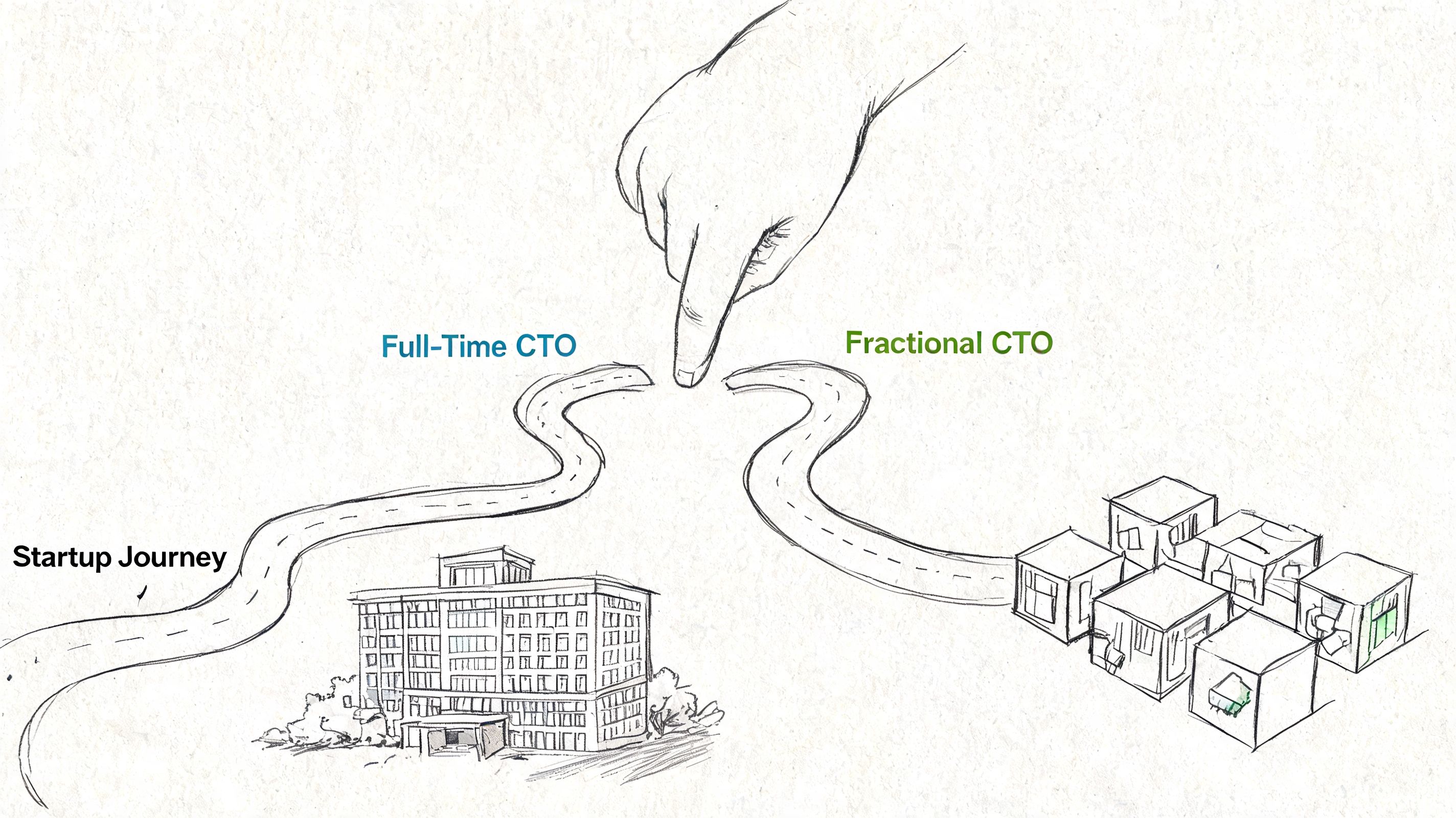
A common founder mistake shows up right after the first signs of traction. Revenue starts to move, the product has real users, and every technical decision suddenly carries more weight. The question becomes whether to hire a full-time CTO now, or buy senior technical judgment in a lighter form until the business is ready.
The answer depends less on headcount and more on risk.
A startup does not create valuation by filling executive titles. It creates valuation by making the right technical choices at the right stage. Early on, that usually means getting senior oversight without committing to a permanent C-suite hire before the company has enough complexity, capital, or strategic clarity to justify it.
When you likely don’t need a full-time CTO
If the company is still validating demand, adjusting the product scope, and searching for repeatable usage, a full-time CTO is often too early.
What the founder usually needs at this point is selective senior input:
Technical planning: choosing a stack, setting architecture boundaries, and keeping the MVP narrow enough to ship
Build strategy: deciding what to outsource, what to keep in-house, and what should wait
Quality control: preventing early shortcuts that later turn into expensive rewrites, security issues, or diligence problems
Hiring judgment: defining the first engineering hires so the team does not grow in the wrong shape
That work matters because early technical mistakes lower future option value. A weak initial architecture can slow product velocity, increase infrastructure cost, and make later hiring harder. Those are business problems, not just engineering problems.
When fractional is the right move
A fractional CTO fits when the business needs senior technical leadership, but not five days a week.
This model works well for founders who are preparing for a seed or Series A raise, managing an agency or small internal team, or trying to turn a fast MVP into a system that can survive customer growth and investor scrutiny. The right partner should contribute in the areas that affect company value: architecture decisions, technical roadmap, engineering hiring, vendor review, delivery risk, and documentation that stands up in diligence.
For startups in that stage, a fractional virtual CTO service for startup technical leadership can provide strategic oversight before a full in-house executive makes financial and organizational sense.
Fractional CTO support is also useful when the founder knows the company will need a full-time CTO later, but wants to avoid hiring the wrong person too early. That is a real trade-off. An early executive hire can help if the business is ready. If it is not, the company often ends up paying for seniority without getting clear strategic output.
When a full-time CTO becomes necessary
A full-time CTO starts to make sense when technical decisions are driving enterprise value every week, not once in a while.
That usually happens when several conditions are true at the same time:
The product is live and growing: architecture, reliability, and roadmap sequencing now affect revenue retention and expansion
The engineering team is expanding: people need standards, decision-making structure, and technical leadership they can follow daily
The company is entering diligence-heavy conversations: investors, acquirers, and larger customers want credible answers on scale, security, and technical risk
The roadmap includes larger bets: platform work, data advantage, proprietary systems, or integration complexity now shape defensibility
Founders are spending too much time arbitrating technical decisions: the business needs an executive owner for technology, not occasional advice
At that point, the CTO is no longer a part-time advisor to the build process. The CTO becomes a strategic operator who protects the asset value of the codebase, the quality of engineering decisions, and the company’s ability to scale without a reset.
For founders, the practical test is simple. If technology is already affecting fundraising, hiring, delivery confidence, customer trust, and the shape of future margins, you need real CTO ownership. If those pressures are emerging but not constant, fractional support is often the smarter move.
The CTOs Impact on Fundraising and Company Valuation
Investors don’t fund code quality as an abstract virtue. They fund risk-adjusted upside.
That’s why the best CTOs have a direct effect on valuation. They reduce the chance that the product will fail under growth, they make the architecture legible during diligence, and they turn the codebase into something a buyer or investor can treat as an asset instead of a cleanup project.
What investors are really evaluating
During fundraising, technical scrutiny usually lands on a small set of questions:
Can this system scale without a rewrite?
Is the engineering organization making deliberate choices or improvising?
Does the product contain proprietary advantage, or is it mostly assembled from commodity parts?
Will future capital go into growth, or into repairing prior shortcuts?
A credible CTO gives disciplined answers to those questions. Not with jargon. With evidence in the form of architecture decisions, engineering standards, documented trade-offs, and a roadmap that matches the company’s business plan.
Audit-ready beats impressive-sounding
Founders sometimes confuse flashy technology with strategic value. Investors usually don’t.
A clean web application with clear service boundaries, sensible observability, consistent deployment practices, and understandable data models is more valuable than a chaotic stack built to sound advanced. If you want a grounded look at how production systems should be approached, Buttercloud’s writing on web application development is directionally aligned with what investors expect from software that’s meant to last.
A technical moat isn’t a pile of tools. It’s a system competitors can’t easily replicate and investors don’t need to fear.
Where valuation gets won or lost
The CTO affects valuation in at least three practical ways:
Technical debt is controlled early
Shortcuts are taken intentionally, documented, and retired before they become structural liabilities.The product architecture matches the business model
Multi-tenant SaaS, mobile workflows, internal operations tooling, and API products all need different technical choices.Due diligence becomes a demonstration, not an apology
Instead of explaining why the codebase is messy, the company can explain why the system was built this way and how it supports future scale.
A founder should treat CTO capability as part of capital formation. Because in practice, that’s exactly what it is.
Hiring Your CTO Sample Job Description and Interview Questions
If you’re hiring a CTO, don’t post a shopping list of frameworks and cloud acronyms. You’re not hiring a syntax encyclopedia. You’re hiring someone who can make the company’s technical decisions compound in the right direction.
A practical startup CTO job description
Use language like this:
Role summary
We’re hiring a Chief Technical Officer to define and lead our technology strategy, shape product architecture, support engineering hiring, and ensure our platform becomes a durable business asset.
What this person owns
Technical roadmap: align architecture and platform decisions with product and company goals
System design: establish scalable, maintainable engineering patterns for the product
Engineering leadership: mentor developers, improve execution quality, and raise technical standards
Risk management: identify security, reliability, and technical debt issues before they become business problems
Investor readiness: communicate technical strategy clearly to founders, boards, and investors
What good looks like
Sound judgment under uncertainty
Clear communication with non-technical stakeholders
Strong product instinct, not just engineering instinct
Evidence of building systems and teams through multiple stages of growth
Interview questions that reveal real CTO capability
Ask questions that force trade-off thinking.
Walk me through how you’d decide between building a feature in-house or buying a third-party solution.
What would you want to understand before committing to our current stack?
How do you decide which technical debt to fix now versus later?
Describe a time you had to explain technical risk to non-technical leadership.
If you joined tomorrow, what would you review first in our codebase, infrastructure, and team setup?
How do you know when a startup is overengineering?
What would make you slow down delivery, even if the founder wanted speed?
What to listen for
Good CTO candidates answer in business terms as often as technical ones.
Listen for whether they connect architecture to margin, reliability to trust, hiring to execution, and debt to valuation. If every answer stays trapped at the tool level, you’re probably speaking with a senior engineer, not a technical executive.
If you’re building an MVP, preparing for diligence, or trying to add real technical leadership without guessing, Buttercloud works with founders on product architecture, investor-ready engineering, and fractional CTO support that ties technical choices directly to business value.