Chief Technical Officer Responsibilities

Founder & CEO, Buttercloud
You’re probably in one of two situations right now.
You’ve got product momentum, investor conversations, maybe even a scrappy MVP in the market, and suddenly every important question is technical. Should you keep building on the current stack? Is your freelance team amplifying your efforts or digging a hole? Can your platform survive customer growth, enterprise security reviews, or due diligence from investors? You know these questions matter. You also know you’re not the person who should be guessing.
Or you already hired developers, and now the pain has changed shape. Features ship inconsistently. Bugs keep resurfacing. Sales asks for security answers nobody can give clearly. Product wants speed, engineering wants rewrites, and you’re stuck arbitrating debates you can’t properly evaluate.
That’s the founder’s crossroads.
A Chief Technology Officer is not just the person who “owns engineering.” A strong CTO turns technical choices into business advantage. A weak one turns your codebase into a valuation discount waiting to happen. If you’re building a startup, chief technical officer responsibilities sit directly in the path of revenue, fundraising, reliability, hiring, and exit value.
Founders often treat this role like a senior developer with a better title. That’s a mistake. The job is bigger and far more consequential. The CTO decides whether your product becomes an asset investors trust or a liability they price against.
The Founder’s Crossroads Without a Technical Co-Pilot
A founder gets through discovery, lands early user interest, hires a few engineers, and starts hearing questions that change the company’s trajectory.
Why did the team choose this backend framework? Can the platform support multi-tenant SaaS properly? Why is onboarding slow? What happens if production goes down? Why is a customer asking for encryption details and disaster recovery plans before signing?
None of those questions are academic. Each one affects sales cycles, product velocity, customer trust, and investor confidence.
Without a technical co-pilot, founders usually default to one of three bad patterns:
-
Delegate blindly: You trust whoever sounds most confident in Slack or on a call.
-
Micromanage from fear: You insert yourself into decisions you’re not equipped to lead.
-
Delay the hard calls: Architecture, security, and hiring standards get postponed until they become urgent and expensive.
The result is predictable. The company ships software, but not necessarily an investor-ready technical asset.
Founders don’t lose leverage because they lack vision. They lose leverage because nobody is translating that vision into durable technical decisions.
That’s why understanding chief technical officer responsibilities matters so early. The CTO role has evolved far beyond operational oversight. Modern CTOs bridge technology and business outcomes, and they directly influence scalability and investor readiness, as described in Indeed’s overview of the modern CTO role.
If you’re a founder, you should judge this role by one standard. Does this person increase the value of the company through technical leadership? If not, the title doesn’t matter.
What Are the Two Faces of a Modern CTO: Strategist and Operator?
A founder feels this split fast. Monday morning, an investor asks whether the platform can support enterprise growth without a rewrite. Monday afternoon, a release slips because the team has no clear ownership, no delivery discipline, and too many manual steps.
Your CTO has to answer both problems.
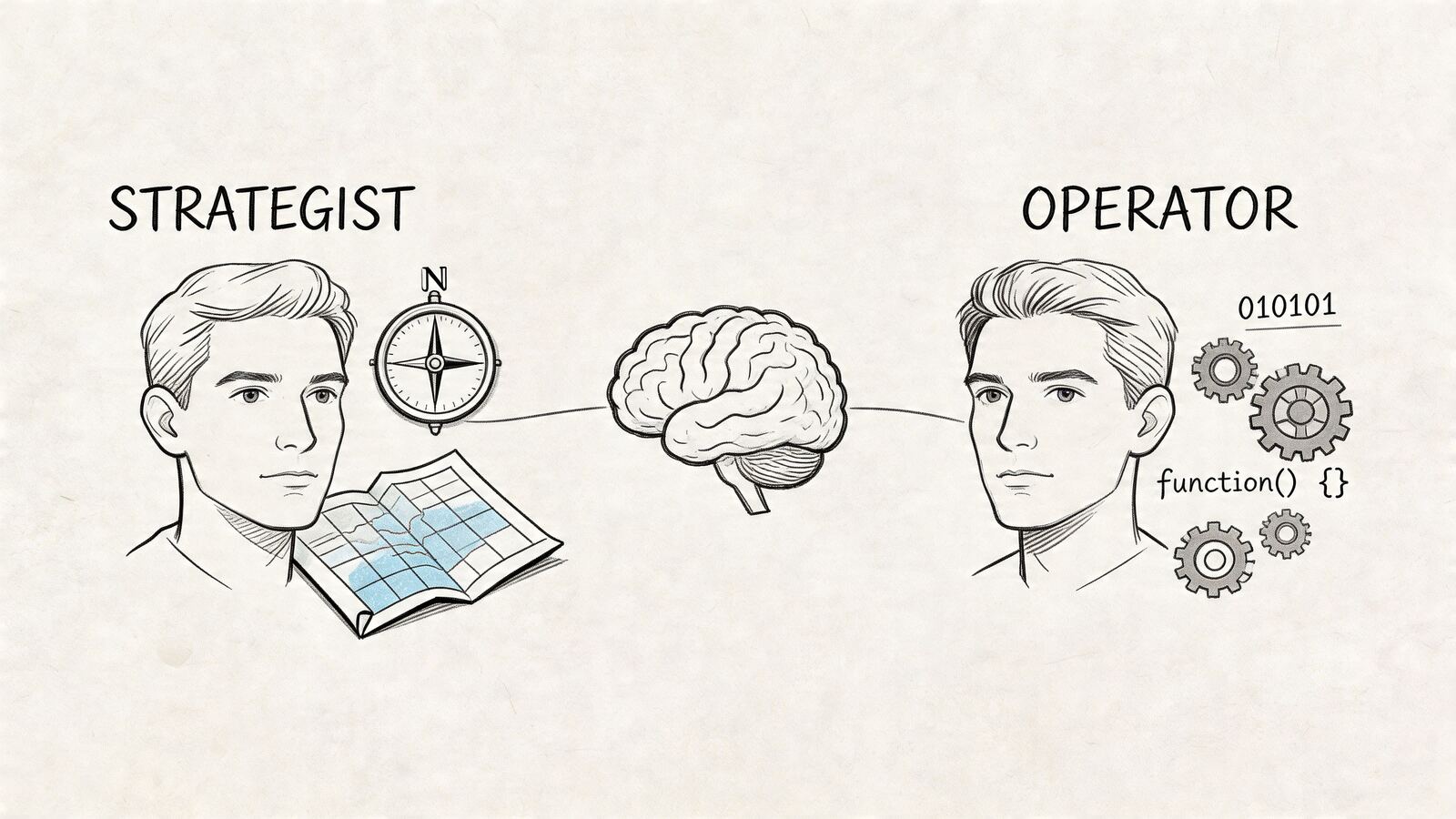
A weak CTO picks one lane. A high-value CTO connects them. Strategy sets the shape of the asset you are building. Operations prove that asset can perform under pressure, survive diligence, and scale without burning cash.
The strategist builds an asset investors can underwrite
The strategist side of the role decides what kind of technical company you own. That decision shows up in architecture, data design, platform boundaries, security posture, and the places where you spend scarce engineering time.
This work has direct valuation impact. Investors do not assign premium value to a codebase that only works under founder supervision. They assign value to a system that can scale, support new products, satisfy larger customers, and absorb growth without chaos.
A strategist-level CTO asks questions like:
Strategic question
Why it matters
Should we start with a modular monolith or plan service boundaries from day one?
The wrong choice either slows product delivery or creates an expensive migration later.
What data model will support reporting, billing, auditability, and enterprise workflows?
Data decisions shape product flexibility and the credibility of your operating metrics.
Which technical investments create defensibility?
Custom work should strengthen margin, retention, or product differentiation.
What should engineering own versus buy from vendors?
Poor ownership choices waste capital and distract the team from the product that drives company value.
Founders often underestimate this mode because the mistakes do not hurt immediately.
They hurt during due diligence, in enterprise sales, and in the first scaling phase when shortcuts stop being cheap.
The operator turns technical intent into repeatable execution
The operator side of the CTO role protects the company from drift. Product plans become delivery systems. Reliability becomes a management standard. Security becomes a habit, not a scramble before a customer call.
That is what makes the business credible.
A CTO operating well in this mode drives:
-
Planning discipline through clear priorities, tradeoff decisions, and predictable execution cadences
-
Production reliability with visible ownership of uptime, incident response, and recovery readiness
-
Engineering quality through SDLC standards, testing expectations, code review, and release controls
-
Platform consistency through sane tooling, infrastructure standards, and developer workflows that reduce avoidable mistakes
-
Technical debt control by deciding which shortcuts are acceptable and which ones reduce speed, margin, or trust
In practice, valuation hinges on operational execution. If releases slip, customer commitments fail. If systems are unstable, enterprise deals stall. If the engineering team cannot explain how software is built, deployed, and secured, investors discount the asset because they see execution risk.
What founders usually miss
They hire for technical talent and assume business judgment will follow.
It usually will not.
The startup does not need a CTO who wins arguments about frameworks. It needs a CTO who can make technical decisions that improve company value, reduce execution risk, and give investors confidence that growth will not break the business.
Practical rule: If a CTO candidate talks mostly about tools, languages, and personal coding preferences, keep looking. The job is to turn technical complexity into an asset the company can sell, scale, and defend.
The modern CTO has two jobs at once. Build the future asset. Run the current machine. If one side is missing, valuation suffers.
How Do CTO Responsibilities Change by Startup Stage?
A founder usually feels the stage change before the org chart reflects it.
One quarter, the company needs a technical builder who can get the first product into customers’ hands without creating expensive cleanup later. The next quarter, that same company needs someone who can install execution discipline, hire stronger engineers, and answer investor questions without sounding vague or defensive. If the CTO does not change with the business, valuation gets capped. Buyers and investors do not pay premium multiples for technical uncertainty.
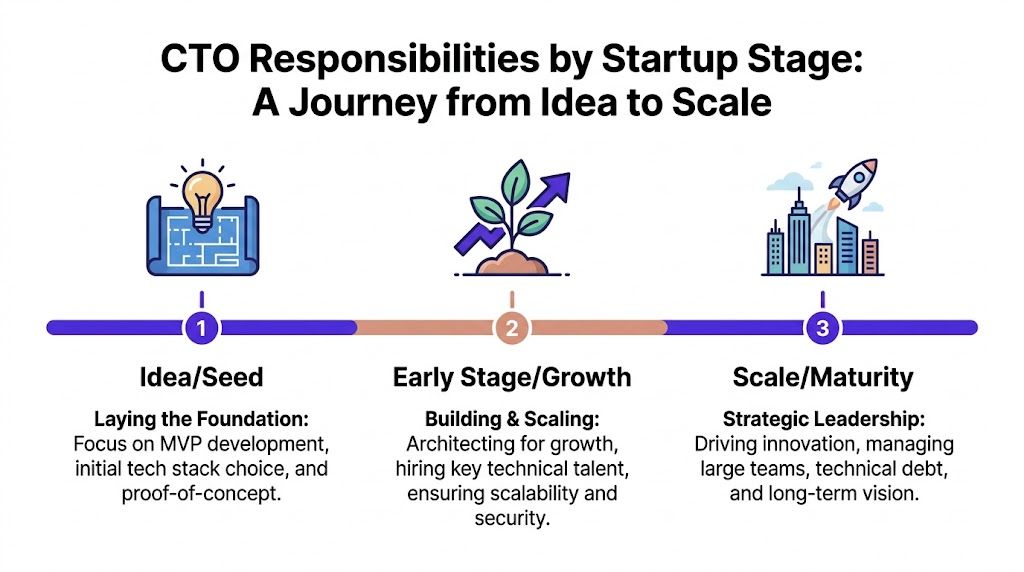
MVP stage
At the MVP stage, the CTO is building more than a product. They are setting the terms for future speed, hiring, and diligence.
The priority is not feature volume. It is choosing the few technical decisions that are expensive to reverse. Stack choice affects hiring. Data model decisions affect reporting, integrations, and pricing flexibility. Early vendor decisions affect margin and security posture. Founders who treat this phase like a race to ship anything usually inherit a fragile codebase that investors later discount.
A strong CTO in this phase should personally own a short list of responsibilities:
-
choose a stack the company can hire and maintain
-
define a simple architecture that can survive real customer usage
-
set coding, testing, and deployment expectations early
-
choose core services such as auth, billing, analytics, and cloud infrastructure
-
make disciplined build-versus-buy decisions
The output is not “we launched.” The output is a technical base that can support revenue, survive diligence questions, and avoid a rewrite the minute the first serious customer asks for more.
Growth stage
Growth is where weak technical leadership stops being a private problem and becomes a company valuation problem.
More customers expose the shortcuts. Sales commits to dates. Product wants broader scope. Engineering starts feeling slower even as headcount rises. The CTO’s job shifts from direct contribution to building a machine that ships predictably and can explain itself to the rest of the business.
At this stage, responsibility changes in a clear way:
Focus area
What the CTO must do
Delivery process
Set planning rhythms, assign ownership clearly, and reduce missed handoffs
Team building
Hire engineers and managers who raise the bar and improve output per head
Execution discipline
Standardize review, testing, release controls, and incident follow-through
Technical debt
Rank debt by business impact, then fix what threatens speed, margin, or trust
Commercial alignment
Explain constraints, tradeoffs, and timing in language product, sales, and finance can use
The growth-stage CTO also becomes a translator. They need to connect roadmap choices to revenue timing, connect architecture choices to delivery risk, and connect engineering capacity to board expectations. If they cannot do that, the company looks less mature than its revenue suggests.
Scaling stage
At scale, the CTO is judged by the quality of the system they build around themselves.
That means leadership bench strength, operating discipline, technical decision quality, and external credibility. A scaling company cannot depend on one person to approve every architecture choice, rescue every incident, or interview every engineer. That structure breaks under growth and signals key-person risk to investors.
Three responsibility shifts matter most.
Risk management becomes part of the job description
The CTO now owns technical exposure with executive consequences. Reliability failures affect renewals. Dependency issues affect security reviews. Poor change management affects enterprise trust. The company needs clear operational ownership, better forecasting, and stronger preparation for incidents and audits.
Organizational throughput matters more than individual output
A scaling CTO builds managers, delegation paths, standards, and decision rules. The goal is not to stay closest to every hard problem. The goal is to make many teams effective at once. That increases shipping capacity without multiplying chaos.
External communication becomes a valuation function
Investors, board members, enterprise customers, and acquirers ask harder questions at this stage. They want crisp answers on scalability, security posture, hiring plans, delivery reliability, and technical risks. A CTO who can explain those issues in business terms raises confidence in the asset. A CTO who cannot explain them creates a discount.
A CTO who fits the first release can still hurt the company later if they never grow past personal execution.
What founders should watch for
Match the CTO to the company you are trying to become, not the company you were six months ago.
-
Pre-product: hire for judgment, product instinct, and clean early technical choices
-
Early traction: hire for process design, hiring quality, and commercial alignment
-
Scaling: hire for org design, risk control, and investor-grade communication
If your technical leader keeps making that transition, back them hard. If they do not, fix it early. Loyalty is not a strategy, and the market does not reward founders who let a misfit CTO slow the company’s path to an investor-ready technical asset.
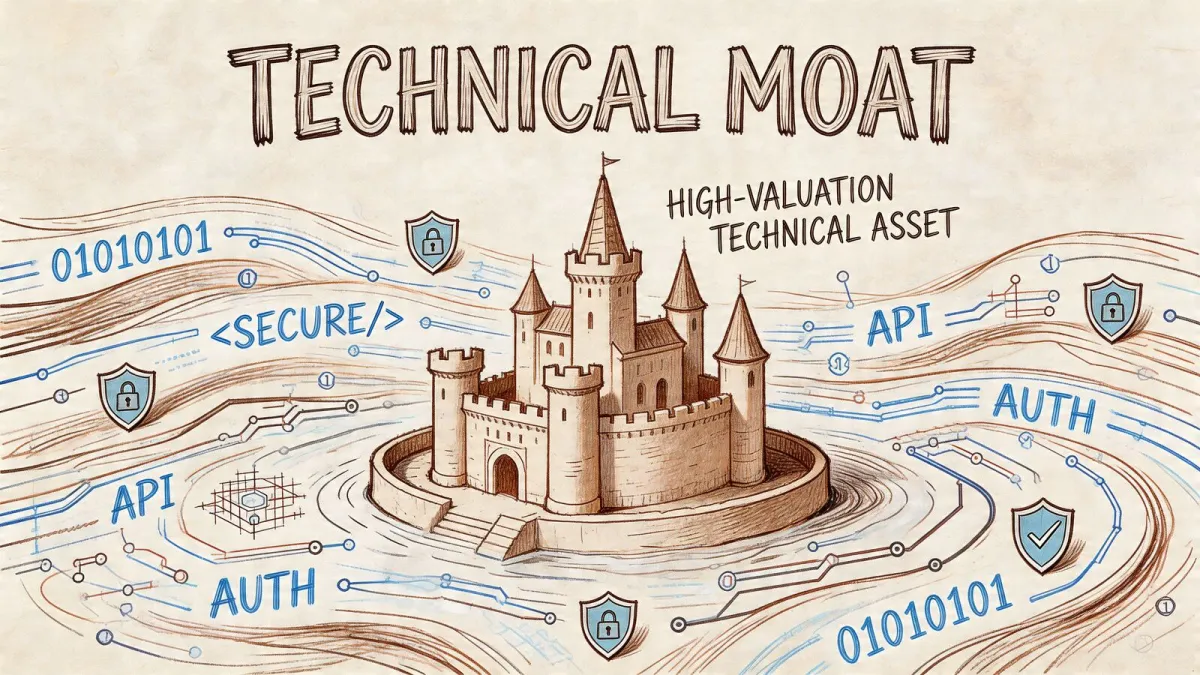
Building a Technical Moat Architectural and Security Duties
A startup’s architecture is not just an engineering concern. It is a pricing signal on future company value.
If your product works today but can’t scale cleanly, can’t pass diligence, or can’t satisfy enterprise security review, you don’t have a moat. You have a demo.
Architecture is a valuation decision
The CTO owns the decisions that determine whether the product becomes durable.
That includes service boundaries, data model evolution, integration strategy, reliability patterns, and platform conventions. It also includes restraint. Founders get hurt by both under-engineering and vanity engineering. A CTO should know when a modular monolith is the right answer and when the business has earned more system complexity.
A defensible architecture that competitors can’t easily replicate usually comes from disciplined choices like:
-
Clear domain boundaries so the product doesn’t become one tangled codebase
-
Sane build-vs-buy decisions for auth, billing, messaging, and observability
-
Predictable deployment pipelines so releases don’t become high-drama events
-
Developer self-service paths that reduce one-off infrastructure requests
Security is not a later-phase add-on
Many startups lose credibility at this point.
Founders often assume security hardening can wait until larger customers ask for it. That logic is backwards. By the time those questions arrive, your technical posture is already being evaluated.
CTO-led cybersecurity strategy matters because non-compliance can risk 20 to 30 percent valuation discounts during investor reviews, according to Baremetrics’ CTO overview. The same source notes that this work includes implementing AES-256 encryption, orchestrating threat detection, and defining disaster recovery with RPO under 5 minutes and RTO under 1 hour.
That’s not abstract governance. That’s business continuity, diligence readiness, and buyer confidence.
The moat is built across systems, not slide decks
When I advise founders, I look for five responsibilities under this umbrella:
-
Platform architecture
The CTO defines how core product services fit together and where future scaling pressure will hit first. -
Data integrity
Reporting, billing, permissions, analytics, and compliance all depend on data design. Bad schema decisions haunt companies for years. -
DevOps discipline
CI/CD, rollback strategy, environment consistency, secrets management, and observability need ownership from day one. -
Disaster readiness
Investors and customers both care whether the platform can recover quickly and predictably. -
Audit readiness
Security controls, access patterns, documentation, and operational evidence should not be assembled in a panic before diligence.
The fastest way to slow a startup is to ship software that creates fear. Fear in customers, fear in investors, and fear inside your own engineering team.
The CTO’s architectural and security duties are what turn software into an asset that can survive scrutiny.
How Should You Build Your CTO Hiring Playbook and Org Design?
The best CTOs don’t just build software. They build the team that keeps building after they step out of the room.
If you’re evaluating chief technical officer responsibilities, many founders underestimate the role’s impact on organizational design. A weak org design creates slow delivery, sloppy ownership, and expensive hiring mistakes. A strong one creates throughput.
The first org chart should be boring
Founders love clever structures. Don’t.
Your earliest engineering org should have clear ownership and minimal ambiguity. Start with the work the company needs done. That usually means product engineering, backend or platform ownership, frontend or mobile ownership, QA discipline embedded into delivery, and infrastructure or DevOps stewardship. Titles matter less than accountability.
A CTO should define:
-
Who owns customer-facing product work
-
Who owns platform and shared services
-
How code review works
-
How incidents get handled
-
How product and engineering planning connect
If you need a practical reference on team shape and role clarity, Buttercloud’s perspective on a team of developers is useful for thinking through early-stage engineering composition.
Hiring should screen for judgment, not just output
Many startups hire developers based on speed signals alone. Fast take-home work. Strong GitHub profile. Solid framework familiarity.
That’s incomplete.
Your CTO should design a process that tests for architecture thinking, ownership, communication, and ability to work in ambiguity. For founders building their first technical team, this guide to recruiting developers is a solid companion resource because it helps structure sourcing and evaluation without reducing the process to resume filtering.
A practical CTO hiring checklist for the engineering org looks like this:
-
Define role scorecards: Each hire should map to business need, not generic “we need more engineers.”
-
Standardize interviews: Use the same rubric for problem-solving, code quality, communication, and ownership.
-
Write sharp job descriptions: Good candidates want to know the system they’re joining, not just the stack.
-
Build onboarding intentionally: New engineers should understand architecture, release process, and coding conventions quickly.
-
Create a career path early: Even a small team benefits from visible standards for growth and accountability.
Retention starts with engineering environment
Top engineers don’t stay because of slogans. They stay because the company has clear decisions, sane processes, and leadership that protects focus.
A CTO’s most scalable contribution isn’t personal coding output. It’s the quality of the engineering environment they create.
That environment becomes a recruiting advantage. It also becomes visible during diligence. Investors can tell when engineering is a system and when it’s a pile of personalities.
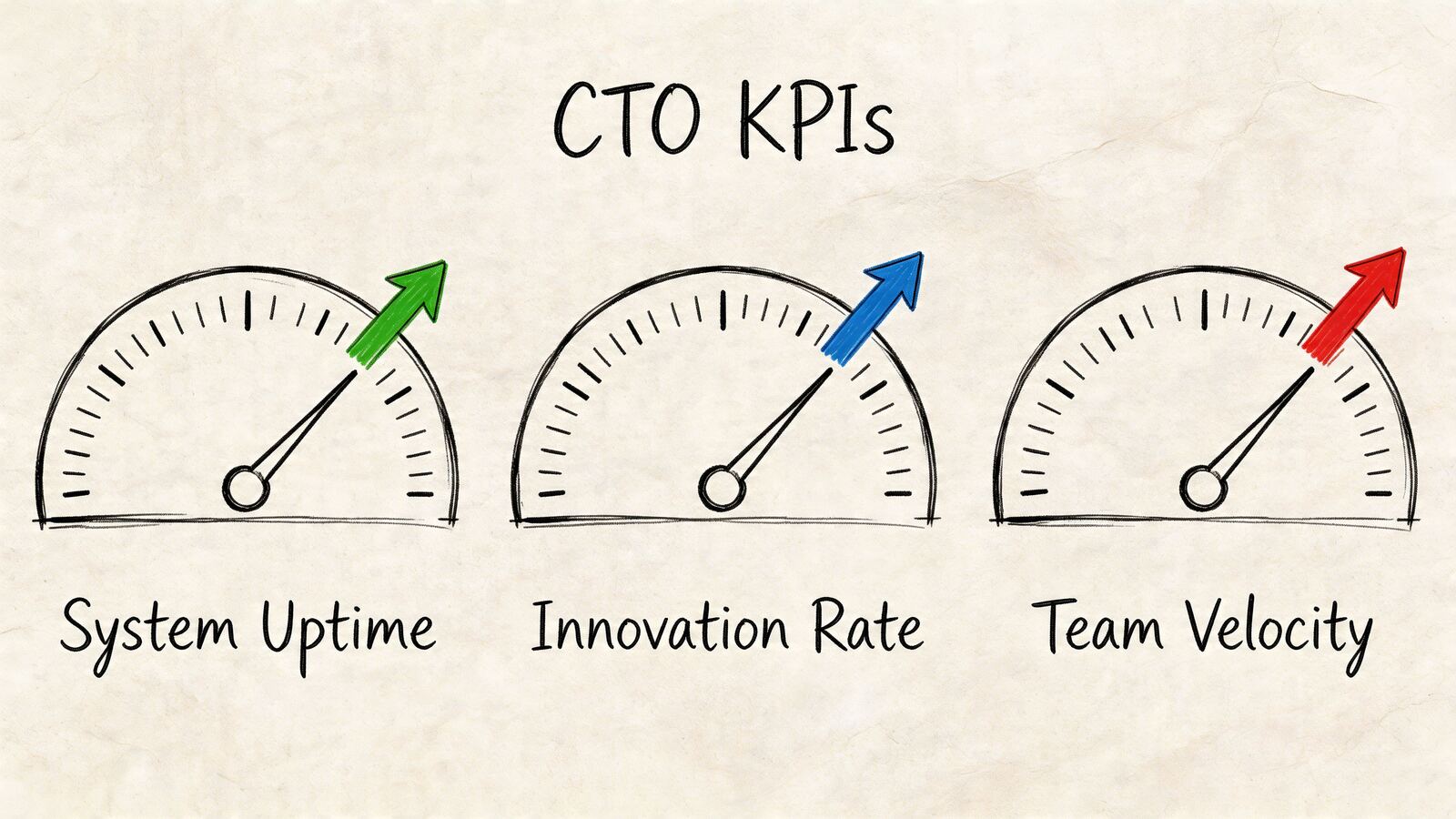
How Do You Measure Success With KPIs for a High-Impact CTO?
If you can’t measure your CTO’s impact, you’ll default to charisma, confidence, and storytelling.
That’s how founders keep the wrong technical leaders too long.
Operational credibility
Start with the hard evidence that the platform is under control.
A CTO in a venture-backed company is often acting as a compliance translator for investors, and 60 percent of Series A rejections are tied to unproven security postures, while the ability to show an audit-ready platform with 99.9 percent uptime is directly linked to fundraising success and valuation, according to MIT Professional Education’s leadership article on the CTO role.
That means your dashboard can’t just focus on feature delivery. It must show whether the technical operation deserves trust.
Track things like:
KPI category
What to look for
Reliability
Availability, incident frequency, recovery quality
Delivery health
Cycle time, release consistency, blocked work
Quality
Bug recurrence, escaped defects, test discipline
Security posture
Audit evidence, vulnerability handling, control maturity
Team and execution signals
A CTO also owns the machine behind the metrics.
You should be asking: Is the team getting faster because the system is improving, or only because a few strong individuals are carrying it? Is delivery predictable enough that product and commercial leaders can plan around engineering capacity?
Useful founder questions include:
-
Can the team ship without drama?
-
Do incidents produce better systems, or just apologies?
-
Are roadmap commitments grounded in capacity, or wishful thinking?
-
Is technical debt being managed deliberately?
Strategic impact
The highest-value KPI category is strategic, even though it’s the hardest to fake and the easiest to ignore.
A CTO should improve the company’s ability to raise capital, win customer trust, and scale architecture without recurring crises. You won’t capture that in a single metric. You’ll see it in patterns.
Look for signs such as:
-
board conversations getting clearer, not murkier
-
enterprise questionnaires getting answered without scramble
-
cloud and infrastructure choices becoming more intentional
-
product decisions reflecting technical reality rather than internal hope
-
engineering leaders emerging beneath the CTO instead of everything centralizing upward
If your CTO reports only activity, you’re missing the point. You need evidence that technical leadership is reducing risk and increasing enterprise readiness.
A good CTO dashboard helps you ask sharper questions. It doesn’t replace judgment, but it prevents fantasy.
The Fractional CTO Your Strategic Co-Pilot to Scale
Early-stage founders often rush into one of two bad hires. They either appoint the strongest developer as CTO before that person has earned the role, or they wait too long and let architecture, process, and diligence readiness drift.
A fractional CTO is often the smarter move.
When fractional beats full-time
If you’re a non-technical founder, you probably don’t need a full-time executive sitting in every internal meeting yet. You need senior judgment on the decisions that matter most: architecture, hiring standards, roadmap realism, security posture, and investor readiness.
That’s exactly where a fractional model works.
According to Splunk’s CTO role overview, 70 percent of failed ventures cite poor codebase quality as a valuation killer, and fractional CTOs help by enforcing build-vs-buy frameworks and automated compliance, which can reduce scaling costs by 40 percent while preparing the company for investor due diligence.
Those are not side benefits. That is the core strategic value.
What a strong fractional CTO actually does
A serious fractional CTO is not a casual advisor who joins one call a month and hands out generic opinions.
They should own high-impact responsibilities such as:
-
technical roadmap and sequencing
-
architecture review and stack decisions
-
engineering hiring process design
-
vendor and tooling decisions
-
technical debt triage
-
board and investor translation
-
security and compliance readiness
-
mentoring senior engineers or new engineering managers
If you want a grounded framework for evaluating throughput and team output once this leadership layer is in place, this resource on engineering productivity measurement is worth reviewing because it helps founders move beyond gut feel.
The founder-level advantage
The biggest benefit is capital efficiency with discipline.
You preserve cash for product development while still getting executive-level technical oversight. That matters when the company is between milestones and doesn’t yet need a permanent CTO operating at full capacity every week.
For startups that need this model, a virtual CTO service can provide architecture guidance, engineering hiring strategy, infrastructure standards, and technical due diligence preparation without forcing a premature full-time executive hire.
Hire full-time when the business needs constant executive technical leadership. Hire fractional when the business needs senior judgment more than executive bandwidth.
A founder should use fractional leadership to de-risk the company, not to postpone hard decisions. If the model is working, it should leave behind stronger systems, better hiring, and a codebase that gets more investable over time.
Your CTO Hiring Toolkit Job Description and Interview Questions
Most startup CTO job descriptions are useless. They ask for “visionary leadership,” “strong communication,” and “deep technical expertise” without defining the actual job.
Write the role around outcomes.
Sample startup CTO job description
Role summary
We are hiring a CTO to lead technology strategy, architecture, engineering execution, and technical team development. This role will translate business goals into an investor-ready technical roadmap and build the systems, standards, and team required to scale the product responsibly.
Core responsibilities
-
Own platform architecture, infrastructure standards, and key technical decisions
-
Establish engineering processes for planning, code quality, testing, CI/CD, and release management
-
Partner with product leadership to align roadmap ambition with technical capacity
-
Manage technical debt deliberately and make tradeoffs visible to leadership
-
Lead security, resilience, and operational readiness across the platform
-
Build and mentor the engineering organization, including hiring, onboarding, and role definition
-
Communicate technical strategy clearly to founders, investors, and external stakeholders
Candidate profile
-
Strong background in software engineering and systems architecture
-
Experience leading engineering teams through startup growth
-
Ability to connect technical decisions to product, revenue, and risk
-
Comfortable operating at both strategic and hands-on levels
-
Clear communicator with non-technical stakeholders
-
Good judgment under delivery pressure
Interview questions that actually test the role
Don’t ask abstract leadership questions first. Ask for decision-making under startup constraints.
Use questions like these:
-
You inherit an MVP with messy code and early customer traction. What do you fix immediately, and what do you leave alone?
-
How do you decide between building a system internally and buying an external service?
-
Describe how you’d align engineering output with product priorities when the roadmap exceeds team capacity.
-
What does an investor-ready architecture look like for a startup at our stage?
-
How have you handled technical debt without freezing feature delivery?
-
Walk me through your approach to incident response and production accountability.
-
What would you measure in your first quarter to understand whether the engineering team is healthy?
-
How do you explain a technical risk to a board member or investor who doesn’t have an engineering background?
What good answers sound like
Strong candidates speak in tradeoffs. They ask clarifying questions. They tie architecture, hiring, and process back to business constraints.
Weak candidates give stack opinions, generic management language, or founder-pleasing optimism with no operational depth.
If you remember one thing from this guide, make it this: chief technical officer responsibilities are valuation responsibilities. The role exists to turn product ambition into a technical asset that can scale, survive diligence, and support a real company.
If you’re building toward an investor-ready MVP or trying to turn a fragile codebase into a scalable technical asset, Buttercloud works with founders on product architecture, fractional CTO leadership, and production-grade engineering systems that support growth and due diligence.
Have a product idea to talk through?
We'll show you how we'd approach it — no pressure, just a real conversation.
Book a Discovery Call