Build a High-Performing Team of Developers

Founder & CEO, Buttercloud
You probably started with a product idea, a few customer conversations, and a vague assumption that you now need “a dev team.”
That framing is too small.
A team of developers is not just the group that ships your app. It is the system that determines whether your product becomes an investable asset or an expensive rewrite. Investors, acquirers, and senior operators do not only look at what your product does. They look at how your team built it, how safely it can evolve, and whether the codebase will survive growth.
Founders get this wrong in predictable ways. They hire for speed without standards. They over-index on résumés and underweight architecture. They confuse cheap labor with a way to gain an advantage. Then they discover that a sloppy MVP is not an asset. It is deferred liability.
Build your team like you are building a company that must withstand scrutiny. Because you are.
The Architect’s Mindset for Building Your Tech Team
Most founders approach hiring as a staffing problem. It is not. It is an asset design problem.
If you are serious about valuation, your first technical decisions should answer one question: will this team produce code, systems, and operating habits that survive due diligence? If the answer is unclear, you are not hiring well enough.
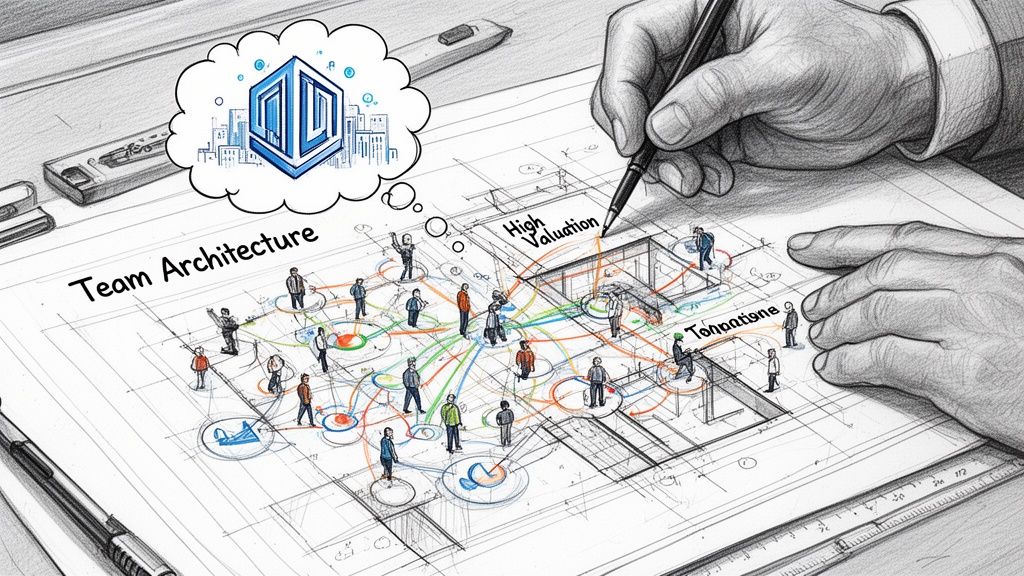
Think like an owner of technical assets
A founder who treats engineering as a cost center hires differently from a founder who treats engineering as company value.
The first founder asks, “Who can build this fastest?”
The second asks better questions:
-
Architecture: Can this team make good early decisions on data models, service boundaries, mobile architecture, and infrastructure?
-
Stewardship: Will anyone still understand this code six months from now?
-
Auditability: Can someone outside the team inspect the system and trust what they see?
-
Resilience: Does the team work in a way that reduces the odds of ugly surprises during growth?
That is the mindset shift. You are not collecting coders. You are building a machine that turns capital and product direction into durable technical advantage.
The market is bigger than your old assumptions
The good news is that talent is not scarce in the simplistic way founders imagine. The global developer population reached approximately 47.2 million by early 2025, up 50% from just over 31 million in Q1 2022, according to SlashData’s global developer population trends for 2025.
That matters for one reason. You have options.
You are no longer constrained to your city, your accelerator network, or whoever posted the loudest on LinkedIn. A modern team of developers can be assembled around capability, communication, and execution standards rather than geography alone.
Practical rule: hire for judgment before you hire for headcount. One architect-level engineer who makes sound decisions creates more value than several people producing unstructured output.
What investors care about
Investors care about speed, but only if the speed is compounding. Fast delivery that creates rework is not speed. It is drift.
They want to see evidence that your team can:
What they inspect
What it signals
Clean architecture choices
Lower rewrite risk
Consistent delivery process
Predictable execution
Clear ownership of systems
Lower operational chaos
Good documentation and reviews
Transferable knowledge
Infrastructure discipline
Safer scaling path
A founder should read that table and adjust every team decision accordingly.
If your current plan is “hire a few developers and figure it out later,” stop. Later is when those weak choices become expensive.
How Do Your First Hires Define Your Technical DNA?
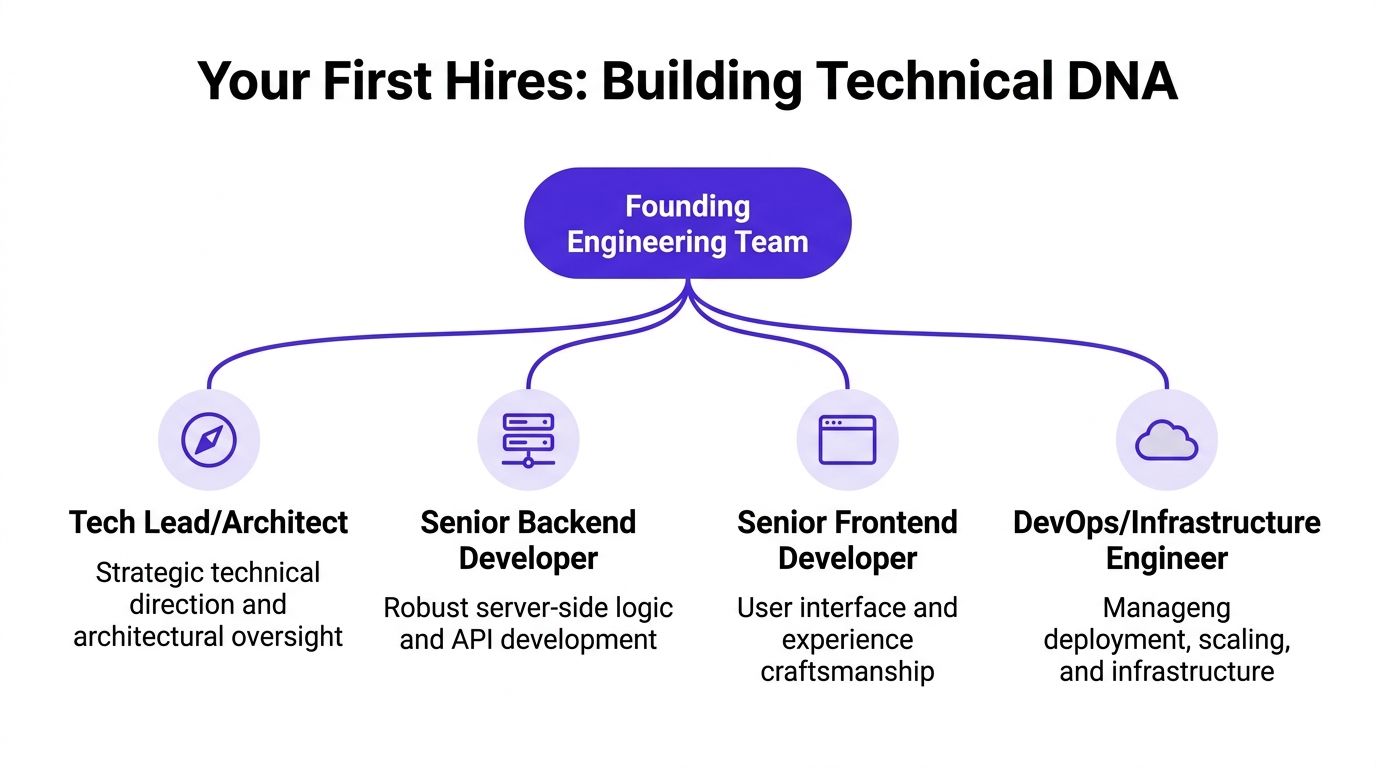
Your first hires do not just fill roles. They set the standard everyone else will copy.
That is why early hiring mistakes linger. A weak first engineer does not just write weak code. They shape your repo structure, testing habits, deployment patterns, naming conventions, and product-engineering culture. The next hire inherits all of it.
Start with a player-coach, not a task-taker
The first strong technical hire should usually be a senior builder who can both ship and make architectural calls.
Do not start with a narrow specialist unless your product has a genuine specialty constraint. Most early-stage products need a T-shaped developer. Broad across product delivery, deep in one core domain.
That person can make trade-offs across frontend, backend, data, infrastructure, and product workflows without freezing the roadmap every time the team hits ambiguity.
A useful benchmark here is talent maturity. Over 50% of the global developer population has more than 6 years of experience, according to ITRansition’s software development statistics. You do not need to settle for a junior-first foundation if your product is important.
Your first one to three hires
For most investor-oriented MVPs, the sequence matters more than the org chart.
Hire one needs judgment
This should be your technical lead, founding engineer, or architect-minded senior full-stack developer.
What they must do well:
-
Translate product ambiguity into systems.
-
Choose boring, durable defaults for frameworks, cloud setup, auth, data storage, and deployment.
-
Write production-grade code, not demo-grade shortcuts.
-
Mentor future hires so the team compounds instead of fragments.
If a candidate only talks about velocity and never talks about maintainability, they are not ready.
Hire two balances the product surface
The second hire should complement the first hire’s weak side.
If hire one is backend-heavy, bring in someone strong on frontend or mobile product execution. If hire one is a polished frontend engineer, add someone with stronger backend and data instincts.
Founders often get distracted by brand-name résumés. Ignore the logo worship. Focus on shipping range, communication, and ability to work from imperfect requirements.
Hire three protects delivery discipline
By the third hire, most startups feel pressure to “just add more devs.” Resist that reflex.
The third hire should improve team reliability. That could be another senior product engineer, or it could be someone with strong infrastructure and DevOps instincts if your product has meaningful operational risk.
If you want a deeper comparison of early-stage team structures, Buttercloud’s guide on app development teams is useful reading.
Founders should ask one blunt question in every interview: “Would I trust this person to explain our architecture to an investor, a future CTO, or an acquirer?” If not, they are not an early hire.
Roles you probably do not need yet
Founders over-hire specialists early because specialists sound impressive.
Usually, you can delay these until the product and usage justify them:
-
Dedicated QA department: early teams should build testing into engineering, not bolt on a handoff model.
-
Premature data science hiring: if you do not yet have meaningful product data, this becomes theater.
-
Separate platform teams: too much organizational structure too early slows product feedback.
A simple lens for role design
Use this quick filter before opening any role:
If your product needs
Prioritize
Broad MVP execution
Senior full-stack generalist
Heavy consumer UX
Frontend or mobile product engineer
Complex workflows or integrations
Backend architect-minded engineer
Security, uptime, deployment rigor
DevOps-capable senior engineer
Your first hires become your technical DNA. Hire for judgment, range, and standards. Skills can be supplemented later. Bad instincts become culture.
Hiring vs Contracting The Unspoken Trade-Offs
Founders usually frame this as cost versus commitment.
That is amateur thinking.
The question is this: which model gives you the strongest mix of speed, IP control, architectural continuity, and operational trust? Sometimes that is a full-time hire. Sometimes it is a contractor. Sometimes it is a boutique partner. These are not interchangeable.
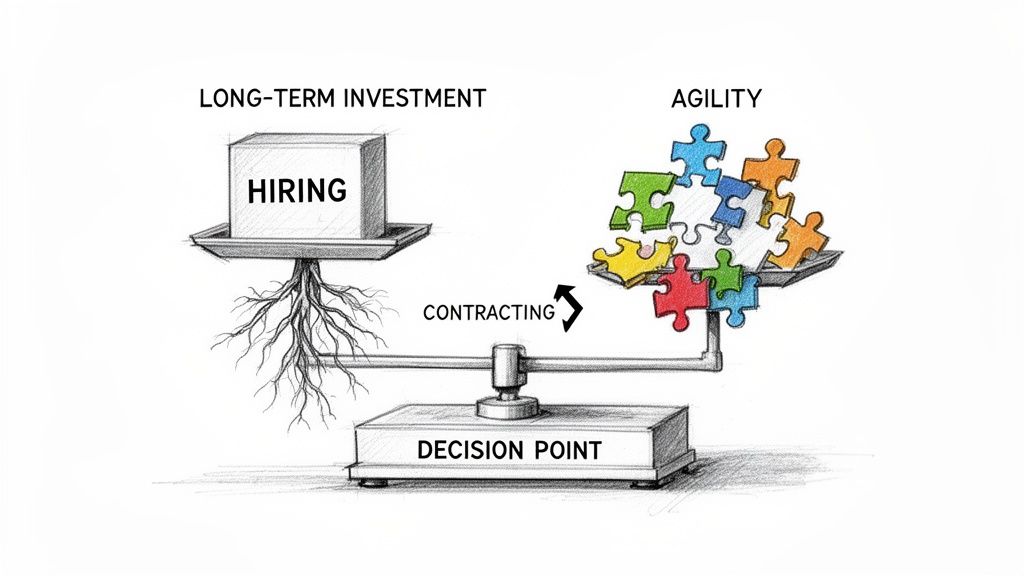
Full-time hires are not automatically safer
A bad full-time engineer can do more damage than a good contractor.
Why? Because founders tend to trust employees by default. They leave them unsupervised, let architecture drift, and assume “in-house” means aligned. It does not. In-house without technical leadership just creates internal technical debt instead of external technical debt.
Full-time hiring makes sense when you need:
-
Long-term product ownership
-
Deep context retention
-
Cultural continuity
-
Permanent internal capability
But if you hire too early, before you know what good looks like, you often lock in the wrong stack, the wrong habits, and the wrong people.
Contractors are valuable when the scope is clear
A contractor can be an excellent move if you know exactly what must be built, how it should be built, and who will own it after delivery.
Contractors fail when founders use them to substitute for missing technical judgment. If you do not have someone setting standards, reviewing decisions, and protecting IP, you are not buying speed. You are renting uncertainty.
This is why black-box outsourcing is dangerous. You get demos, not durable systems. You get deliverables, not stewardship.
Boutique partnerships can outperform both
A strong boutique engineering partner sits in the middle. You get execution plus architectural oversight, but without prematurely building a bloated internal org.
That model works when the partner behaves like an extension of the company rather than a ticket-processing vendor. You need transparency, code access, documentation discipline, clear ownership terms, and active founder education.
That is the difference between outsourcing and partnership. One hides complexity. The other helps you master it.
Stop chasing loud talent
One of the most underrated hiring errors is equating visibility with competence.
Scott Hanselman’s framing of “Dark Matter Developers” is useful here. He describes the silent 99% of developers who avoid blogs, conferences, and social media but still build the systems companies depend on, in his piece on Dark Matter Developers.
These are often the exact people founders should want.
They care about shipping reliable systems. They are comfortable with ugly integrations, internal tooling, deployment pipelines, and business-critical software that never gets applause. A serious team of developers needs some of those people. They are builders, not performers.
My advice: hire at least one person who gets excited by stable releases, clean migrations, and sane infrastructure. Every startup has enough people excited by shiny features already.
A practical decision matrix
Situation
Best fit
You need enduring product ownership and have strong technical leadership
Full-time hiring
You need targeted expertise for a defined problem
Specialist contractor
You need execution plus architecture plus founder support
Boutique engineering partner
You have no internal technical judgment yet
Fractional CTO plus carefully managed delivery support
The unspoken due diligence issue
Investors do not reject contractor-built products on principle.
They do worry about these issues:
-
Who owns the code and all supporting assets
-
Whether knowledge is trapped outside the company
-
Whether the architecture is coherent
-
Whether future internal hires can take over cleanly
So the right answer is not “never use contractors.” The right answer is “never use contractors without governance.”
A disciplined founder treats the model as secondary. Governance is primary.
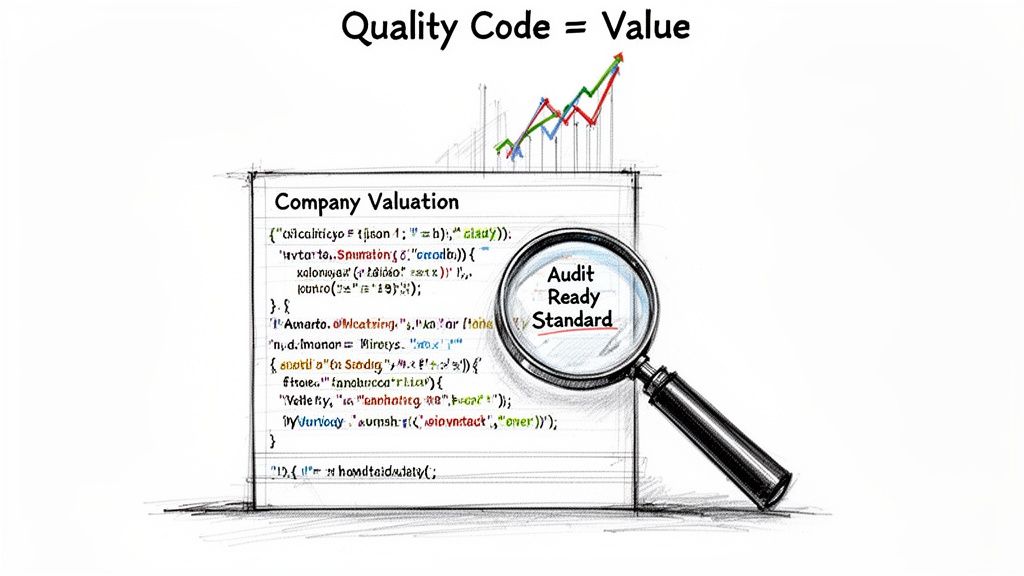
Why Is Code Quality Company Valuation?
Most founders think code quality is an engineering concern.
It is a financing concern.
When investors or acquirers evaluate your company, they are not paying for the lines of code already written. They are paying for the confidence that your product can keep evolving without collapsing under its own weight. That confidence comes from engineering discipline.
Deployment habits tell the truth
A polished demo can hide weak engineering. Delivery patterns cannot.
Elite development teams maintain change failure rates between 0-5%, while medium-performing teams experience 10% failure rates, according to Axify’s summary of agile engineering metrics. The important part is not only the number. It is how elite teams get there. They deploy in smaller increments, review code carefully, and rely on stronger automated testing.
That is exactly what discerning investors want to see. Not perfection. Control.
What audit-ready engineering looks like
You do not need enterprise bureaucracy. You need a small set of essential habits.
CI and deployment automation
Every commit should move through a predictable pipeline.
That means your team uses tools like GitHub Actions, GitLab CI, or CircleCI to run checks automatically before code reaches production. Manual release rituals are a red flag. They create inconsistency, tribal knowledge, and fear.
Smaller releases are easier to verify, easier to rollback, and easier to explain.
Automated testing that matches business risk
Do not chase vanity test suites. Build the tests that protect the business.
A useful early stack often includes:
-
Unit tests for core business logic
-
Integration tests for payment flows, auth, and critical APIs
-
End-to-end tests for core user journeys using tools like Playwright or Cypress
-
Smoke tests after deployment
The point is not “high coverage.” The point is confidence in the paths that matter.
Code review as risk control
A team of developers without serious code review is just a collection of soloists.
Every meaningful change should be reviewed for architecture, clarity, naming, edge cases, and downstream effects. Good review catches defects, but it also spreads context. That matters in diligence because buyers and investors look for systems that are understandable by more than one person.
Simple rule: if only one engineer understands a critical part of your system, that part of the system is under-governed.
Documentation is not optional
Founders hate hearing this because documentation sounds slow.
Bad documentation is slow. Useful documentation is speed.
At minimum, keep these current:
Document
Why it matters
System architecture overview
Helps new hires and investors understand the platform
Deployment and rollback process
Reduces release risk
Data model and key services
Prevents fragile tribal knowledge
Third-party dependencies and integrations
Exposes hidden business risk
Access and ownership map
Clarifies who controls what
If your team cannot explain the system clearly, the system is too fragile.
Quality standards that should exist from day one
Use a short operating checklist:
-
Version control discipline: protected branches, pull requests, and clear commit history.
-
Environment separation: development, staging, and production should not blur together.
-
Observability: logs, alerting, and basic application monitoring must exist before scale forces the issue.
-
Secrets management: credentials should not live in code or ad hoc documents.
-
Rollback readiness: every release should have a clear retreat path.
These are not “later stage” practices. These are the mechanics of trust.
Why this affects valuation directly
Messy code costs more than developer time.
It slows features, weakens security posture, complicates compliance, and makes leadership less credible when someone asks, “How does this scale?” A disciplined engineering culture answers that question with evidence.
If you want your codebase to increase company value, stop treating quality as polish. Treat it as infrastructure for trust.
When Should You Bring in a Fractional CTO?
Most founders wait too long to bring in technical leadership.
They hire developers first, then discover they still have nobody making the hard calls. Nobody is deciding architecture trade-offs, setting engineering standards, vetting vendors, or connecting the roadmap to fundraising. At that point, the team is busy but under-led.
A Fractional CTO exists to solve that gap.
The right moment is earlier than you think
Bring in a Fractional CTO when any of these are true:
-
You are non-technical and cannot evaluate engineering decisions confidently.
-
Your current developers can build, but no one is shaping the system.
-
You are preparing for diligence, fundraising, or a major product expansion.
-
You need to decide stack, hiring sequence, security posture, or platform direction.
-
You are using multiple contributors and want one decision-maker above the noise.
This is not a project manager role. It is not a scrum role. It is not a delivery coordinator.
A Fractional CTO makes high-impact decisions that prevent expensive drift.
What the role should do
A strong Fractional CTO should own decisions such as:
Technical roadmap
They map the product plan to the right implementation path.
That includes identifying what must be custom-built, what should be bought, what can be postponed, and what creates future lock-in.
Architecture and standards
They choose sane defaults.
That means deciding on backend approach, mobile strategy, cloud structure, data boundaries, security expectations, testing expectations, and release process before the team improvises itself into a corner.
Hiring and team calibration
They help you assess whether candidates can improve your technical position.
That includes reviewing portfolios, conducting technical interviews, defining role scorecards, and correcting the common founder mistake of hiring charisma over judgment.
They also unlock hybrid execution
A useful but underused strategy is letting non-technical operators build internal workflows with low-code tools while professional engineers maintain oversight.
According to Kintone’s summary of John Rymer’s view on citizen developers, a Fractional CTO can orchestrate low-code work that accelerates software production by up to 10x while keeping technical debt under control.
That matters when your startup needs internal dashboards, operations tooling, or workflow automation without pulling core engineers off the product.
Done badly, low-code creates fragmentation.
Done well, it frees the engineering team to focus on the product moat.
Use low-code for internal benefit, not for avoiding architecture. A Fractional CTO should know the difference.
Full-time CTO versus Fractional CTO
Need
Better fit
Daily internal exec presence across a larger org
Full-time CTO
Early-stage strategy, architecture, hiring, and oversight
Fractional CTO
Delivery coordination only
Project or product leadership
Temporary technical stabilization before scaling
Fractional CTO
If you are early and still shaping the business, full-time executive overhead is often premature. Strategic part-time leadership is usually enough.
If you want to understand what that engagement typically covers, Buttercloud outlines the model in its virtual CTO service.
From Team to Durable Competitive Advantage
A team of developers becomes valuable when it produces more than features.
It becomes a technical moat when the team creates a codebase, delivery system, and operating culture that competitors cannot easily copy. Not because the syntax is exotic. Because the execution is disciplined.
What turns a team into a moat
The moat starts when your team does three things consistently:
-
Builds with architectural intent
-
Preserves quality under pressure
-
Transfers knowledge instead of hoarding it
That combination is hard to fake. Plenty of startups can launch. Far fewer can scale product complexity, onboarding, compliance needs, integrations, and release tempo without losing control.
The moat is not just in the code
Your advantage also lives in the habits around the code.
That includes how your team reviews changes, documents key systems, handles releases, decides what not to build, and protects the product from chaotic shortcuts. A sloppy competitor can copy UI. They cannot quickly copy a mature engineering culture.
Founder takeaway
If you remember one thing, remember this:
Your early team-building choices do not merely affect execution. They shape the financial quality of the company.
A weak team of developers creates hidden liabilities. A well-led team creates an asset that survives hiring changes, supports fundraising, and gives buyers confidence that the product can keep compounding.
That is the standard.
Common Founder Questions on Building a Dev Team
Should I hire junior developers to save money on an MVP
Usually, no.
Junior developers can be useful inside a strong system. They are dangerous as the foundation of one. Early work sets architecture, data structure, release habits, and security posture. That work needs experienced judgment.
If budget is tight, reduce scope before you reduce seniority.
What is the biggest hiring mistake founders make
Hiring for output without testing for judgment.
A candidate can talk fast, ship quickly, and still create a fragile system. Ask how they handle trade-offs, how they decide what not to build, how they review code, and how they would make the system understandable to future hires.
The right early engineer thinks in systems, not just tickets.
Should I build an in-house team immediately
Only if you can lead it properly.
If you do not have internal technical leadership, building a full in-house team too early often magnifies confusion. A smaller, senior-led model usually performs better than a larger unmanaged team.
Can low-code tools fit into a serious product company
Yes, if you keep boundaries clear.
Use low-code for internal workflows, admin tooling, ops dashboards, and temporary process support. Keep your core product, customer-facing logic, and defensible IP inside a professionally governed codebase.
That split gives you speed without surrendering control.
How do I know if my current team of developers is investor-ready
Ask for evidence, not reassurance.
Look for these signals:
-
Clear architecture documentation
-
Predictable release process
-
Automated testing around critical flows
-
Shared code ownership
-
A credible answer to security, scaling, and handoff questions
If your team cannot show those basics, you are not investor-ready yet.
Should I optimize for speed or quality
That is the wrong choice.
Good engineering systems create speed through quality. Weak engineering creates apparent speed followed by rework, outages, and expensive cleanup. Founders who separate speed from quality usually pay for both.
If you are building an MVP, repairing an under-led dev function, or preparing for investor scrutiny, Buttercloud helps founders turn product ideas into production-grade technical assets with app development, DevOps, and Fractional CTO support.
Have a product idea to talk through?
We'll show you how we'd approach it — no pressure, just a real conversation.
Book a Discovery Call