A Founder's Guide to Custom Application Development

For a startup founder, custom application development isn’t just about coding an app. It’s about engineering your company’s single most valuable asset from the ground up. This means designing and building a unique piece of software, tailored perfectly to your business model, that serves as a technical moat. It’s how you move beyond generic tools to create a product with an undeniable competitive advantage and a high valuation.
From Idea to Investable Asset
As a founder, your journey is defined by high-stakes decisions. One of the earliest and most critical is choosing between a pre-built, off-the-shelf solution and engineering your own custom application. A quick-fix tool might seem tempting for its speed, but it will quickly become a liability that suffocates your growth and makes investors wary.
Think of it this way: off-the-shelf software is like buying a suit off the rack. It might get the job done for a single event, but it will never have the precision, feel, or impact of a bespoke suit tailored to you. For a startup, your core technology is that suit.

A custom-built application is engineered to fit your business precisely, giving you a strategic advantage that generic software simply cannot match.
Building Your Technical Moat
The ultimate goal of custom application development is to build a “technical moat”—proprietary technology that is incredibly difficult for competitors to replicate. This is what transforms your software from a simple operational tool into a core, investable asset that dramatically increases your company’s valuation.
An investor-ready product needs to do more than just function. It has to prove it’s scalable, secure, and built on an audit-ready foundation. This guide is your strategic roadmap for turning a vision into a product that will fly through technical due diligence.
We’ll show you how to:
-
Translate your vision into a precise architectural blueprint.
-
Engineer an investor-ready MVP. For a deeper dive, check out our guide on how to build an MVP that secures funding.
-
Establish scalable infrastructure that’s ready for explosive growth.
For founders navigating this process, understanding the nuances of outsourcing custom software development can be a game-changer. It allows you to partner with elite engineering teams who can bring your vision to life with precision.
A well-engineered custom application isn’t an expense; it’s the foundational asset upon which your entire company valuation is built. It’s the difference between a product that merely works and a product that is engineered to win.
When you focus on audit-ready engineering from day one, your technology stops being a source of technical debt and becomes the engine driving your long-term success and investor confidence. That’s the secret to building a truly high-valuation tech company.
Why Off-The-Shelf Software Limits Your Startup’s Valuation
As a founder, the siren song of off-the-shelf software is hard to ignore. It’s fast, seems cheap, and gets you to market quickly. But that initial convenience hides a steep price—one that directly torpedoes your startup’s long-term valuation and your ability to secure investment.
When investors perform technical due diligence, they aren’t just checking if your app works. They’re stress-testing its very foundation, actively looking for the cracks that will shatter your growth plans. Off-the-shelf solutions, for all their initial appeal, are riddled with these foundational weaknesses, and sharp investors spot them a mile away.
The Illusion of Speed and Cost Savings
That quick “win” from launching on a pre-built platform is often masking a mountain of technical debt piling up behind the scenes. These platforms are built for the masses, not for the unique business logic that gives your startup its competitive edge. As you try to wrestle the software into performing your core functions, you’ll slam into a wall where your unique value proposition simply can’t be built.
Consider a fintech startup. Its true value lies in proprietary workflows for risk assessment and compliance—that’s the intellectual property. A generic CRM or an off-the-shelf platform just can’t handle that level of specific detail without clunky, expensive workarounds that you’ll have to rip out and rebuild from scratch later.
An investor doesn’t see this as a clever shortcut. They see it as a future liability. The money you think you “saved” upfront is nothing compared to the cost of the inevitable, full-scale rewrite needed to create a defensible, scalable product.
Vendor Lock-In and Intellectual Property Gaps
One of the biggest traps with pre-built software is vendor lock-in. Suddenly, your entire business hinges on a third party’s product roadmap, their pricing changes, and their very survival. What happens if they get acquired, pivot their strategy, or just shut down? Your business is left completely at their mercy.
Even more critical is the fact that you don’t own the code. The intellectual property you’re building—the core asset of your company—is sitting on rented land. When it’s time to raise a funding round, proving you own your technology is a non-negotiable deal-breaker. If your “secret sauce” is just a fancy configuration of someone else’s software, your valuation takes a nosedive.
This tension is visible in the market. The low-code development space is projected to explode from $57 billion in 2025 to $388.6 billion by 2034, driven by a need for speed. Simultaneously, the market for custom application development focused on proprietary tech is growing strong, set to hit $109.5 billion by 2034. These software development statistics highlight the split: while 81% of companies use low-code for simple internal tasks, custom development is what builds a true competitive moat.
The Inevitable Scalability Ceiling
Off-the-shelf software is designed for the “average” user. It was never architected to handle the explosive, unpredictable scaling patterns of a high-growth startup. What happens when your user base jumps from 1,000 to 1,000,000?
You can’t just patch together a generic tool and hope it supports a complex multi-tenant SaaS architecture, for instance. Pre-built solutions have a hard scalability ceiling. Once you hit it, performance tanks, security vulnerabilities appear, and the user experience falls apart, leading to churn.
Investors have seen this movie before. They know a product built on a shaky, non-scalable foundation will crumble under the weight of its own success. This is why custom application development isn’t an expense. It’s a strategic investment in building a durable, high-valuation asset that can handle hyper-growth and sail through the toughest due diligence.
The Founder’s Journey: From Idea to Scalable Product
You have a game-changing idea. But how do you turn that vision into a rock-solid technical asset that investors will fight over? It’s not a single, mad dash to the finish line. Building a real technical moat—something that defends your business and skyrockets its value—happens in deliberate, focused stages.
Think of it as a clear roadmap. Instead of getting lost in a “black box” of code, you follow a transparent path where each step builds on the last. This is how we guide founders, transforming an idea into an undeniable, investor-ready company. We don’t just build apps; we engineer high-valuation technical assets.
Stage 1: Product Design & Discovery
Before a single line of code is written, we need a blueprint. This is the Product Design & Discovery phase, and it’s where a product’s competitive advantage is defined. This isn’t just about creating wireframes; it’s a deep dive into the DNA of your business, your users, and the unique problem you’re solving.
We step in as your mentor-architects, helping you define the answers to make-or-break questions:
-
What is the core user journey that delivers an immediate “aha!” moment?
-
Which specific features will build your technical moat and make you truly defensible?
-
What is the leanest, most intelligent architecture that can be built today without requiring a complete teardown when you reach a million users?
The outcome is a crystal-clear strategic roadmap and a high-fidelity, user-centric design that serves as our North Star for the entire build. It’s about locking in the strategy before engineering begins.
You wouldn’t build a skyscraper by just sketching where the windows go. You’d start with the steel frame, the foundation, and the load-bearing walls. Our discovery phase does exactly that for your business—it designs the technical skeleton to ensure it can handle your greatest ambitions.
This rigorous planning separates a real, investable asset from a flimsy prototype that will crumble under pressure. It’s the first and most critical step to eliminating technical debt at its root.
Stage 2: Investor-Ready MVP Development
With the blueprint locked in, we shift into engineering your Minimum Viable Product (MVP). Let’s be clear: our definition of an MVP is fundamentally different from the common prototype. For many, an MVP is a quick-and-dirty build, destined for the trash heap once an idea is proven.
That’s not how we operate. For us, an MVP is your first and most valuable technical asset. It’s engineered from day one to be investor-ready and built as a “Technical Moat”—not a prototype.
We build using what we call “Audit-Ready Engineering.” This means the code is clean, meticulously documented, and built on an architecture that’s primed for scale. It’s designed to pass the intense technical due diligence that every serious investor will put you through.
This approach is crucial for avoiding the common pitfalls of off-the-shelf solutions.
For a founder, deciding between building from scratch and using a pre-built tool is a major fork in the road. One path leads to ownership and enterprise value; the other often leads to dead ends. This matrix breaks down why.
Custom vs Off-the-Shelf: A Founder’s Decision Matrix
Factor
Custom Application Development
Off-the-Shelf Software
Intellectual Property (IP)
100% owned by you. This is a core asset that directly increases company valuation.
Zero ownership. You’re licensing the software, creating no transferable asset value.
Competitive Advantage
You can build a unique, defensible moat with features no one else has.
You get the same features as your competitors. It’s a race to the bottom on price.
Scalability
Limitless. The architecture is designed for your specific growth trajectory.
Capped. You’ll eventually hit a ceiling and be forced into a costly, painful migration.
User Experience (UX)
Perfectly aligned with your users’ needs, creating brand loyalty and stickiness.
Generic and clunky. The UX is designed to serve everyone, so it serves no one perfectly.
Integration & Flexibility
Seamless integration with any tool or system. The software adapts to your business.
Limited and rigid. You’re stuck with their pre-approved integrations. Your business must adapt to the software.
Long-Term Cost
Higher initial investment, but lower total cost of ownership as you avoid rewrite costs and licensing fees.
Lower upfront cost, but spiraling subscription fees and eventual migration costs create a massive financial drag.
Vendor Lock-In
Zero lock-in. You own the code and can take it to any team, anywhere.
Total lock-in. Moving your data and processes is often prohibitively difficult and expensive.
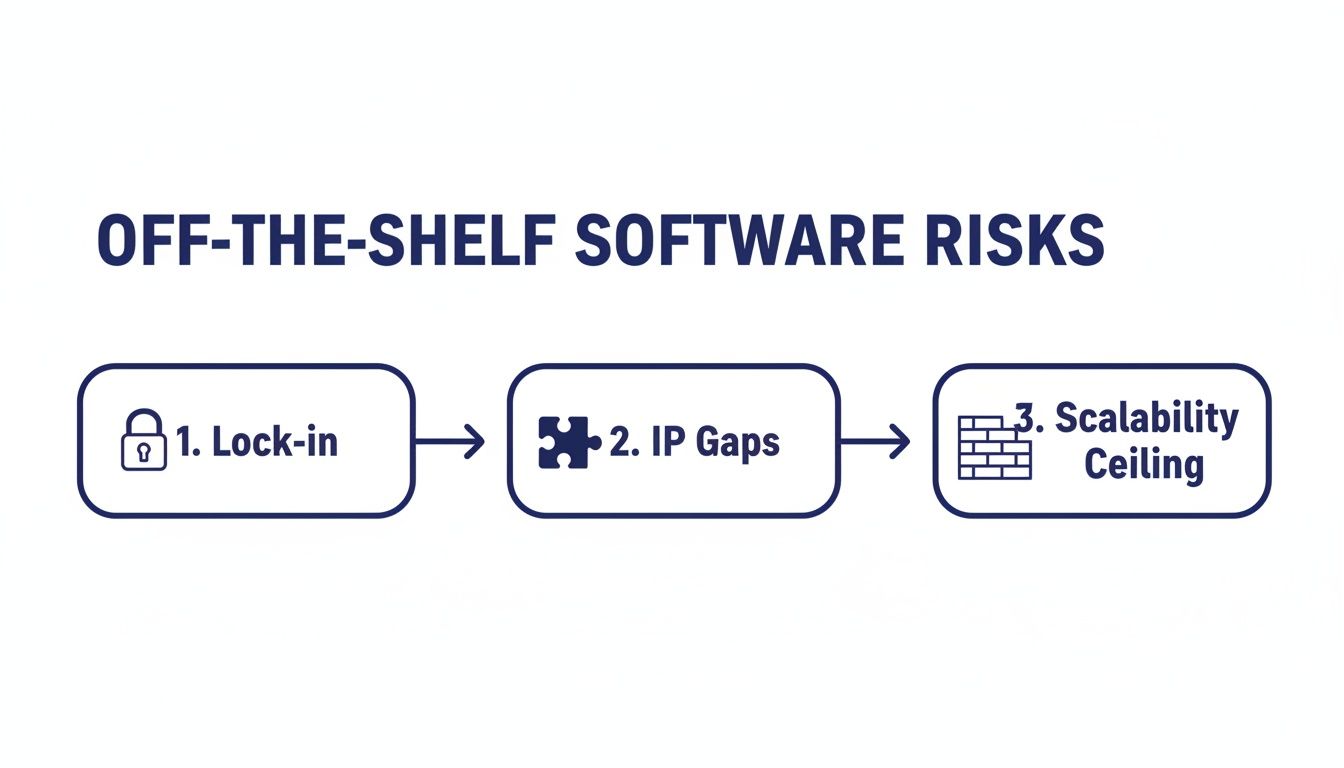
The choice is clear. While off-the-shelf tools can seem tempting for speed, they introduce foundational risks that can cripple a startup’s long-term value. Building custom is about building for an exit, not just for today.
Stage 3: Scaling & Infrastructure
An MVP that goes viral and then immediately crashes is not a success story; it’s a cautionary tale. The final stage in building your moat is ensuring your product remains stable, secure, and audit-ready as it scales. This is where boutique DevOps and managed infrastructure become your greatest strategic assets.
This isn’t something we bolt on at the end. It’s woven into the development process from the start. We ensure your product is:
-
Stable: By using automated testing and CI/CD pipelines, we can ship new features rapidly without breaking what already works. No more holding your breath on deployment day.
-
Secure: We harden your infrastructure against modern threats and build it to be audit-ready for compliance standards like SOC 2 or HIPAA.
-
Scalable: Your application is built on an architecture that can handle a feature on TechCrunch without melting down. Sudden user spikes? No problem.
This hands-on, boutique approach to DevOps means your infrastructure grows with your business. As you scale, your technology remains your greatest asset, not your biggest bottleneck. Each stage—Discovery, MVP, and Scaling—works in concert to forge a company that’s not just valuable, but defensible.
Building Your A-Team for Development
Let’s be blunt: hiring a few coders and hoping for the best is a surefire way to build a technical asset nobody wants to invest in. The traditional “outsourcing” model—where you toss a spec sheet over the wall to a mass-market black box firm—is a recipe for expensive mistakes, technical debt, and a product that disappoints investors.
It creates a “black box.” You lose control, visibility, and ultimately, value.
We believe in the “Anti-Outsourcing Model.” Think of it less like hiring a vendor and more like bringing on a high-touch, boutique partner. The goal isn’t just to get the job done; it’s to mentor you, the founder, through the entire process. This is about transparent, high-touch partnership that de-risks development, builds code that investors love, and sets you up to eventually build your own in-house, high-performance culture.
You don’t need task-takers. You need senior partner-level architects who understand the why behind your business.
The Core Roles of a Founder-Focused Team
Getting your initial engineering team right is critical. This decision dictates your product’s quality, its architecture, and whether it can scale. Trying to save money here with junior talent or a faceless agency is a classic founder mistake with a very high price tag.
Your core engineering strike team should look something like this:
-
Fractional CTO: For a non-technical founder, this isn’t optional; it’s essential. A Fractional CTO is your strategic co-pilot, translating your vision into a concrete technical roadmap, guiding the architecture, and ensuring every decision aligns with what investors want to see.
-
Senior Engineers (Native & Web): These are the elite engineers who build your product’s foundation—your technical moat. They don’t just write code; they engineer robust systems. Senior talent is what produces clean, audit-ready code that is built for scale from day one.
-
Product/UX Designer: This person ensures the app isn’t just functional but is a joy to use. They work side-by-side with the engineers to translate the vision from the discovery phase into a pixel-perfect reality.
A real engineering partner doesn’t hide behind layers of project managers. They give you a direct line to the senior architects building your product, so you understand every trade-off and decision in business terms, not just tech-speak.
This boutique precision and transparent partnership is what separates a high-valuation technical asset from a cheap prototype that falls apart.
Why a Boutique Partnership Beats Mass-Market Outsourcing
The market for custom app development is booming, projected to jump from $71.2 billion in 2025 to $77.94 billion by 2026. That’s a massive 9.5% CAGR fueled by founders who understand that strategic engineering is a huge competitive advantage.
In fact, 72% of companies are already bringing in outside help to access elite talent (32%), meet customer needs faster (35%), and boost overall quality (33%). You can explore the complete market analysis to see just how big this shift is.
But not all “outsourcing” is the same. The “Anti-Outsourcing” model has clear advantages over big, impersonal dev shops:
-
Valuation Over Volume: Our goal is to build investable assets for a select group of founders. Large firms often focus on billing hours, which can lead to bloated code and misaligned incentives. Our success is directly tied to your product’s success.
-
Mentorship, Not Management: You’re not just a client; you’re a partner. We mentor you through the process so you feel empowered to make smart decisions. This readies you to confidently lead your own tech team when the time comes.
-
Audit-Ready by Default: We build everything with one eye on passing VC technical due diligence. That means eliminating technical debt at the root and ensuring your code is clean, documented, and well-architected from day one.
Choosing your first engineering team is one of the biggest calls you’ll make. By going with a boutique partner, you’re not just buying code—you’re investing in the strategic leadership and foundation of your entire company.
The Foundation for Scalability and Security
Let’s get one thing straight: a brilliant product idea without a solid technical foundation is like building a skyscraper on sand. It’s only a matter of time before it all comes crashing down. For founders, infrastructure, security, and scalability aren’t just technical jargon—they are the absolute bedrock of your custom application.
This is where DevOps enters the picture, and it’s arguably your startup’s most powerful secret weapon.
Think of DevOps (Development and Operations) as the master architect and engineering crew for your skyscraper. They’re not just hanging drywall on the visible floors; they’re pouring the deep foundation, erecting the steel framework, and installing the complex systems that let the building handle thousands of people—or a sudden earthquake. This is the heart of our “Boutique DevOps” philosophy.
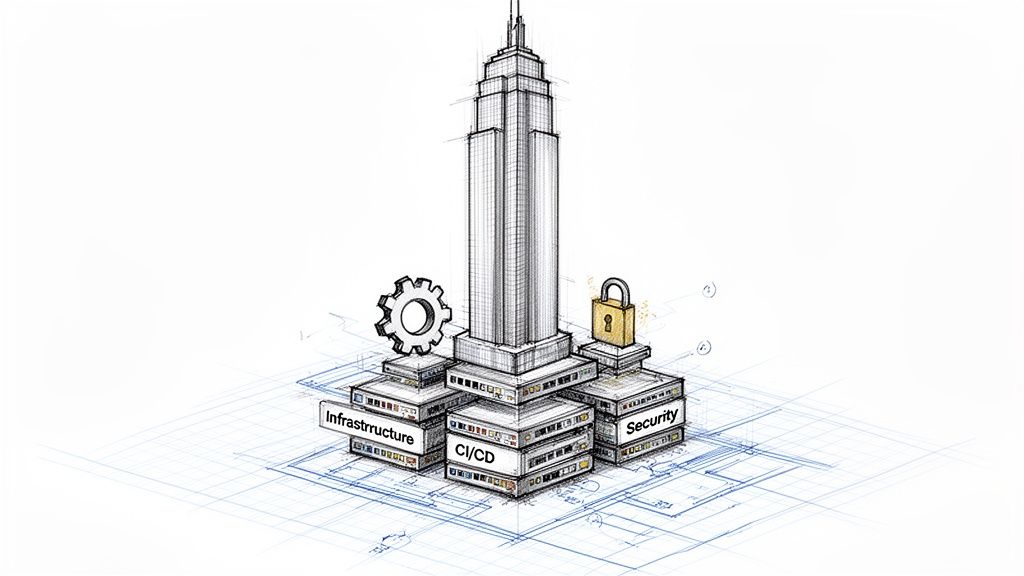
DevOps as a Strategic Advantage
Too many founders view infrastructure as a line-item expense. We see it as an engine for valuation. A solid DevOps setup directly increases your business value by ensuring your app is fast, stable, and secure. These aren’t nice-to-haves; they’re non-negotiable for both your customers and your future investors.
Our approach boils down to three core pillars:
-
Managed Infrastructure: We design and manage your cloud infrastructure to be both cost-effective and ready to scale. When that big press hit comes, your app won’t melt under the traffic surge.
-
CI/CD Automation: Think of Continuous Integration/Continuous Deployment (CI/CD) as your own automated assembly line for shipping code. It lets your team push out new features faster and with far more confidence because every change is automatically tested and deployed.
-
Rigorous Security Hardening: We don’t bolt security on at the end. It’s woven into the very fabric of your application from day one. This proactive approach protects your user data, builds trust, and makes passing security audits routine.
This isn’t just our opinion; it’s a massive market trend. The industry is set to jump from $50.6 billion in 2026 to an eye-watering $213.4 billion by 2035. Why? Because enterprises are finally ditching their clunky old platforms for the flexible, scalable cloud environments that DevOps enables. You can discover more about this enterprise market shift and see why a cloud-native build is the only way to go.
Building an Audit-Ready Company
Here’s a piece of advice: be audit-ready from the first line of code you write. This means building your systems and processes to meet compliance standards like SOC 2 or HIPAA from the get-go. Waiting until you need compliance is a recipe for a costly, painful, and rushed overhaul.
Being audit-ready isn’t just about ticking a box to land an enterprise client. It’s a powerful signal to investors that you run a mature, disciplined company that has its technical and business risks under control.
A strong foundation also means you’re constantly working on how to reduce technical debt, that silent killer of growth and security. Good DevOps practices instill the discipline needed to keep that debt from piling up in the first place.
Our specialized DevOps as a Service for startups is designed to ensure your infrastructure isn’t just built for today’s MVP. It’s primed for the demands of a global user base tomorrow, making sure the technical asset you’re building is stable, secure, and ready to drive your valuation through the roof.
Founder FAQs
As a founder, you’re not just asking questions—you’re making high-stakes decisions. You need straight answers that cut through the technical noise and focus on what actually moves the needle on valuation and success. Let’s tackle the big ones.
How Much Does a Custom App Really Cost a Startup?
Stop thinking about it as a “cost.” It’s not an expense you write off; it’s the single most important investment you’ll make in your company’s core asset.
The real drivers of that investment are the scope of your MVP, the seniority of your engineers, and the complexity of the tech you need (like AI features or native mobile apps).
Here’s a trap I see founders fall into all the time: they build a cheap prototype to save cash upfront. But that “savings” evaporates when investors show up. A cheap app will almost certainly fail technical due diligence and require a complete rewrite, burning capital and delaying your growth.
We don’t talk about cost vs. valuation. We focus on building Production-Grade MVPs where every dollar spent creates a clean, scalable, and auditable codebase. The real investment isn’t just in the code itself—it’s in avoiding the technical debt that sinks startups.
The most expensive app you can build is a cheap one that has to be thrown away. A properly engineered MVP becomes the foundation of your company’s valuation and the defensible moat that gets investors excited.
How Do I Make Sure My App Is Investor-Ready?
An “investor-ready” app is one that can sail through technical due diligence. This is the part where investors bring in their own experts to pop the hood and look for hidden risks.
They’re trying to answer four make-or-break questions:
-
Code Quality & Architecture: Is the code clean, maintainable, and built to scale? Or is it a tangled mess of “spaghetti code” that will crash the moment you get a surge of users?
-
Infrastructure & Security: Is the app secure and compliant? Is it running on a stable, scalable cloud setup, or is it held together with digital duct tape?
-
Team & Process: Is there a clear technical roadmap and a mature development process in place? Or is it just chaos and undocumented code?
-
Intellectual Property (IP): Does the company own 100% of the core code? This is non-negotiable. If you don’t own your IP, you don’t have a tech company.
Our entire “Audit-Ready Engineering” philosophy is built to give investors a resounding ‘yes’ to all four. We provide fractional CTO leadership to build the roadmap, document the architecture, and ensure your codebase is a powerful asset—not a liability—when VCs start digging.
I’m a Non-Technical Founder. How Do I Manage All This?
This is exactly why we created our “Anti-Outsourcing Model.” As a non-technical founder, the last thing you need is a “black box” firm that just takes your order and disappears for a few months. You need a strategic engineering partner who acts as your dedicated technical co-founder.
You need a guide, not just a team of coders.
Our Fractional CTO service gives you the executive-level technical leadership you’re missing. This senior partner acts as the bridge between your business vision and the engineering team, making sure every line of code serves your ultimate goals.
We operate with total transparency, basically mentoring you through the entire process. We translate complex tech decisions into simple business trade-offs you can actually understand. You’re always in the driver’s seat, fully aware of how each engineering choice impacts your budget, your timeline, and your ability to hit those crucial milestones. We don’t just work for you; we partner with you to turn that vision into a high-valuation technical asset.
At Buttercloud, we don’t just build software. We engineer the high-valuation technical assets that transform visionary startups into scalable, investor-ready companies. If you’re ready to build your technical moat, learn more about our founder-centric approach at https://www.buttercloud.com.
Have a product idea to talk through?
We'll show you how we'd approach it — no pressure, just a real conversation.
Book a Discovery Call