Custom Software Development for Startups

Founder & CEO, Buttercloud
As a founder, you have to make a critical mindset shift. Custom software development isn’t just another line item on your budget; it’s the process of engineering your company’s single most valuable, defensible asset.
We’re moving past the era of disposable prototypes. This is about engineering the core product that is your business, built to pass VC technical due diligence and increase your company’s valuation.
Why Build Technical Assets, Not Just Apps?
This isn’t just a niche trend; it’s a massive market signal. The global custom software development market was valued at USD 43.16 billion in 2024, but it’s projected to explode at a CAGR of 22.6%, hitting USD 146.18 billion by 2030. That growth tells you one thing: smart founders are all-in on proprietary tech to build high-valuation companies.
This strategic choice is about building proprietary systems so intertwined with your unique business logic that competitors can’t easily replicate them.
Off-the-shelf tools have their place in operations. But for your core product? They provide zero competitive edge. They are rented tools, not owned, investable assets.
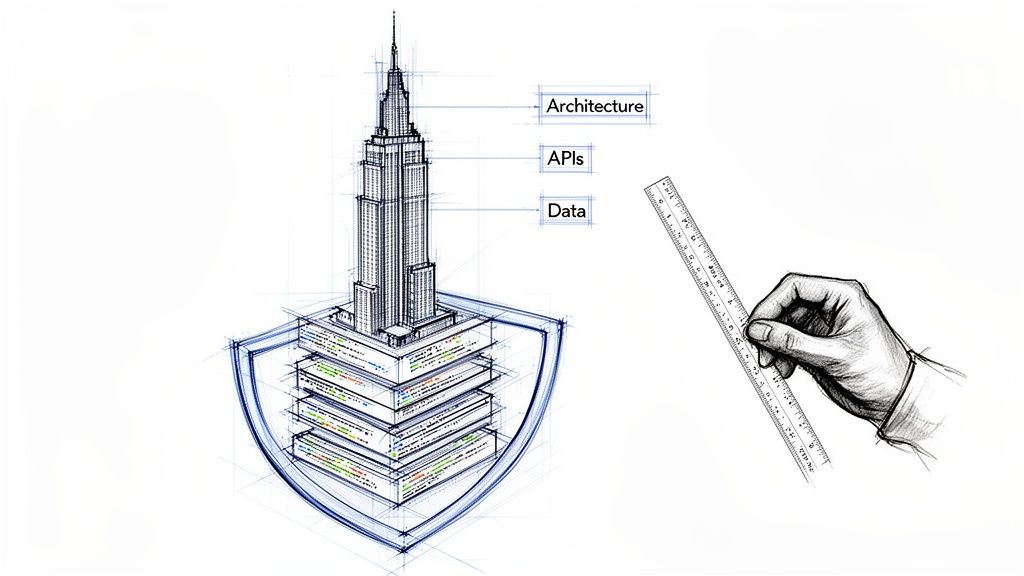
Think of it like this: you can either build a temporary shelter or engineer the foundation for a skyscraper. One gets you through the night. The other supports a lasting, high-value enterprise that can grow for decades. Your core product deserves a skyscraper’s foundation.
So, how does this play out for a founder? Here’s a breakdown of the fundamental choice between building a proprietary asset and renting a generic tool.
Custom Asset vs Off-the-Shelf Solution
Attribute
Custom Software (Technical Asset)
Off-the-Shelf Software (Operational Tool)
Ownership
You own the IP, codebase, and data structure.
You rent a license; the vendor owns the IP.
Competitive Edge
Creates a defensible moat around your core business.
Zero competitive advantage; anyone can use it.
Valuation Impact
Directly increases company valuation as a proprietary asset.
Considered an operational expense (OpEx), not an asset.
Scalability
Built to scale with your specific business needs.
Limited by the vendor’s roadmap and infrastructure.
Integration
Deeply integrates with your unique workflows.
Generic integrations that may require clunky workarounds.
Flexibility
Total freedom to pivot, adapt, and innovate.
Constrained by the platform’s features and limitations.
Choosing to build a technical asset is a declaration that you’re focused on building real, defensible value for the long haul.
The Mindset of an Asset Builder
When you think like an asset builder, your perspective shifts. You stop asking, “What’s the fastest way to launch?” and start asking, “What’s the right way to build for long-term valuation?”
This simple change forces you to prioritize clean, scalable, and audit-ready engineering from day one. A true technical asset isn’t just code; it’s a value-generating machine.
-
Increases Company Valuation: Well-architected, proprietary code is a tangible asset that investors will scrutinize during technical due diligence. Audit-ready engineering directly translates to a higher valuation.
-
Creates Defensibility: A custom solution built around your specific business logic is incredibly difficult for competitors to replicate. It protects your position in the market.
-
Enables Strategic Pivots: Owning your codebase means you have complete freedom to adapt and innovate without being trapped by a third-party platform’s limitations.
-
Eliminates Technical Debt: Building it right the first time eliminates the crippling technical debt that forces so many startups into costly, time-sucking rebuilds down the road.
Engineering for a High-Stakes Future
Focusing on unique technical assets sometimes means getting your hands dirty to solve a very specific problem. A great micro-example is when a team decides to build a Slack bot from scratch to automate a unique internal workflow. That’s the macro-principle in action: you create a bespoke solution for a unique problem, which in turn generates proprietary value no one else has.
For founders, this journey requires a partner who is more than just a coder—someone who thinks like both mentor and architect. This is the senior partner who guides you through the high-stakes decisions that turn a promising idea into a product VCs will fight over.
They help you navigate the path from an investor-ready MVP to a fully scalable product, ensuring your technology is engineered not just to work, but to compound in value over time.
As a founder, one of your first technical decisions is a big one: how are you going to build this thing? The path you take—whether it’s full custom software, a no-code platform, or an off-the-shelf tool—will shape your product’s future, its value in the eyes of investors, and your ability to outmaneuver the competition.
This isn’t just a technical choice; it’s a core strategic decision. Let’s have a direct conversation about these options, focusing on what actually matters: speed, scale, and building a real technical asset. Each path has its place, but only one is engineered for a high-growth, high-valuation company.
The Rise of No-Code and Off-the-Shelf Tools
Let’s be clear: no-code and low-code platforms are fantastic for one specific thing: idea validation. They give you the power to assemble a functional interface and test a core idea with actual users, all without writing a line of code. It’s an incredible way to see if you’re onto something.
Similarly, off-the-shelf software is perfect for standard internal processes that provide zero competitive advantage.
But you have to go in with your eyes open. This is the classic discussion around the build vs buy decision, and while these tools give you a head start, you’re ultimately renting, not owning. You’re building your empire on someone else’s land.
A no-code app is like leasing a beautifully furnished storefront. It’s perfect for testing a new market and opening your doors fast. But you can’t knock down walls, re-wire the electrical, or build an extension. Your business is always going to be limited by the landlord’s rules.
The market trends reflect this. By 2026, an estimated 70% of new applications will be assembled with low-code or no-code tech. That’s amazing for making development more accessible. But for a startup founder with ambitions of building a sophisticated SaaS platform or a complex AI workflow, this path leads straight to a dead end.
The Inevitable Scalability Ceiling
Every founder using a no-code tool will eventually run into the “scalability ceiling.” This is the point where the platform simply can’t keep up with your growth. It’s not a matter of “if,” but “when.”
When you hit it, it hurts. You’ll see it in a few critical ways:
-
Performance Bottlenecks: Your app starts to feel sluggish as more users sign on. The platform’s shared infrastructure can’t handle the load, leading to a terrible user experience.
-
Lack of Customization: You can’t build that one killer feature that sets you apart. You’re stuck with the platform’s pre-built blocks, which means you can’t create a real, defensible advantage.
-
Integration Nightmares: Trying to make your tool talk to other essential systems becomes a mess of hacks and workarounds that feel like they’re held together with duct tape.
-
Data and IP Ownership: Your company’s lifeblood—your user data and intellectual property—is often held hostage in the vendor’s system, making it nearly impossible to leave without starting over from scratch.
For a product-led company, hitting this ceiling is a disaster. It stops growth dead in its tracks, spooks investors, and usually forces a frantic, expensive, and painful rebuild into custom software under immense pressure.
Why Custom Software Is the Path to Valuation
This leads us to the real prize: custom software development. Yes, the upfront investment is higher. But it’s the only path to building a core, defensible product that becomes your company’s single most valuable asset.
When you go custom, you own everything—the intellectual property, the source code, the architectural roadmap. You have absolute freedom to build exactly what your vision demands, creating a solution that is a perfect fit for your unique business logic. This is how you create a product that is not just working, but is audit-ready and investable.
For a founder, the playbook is straightforward. Use no-code to validate your idea cheaply. Use off-the-shelf tools for back-office operations. But when you’re ready to build the product that is the business, custom development is the only path to engineering a lasting asset that drives your valuation and secures your future.
What’s the Blueprint for an Investor-Ready MVP?
Let’s get one thing straight about the Minimum Viable Product (MVP). Too many founders think it’s a cheap prototype, something you build fast and throw away later.
That mindset is a death sentence for a serious startup.
For founders playing to win, the MVP is the first, most critical version of your core technical asset. It’s engineered from day one to land investors, pass technical due diligence, and serve as the rock-solid foundation for future growth.
This isn’t just about launching. It’s about engineering for your Series A from the moment you start.
From Idea to Blueprint with Product Design & Discovery
So where do you begin? Not with code. Never with code.
The journey starts with the phase most people skip: Product Design & Discovery. This is where your vision is distilled into a tangible, strategic blueprint. It’s about much more than just wireframing.
We’re zeroing in on the core problem your product solves and identifying the absolute leanest set of features needed to prove it. We map the exact user journey that defines your competitive advantage. It’s about building the right things with surgical precision.
A well-executed discovery phase acts as your architectural blueprint. It ensures every feature built has a strategic purpose, aligns with your business goals, and contributes directly to creating an investable product, preventing wasted time and capital on features that don’t drive value.
This blueprint becomes the North Star for your engineering team, ensuring every hour is focused on building something with real market impact.
The infographic below shows the different ways you can bring a product to market. It clarifies why, for a true asset, custom development is the only long-term path.
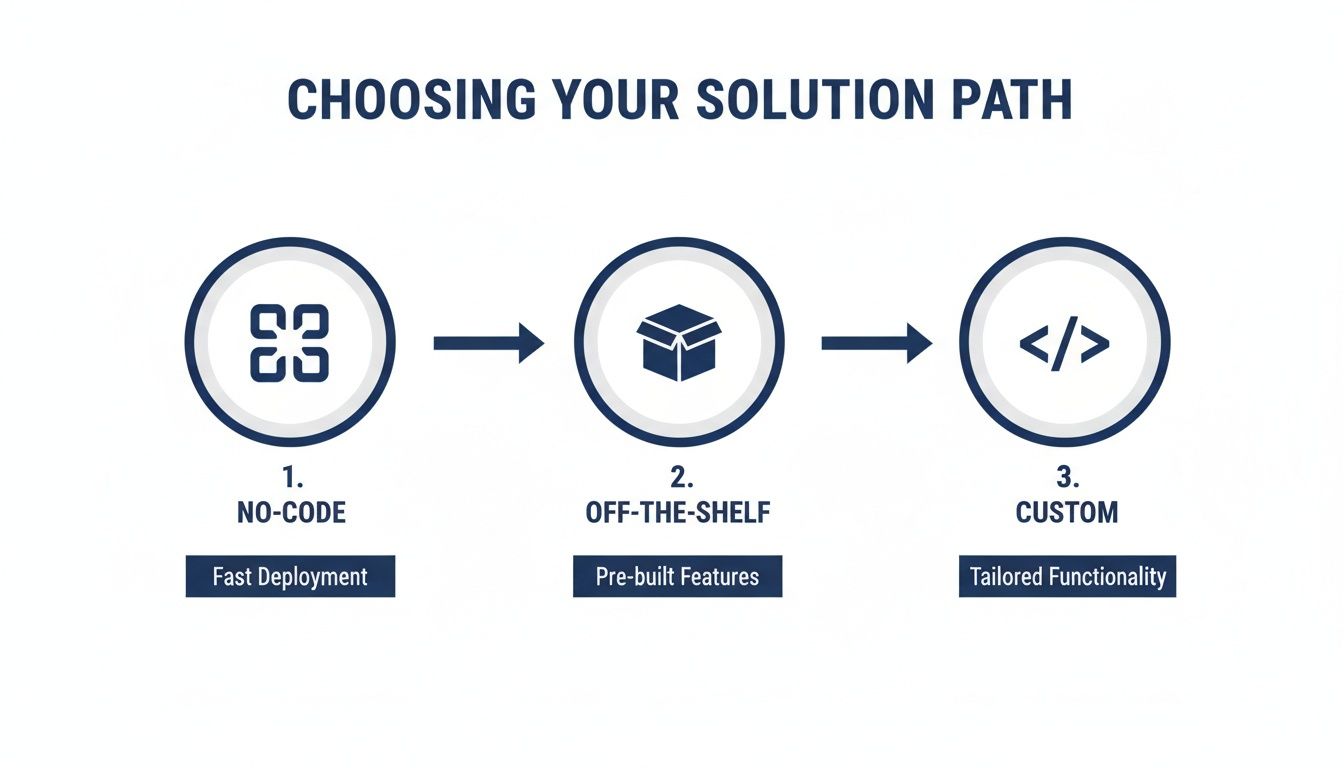
As you can see, No-Code and Off-The-Shelf tools are great for quick validation. But only a custom build gives you the ownership and scalability required to create a valuable technical asset.
Building a Defensible System with Elite Engineering
With a solid blueprint in hand, the focus shifts to building something genuinely hard to copy.
We’re not building a flimsy demo; we’re engineering the first iteration of a scalable system. That means clean code, a sound architecture, and a foundation strong enough to build on for years without cracking.
This is all part of a principle we call Audit-Ready Engineering. Think about it: your codebase is an asset. When a VC firm decides whether to write you a check, their technical experts will tear your code apart.
A messy, duct-taped codebase is a massive red flag. It can slash your valuation or kill a deal on the spot.
An audit-ready MVP is engineered differently from the start.
-
Clean and Documented Code: It’s logical, maintainable, and easy for new developers to get up to speed.
-
Scalable Architecture: The system is designed to handle a flood of new users and features without needing a total rewrite.
-
Zero Technical Debt: We intentionally avoid the “shortcuts” that create future fires, ensuring the product is stable from day one.
-
Security by Design: Security isn’t an afterthought. It’s woven into the development process from the very beginning to protect your company and your users.
Building cleanly from the start is your greatest defense against the expensive, soul-crushing rebuild that sinks so many startups. We take a hands-on, senior-led approach, guiding founders to make the right engineering calls that pay off in valuation and scale.
Your MVP shouldn’t just be a product—it should be a statement about your company’s technical excellence. For a deeper dive, check out our guide on how to build an MVP that investors will love.
Understanding the Cost of Custom Software
It’s the first question every founder asks: “What’s this going to cost?” But when you’re talking about custom software, fixating on an hourly rate is like judging a skyscraper by the price of a single brick. The real conversation isn’t about cost—it’s about value and, more importantly, the Total Cost of Ownership (TCO).
We’ve seen it a hundred times. A low upfront price tag often hides a mountain of expenses down the road. That cheap outsourced project might feel like a win today, but it almost always ends in a complete, budget-crushing rebuild when the code can’t pass investor due diligence or collapses under user traffic.
The smart play is to understand what actually drives the budget for a piece of software that becomes a valuable technical asset, not a liability.
Key Drivers of Custom Software Development Cost
The final budget reflects the complexity of your vision. Let’s pull back the curtain on the main factors that shape your investment.
To give you a clearer picture, here’s how different project requirements stack up and impact your budget.
Cost Driver
Description & Impact on Budget
Example
Architectural Complexity
This is the system’s foundation. A simple app is a single-family home; a multi-tenant SaaS platform is a high-rise. More complexity means a bigger upfront investment in solid, audit-ready engineering.
A basic content app versus a multi-sided marketplace with real-time bidding. That marketplace needs a far more robust and scalable architecture from day one.
Integrations
This is about connecting your software to other services—payment gateways, APIs, CRMs. Every connection point adds development time for coding, testing, and future maintenance.
Integrating with Stripe is standard. But trying to sync with a clunky, legacy enterprise system or multiple obscure data sources? That’s where complexity and costs shoot up.
AI and Machine Learning
Need to build custom AI models, data pipelines, or advanced algorithms? This isn’t plug-and-play. It requires specialized expertise and R&D, which directly adds to the budget.
A standard recommendation engine is one thing. A proprietary natural language processing (NLP) model trained on your unique dataset is a whole different ballgame.
Compliance & Security
If you’re in an industry with strict rules (like HIPAA in healthcare) or need bank-level security, you can’t cut corners. This means rigorous development, special audits, and constant monitoring—all of which add to the cost.
A social media app with basic security is worlds away from a fintech app that needs bank-level encryption, multi-factor authentication, and auditable transaction logs.
Shifting from Cost to Total Cost of Ownership
Looking at the price tag through the lens of TCO is a founder-level move. TCO doesn’t just include the initial build; it accounts for everything that comes after: maintenance, hosting, scaling, and—the big one—re-engineering when the first attempt was a dud.
A low-cost MVP built with shoddy code is the most expensive thing a founder can buy. It creates massive technical debt that acts like a high-interest loan on your company’s future, eventually coming due in the form of a crippling, valuation-destroying rebuild.
When you invest in an audit-ready architecture from the start, you dramatically lower your TCO. Clean, scalable code means less time spent on maintenance, a smooth technical due diligence process, and a product that can actually grow without breaking.
This changes your development budget from a simple expense into a strategic investment in a high-valuation technical asset. It’s the difference between building something that just works and engineering a product that wins. By prioritizing quality engineering upfront, you’re not just managing costs; you’re building a foundation for sustainable growth and a healthier company valuation.
How Does Boutique DevOps Enable Scaling?
So you engineered an incredible product. The work is just getting started. The moment you launch, you’ve stepped into a new arena: running a high-growth startup. This is where “DevOps” stops being a technical term and becomes the engine that keeps your company alive and growing.
Too many founders treat their infrastructure like a problem for “future them.” That’s a massive mistake. A boutique DevOps strategy isn’t about cleaning up a mess later; it’s about building a solid foundation from day one, so your product remains stable, secure, and ready for the flood of users you’re working to attract.
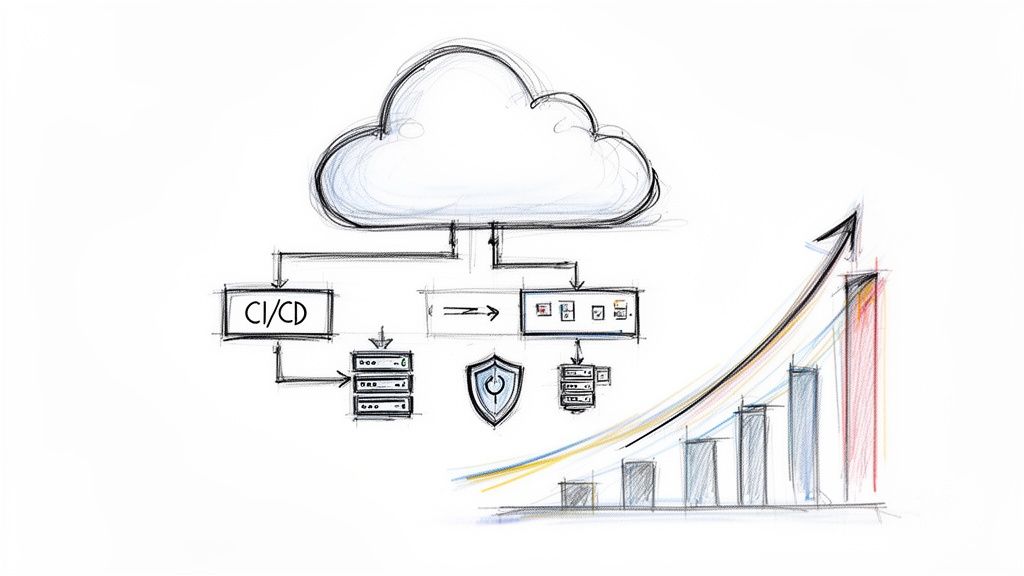
Being operationally ready has never been more critical. The cloud has completely changed the game. Global public cloud spending is expected to skyrocket to $723.4 billion by 2026. And with 95% of new digital workloads being deployed on cloud platforms, a startup’s ability to manage its environment is the difference between reliability and a crash-and-burn story.
This is why having a real DevOps plan is the backbone for getting from your investor-ready MVP to a Series A.
Managed Infrastructure: The Bedrock of Stability
As your user count climbs, your servers will feel the heat. Without a real infrastructure plan, your app will slow to a crawl, start crashing, and send hard-won users running. This is where managed cloud infrastructure becomes non-negotiable.
Instead of your team getting pulled into a black hole of server patching and network headaches, a managed approach provides a stable, optimized environment built for your app. Your product stays fast and reliable, even during that surprise traffic spike from a feature on TechCrunch.
-
Proactive Monitoring: A dedicated team keeps an eye on performance issues and potential bottlenecks before they affect your users.
-
Automated Scaling: Your infrastructure flexes automatically to handle more demand, so the user experience stays smooth without anyone needing to manually spin up more servers at 3 AM.
-
Cost Optimization: Cloud resources are managed smartly to keep your bills from spiraling out of control as you grow.
A boutique DevOps partner acts as a senior technical partner for your infrastructure. They don’t just set up servers; they build a resilient foundation that supports your growth, freeing your internal team to focus on building your product.
Suddenly, your infrastructure isn’t a source of anxiety; it’s a genuine advantage. It means you’re always ready for the next big marketing push.
CI/CD and Automation: The Engine of Speed
How do you ship new features fast without breaking everything that already works? The answer is a solid Continuous Integration and Continuous Deployment (CI/CD) pipeline. Think of it as an automated workflow that grabs new code, runs it through a gauntlet of tests, and deploys it to your users—safely and efficiently.
This automation is huge. First, it kills the risk of human error during deployments. No more “fat finger” mistakes taking down the site. Second, it lets you build, test, and release features way faster than competitors who are stuck doing everything by hand.
For a startup, this speed is everything. It means you can react to user feedback almost instantly, pushing out fixes and updates in hours, not weeks. That kind of agility is a secret weapon in a crowded market. You can dig into how we use this automation to create real business value in our DevOps as a service for startups guide.
Security Hardening for Investor Audits
The more traction you get, the bigger a target you become for security threats. At the same time, any serious investor is going to put your security posture under a microscope during due diligence. A data breach isn’t just a tech headache; it’s a direct hit to your company’s reputation and valuation.
A boutique DevOps approach weaves security into every step. This “security by design” mindset includes:
-
Proactive Security Hardening: Your infrastructure is configured from the ground up to defend against common attacks and vulnerabilities.
-
Compliance Readiness: Your systems are built to be audit-ready, so you’re prepared to meet the standards required by investors or regulations like SOC 2.
-
Continuous Monitoring: Security tools are always scanning for threats, ensuring you can respond to any potential issue immediately.
Ultimately, this rigorous process makes sure your product isn’t just scalable—it’s a trusted, secure asset. For a founder, that means you can sleep at night and walk into your next fundraising meeting with total confidence.
Picking your custom software partner is a make-or-break decision every founder faces. Get it right, and you’ve engineered a solid foundation for your company’s future. Get it wrong, and you’re in for a world of hurt.
The market is saturated with mass-market firms that promise the world—cheap code, delivered yesterday. This is the classic outsourcing model, and frankly, it’s a trap.
You hand over your vision, they disappear into a black box, and poof—a product appears. But you have zero clue how it was built or who was behind it. More often than not, the code is a tangled mess that’s impossible to scale and a massive red flag for any investor doing their homework. This model doesn’t serve you; it just feeds the agency’s high-volume machine.
The Anti-Outsourcing Mindset
A true partner operates from a different playbook: the Anti-Outsourcing Model. This isn’t about just checking a project off a list. It’s a transparent, high-touch partnership where the founder is mentored, not just served.
Your technical partner should think like both mentor and architect, not act like a hired gun. Their job is to elevate your vision with smart engineering, build an asset that increases your company’s valuation, and turn you into a more confident technical leader.
This approach is about quality over quantity, serving as a dedicated guide for a select group of founders. The goal isn’t to churn out apps; it’s to engineer valuable technical assets that are built to last.
Vetting a Partner: What to Look For
So, how do you spot a genuine Mentor-Architect in a sea of vendors? It boils down to vetting them on three key areas that separate boutique partners from commodity code shops.
-
A Portfolio of Audit-Ready Work: Don’t just look at their shiny finished apps. Ask them to pop the hood and show you how they built them. A top-tier partner will be eager to talk about their commitment to audit-ready engineering. They’ll show you examples of clean code, scalable architecture, and projects built to eliminate technical debt from day one.
-
A Boutique, High-Touch Process: Ask them to walk you through their process. If it sounds like a factory assembly line, run. A real partner will talk about a deep discovery phase, direct access to senior engineers, and a collaborative flow where you’re in the room for key architectural decisions. The focus is on mentoring you, not just sending status reports.
-
Strategic Leadership and Founder Mentorship: The best partners deliver more than just code. They bring strategic leadership to the table, often through Fractional CTO services. They’ll help you map out your technical roadmap, navigate tough trade-offs, and even guide you on tech team hiring when the time is right.
Choosing a partner isn’t just a line item; it’s an investment in your company’s technical DNA and your own leadership. The right partner won’t just build your MVP. They’ll equip you with the knowledge and strategy to scale it with confidence. That’s the heart of the Anti-Outsourcing Model: building your product and your founder skills at the same time.
Straight Answers to Your Custom Software Questions
Thinking about building custom software? It’s a big step, and you probably have questions. Let’s cut through the noise and get straight to the practical answers every founder needs to hear.
How Long Does It Take to Build a Custom MVP?
Plan for 3 to 6 months to engineer a genuine, investor-ready MVP. The exact timeline hinges on your product’s complexity and which features are absolutely essential for proving your core value proposition.
The goal isn’t just to launch fast; it’s to launch with something solid that you can actually build a business on. A true partner will kick things off with Product Design & Discovery. This is where you’ll map out the core features to be engineered to a high standard, ensuring you start with a valuable asset, not a pile of technical debt.
Is Custom Software More Expensive Than SaaS?
Upfront, yes. A custom build requires a bigger initial investment than a monthly SaaS subscription. But you’re not just comparing costs; you’re comparing two completely different things: an operational expense versus a balance sheet asset.
Think of it like renting an apartment versus buying a house. A SaaS subscription is like rent—it gets you a place to operate, but the payments never end and you build zero equity. Custom software is like buying the house. It’s an asset you own, it directly increases your company’s valuation, and you can renovate it however you want. For the core of your business, the ROI on owning will always beat renting.
When Should I Hire a Fractional CTO?
Bring a Fractional CTO on board as early as possible—ideally at the idea or pre-MVP stage. Their expertise is most valuable before you start building, when they can translate your vision into a smart technical roadmap and save you from making expensive mistakes with your architecture or tech stack.
This is especially critical for non-technical startup founders. A Fractional CTO acts as your senior tech partner, getting your product ready for investor due diligence and ensuring it’s engineered to win from day one, long before you need a full-time executive.
Curious what custom software like this actually costs? Our free MVP Cost Calculator gives you a directional number in minutes.
Ready to turn your idea into a high-valuation technical asset? Buttercloud is the boutique engineering partner that guides founders through the entire journey. We engineer investor-ready MVPs and provide the strategic leadership you need to scale with confidence.
Have a product idea to talk through?
We'll show you how we'd approach it — no pressure, just a real conversation.
Book a Discovery Call