iOS App Development for Startups

For a founder, an iOS app is never just software. It is the engine of your business, the core asset that defines your company’s valuation in the eyes of customers and, more critically, investors.
This isn’t a guide about simply writing code. It’s a strategic playbook for turning an idea into a finished product, specifically for Apple’s ecosystem—iPhone, iPad, and beyond. It’s about engineering a high-valuation technical asset that becomes the foundation of your market position.
Building Your Technical Moat with iOS App Development
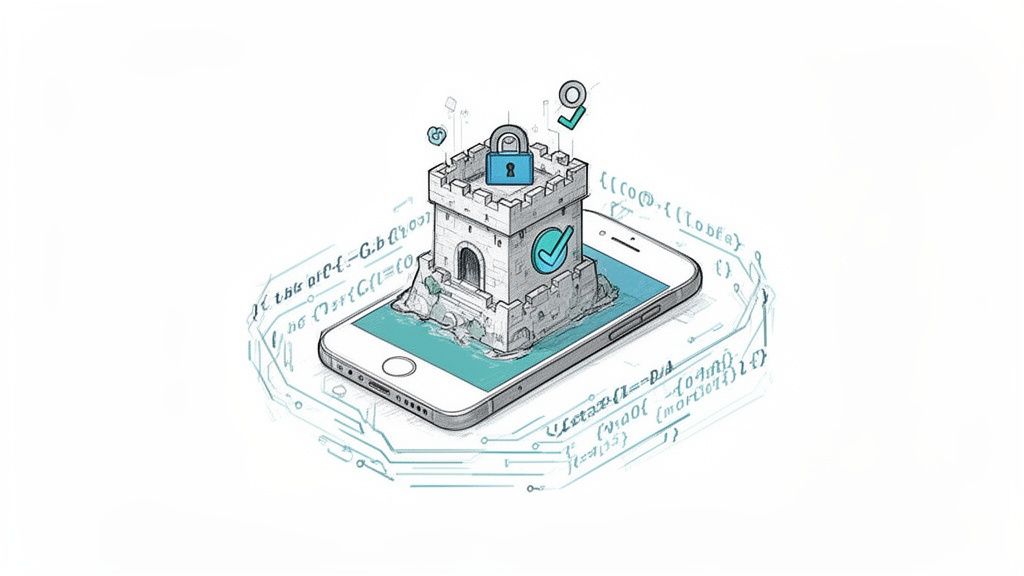
Let’s be direct: an app is never just an app. It is the primary technical asset that investors will scrutinize, that you must scale for millions of users, and that will ultimately determine your valuation. This guide is not about the act of building software; it is about making a series of critical business decisions that turn an idea into an investor-ready product.
This is your blueprint for building a “Technical Moat”—a defensible, scalable, and valuable asset engineered to pass rigorous VC technical due diligence. This is the anti-outsourcing model: a high-touch partnership where the founder is mentored, not just “served.”
Engineering an Investable Asset
From the first line of code, your objective must be to create value. This demands a fundamental mental shift. You are not building a prototype; you are engineering an asset.
This approach is defined by:
-
Audit-Ready Engineering: Producing clean, documented, and scalable code that eliminates technical debt at the root, ensuring it passes technical due diligence and increases company valuation.
-
Strategic Technology Choices: Selecting frameworks and platforms for business longevity, not just for the fastest possible launch.
-
Inherent Security: Treating security as a core architectural principle from day one, not an afterthought.
A formidable technical moat depends on adhering to essential Mobile App Security Best Practices. Protecting user data builds trust, which is the bedrock of any high-valuation company.
A boutique, partner-led approach prioritizes this level of precision. Unlike the “black box” model of mass-market firms, a dedicated “Mentor-Architect” ensures your vision translates into a high-valuation technical asset, preparing you for long-term success and attracting serious investment.
The Market Opportunity for Founders
The strategic imperative is clear. The global mobile app market is projected to reach an astounding $378 billion in 2026.
This trajectory is set to surge toward $1.2 trillion by 2035, creating an immense window of opportunity for founders who build stable, scalable platforms. You can examine these projections in this detailed mobile industry analysis.
This journey from Idea → Investor-Ready MVP → Scalable Product begins with one critical decision: your core development path.
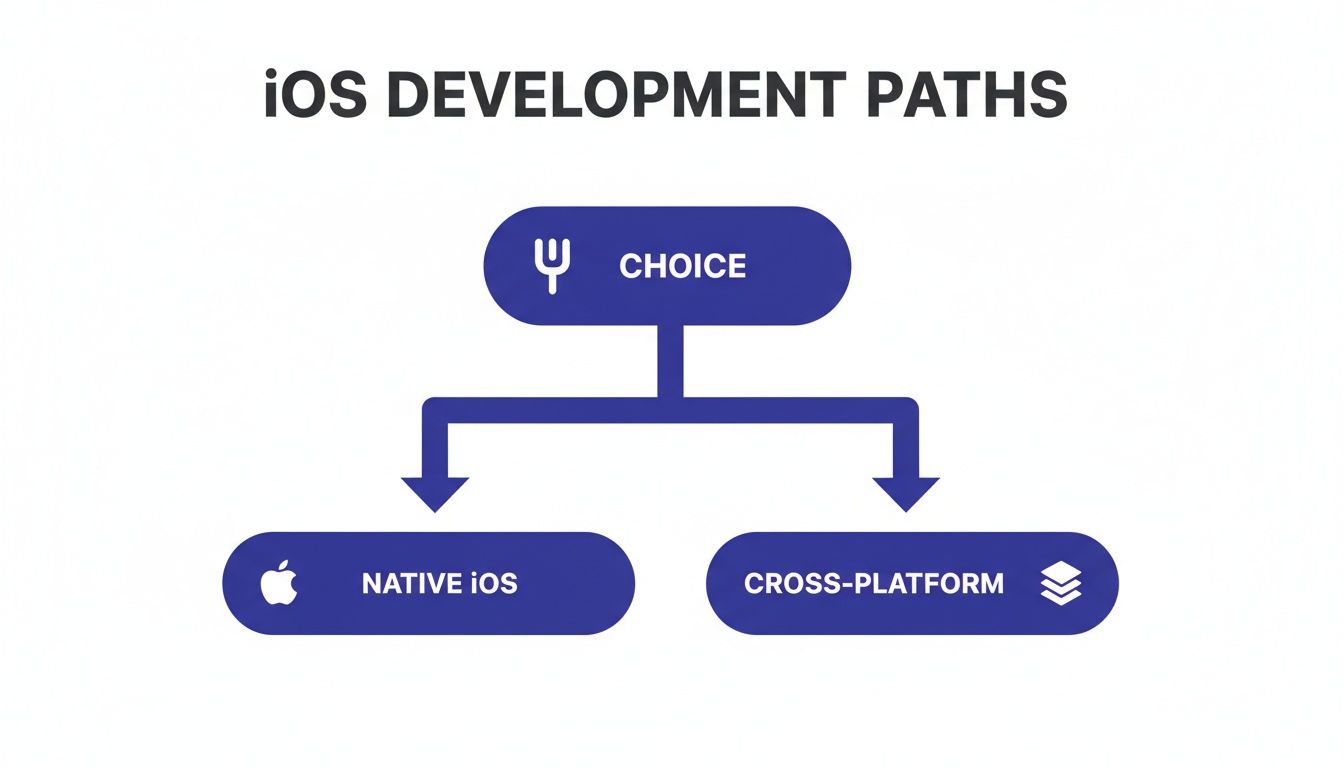
Your First Big Choice: Native iOS vs. Cross-Platform
As a founder, one of your first strategic forks is the decision between native iOS and cross-platform development. This is not a mere technical detail; it is a business decision that will define your user experience, scalability, and long-term capital expenditure.
Get this right, and you construct a powerful, defensible asset. Get it wrong, and you risk a costly rewrite precisely when you should be scaling.
Let’s cut through the noise.
Native iOS development is akin to commissioning a Formula 1 car. It is meticulously engineered with Swift and SwiftUI to dominate one specific track—Apple’s ecosystem. The result is unparalleled performance, seamless hardware integration, and a user experience that is qualitatively superior.
Cross-platform development, using frameworks like React Native or Flutter, is like building a high-performance rally car. It is designed to compete across multiple terrains (iOS and Android) from a single codebase. It is versatile, but it will always have performance and integration trade-offs compared to the specialized F1 car on its home circuit.
The Founder’s Dilemma: Performance vs. Speed to Market
For many founders, the siren call of cross-platform is its “build once, deploy everywhere” promise. It appears faster and cheaper. However, that initial velocity often introduces long-term friction. To make the correct decision, you must weigh the trade-offs of developing an app for multiple platforms against your specific business objectives.
The native path, while focused on a single platform, perfects the experience Apple users demand. In the premium landscape of iOS app development, failing to meet these high expectations is a strategic error. Native apps integrate with all new iOS features—from advanced camera APIs to ARKit—on the day of their release.
From an investor’s perspective, a native iOS app often signals a commitment to quality and a deep understanding of the target market. It demonstrates a strategy focused on building a premium, high-performance technical asset—a core component of a strong technical moat.
In a technical due diligence meeting, you must be prepared to defend this choice. An investor will demand to know why you chose one path over the other and how that decision strengthens your company’s long-term vision.
Strategic Trade-Offs: Native iOS vs. Cross-Platform
To frame this decision, here is a founder-focused comparison. This is not about code; it is about building a valuable, enduring company.
Factor
Native iOS (Swift/SwiftUI)
Cross-Platform (React Native/Flutter)
Performance & UX
Unmatched. Direct access to device hardware and OS features ensures the fastest, smoothest experience.
Good to Great. Performance is high but can suffer from an abstraction layer. May lack the polished “feel” of native.
Investor Perception
Highly Favorable. Seen as a premium, long-term investment in a high-quality, auditable asset.
Mixed. Often viewed as a good MVP strategy for market testing but can raise concerns about future scalability and technical debt.
Long-Term Costs
Higher initial cost for a single platform, but lower maintenance and fewer platform-specific bugs over time.
Lower initial cost to hit two platforms, but can have higher long-term costs due to complex updates and debugging.
Access to New Features
Immediate. Full support for new iOS features and APIs on day one of their release by Apple.
Delayed. Must wait for the cross-platform framework community to add support for new native features.
The right choice is dictated by your business strategy.
If your primary goal is rapid market validation across the widest audience, cross-platform can be a smart move. But if your mission is to build a high-valuation technical asset with a flawless user experience designed to win the lucrative Apple ecosystem, native iOS is the undisputed strategic choice.
For founders ready to pursue this path, our complete guide to native app development breaks down all the strategic advantages.
Building an Investor-Ready MVP and Picking Your Tech Stack
Let’s clarify the term MVP, or Minimum Viable Product. It is widely misunderstood. Most interpret it as a flimsy, disposable prototype built cheaply to test an idea. This type of MVP is riddled with technical debt and becomes a significant liability under investor scrutiny.
That is not how we define it.
An investor-ready MVP is Version 1.0 of your technical asset. It is not a throwaway prototype; it is a stable, secure, and scalable foundation engineered for production from day one. This is the distinction between “building an app” and engineering a high-valuation technical asset.
Your first decision is the path: native iOS or cross-platform. Each dictates a different set of tools.
The Tech Stack We Trust for Modern iOS Apps
If you are serious about building a best-in-class product on Apple’s platform, the technology choice is clear. Modern, future-proof iOS apps are built with Swift and SwiftUI.
-
Swift: This is Apple’s proprietary programming language. It is powerful, safe, and clean to write, enabling engineers to focus on building value-creating features rather than debugging.
-
SwiftUI: This is Apple’s declarative UI framework. Instead of manually coding screen states, you describe the desired UI, and the framework handles the implementation. This accelerates development and simplifies maintenance.
Choosing Swift and SwiftUI signals to investors that you are building for the long term. This stack ensures your app is prepared for every new iPhone, iOS update, and feature Apple releases, protecting your investment from a future costly rewrite.
Choosing Your Backend Architecture
The app is the frontend; the backend is the engine. A sound backend architecture is critical for performance, cost-efficiency, and scalability.
For most startups, the decision comes down to two primary options:
-
Monolith: A classic, all-in-one architecture where the entire backend is a single application. It is generally faster to build and deploy, making it an excellent choice for most MVPs.
-
Microservices: The backend is deconstructed into a collection of small, independent services. Each service handles a specific function and can be scaled independently. This offers long-term flexibility but introduces significant upfront complexity.
For most founders, a well-architected monolith is the superior choice. It accelerates time-to-market for product validation. As you scale, you can strategically decouple components into microservices—a pattern known as the “Strangler Fig” approach.
The Foundation: Your Cloud and DevOps
Your backend requires a home, and that home is the cloud. We almost universally recommend a major provider like Amazon Web Services (AWS) for its reliability, security, and on-demand scalability. Building on a trusted platform like AWS provides investors with institutional-grade assurance.
Finally, foundational DevOps (Development and Operations) practices are non-negotiable from day one. This is not about complex enterprise software; it is about establishing a simple, automated pipeline to ensure quality and velocity.
At a minimum, this includes:
-
Version Control (Git): A complete, time-stamped history of every code change. It is indispensable for team collaboration and passing an investor audit.
-
Continuous Integration (CI): Automatically runs tests with every code commit, identifying bugs before they reach users.
-
Continuous Deployment (CD): Automatically releases code that has passed its tests, enabling rapid and reliable updates.
Every component of this stack—from the SwiftUI code to the CI/CD pipeline—works in concert to create a stable, secure, and auditable product. This is how you build an MVP that not only functions but actively increases your company’s valuation.
To get a better idea of what technologies might work for your specific product, check out our tech stack recommender tool.
Assembling Your Elite Development Team
Building a technical asset that investors covet is not achieved by hiring a large, anonymous agency or a lone developer. To engineer a high-valuation asset, you need a small, senior, and strategic unit. This is the core of the anti-outsourcing model—a focused team of experts who operate as your partners.
Dispense with the myth that a larger team yields faster progress. In high-stakes product development, a lean team of elite engineers will consistently outperform a large team of junior developers. They write superior code, make sounder architectural decisions, and build for longevity, not just a launch.
This approach centers on a few key roles, each with a direct and critical impact on your business.
The Core Roles That Build Value
An elite iOS development team is defined by its precision, not its headcount. For an investor-ready MVP, three roles are non-negotiable. They are the value creators.
-
Senior iOS Engineer: Your master artisan for the Apple ecosystem. They are fluent in Swift and SwiftUI, ensuring your app feels native to the iPhone. They do not merely add features; they engineer an experience that is fast, secure, and polished—delivering the premium quality that Apple users demand and investors respect.
-
Backend Engineer: The architect of your app’s engine. They design the high-performance systems—database, server logic, cloud infrastructure—that allow your app to scale from 10 users to 10 million without failure.
-
Product Designer (UX/UI): The voice of the user and a business strategist. This role transcends aesthetics. A great product designer maps the entire user journey, conducting research to ensure the app is intuitive, solves a real problem, and carves out a competitive advantage through user-centric design.
This focused team is the engine of your success. Each role is a pillar supporting the final structure, ensuring it is robust enough to withstand market shifts and the intense scrutiny of technical due diligence.
The Mentor-Architect: The Fractional CTO
For most non-technical founders, a formidable gap exists between business vision and technical execution. How do you lead an engineering team without speaking their language? How do you know if they are building a scalable asset or a time bomb of technical debt?
This is where the most critical role emerges: the Fractional CTO.
The Fractional CTO is your “Mentor-Architect.” This is not a project manager; this is your strategic technical co-founder. They provide the senior leadership and oversight to ensure every line of code serves your business goals and actively increases your company’s valuation.
The Fractional CTO is the translator between your founder vision and the technical roadmap. They are the bridge connecting your business goals to the engineering team, ensuring the product isn’t just built right, but that you’re also ready to defend its architecture in front of investors.
A Fractional CTO’s responsibilities include:
-
Architectural Oversight: Vetting all major technology choices to prevent decisions that will necessitate a costly future rewrite.
-
Due Diligence Prep: Systematically preparing all documentation and engineering workflows so you are “audit-ready” for VCs from day one.
-
Strategic Mentorship: Guiding you, the founder, through the complexities of tech team hiring, roadmap planning, and budget forecasting.
Partnering with a boutique firm that provides this integrated leadership is the definitive anti-outsourcing move. You are no longer a client being “served”—you are a founder being mentored, guided, and empowered to lead your technology company with confidence. This is how you build a technical moat around your business, not just another app.
Navigating App Store Submission and Compliance
You have engineered your product, and you are prepared for launch. However, a rejection from Apple’s App Store is not a minor technical setback; it is a direct blow to your timeline, marketing budget, and momentum.
This is not a simple “upload and pray” process. In 2026, with over 4.4 million apps competing for attention, your app must meet an exceptionally high standard to even be considered. To understand what is currently capturing reviewers’ attention, you can study these recent iOS app trends.
Understanding Apple’s Human Interface Guidelines
Apple’s Human Interface Guidelines (HIG) are not suggestions. They are the non-negotiable rulebook for how an app must look, feel, and behave on an iPhone—the design DNA of every great iOS app. Ignoring them is the most efficient path to rejection.
A strategic engineering partner integrates these guidelines from the first product design sketch. This ensures your app speaks fluent iOS, which requires:
-
Intuitive Navigation: The user flow must feel natural and predictable, consistent with Apple’s own applications.
-
Clarity and Legibility: Text must be readable, icons must be immediately comprehensible, and the interface must be clean, not cluttered.
-
Respect for the Platform: Your app must integrate seamlessly with core iOS features like Dark Mode, notifications, and accessibility tools.
An app that disregards the HIG feels unprofessional and untrustworthy—not just to users, but to the human reviewers at Apple. Adherence is not about aesthetics; it is about demonstrating that your product belongs on their platform.
Common Rejection Pitfalls and How to Avoid Them
Apple rejects thousands of apps weekly, often for preventable mistakes. An elite team anticipates these traps, saving you from a post-launch rejection cycle.
Here are the classic errors that trap founders in submission limbo:
Rejection Reason
The Real Problem
The Founder’s Fix
Bugs and Crashes
Your app is unstable. It crashes or freezes, signaling amateur execution to the review team.
Your partner must have a rigorous QA process. Every submitted build must be thoroughly stress-tested. No exceptions.
Incomplete Information
You have made the reviewer’s job difficult by omitting a demo account, clear instructions, or contact information.
Treat the submission notes as a critical product component. Provide the reviewer with a seamless testing experience.
Misleading Users
Your App Store page promises features or an experience that the app does not deliver.
Be precise. Your marketing must be exciting but truthful. What you show is what reviewers and users must receive.
Privacy Violations
You are collecting user data without explicit permission or a clear privacy policy. This is a major red flag for Apple.
Map every piece of data your app accesses. Your engineering partner must ensure compliance with GDPR, CCPA, and Apple’s strict privacy rules.
Ultimately, navigating the App Store review process is about demonstrating respect—for the user, the platform, and the process itself. When you build an app that is stable, transparent, and secure by design, you are not just seeking approval. You are signaling to users and future investors that you are building a serious, professional, and trustworthy business.
Scaling Beyond the MVP with DevOps and Maintenance
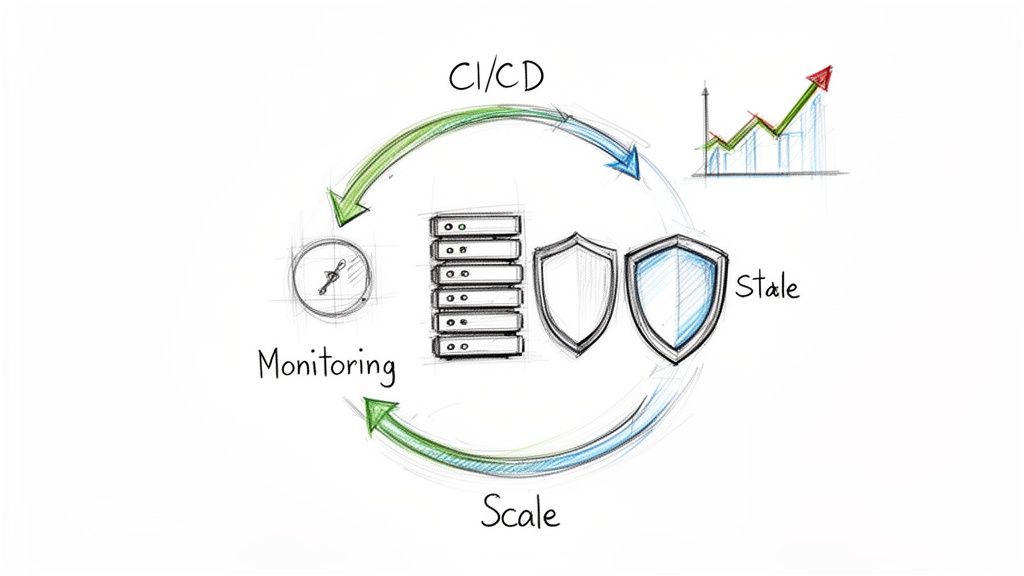
Launching your MVP is the starting line, not the finish. This is the moment your app begins its journey to becoming a defensible asset. The decisions you make now determine whether you scale smoothly or collapse under the weight of success.
This next phase is about fortifying your technical moat. It comes down to two critical, intertwined disciplines: boutique DevOps and ongoing maintenance. For a founder, this means implementing lean, powerful systems to protect your investment and prepare for growth.
Boutique DevOps: The Founder’s Advantage
DevOps, short for Development and Operations, is the practice of merging software development with IT operations to ship better software, faster.
Think of it as building a small, automated factory for your code. A well-designed DevOps pipeline allows you to deploy new features and bug fixes rapidly and reliably. For a startup, this velocity is a strategic weapon.
The core of this factory is CI/CD (Continuous Integration/Continuous Deployment).
-
Continuous Integration (CI): Every time a developer commits a change, an automated system builds the app and runs a full suite of tests. This catches bugs almost instantly.
-
Continuous Deployment (CD): Once code passes all automated checks, it can be automatically released to users. This eliminates error-prone manual releases and allows you to deliver value with confidence.
This is not a mere technical “nice-to-have.” It is a direct signal to investors. A robust CI/CD pipeline demonstrates a professional, predictable engineering process. It de-risks their investment and proves your platform is built for the long haul.
Managed Infrastructure for Audit-Ready Stability
As your user base grows, the backend servers supporting your iOS app development must scale accordingly. A server crash following a major press feature can destroy momentum and damage your reputation. This is where managed infrastructure and proactive maintenance become non-negotiable.
This is more than “keeping the lights on.” It is about engineering an environment that is secure, scalable, and audit-ready.
-
Scalability: Your cloud infrastructure must scale automatically with traffic surges and contractions, ensuring a flawless user experience while controlling costs.
-
Security: Proactive security is essential. This includes regular patching, vulnerability scanning, and adherence to compliance standards to ensure you are always audit-ready.
-
Monitoring & Logging: You cannot fix what you cannot see. Robust logging and alerting systems provide real-time visibility into application health, enabling your team to resolve issues before users are impacted.
Thinking about scale from day one is how you build a real technical moat. This proactive stance on DevOps and maintenance keeps your product stable, secure, and ready to impress as you accelerate toward your next funding round. It is the difference between building an app and engineering a business.
Founder Questions on iOS App Development
As an engineering partner, we engage directly with founders. We field the direct, critical questions about cost, timelines, and strategy that define a startup’s trajectory.
Here are the straight answers to the questions we hear most, from the perspective of building a technical asset that investors will fund.
What Is a Realistic Budget for an Investor-Ready iOS MVP
While every product is unique, a true, investor-ready MVP built by an elite engineering team typically falls in the $75,000 to $250,000+ range. View this not as a cost, but as an investment in an auditable technical asset, not a disposable prototype.
This investment buys you elite engineering and an architecture that eliminates technical debt from day one. This level of precision directly increases your company’s valuation and de-risks future funding rounds by proving your technology is built for longevity.
How Long Does It Take to Develop a Quality iOS MVP
For a well-scoped MVP, a focused senior team can deliver an investor-ready product in approximately 4 to 6 months. This encompasses the full lifecycle: Product Design & Discovery, engineering, rigorous quality assurance, and deployment.
Unlike firms that rush a fragile prototype to market, a true partner prioritizes meticulous engineering. The objective is a codebase that is scalable, secure, and prepared to withstand the intense scrutiny of VC technical due diligence from the moment of launch.
This is not about moving slowly; it is about moving with strategic purpose, baking quality directly into the product’s DNA.
Do I Need a Technical Co-Founder if I Hire a Partner Firm
Not necessarily, provided you select the right firm. A genuine engineering partner—one that operates as an extension of your founding team—effectively serves as your Fractional CTO. They are not merely taking orders; they are mentoring you.
This partner provides senior architectural oversight and translates your business objectives into technical decisions, just as a technical co-founder would. They help shape your roadmap, advise on future tech team hiring, and ensure every line of code serves the ultimate goal: increasing valuation. This empowers a non-technical founder to lead with confidence, knowing their technology is building a sustainable competitive advantage.
At Buttercloud, we don’t just build apps; we engineer high-valuation technical assets. We guide founders through the entire journey, from idea to investor-ready product, acting as the strategic engineering partner you need to succeed. Turn your idea into an investable product with us.
Have a product idea to talk through?
We'll show you how we'd approach it — no pressure, just a real conversation.
Book a Discovery Call