A Founder's Guide to Native App Development

Deciding how to build your product is one of the most fundamental business decisions you’ll make, not just a technical footnote. Native app development is the practice of engineering an application specifically for one platform—one for Apple’s iOS, a separate one for Google’s Android. For founders building for valuation, this path is the only way to guarantee elite performance, ironclad security, and a user experience that defines your competitive advantage.
Why Native Development Is Your Strongest Strategic Move
For any serious founder, this choice isn’t just about code; it’s a decision that will echo in boardrooms and investor pitches for years. Committing to native app development is the definitive strategy for building a high-valuation technical asset, not a disposable prototype. It’s the difference between commissioning a custom-built headquarters engineered to last for decades versus leasing a temporary office you’ll outgrow in a year.
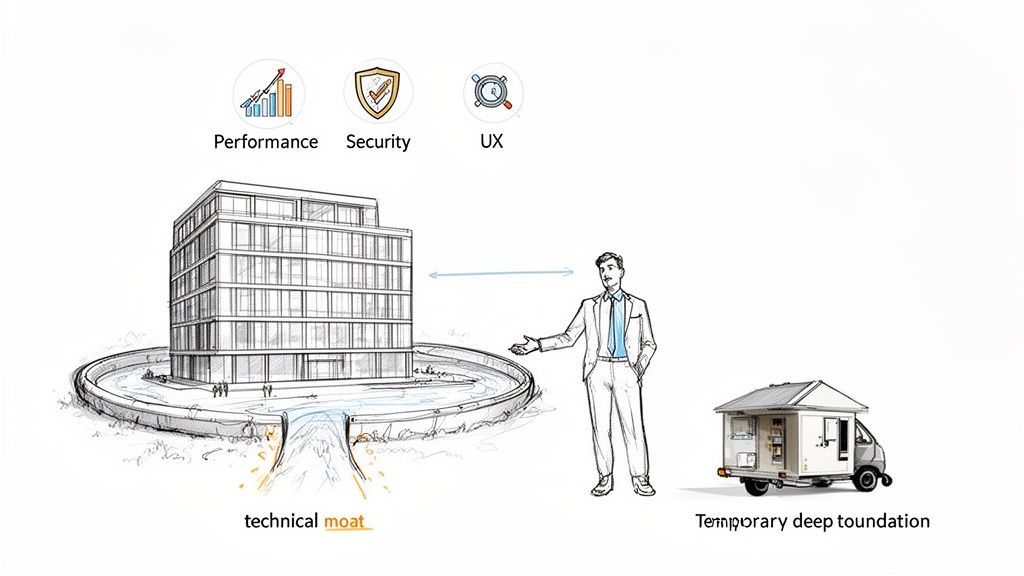
Faster, cheaper alternatives promise a quick launch, but they often build a product with a low ceiling. These apps feel clunky, cannot access the latest device features, and harbor hidden performance issues that surface the moment you start to scale. This inevitably leads to a costly, time-consuming rebuild—a massive red flag for any VC performing technical due diligence.
For founders building an enduring company, native development isn’t just an option; it’s the most direct route to creating an investable and defensible product. It proves you are building for valuation from day one.
Before we dive deeper, let’s analyze the strategic implications. This table breaks down the core differences for a founder deciding which path to take.
Strategic Snapshot: Native vs. Cross-Platform for Founders
Factor
Native App Development (The Mentor-Architect Approach)
Cross-Platform & Low-Code (The Mass-Market Alternative)
Business Outcome
A high-value, defensible technical asset engineered for long-term valuation and market leadership.
A short-term tool for rapid validation, often requiring a complete rebuild to scale.
Investor Perception
Seen as a serious investment in a scalable, production-grade foundation. Signals long-term vision.
Often viewed as a prototype. Raises concerns about technical debt and future refactoring costs.
User Experience
Flawless, fast, and intuitive. Feels like a natural extension of the phone’s operating system.
Can feel “off.” Slower performance, generic UI, and a noticeable lag are common complaints.
Scalability & Performance
Engineered to handle growth from day one with a robust, efficient architecture.
Performance bottlenecks are common when user load increases, hindering growth.
Access to Device Features
Immediate and direct access to all new OS features and hardware (cameras, GPS, biometrics).
Delayed or limited access. Always playing catch-up to the native platforms.
Long-Term Cost
Higher initial investment, but a lower total cost of ownership. Avoids expensive, company-killing rebuilds.
Low initial cost, but high long-term costs due to performance issues, maintenance, and the eventual need to refactor.
As you can see, the choice goes far beyond the initial budget. It’s about what kind of company you’re engineering.
Building an Investor-Ready Technical Moat
A native app is engineered to run flawlessly on its home turf. It “speaks the device’s first language”—like Swift for iOS or Kotlin for Android. This gives it a direct line to the phone’s hardware, like the camera, GPS, and processor, resulting in unmatched speed, responsiveness, and reliability.
This approach delivers immediate benefits that investors instantly recognize:
-
Unmatched User Experience: Native apps just feel right. They’re smooth, intuitive, and perfectly align with the UI and performance standards users expect.
-
Fortified Security: By tapping directly into the operating system’s built-in security architecture, native apps provide a much safer home for your user’s data.
-
Future-Proof Scalability: The entire product is built on a rock-solid foundation, ready to grow with your user base without hitting the performance walls that plague cross-platform apps.
The Market Demands Production-Grade Architecture
The global app development market is exploding, on track to hit a staggering USD 618.65 billion by 2031. In an arena with stakes this high, founders cannot afford to show up with a half-baked MVP, especially when investor audits demand a production-grade architecture from the start.
There’s a reason native app development commands 37.92% of total revenue: building a true “technical moat” requires the precision and raw performance that only a custom, native build can deliver. You can explore the full market dynamics and discover more insights about these app development trends. This market velocity highlights a critical reality for startups—your first build has to be your best build.
Choosing Your Platform Battleground: iOS vs. Android
You’ve decided to engineer a native product. Smart move. Now for the next big question, one that will define your go-to-market strategy: where do you plant your flag first? Will it be in Apple’s pristine, highly profitable iOS ecosystem, or Google’s sprawling, globally dominant Android territory?
This isn’t a simple coin toss. It’s a deliberate, strategic decision that signals to investors you’ve thought deeply about how you’re going to validate your idea and capture your first users.
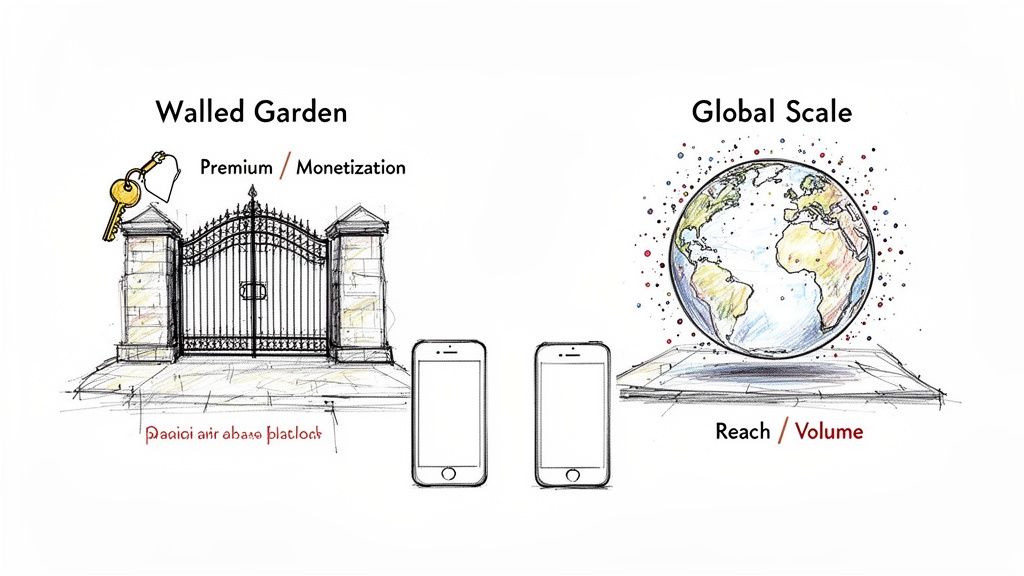
The right answer boils down to your business goals, target user profile, and monetization model. Each platform offers a unique advantage. Picking the right one means you’re aiming your limited capital with laser precision to make your MVP count.
Trying to tackle both simultaneously is a classic startup mistake. It doubles your costs, kills your focus, and pushes back your launch—three things no early-stage company can afford.
The Case for iOS First: Apple’s Walled Garden
Launching on iOS first means playing inside Apple’s famous “walled garden.” Think of it as an exclusive, members-only club. The ecosystem is tightly controlled, the app review process is notoriously strict, and the hardware-software experience is perfectly unified. Most importantly, the members of this club are known for spending money.
An iOS-first strategy is usually the correct path if your business plan depends on:
-
Premium Monetization: It’s a simple fact—iOS users spend more on apps, in-app purchases, and subscriptions. If revenue comes directly from your users’ pockets instead of ads, the App Store is where you need to be.
-
Targeting Affluent Demographics: In markets like North America and Western Europe, the iPhone is the device of choice for higher-income consumers. This makes it the perfect launchpad for luxury products, high-end services, or B2B tools aimed at professionals.
-
Leveraging Cutting-Edge Tech: Apple is often first to market with groundbreaking hardware and software features. If your app’s magic relies on the newest camera tricks, ARKit, or advanced on-device AI with CoreML, building a native iOS app gives you first-dibs access with superior performance.
Choosing iOS first is a bet on quality over quantity. You’re prioritizing a smaller, high-value group of users who are willing to pay for a polished, secure, and premium experience. That’s a powerful story to tell investors who care about strong unit economics from day one.
The Case for Android First: Global Scale and Accessibility
On the flip side, an Android-first approach is your ticket to mass-market domination. Android runs on a staggering variety of devices from hundreds of manufacturers, giving it an unmatched global footprint, especially in fast-growing emerging markets.
Going with Android first is the clear winner when your main objectives are:
-
Maximum Reach: Android holds over 70% of the global market share. This gives you access to an enormous and incredibly diverse user base. It’s an absolute must for consumer apps, social networks, and any product that relies on network effects to win.
-
Flexibility and Openness: The Google Play Store is generally more relaxed with its review process. The open-source nature of Android also gives you more freedom for certain app functions and even alternative ways to distribute your app.
-
Targeting Specific Global Markets: In huge parts of Asia, South America, and Africa, Android isn’t just the market leader—it’s practically the only option. If your growth plan is focused on these regions, starting with Android is non-negotiable.
Choosing the right platform is a major decision, but it doesn’t have to be a shot in the dark. A structured framework can help you weigh the pros and cons for your specific situation. For a more direct answer, you can get a recommendation for your tech stack that’s built around your unique product goals.
Ultimately, your choice here shapes your entire narrative. It tells investors if you’re focused on proving out a premium business model with a niche audience (iOS) or if you’re building a rocket ship designed for massive, worldwide scale (Android). Both are valid strategies, but only one is right for your MVP.
The True Cost and Timeline of a Native MVP
Let’s get right to it—the two questions every founder asks: “How much will this cost?” and “How long will it take?”
There’s no simple price tag, because a true Minimum Viable Product (MVP) isn’t just an expense. It’s a capital investment in the machinery of your business. It’s not a line item you can cut corners on.
When you engineer a native MVP the right way, you’re creating the foundational asset that will carry your business through its first years of growth and into the investor boardroom. It’s the difference between a shiny-but-hollow prototype and a high-value technical asset that actually scales.
From Prototype Price to Asset Investment
It’s easy to get lured in by the lowest bidder promising a fast, cheap app. But what you often end up with is a “disposable prototype.” It looks the part, but underneath it’s a mess of shortcuts and technical debt. It might be enough to validate an idea, but it will absolutely crumble under real-world pressure and fail any serious technical due diligence.
The most expensive MVP is the one you have to throw away. An investor-ready native MVP, built with clean, audit-ready engineering from day one, saves you from the painful and costly rebuild that kills so many startups after they raise money.
An investor-ready MVP, on the other hand, is built for the long haul. The higher initial investment reflects the elite engineering required to create a clean, documented, and scalable codebase. This upfront investment pays for itself by saving you hundreds of thousands of dollars and months of lost time you would have spent on a complete do-over.
Key Drivers of Native MVP Cost and Timelines
So, what actually determines the budget and schedule for your native MVP? It boils down to three core factors. Getting a handle on these is crucial for setting expectations with your team and investors.
A solid, investor-ready native MVP for one platform (either iOS or Android) typically lands in the $75,000 to $250,000+ range and takes about 4 to 9 months to build. Here’s what’s driving those numbers:
-
Feature Complexity: This is the primary driver. An app that just displays content is a world away from one that needs real-time chat, complex user permissions, or custom machine learning algorithms. The more your app must do, the more time and capital it will require.
-
Backend Architecture: Your app needs a brain. A resilient backend to handle user accounts, manage data, and run all the server-side logic is a huge part of the build. A scalable cloud infrastructure isn’t just a nice-to-have; it’s a non-negotiable for any product that hopes to attract investment.
-
Third-Party Integrations: Need to process payments with Stripe, display maps with Google Maps, or send messages with Twilio? Each of these services needs to be carefully engineered into your app, which adds complexity and development hours.
Shifting the Conversation to Long-Term ROI
A cheap prototype might get a few nods in a pitch meeting, but it won’t get you funded. The real conversation isn’t about the sticker price; it’s about the total cost of ownership and the return on investment. By investing in quality native app development from the start, you’re building an asset that grows in value.
Think about these long-term wins:
-
Higher Company Valuation: A clean, scalable, and secure codebase is a massive asset during VC technical due diligence. It signals you’re a serious, de-risked investment.
-
Faster Scaling Post-Launch: When you’re ready to grow, you can add features and onboard new users without hitting a technical wall. You can move faster than your competition.
-
Reduced Long-Term Maintenance: Well-architected code is simply easier and cheaper to maintain. You’ll spend less time fixing bugs and more time building what your customers want.
Getting this right from the beginning is one of the most important decisions you’ll make. If you’re still weighing the options, our deep dive into mobile application development costs and timelines offers even more financial detail. Ultimately, investing in a high-quality native MVP is a strategic move that sets your startup up for sustainable growth and a much smoother fundraising journey.
Architecting for Valuation with Audit-Ready Engineering
When you’re pitching investors, they’re looking at more than your pitch deck and revenue charts. Sooner or later, their tech team will pop the hood on your product. This is called technical due diligence, and it’s where your app’s architecture can either kill the deal or send your valuation soaring.
This is where having audit-ready engineering becomes your secret weapon.
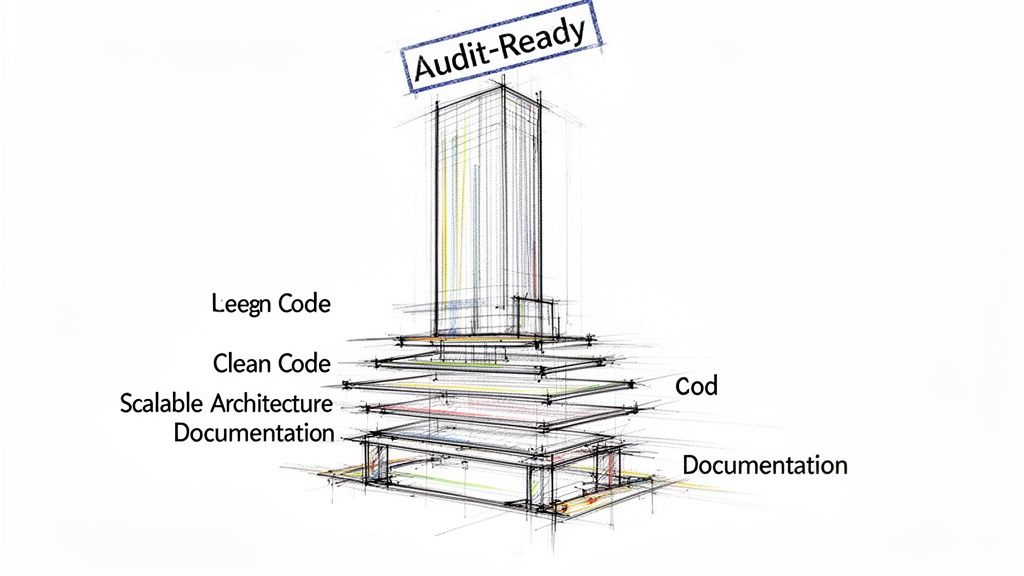
You wouldn’t build a skyscraper on the foundation of a suburban home. It wouldn’t hold up. In the same way, an app built with tangled code, zero documentation, and a flimsy structure is a time bomb. And investors are experts at spotting them.
Audit-ready engineering is about building your native app with the foresight that this intense scrutiny is coming. It’s about creating a technical moat—an app so well-built, secure, and scalable that it’s a genuine asset, not just fragile code. It’s a huge green flag for VCs that you’re building a serious business, not just a project.
What, Precisely, Is a Technical Moat?
A technical moat isn’t just your clever idea. It’s the sheer quality of the execution—an engineering standard so high that competitors can’t simply copy it overnight. It’s that perfect trifecta of clean code, a smart, scalable architecture, and crystal-clear documentation.
For any founder chasing venture capital, these aren’t nice-to-haves; they’re deal-makers.
Building this way from the start ensures your app can:
-
Scale Without Cracking: Go from 100 users to 1,000,000 without having to tear everything down and start over.
-
Sail Through Due Diligence: Hand over a codebase that’s a joy for an investor’s team to inspect, not a nightmare.
-
Onboard New Hires Fast: Let new engineers become productive immediately, instead of spending months deciphering spaghetti code.
A solid technical moat makes your startup a much safer bet, and that’s why it directly increases your valuation. It’s proof that the engine of your company is built to last.
An app’s architecture is the silent narrator of your startup’s story. A clean, scalable structure tells investors you’re prepared for long-term success. A messy one tells them you’re building on borrowed time.
The AI Coding Boom and the Trust Deficit
The developer world is buzzing with AI tools promising to write code faster than ever. While they can be handy, they’re a minefield if you don’t know what you’re doing. Here’s a stat that should make any founder pause: while 84% of developers are using AI, a whopping 46% admit they don’t trust the code it produces.
That’s a massive trust deficit.
This is exactly where elite native app development proves its worth. It’s about pairing the speed of AI with the wisdom of senior human architects to build something truly bulletproof. AI is great for cranking out boilerplate, but it can’t replace the architectural experience needed to avoid painting yourself into a corner with technical debt.
This is why a high-touch, partner-led approach consistently delivers MVPs that fly through the toughest technical audits. We use AI as a turbo-boost, not as a replacement for the critical thinking that builds real, lasting value.
Architectural Pillars That Boost Your Valuation
When VCs send in their tech auditors, they aren’t just glancing at your app’s UI. They are hunting for specific architectural patterns that signal “quality” and “scalability.” Below are the key pillars that directly increase your company’s valuation.
The table breaks down what VCs look for and why it makes your startup a more valuable, de-risked investment.
Architectural Pillars of an Investor-Ready Native App
Architectural Pillar
What It Is
Why It Increases Valuation
Clean, Testable Code
Code that is easy to read, modify, and covered by automated tests. It follows established design patterns and best practices.
Reduces the risk of bugs and future maintenance costs. Proves the team is disciplined and makes it easier to add new features or onboard new engineers.
Scalable Architecture
The underlying structure (e.g., serverless, microservices) is designed to handle user growth without performance degradation or a full rewrite.
Investors are betting on growth. A scalable architecture proves you can handle success, de-risking the investment in a 10x or 100x user scenario.
Thorough Documentation
Clear, up-to-date documentation for your API, codebase, and infrastructure setup. It explains the “why” behind key decisions.
Massively reduces the time and cost for a new team to take over or for an investor’s team to validate your tech. It’s a sign of a professional, mature engineering culture.
Robust Security
Your app is built with security in mind from day one, protecting user data and preventing common vulnerabilities.
A data breach can kill a startup. Strong security protects your users and the company’s reputation, removing a major liability. Check out these 10 Crucial Mobile App Security Best Practices.
CI/CD & DevOps Automation
An automated pipeline for testing and deploying new code (Continuous Integration/Continuous Deployment).
Shows you can ship features quickly, reliably, and with less risk. It signals an efficient and modern development process that can outpace competitors.
By focusing on these pillars from day one, every hour your team spends coding becomes a direct investment in your company’s future value. This is how you transform engineering from a cost center into your most powerful competitive edge.
Assembling Your A-Team for Development
An idea is only as good as the team that brings it to life. We’ve covered the “what” and the “why” of native app development—the architecture, the platform choices, and the strategy for long-term value. Now, let’s get into the “who.” This is where most founders stumble: building the right technical team.
The typical move? Find the cheapest overseas firm, throw a spec sheet over the wall, and cross your fingers. That is the anti-outsourcing model in reverse—a recipe for disaster. This black-box approach treats your product like a commodity, leaving you with code you can’t understand and a business you can’t control. A real engineering partner doesn’t just hand you a finished product; they mentor you and build with you.
You aren’t just filling seats on a project. You’re building the heart of your company. That requires a completely different approach—one focused on assembling an A-team that can build a high-value asset from the ground up.
The Core Roles for a Native App MVP
Building a native app that gets investors excited isn’t a one-person show. The temptation to hire a single “full-stack” developer to do it all is a classic startup mistake that leads to burnout, missed deadlines, and a brittle product.
Instead, you need a small, focused team of specialists. Here are the must-have roles for building a high-performance technical culture:
-
Native Mobile Engineer (iOS or Android): This is your platform guru. They live and breathe Swift or Kotlin and know every quirk of their ecosystem. Their job is to craft a fast, intuitive app that feels like it belongs on the device.
-
Backend Engineer: Think of this person as the architect of your app’s brain. They build the server, database, and APIs that handle everything from user logins to processing data. A great backend engineer ensures your app is secure, scalable, and ready to grow.
-
DevOps Specialist: This role is your insurance policy. They’re the ones building the automated pipelines (CI/CD) that let your team test and ship code reliably. They handle cloud setup, lock down security, and make sure your app doesn’t fall over when you get that first big wave of users.
The goal isn’t just to hire developers. It’s to build a cohesive unit where each person is a master of their domain. This is the foundation of an engineering culture that investors want to bet on.
The Fractional CTO: Your Strategic Architect
For most founders, especially non-technical ones, this all sounds intimidating. How do you vet a senior iOS engineer on their Swift skills when you’ve never written a line of code? How can you tell if your backend architecture is actually scalable or just a time bomb?
This is precisely where a Fractional CTO becomes your strategic weapon. A Fractional CTO is a veteran technology leader who provides part-time strategic guidance. They aren’t just a consultant; they’re your mentor-architect, guiding your tech roadmap and helping you hire the right people.
The value they bring is massive:
-
Vetting and Hiring: They know exactly what to look for and can interview technical talent at a level most founders can’t. They’ll help you find and land A-players who are a perfect fit.
-
Architectural Oversight: They make sure your team is building a scalable, secure, and audit-ready product, preventing the kind of tech debt that quietly sinks startups.
-
Investor-Facing Strategy: When it’s time for due diligence, they speak the language of investors. They can confidently defend your architecture and prove your team can execute, dramatically boosting investor confidence.
Bringing on a Fractional CTO helps you sidestep the classic hiring blunders that plague early-stage companies. It ensures every technical decision and every new hire is aligned with your business goals. This is the anti-outsourcing model in action—a true partnership built on expertise and trust.
Your Founder’s Decision Framework for Going Native
We’ve talked strategy, capital, and architecture. Now for the gut-check. Choosing how to build your app isn’t a technical detail—it’s one of the most important business decisions you’ll make. It sets the trajectory for your startup.
This isn’t about hypotheticals. This is about bringing all those layers—financial, strategic, and technical—into a simple, clear framework. Think of it as the moment of truth that helps you decide if going native is the right move for your specific vision.
Your answers to a few key questions will tell you everything you need to know. Are you building a high-valuation technical asset, or are you still trying to prove your core concept? Be brutally honest with yourself. Your company’s future is riding on it.
The Litmus Test for Founders
Ask yourself these three questions. If the answer is a resounding “yes” to all of them, the argument for native development becomes almost impossible to ignore.
-
Is a killer user experience your main competitive advantage? If your app lives or dies by its fluid animations, instant response times, and deep integration with the phone’s hardware, you simply can’t afford to compromise. Native is the only way to guarantee that flawless, premium feel.
-
Is raising venture capital a core part of your plan? VCs aren’t just funding a cool idea; they’re investing in a scalable, defensible asset. Showing up with audit-ready, native engineering proves you’ve built a solid foundation that can handle due diligence and the explosive growth that follows an investment.
-
Are you trying to build a defensible, long-term business? If the goal is to create a true market leader with a “technical moat”—something competitors can’t easily copy—then native isn’t a choice. It’s a requirement. It’s how you build a robust platform, not just a disposable feature.
This next part is crucial. Once you have the vision, you need the right team to bring it to life. The diagram below shows how a founder, with the right technical leadership, can assemble the team to execute that native vision.
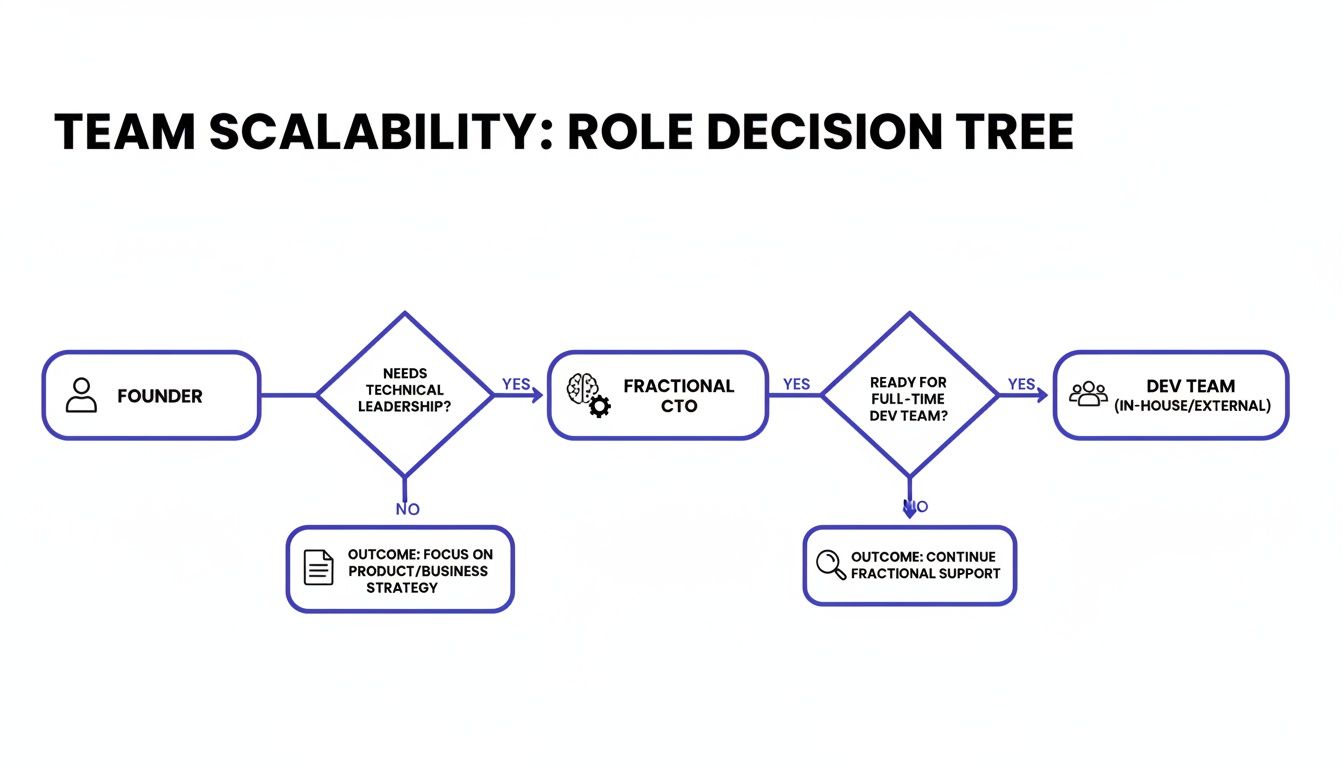
As you can see, successful execution is about more than just writing code. It requires a clear chain of command, from high-level vision all the way down to implementation.
For founders building enduring companies, native app development isn’t just an option—it’s the definitive route to creating an investable, defensible, and ultimately more valuable product. It is a declaration that you are building for the long term.
If you found yourself hesitating on any of those questions, don’t panic. It doesn’t mean your idea is bad. It just means your immediate priority should probably be more validation, perhaps with a simpler tool before you commit to a full-scale native build.
But for those of you ready to build an iconic company? The path forward is crystal clear.
Straight Answers to Tough Questions
Let’s cut to the chase. Founders always have a few big, make-or-break questions about building a native app. Here are the direct answers you need to engineer a product that investors will actually value.
How Can I Validate My App Idea Before Investing in a Full Native MVP?
You don’t need to write a single line of code to validate your idea. Before you even think about committing to a full native app development project, your job is to prove people want what you’re selling.
Get scrappy. Build interactive mockups using design tools, spin up a simple landing page with an email sign-up form, and run a few targeted ads to see who bites. Some founders even go old-school and manually perform the service their app would automate—a “concierge” MVP.
This is where you get priceless feedback. You’re confirming you’ve found a real-world problem worth solving before you spend a dollar of your (or your investors’) capital on engineering.
Can I Launch on Both iOS and Android Simultaneously?
You can, but it’s almost always a terrible idea for a new startup. Trying to launch on both platforms at once is a classic rookie mistake. It doubles your costs, splits your team’s focus, and drags out your timeline, killing the momentum you desperately need.
The smart play? Pick one platform. Determine where your target users live—are they on iPhones or Androids? Launch an incredible MVP there, get traction, and learn what works. Once you have a winning formula, you can attack the second platform from a position of strength, not desperation.
What Is the Single Biggest Mistake Founders Make with Their MVP?
The biggest, most catastrophic mistake is building a disposable prototype instead of an investable asset. Founders get tempted by a low price tag and end up with code that looks okay on the surface but is a complete disaster underneath.
This kind of MVP is a ticking time bomb. It can’t scale, it will fail any serious technical due diligence from investors, and it forces a full, expensive rewrite right after you get funded. It’s a momentum-killer that wastes precious time and money.
How Does a Technical Moat Protect My Business Long-Term?
A technical moat isn’t just about having a great idea. Your idea will be copied. A moat is when your execution is so elite that it becomes your defense.
Think of it this way: expert native engineering creates a product that’s incredibly difficult for a competitor to replicate. It’s the buttery-smooth performance, the rock-solid security, and the flawless user experience that comes from truly high-quality architecture. This level of craftsmanship is what separates a fleeting success from a business with a durable, long-term competitive advantage—and a much higher valuation.
At Buttercloud, we don’t just build apps. We partner with founders to engineer the high-valuation technical assets that become the bedrock of scalable companies. Learn how we can help you turn your idea into an investor-ready product.
Have a product idea to talk through?
We'll show you how we'd approach it — no pressure, just a real conversation.
Book a Discovery Call