Mobile Application Development: A Founder's Guide

Let’s be direct. Building a mobile app isn’t about writing code. It’s about engineering a high-valuation technical asset from the ground up. For a startup founder, your goal isn’t a simple prototype—it’s an investor-ready MVP that becomes the scalable core of your business.
Transforming Your Vision Into An Investable Asset

You have an idea. But the journey from that spark of vision to a scalable product is where most startups fail.
Success isn’t about finding a team to “build an app.” It’s about securing an engineering partner who understands that every line of code must contribute directly to your company’s valuation. We must shift the mindset from app development as a cost center to what it truly is: the engineering of a defensible, high-growth asset.
The market confirms this. The global mobile app economy is projected to exceed $1.2 trillion by 2035. This growth is driven by nearly 4.7 billion smartphone users who spend significant time within apps. For founders, the message is clear: your application is the primary battleground for creating a durable competitive advantage. You can review the data in this detailed mobile app development statistics report.
Beyond Prototypes: The Technical Moat
Much of startup advice advocates for building a quick, cheap prototype. This is a strategic error.
A flimsy prototype is the fastest way to accumulate “technical debt”—a convoluted mess of flawed code and poor architecture that must be completely rebuilt before scaling is possible. This is not just expensive; it’s a critical red flag for investors during technical due diligence.
The superior strategy is to engineer a “Technical Moat” from day one. This concept is fundamental to building a high-valuation company. Think of it as your product’s intrinsic defensibility, forged through elite engineering and precise architectural choices.
A Technical Moat ensures your codebase is an asset, not a liability. It’s the difference between a product that merely works and a platform engineered to dominate a market, pass investor audits, and scale without compromise.
From Idea to Investor-Ready MVP
The journey begins by treating your MVP (Minimum Viable Product) not as a disposable experiment, but as the foundational core of your future enterprise. This requires getting three things right from the start:
-
Scalable Architecture: A system engineered to handle 1,000 users with the same reliability as it handles one million.
-
Audit-Ready Code: Clean, documented, and secure code that will impress any VC or technical auditor who examines the asset.
-
User-Centric Design: A relentless focus on solving one core user problem so exceptionally well that it becomes your definitive competitive advantage.
This guide will walk you through that strategic process, from locking down your product design to scaling your infrastructure. Consider it your first step in building a company, not just an app. We will show you how to make the right decisions to transform an idea into a polished product that commands a high valuation and is truly engineered to last.
Product Design & Discovery: Your Product Blueprint
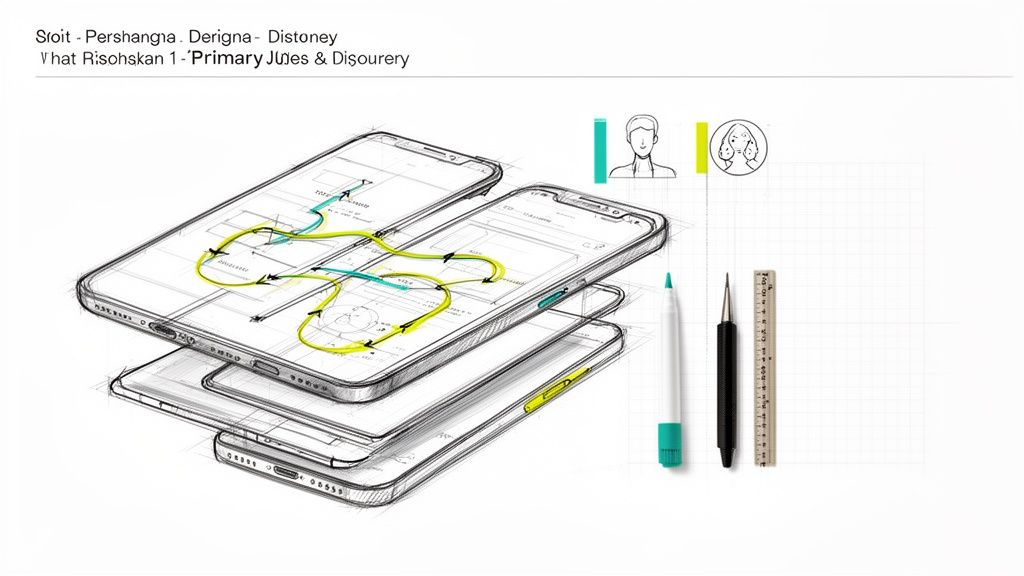
The game is won or lost here, long before a single line of code is written. This is the Product Design and Discovery Phase, where your idea is forged into a tangible, strategic product blueprint. This isn’t about choosing colors; it’s about defining your core business logic and competitive differentiation.
Many founders get this wrong by jumping directly to a long wish list of features. The correct approach is to build a strategic product roadmap by methodically validating core assumptions. You must ask the hard questions: Who, precisely, are we building this for? What is the single most painful problem we are solving? How will we measure success?
From Assumptions to a Defined User Journey
Answering these questions moves you from guesswork to solid ground. The objective is to define the primary user journey—the A-to-B path a user follows to solve their core problem using your app. Every step, screen, and interaction must be intentional and serve that one path. Anything else is noise.
This involves mapping user flows, which are visual roadmaps of how a user accomplishes a task. These flows force clarity and expose gaps in logic before they become expensive engineering problems. Remember, complexity is the enemy of a strong MVP. Your initial blueprint must be relentlessly focused on core value.
Creating Wireframes as an Engineering Foundation
Once the user journey is defined, it’s time to create wireframes. Do not think of these as design mockups. They are the architectural plans for your application—bare-bones layouts focused entirely on structure, function, and information flow. They are intentionally stripped of visual design to keep the conversation centered on what it does, not what it looks like.
Wireframes are a critical communication tool between the founder and the engineering team. They ensure alignment on what is being built, how it will function, and why each element exists. This alignment prevents costly rework and scope creep.
The output of this phase is more than a few drawings. It’s a validated, well-documented product blueprint that serves as the non-negotiable starting point for an elite engineering team. To master this stage, our deep dive on product design for startups is required reading. This meticulous planning is what separates a product built for high valuation from one that is dead on arrival.
Your final blueprint must include:
-
Validated User Personas: A precise profile of your ideal user, their goals, and their primary pain points.
-
Core User Journey Map: The step-by-step map showing how users solve their main problem.
-
Functional Wireframes: Screen-by-screen layouts defining the app’s structure and flow.
-
Prioritized Feature List: A strategic list of MVP features laser-focused on solving the single core problem.
Engineering The Investor-Ready MVP
The term “MVP” is dangerously misunderstood. Too many founders hear “Minimum Viable Product” and think “quick, cheap, disposable.” They envision a fragile prototype hacked together merely to prove an idea can exist.
This is a strategic failure. It’s a shortcut that leads directly to a mountain of technical debt, creating an “asset” that will crumble the moment an investor’s technical team looks under the hood.
A serious founder aims higher. We don’t build disposable prototypes; we engineer Investor-Ready MVPs. This reframes the goal entirely. You’re not just launching fast. You’re launching with a high-quality codebase that is an investable asset from day one, built to pass venture capital technical due diligence.
The Myth Of The ‘Quick and Dirty’ MVP
A cheap, rushed MVP might feel like a win, but it will cripple your ability to scale. Every shortcut—poor architecture, undocumented code, no security considerations—becomes a crack in your foundation.
The moment you need to add a key feature or your user base grows, the entire system begins to fail. Eventually, it must be torn down and rebuilt. That costs you time, money, and, most importantly, investor confidence.
An investor-ready MVP, by contrast, is built with intention. It prioritizes clean, scalable architecture from the start and eliminates technical debt at its root.
This isn’t about building every feature you’ve imagined. It’s about engineering the most critical feature set to a production standard, ensuring the foundation is solid enough to build a billion-dollar company upon.
This strategic approach is the only way to ensure your codebase increases your company’s valuation, rather than diminishing it. We detail this process in our guide on how to build an MVP that investors will love.
Building Your Technical Moat
This is also where you dig your “Technical Moat.” This is what makes your product defensible. It’s not one feature; it’s the combination of superior architecture, flawless performance, and proprietary logic that competitors cannot easily replicate.
Your moat is built by making deliberate choices in three key areas:
-
Architecture: Selecting a backend and database that are not just secure, but engineered from day one for future complexity and user growth.
-
Performance: Ensuring the app is lightning-fast, responsive, and reliable. A superior user experience is a tangible differentiator that drives retention.
-
Proprietary Logic: This is your core algorithm, unique workflow, or data processing that delivers your unique value proposition.
To prove this to investors, you need data. Selecting the right analytics tools for mobile apps is a non-negotiable step. These metrics provide the validation of your product’s value.
Choosing Your Development Path: Native vs. Web
The final piece is choosing your technology path. This is a core business strategy decision, framed by your goals for user experience, performance, and time to market. You have three main paths, each with clear trade-offs.
Deciding between Native, Hybrid, and a Web App is a major strategic fork in the road. There’s no single “right” answer—only the right answer for your business, your budget, and your strategic goals. This table breaks down the core trade-offs.
Factor
Native App (iOS/Android)
Hybrid App (e.g., Flutter, React Native)
Progressive Web App (PWA)
Performance
Highest. Direct hardware access delivers the fastest, smoothest experience.
Good. Offers near-native performance with a slight overhead.
Variable. Performance depends on the browser and device.
User Experience
Best. Adheres perfectly to platform-specific design guidelines (e.g., Apple’s HIG).
Consistent. Provides a uniform look and feel across iOS and Android.
Limited. Cannot fully replicate the native feel or access all device features.
Speed to Market
Slower. Requires separate codebases and development teams.
Faster. A single codebase can be deployed to both platforms.
Fastest. Leverages existing web technologies for rapid deployment.
Investor Perception
Excellent. The gold standard for serious, long-term product commitment.
Good. Widely accepted for MVPs, especially when speed is a factor.
Fair. Can be viewed as a lower-commitment starting point.
For founders serious about building a technical moat, a native app often provides the sharpest competitive edge in performance and UX, sending a strong signal to investors. However, a web or hybrid app can be a strategic choice to get a quality product to market faster. The right choice depends entirely on your specific strategy.
Scaling & Infrastructure: Building An Architecture That Scales
Your MVP is a success. The first 1,000 users are engaged. Now for the hard part. Initial success introduces the next founder challenge: scaling. Your mindset must shift from acquiring the first users to preparing for the next 100,000.
Planning for growth is not a future problem—it’s a decision that must be baked in now to prevent catastrophic failure later.
This isn’t about adding servers when traffic spikes. It requires a real infrastructure strategy—one that is stable, secure, and ready for success. You need a system that won’t buckle under pressure as you progress from your seed round to Series A.
The last thing you want is for your success to crash your product.
This flowchart lays out the choices you’ll face, pitting the immediate need for speed and a tight budget against the long-term demands of performance and scalability.
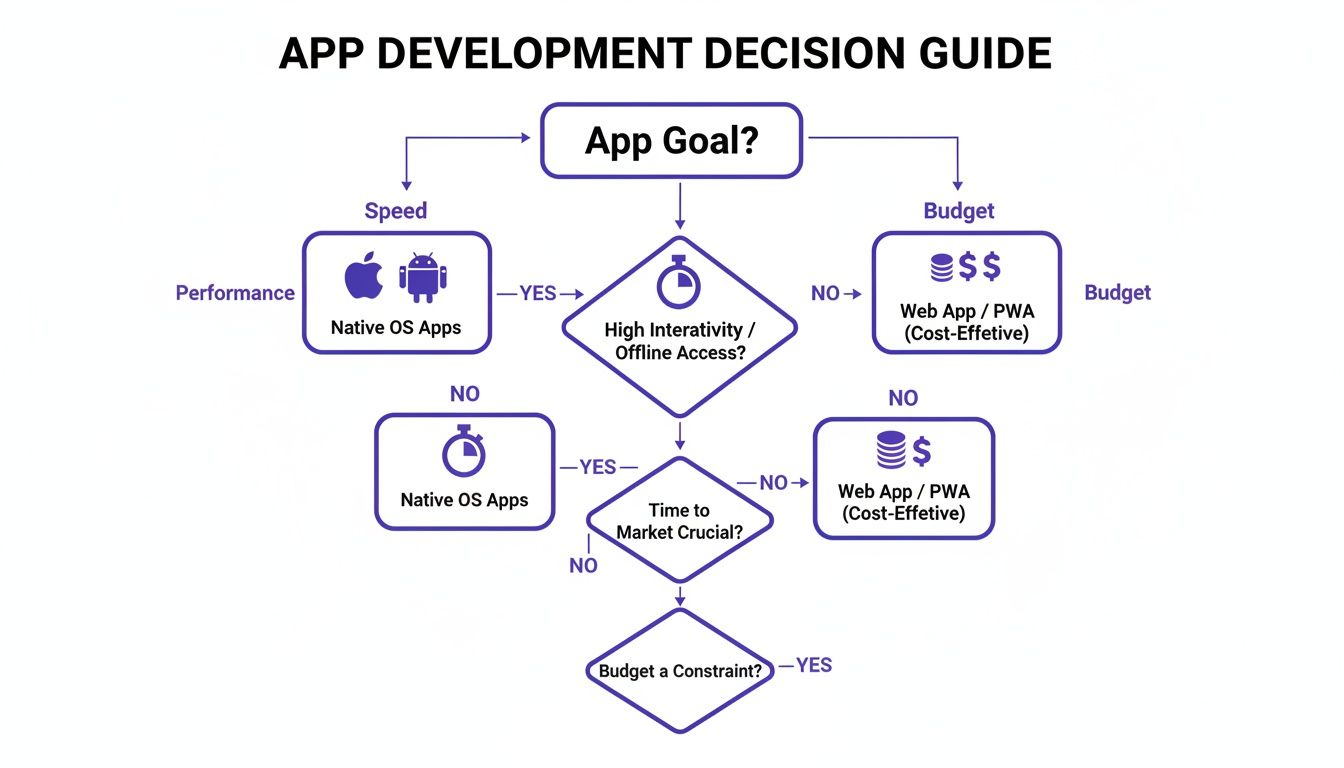
As shown, the quick and cheap path often runs directly counter to the one needed for a truly scalable, high-performance application. This is the core tension every founder must navigate.
Boutique DevOps For Founders
The term “DevOps” can sound like a costly enterprise endeavor. For a startup, it is a lifeline.
Boutique DevOps is your strategic weapon. It is the art of creating automated systems to build, test, and release software quickly and reliably, tailored for a startup’s scale and speed. It is the engine room of modern product development.
For a founder, this means one thing: shipping new features faster than your competition without breaking the product.
A critical component is the CI/CD pipeline, which stands for Continuous Integration/Continuous Deployment.
-
Continuous Integration (CI): As developers commit new code, CI acts as an automated gatekeeper. It runs tests on every change, ensuring new code integrates flawlessly. It catches bugs instantly, not days later.
-
Continuous Deployment (CD): Once code passes CI checks, CD automatically pushes those changes live to your users. This transforms high-risk release days into non-events.
This automated pipeline is your factory for shipping high-quality updates at an accelerated pace.
Architecting For Unpredictable Growth
When a marketing campaign goes viral, your infrastructure must be ready. This is where key architectural concepts become critical.
Containerization (e.g., Docker, Kubernetes)
Imagine your application as a set of LEGO bricks—database, user login, backend logic. Containerization places each component into its own sealed “container.”
These containers can be replicated, moved, or replaced instantly without affecting other components.
This is a game-changer for a startup. If your user login system is overloaded, you can instantly add more “login” containers to handle the load without touching—or paying for—the rest of the system. This optimizes both stability and cost.
Serverless Architecture
With a serverless approach, you stop managing servers entirely. You write your application code, and a cloud provider like AWS or Azure handles everything else—running the code when needed and automatically scaling it to meet demand.
Serverless architecture is a founder’s best friend for managing unpredictable traffic. You pay only for the compute time you consume, making it incredibly cost-effective while ensuring your app can handle sudden surges in activity without crashing.
Ultimately, these choices are about building a resilient, audit-ready cloud infrastructure. A smart architecture doesn’t just keep the lights on; it’s a powerful signal to investors. It proves you have engineered a real product for serious growth, not a fragile MVP.
Integrating AI And Modern Technologies
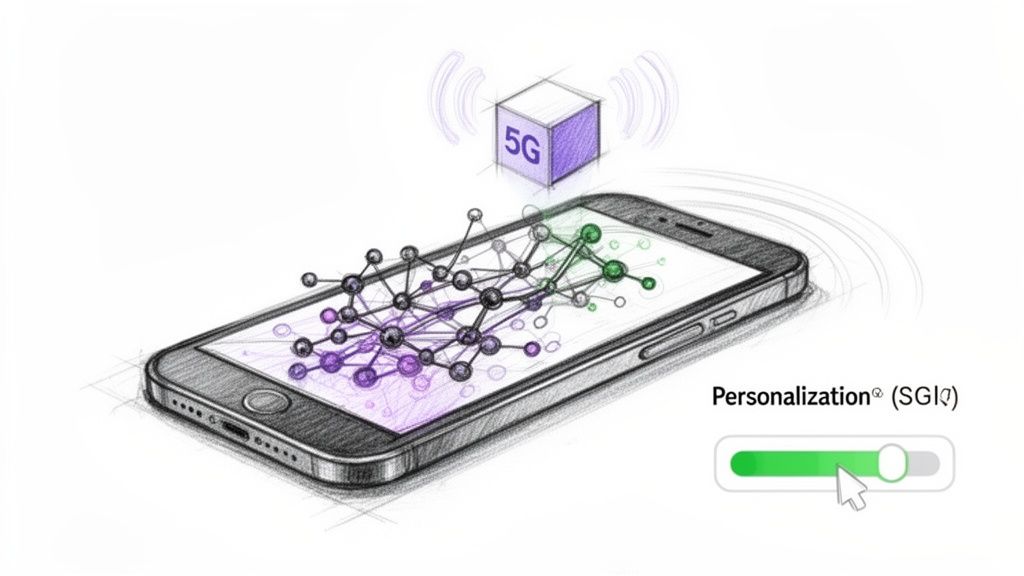
To be blunt: a static mobile app is obsolete. For founders building a high-value company, integrating modern technologies like Artificial Intelligence isn’t about chasing buzzwords. It’s about building a real, defensible competitive advantage.
The goal is to move beyond gimmicks and use AI to create smart, responsive, and deeply personal experiences. This is how you build a technical moat. This means embedding predictive analytics and hyper-personalization into your product’s core.
The market for AI in mobile apps is projected to hit $221.9 billion by 2034. Generative AI apps alone are on track for $1.9 billion in revenue in the first half of 2025. With 70% of developers already using AI, it is now table stakes. You can review more key mobile app and AI statistics.
AI As A Core Product Differentiator
Founders must think of AI as a foundational layer, not an add-on. Instead of showing users a static list, what if your app could predict their needs before they search?
That is the leap from a functional tool to an indispensable partner.
Consider these high-impact applications:
-
Hyper-Personalization: An e-commerce app that rearranges its interface and recommendations based on real-time behavior, time of day, and location.
-
Predictive Analytics: A fintech app that analyzes spending patterns to warn users of a potential cash crunch before it happens.
-
Intelligent Workflows: A B2B SaaS app that automates reports, learning from user corrections to become more accurate with each use.
These are the features that create sticky habits and deliver tangible value, making your app essential.
Beyond AI: Emerging Tech That Builds Moats
While AI dominates headlines, other technologies like Augmented Reality (AR) and 5G are powerful tools for deepening your technical moat—if engineered correctly.
An AR feature isn’t a gimmick. For a furniture company, it’s a tool that lets a customer visualize a sofa in their living room, drastically reducing returns and increasing conversions.
The biggest mistake founders make is treating these technologies as separate features. The real magic happens when you combine them. Imagine an AR preview powered by an AI recommendation engine, delivered instantly over a 5G connection. That is a product experience competitors cannot easily replicate.
Tools like AI Coding Agents are becoming game-changers, helping teams build sophisticated features faster than ever.
Ultimately, this is a calculated move to engineer a product that is fundamentally more valuable, more engaging, and far more difficult to replicate. For founders focused on valuation, this is a non-negotiable part of the journey.
Strategic Leadership & Hiring
You have a brilliant app idea. You may even have early code. That is just the starting line.
The real challenge begins when you shift from building a product to leading a technical strategy and team. This is where even the sharpest founders can stumble. Brilliant code without brilliant leadership is a race car with no driver.
Non-technical founders may feel out of their depth. Technical founders face the challenge of transitioning from coder to strategic leader. The answer is not to abdicate responsibility, but to secure the right co-pilot.
The Fractional CTO As Your Strategic Partner
Hiring a full-time, six-figure Chief Technology Officer is often a premature and costly move for an early-stage startup. The Fractional CTO model has become a game-changer for founders.
Think of a Fractional CTO as a “Mentor-Architect.” This is not a temporary coder, but a seasoned executive who provides top-tier strategic guidance on a part-time basis.
This is the opposite of outsourcing your vision. A great Fractional CTO mentors you, helping you build the technical acumen to make smart decisions and avoid perpetual reliance on outside agencies.
Their role is purely strategic:
-
Technical Roadmap: They translate your business vision into a concrete, step-by-step technical plan.
-
Budgeting & Risk Management: They show you where to invest for maximum impact and how to identify technical risks before they escalate.
-
Investor Communication: They are masters at articulating your tech strategy to investors, instilling the confidence needed to secure funding and pass due diligence.
Navigating Tech Team Hiring
Ultimately, the goal is to build an elite in-house team. Hiring A-player engineers is one of the toughest challenges a founder will face. The market is competitive, and top talent demands more than a salary.
The anti-outsourcing model is about founder empowerment. It provides the high-touch partnership and mentorship needed to make smart hires, build a robust technical roadmap, and create an investable company, not just a functional app.
To land elite engineers, you must offer what large corporations cannot: a compelling mission, genuinely hard problems to solve, and a culture of ownership.
When interviewing, look beyond their GitHub profile for these core traits:
-
Product Mindset: Do they care about why a feature is being built? Can they connect their code to the value a user receives?
-
Architectural Forethought: Do they build for today while planning for tomorrow? Ask them how they would design a system to handle 100x its current load. Their answer reveals their strategic depth.
-
Clean Code & Low Debt: The best engineers take pride in writing clean, documented, and testable code. They view technical debt as a personal failure.
Building your team is not about filling seats. It’s about curating a small, focused group of engineers who are obsessed with quality and fully aligned with your vision. This is how you create a technical powerhouse that becomes one of your company’s most valuable assets.
Your Top Questions Answered
As a founder, you constantly navigate high-stakes decisions. When it comes to building your app, the questions get even tougher. Here are the direct answers to the questions we hear most from founders focused on building valuable companies.
How Much Does An Investor-Ready MVP Really Cost?
Let’s be clear: cost reflects strategy. A quick-and-dirty prototype can be built for $20,000. The problem is that “deal” buries a mountain of technical debt that can cost hundreds of thousands to fix when it’s time to scale—a massive red flag for any savvy investor.
A true, investor-ready MVP—built on clean, scalable architecture—will cost between $75,000 and $250,000+. This is an investment in your company’s valuation, not an expense. It is the difference between a flimsy prototype and a robust technical asset.
A great development partner doesn’t just build an app; they engineer an asset designed to pass venture capital technical due diligence. That upfront investment is a direct driver of a higher valuation and proves you’re building a serious, scalable business.
How Long Does Mobile App Development Take?
For a production-grade MVP, a realistic timeline is 4-6 months. You will hear pitches for faster builds, but those shortcuts almost always skip the critical discovery and architectural planning that prevent your app from crashing, leaking data, or failing under user load.
Rushing the foundation is the fastest way to burn capital on costly rebuilds.
A solid project timeline includes:
-
Discovery & Design: 4-6 weeks
-
Core Feature Engineering: 10-14 weeks
-
Testing, DevOps & Launch Prep: 4-6 weeks
This is not about being slow; it’s about strategic speed. Building it right the first time is how you maintain momentum and avoid the soul-crushing delays that kill startups.
Should I Build For IOS, Android, Or Both?
This is a business question, not a technical one. Do not automatically build for both—a common and expensive mistake. The choice depends on your target audience and monetization strategy.
If you’re launching a premium consumer app in the US, an iOS-first strategy is often the smartest play, as iOS users historically spend more in-app. If your target market is global or in emerging economies where Android dominates, starting with Android makes more sense.
You might also consider a Web App or a hybrid approach to reach both platforms on a tighter budget, but be honest about the performance trade-offs versus a true native app. The key is to deeply understand your first users and meet them where they are.
Building a technical asset that investors will fight over requires more than just code—it demands world-class engineering and a strategic mind. Buttercloud is a boutique engineering partner that helps founders turn their ideas into finished products. Schedule a consultation with our team and let’s discuss your technical roadmap.
Have a product idea to talk through?
We'll show you how we'd approach it — no pressure, just a real conversation.
Book a Discovery Call