
React JS vs Angular vs Vue JS: MVP Tech Stack Guide
You’re probably in one of two situations right now.
Either you’re building your first serious product and your developers are debating React, Angular, and Vue like it’s a matter of personal identity. Or you’ve already raised early capital, and now every technical decision suddenly feels expensive because it is. The framework you choose today won’t just shape your product. It will shape hiring, delivery speed, maintainability, and how credible your engineering story sounds when investors start asking hard questions.
Founders often treat frontend framework choice as a developer preference. That’s a mistake. This is an asset design decision. If you get it right, you build faster, hire faster, and preserve strategic flexibility. If you get it wrong, you’ll spend the next year paying for avoidable complexity, slower iteration, and awkward technical justifications in diligence.
For most startups, my recommendation is simple: choose React. There are exceptions. Angular has a place. Vue has a place. But if your goal is to ship an investor-ready MVP and turn it into a scalable product without boxing yourself in, React is usually the strongest business decision.
The Choice That Defines Your Technical Moat
A founder closes a seed round, hires a small product team, and wants a polished MVP in market before the next fundraising conversation. The product needs dashboards, onboarding flows, billing screens, admin tools, and enough speed to look credible in live demos. Then the team hits the first major stack debate: React js vs Angular vs Vue js.
At that moment, the wrong conversation usually starts. Developers compare syntax preferences, state management styles, or which framework feels cleaner. Founders hear technical jargon and assume the differences are mostly cosmetic.
They aren’t.
Your frontend framework becomes part of your operating model. It affects how quickly new engineers can contribute, how easily you can swap vendors or internal hires, how much architectural discipline is baked in, and whether your codebase feels like a durable technical asset or an expensive prototype.
Founders don’t get rewarded for picking the most elegant framework. They get rewarded for building momentum with a stack they can hire for, maintain, and defend.
A strong technical moat isn’t just proprietary logic or clever infrastructure. It’s the combination of product speed, code quality, team effectiveness, and future optionality. Framework choice sits at the center of that.
Here’s the practical lens I use:
If you need broad hiring access, pick the framework with the deepest market adoption.
If you need rapid iteration without enterprise overhead, avoid heavyweight structure too early.
If you expect due diligence scrutiny, choose the path that gives you the clearest architecture, strongest tooling, and easiest handoff between teams.
If you need to preserve valuation, don’t let an early technical decision create migration pressure right before scale.
The founder’s job isn’t to win a framework debate. It’s to make a stack decision that protects time-to-market now and enterprise value later.
Why Your Framework Choice Matters to Investors
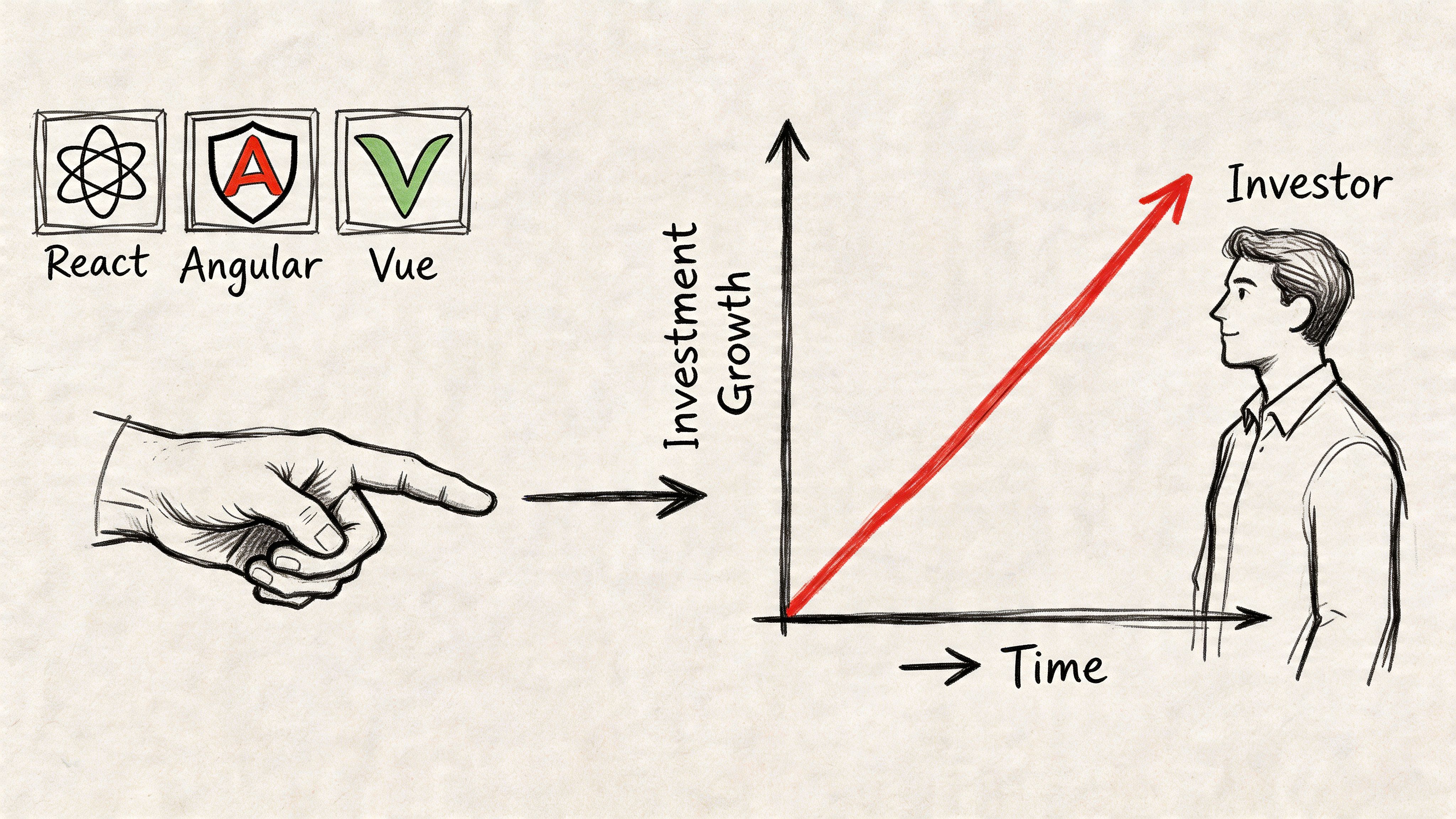
Investors won’t usually ask whether your team prefers hooks, signals, or templates. They will ask questions that expose the consequences of those choices. Can you ship on time? Can you hire? Can you scale without a rewrite? Can another team understand your code if the current team leaves?
That’s why framework choice matters.
Investors evaluate execution risk
A startup’s frontend stack influences how quickly product can move from concept to revenue-bearing software. If your team chooses a framework that slows onboarding, increases architectural friction, or narrows your hiring pool, investors read that as execution risk.
That doesn’t mean investors are auditing your component tree. It means they’re evaluating whether your product engine is built for compounding speed or drag.
A founder-friendly way to view this:
Business concern | What investors really mean | Why framework choice matters |
|---|---|---|
Speed to MVP | Can this team ship predictably? | Some frameworks support rapid iteration better than others |
Hiring risk | Can this company add engineers without friction? | Ecosystem size and talent availability matter |
Technical debt | Will this code survive growth? | Structure, tooling, and maintainability shape future cost |
Diligence readiness | Can an outside expert understand this system fast? | Standard patterns and mature tooling reduce audit friction |
If you want a broader view of how these decisions fit into your product architecture, this guide to a startup tech stack strategy is worth reviewing before you lock in anything.
Valuation is tied to technical credibility
At early stage, valuation is narrative plus evidence. Your product and traction carry weight, but so does the technical story underneath them. A messy MVP built on shaky assumptions can still demo well. It won’t hold up as cleanly when an investor’s technical advisor starts asking whether the product can support scale, team growth, and ongoing delivery.
A strong framework decision helps in four ways:
Cleaner hiring story. You can explain how you’ll grow engineering without depending on rare specialist profiles.
Lower migration pressure. Investors dislike hearing that a rewrite may be needed after funding.
Better vendor and team optionality. If you need to replace an agency, add staff, or bring in a fractional CTO, common stacks make that transition easier.
More confidence in roadmap execution. Mature tooling and established practices reduce uncertainty.
Practical rule: if a framework makes your first build easier but your next two years harder, it’s not a founder-friendly choice.
Diligence doesn’t reward novelty
Founders sometimes overvalue uniqueness in technical decisions. Investors don’t. In diligence, unusual stack choices often create more questions, not more admiration. The burden shifts to you to justify why the team avoided the most legible, well-supported path.
That’s why this decision belongs in the business column, not the preference column. Your frontend framework affects delivery speed, hiring flexibility, and audit readiness. Those are valuation issues.
A High-Level Introduction to the Contenders
There are three serious contenders in this conversation. They solve similar frontend problems, but they do it with very different philosophies.
Before you compare features, understand what each one is trying to optimize for.
React
React is the default choice for most startups because it sits in the strongest strategic middle ground. It’s flexible, widely adopted, and backed by a massive ecosystem. That matters because startups rarely need just a frontend library. They need a path to routing, rendering, authentication, forms, performance, hiring, and eventually mobile and platform expansion.
The market picture is decisive. React is used by 6.3% of all websites globally and holds a 7.9% market share of known JavaScript libraries, compared with Vue.js at 0.7% usage and 0.9% share, and Angular at 0.2% usage and 0.3% share according to W3Techs market data from March 2026. The same source notes that the 2023 State of JavaScript survey showed 84% of respondents use React.
That’s not trivia. That’s a hiring advantage.
Angular
Angular is the enterprise machine. It’s opinionated, complete, and designed for teams that want a full framework with strong conventions built in. Angular gives you structure out of the box, which can be valuable in large organizations with multiple teams, strict standards, and long-lived applications.
It’s often a better fit for internal platforms, regulated workflows, or large corporate applications where consistency matters more than rapid experimentation.
The trade-off is straightforward. Angular asks for more upfront discipline and more framework-specific knowledge. That can be an advantage in enterprise settings and a drag in startup environments.
Vue
Vue wins early affection because it’s approachable. It’s easier to pick up, cleaner for many developers, and often fast to get moving with. For small teams trying to launch quickly, that’s attractive.
Vue is strongest when the product scope is moderate, the team is small, and simplicity is a real advantage. It can be an excellent choice for a focused product with limited frontend complexity.
The concern for founders isn’t whether Vue is good. It is. The concern is whether it gives you the same long-range hiring and ecosystem advantage as React when the company grows.
The founder summary
Here’s the shortest honest read:
React is the best default for startups.
Angular is best when enterprise structure is the requirement, not a future possibility.
Vue is best when speed of initial adoption matters more than ecosystem depth.
Each framework can build a real business. But they don’t create the same business conditions around talent, flexibility, and scaling.
Deep Dive A Founder-Focused Framework Comparison
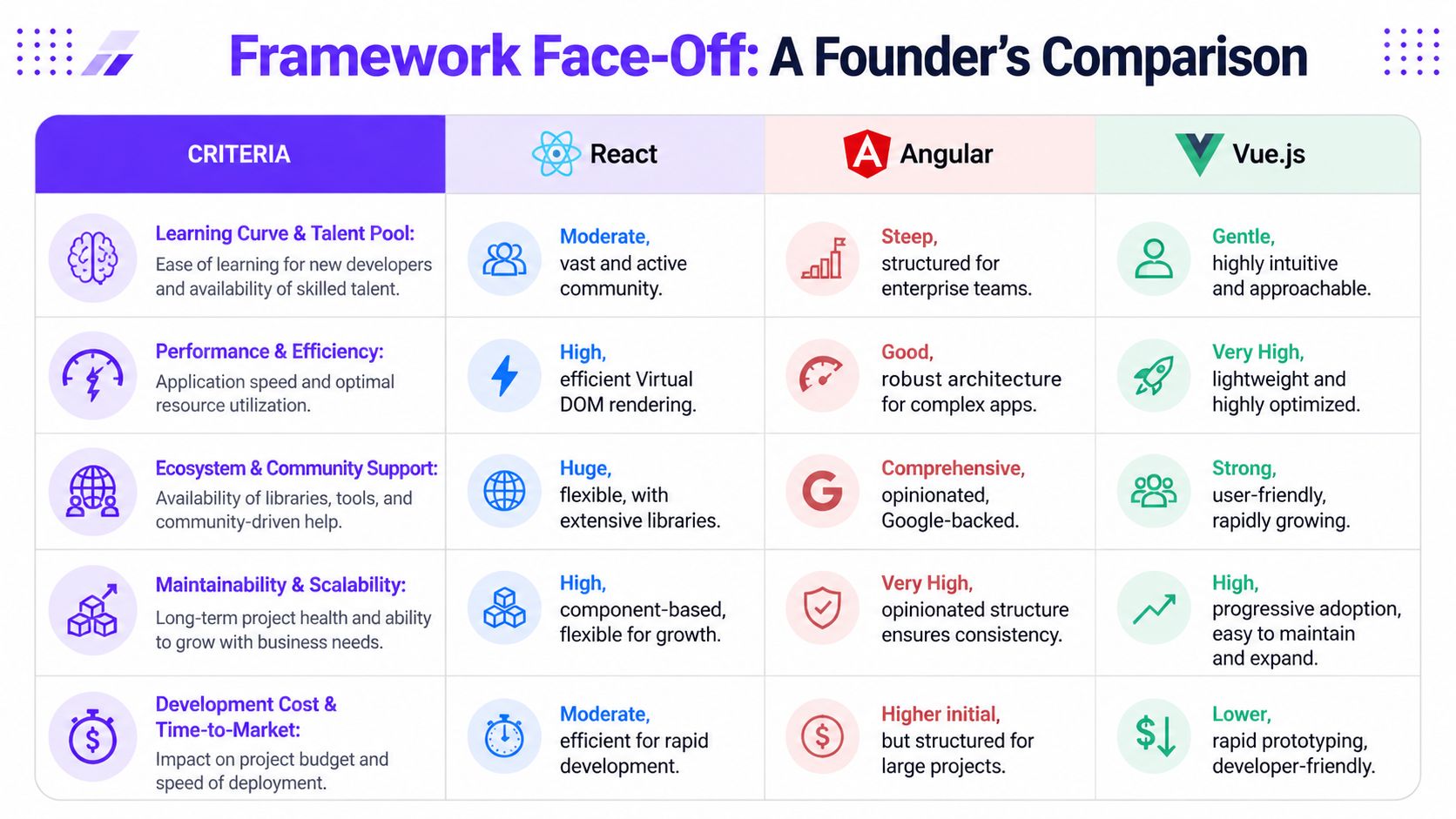
Most framework comparisons are written for engineers arguing about implementation details. Founders need a different view. You need to know which stack helps you ship, hire, scale, and survive diligence with the least friction.
Here’s the founder version.
Development speed and time to MVP
Your first concern is usually velocity. Not theoretical velocity. Real velocity. Can your team go from product spec to production-grade interfaces quickly without setting traps for future growth?
React performs well here because it gives teams flexibility without forcing enterprise ceremony too early. Combined with tools like Next.js, it supports pragmatic startup delivery: server-side rendering when you need it, component-driven UI development, and a large ecosystem for common requirements.
Vue can feel faster at the start. Its onboarding friction is lower, and smaller teams often like how quickly they can become productive. That’s a real advantage for simple or moderately complex products.
Angular is the slowest starting point for most startups. It comes with more built-in structure, but that structure has a cost. Teams pay for it in setup complexity, stricter conventions, and a heavier conceptual load.
If your company is still validating the product, a framework that slows experimentation is a strategic liability.
Performance and user experience
Founders don’t need benchmark obsession. You do need to know whether the framework will support responsive product experiences and credible demos.
According to LogRocket’s 2026 performance comparison, React 19 records the fastest First Contentful Paint at 0.8s and the fastest Speed Index at 0.8s, compared with Angular 20+ at 1.1s FCP and 1.2s Speed Index, and Vue 3.5 at 1.2s FCP and 1.7s Speed Index. The same benchmark reports zero Total Blocking Time for both React and Vue, while Angular records 200ms TBT.
That gives React a practical edge for startup products where the first impression matters, especially in demos, onboarding, and conversion-critical flows.
Here’s the benchmark snapshot:
Metric | React 19 | Angular 20+ | Vue 3.5 |
|---|---|---|---|
First Contentful Paint | 0.8s | 1.1s | 1.2s |
Speed Index | 0.8s | 1.2s | 1.7s |
Total Blocking Time | 0 | 200ms | 0 |
Performance isn’t the only reason to choose a framework. But if one option also wins ecosystem, hiring, and flexibility, the performance edge becomes part of a larger business case.
Maintainability and technical debt
Early-stage teams often make one dangerous assumption: “We’ll clean it up later.”
Usually they won’t. They’ll be shipping under pressure, hiring into an imperfect codebase, and layering features on top of rushed decisions. Framework choice influences how painful that becomes.
Angular’s best argument is maintainability through structure. It pushes teams toward consistency, TypeScript-first architecture, and standardized ways of building. In a large organization, that’s valuable. You get fewer debates and more uniformity across teams.
React is more flexible, which means it can produce either a clean system or a mess depending on leadership. That’s why React works best when the architecture is supervised properly. The upside is that you can build disciplined systems without accepting Angular’s startup drag.
Vue is easier to manage early, but founders should think about maintainability in relation to team growth. Simplicity helps at the beginning. Ecosystem depth and hiring legibility matter more later.
Ecosystem and tooling maturity
Framework choice is never just framework choice. It’s ecosystem choice.
React’s biggest strategic advantage is that it isn’t alone. It sits inside a huge network of production-ready tools, libraries, templates, hosting patterns, documentation, and community conventions. For founders, that means less custom invention and fewer dead ends.
Angular also has a mature ecosystem, but it’s more tightly shaped by the framework itself. That can be good for consistency. It’s less helpful when you want broad optionality.
Vue’s ecosystem is strong, but not as deep or commercially dominant as React’s. That gap matters more once the product expands into more specialized requirements.
If you want an additional perspective focused specifically on startup decision-making, this breakdown of Angular vs React is useful because it frames the trade-off through product-building reality rather than pure developer preference.
A startup stack should reduce the number of custom decisions your team has to invent under pressure.
Hiring market and team design
Many founder decisions become expensive at this point.
When you choose a framework, you’re also choosing the labor market you’ll recruit from. That affects speed, salary pressure, agency options, contractor availability, and how easy it is to replace key people.
React gives you the broadest talent pool. That lowers operational risk. You can hire full-time engineers, freelancers, agencies, or fractional technical leadership with less friction because more people already know the stack and its surrounding tools.
Angular hiring is narrower. The engineers tend to be more enterprise-oriented, and that’s not always what a startup needs in its earliest phases.
Vue hiring can work well, especially for compact teams, but the market is still thinner than React’s. That doesn’t mean you can’t hire. It means you have fewer options when speed matters.
Learning curve and onboarding cost
Onboarding speed matters more than founders think. Every time you add an engineer, you’re paying for context transfer. Framework complexity changes that cost.
A practical summary:
React offers a moderate learning curve and broad familiarity across the market.
Angular has the steepest curve because it expects developers to understand its conventions and structure thoroughly.
Vue is generally the easiest to pick up for new contributors.
This is one reason React wins so often. It doesn’t optimize purely for lowest-friction onboarding like Vue, and it doesn’t impose the steep enterprise ramp of Angular. It stays in the useful middle.
Strategic founder verdict
If I’m advising a startup building an investor-ready MVP, this is my ranking:
React for most companies
Vue for small teams optimizing for quick initial progress on a contained product
Angular only when enterprise-grade structure is required from day one
That recommendation isn’t based on framework fandom. It’s based on how these choices affect shipping speed, talent access, architecture flexibility, and future financing conversations.
The Buttercloud Decision Matrix for Your MVP
Founders don’t need one universal answer. You need the right answer for your business constraints.
The simplest way to decide is to identify your single highest priority. Not your team’s wishlist. Your actual priority.
Startup decision matrix
If Your #1 Priority Is... | Top Recommendation | Rationale |
|---|---|---|
Fastest path to a broadly scalable MVP | React | Best balance of delivery speed, ecosystem depth, and long-term flexibility |
Enterprise structure and strict conventions from day one | Angular | Strong built-in architecture for large, process-heavy teams |
Lowest-friction onboarding for a small team | Vue | Easier to learn and fast to start with |
Access to the broadest hiring market | React | Largest talent pool and strongest ecosystem leverage |
Rapid initial prototype for a smaller product scope | Vue | Good early velocity with lower onboarding friction |
Highly structured large-team application environment | Angular | Better fit when architectural rigidity is an asset |
The plain-English interpretation
The core trade-off is simple. Angular’s steep learning curve and rigid structure make it suitable for large enterprises but risky for rapid MVP iteration. Vue.js offers faster initial velocity but can create long-term scalability concerns. React gives founders the strongest balance with a moderate learning curve, strong flexibility through tools like Next.js, and the largest talent pool according to this framework comparison from Tiny.
For most startups, that balance wins.
Ask these questions before you commit
Use these as a founder filter:
Will this product need to scale beyond the founding team quickly?
If yes, React usually gives you the safest staffing path.Are you building a complex internal enterprise system or a startup product searching for market pull?
Enterprise systems can justify Angular. Startup products usually can’t.Do you need immediate onboarding simplicity more than ecosystem depth?
If yes, Vue may fit. Just be honest about whether the product will stay small.Will investors or acquirers expect a common, legible stack?
If yes, React is the cleanest default answer.Do you have strong architectural leadership already in place?
If not, avoid choices that increase complexity before you need it.
The best MVP stack isn’t the one your first developers like most. It’s the one that still makes sense when you double headcount, ship faster, and prepare for diligence.
If you want a shortcut for this decision, use this tech stack recommender for founders. It’s useful when you’re weighing product stage, team shape, and scaling plans together.
My direct recommendation
If you’re a founder building your first serious SaaS, marketplace, platform, or productized service, choose React unless you have a specific reason not to.
Choose Vue if your team is small, your scope is tightly controlled, and fast adoption matters more than long-range ecosystem advantage.
Choose Angular only if you know you’re building an enterprise-style application with the team and process maturity to benefit from its structure immediately.
Long-Term Implications for Scaling and Due Diligence
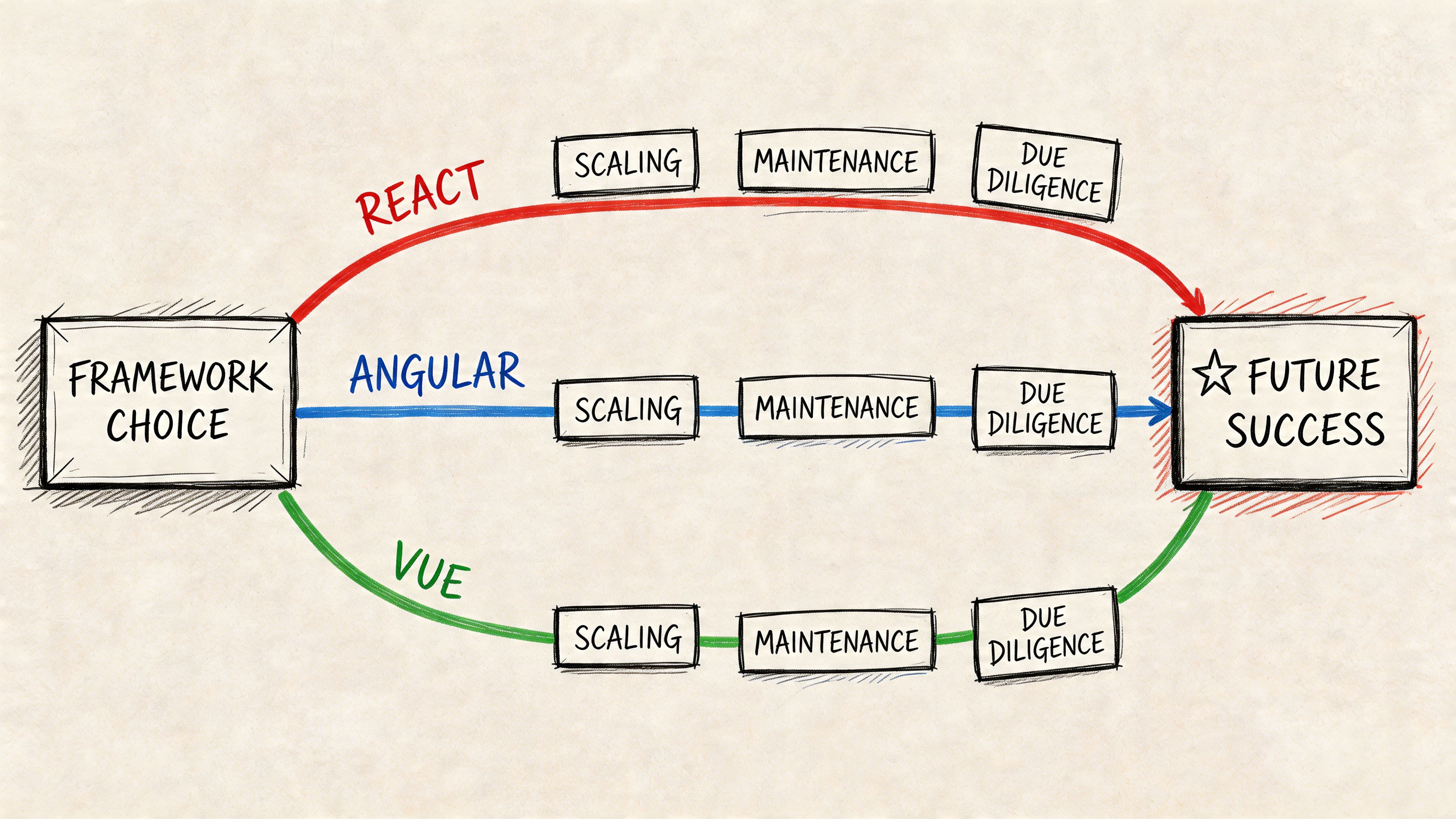
Your framework decision comes back later. It shows up when you hire your fourth engineer, when product complexity spikes, when onboarding slows down, and when investors send in technical diligence.
That’s why founders should think beyond launch.
What due diligence teams care about
Technical diligence teams usually aren’t looking for theoretical perfection. They’re looking for risk concentration.
They’ll want to know whether the frontend is understandable, whether the architecture can support expansion, whether the team can hire into it, and whether the product relies too heavily on a few individuals. Common, well-supported frameworks reduce that risk because external reviewers already know the ecosystem and its standard patterns.
React usually presents well in this context because the stack is familiar and the supporting ecosystem is broad. Angular can also present well if the product clearly benefits from enterprise structure. Vue can be fine, but the founder should be ready to explain why it was chosen and how the team will preserve scaling flexibility.
Scaling isn’t just technical
Founders often talk about scaling like it’s purely a traffic problem. It isn’t. Team scaling matters just as much. Process scaling matters. Handoff quality matters. Your ability to grow the frontend alongside backend systems matters.
If you’re also thinking about the backend side of that equation, this piece on how to effortlessly scale your backend like a pro is a useful complement because frontend and backend architecture decisions compound together.
Here’s the long-term lens:
React usually creates the best blend of hiring flexibility, ecosystem longevity, and product adaptability.
Angular can reduce chaos in very large systems, but many startups adopt that rigor before they’ve earned the need for it.
Vue can age well in disciplined teams, but founders should think carefully about future staffing and platform expansion.
A startup’s first stack should help the next team move faster, not force them to explain old decisions.
The valuation implication
A clean, scalable codebase supports valuation because it lowers perceived execution risk. A codebase that signals likely rework, narrow hiring options, or inconsistent architecture introduces discount pressure, even if nobody states it that bluntly in the meeting.
Founders don’t need the most complex stack. You need the one that looks credible under scrutiny and stays operationally efficient as the company grows. In most cases, that still points back to React.
Frequently Asked Questions From Founders
How hard is it to switch frameworks later?
Harder than most founders expect. Frontend migration isn’t just replacing syntax. You’re often reworking routing, state management, rendering strategy, components, testing patterns, and developer workflows. If you can avoid a migration by choosing correctly now, do it.
Does frontend framework choice lock me into a backend stack?
No. React, Angular, and Vue can all work with different backend approaches. Your frontend choice affects the client-side architecture more than the server-side language. What it does influence is how easily your frontend and backend teams coordinate around data contracts, rendering strategy, and deployment workflows.
What if I want a mobile app later?
This matters. If mobile is part of the likely roadmap, React gives you the most strategic adjacency because of the broader React ecosystem and the familiarity many teams already have with React-based workflows. That doesn’t force a mobile decision today, but it keeps doors open.
Is no-code better than any of these for an MVP?
Sometimes, yes. If you’re validating demand, testing a narrow workflow, or pre-selling before a real build, no-code can be smart. But if the product itself is the company’s core asset, no-code usually becomes limiting fast. Founders should use it for validation, not as a long-term substitute for an investor-ready application.
What if my developers disagree strongly?
That’s normal. Developers evaluate ergonomics. Founders must evaluate business consequences. Let the team weigh implementation concerns, but make the final decision based on hiring, execution speed, maintainability, and diligence readiness.
So what should I choose?
If you want the shortest honest answer: React for most startups, Vue for narrowly scoped small-team builds, Angular for enterprise-heavy environments that need strict structure from day one.
If you’re making this decision right now and want senior technical guidance before you commit, Buttercloud helps founders turn early product ideas into investor-ready technical assets. We advise on stack decisions, architecture, MVP delivery, and scale planning so your first build supports valuation instead of undermining it.