Smart Contracts Development Services
You’re probably in one of two positions right now. You either have a product idea that needs on-chain logic, or you’re feeling pressure from investors, users, or the market to “add blockchain” without a clear technical reason. Those are very different situations, but they lead to the same decision point.
If you commission a smart contract the wrong way, you won’t just waste money. You’ll create a permanent liability in the center of your product. If you commission it correctly, you can build a defensible technical asset with clear business advantage, stronger due diligence posture, and infrastructure that can scale with the company.
The High-Stakes World of Smart Contract Engineering
Founders often treat smart contracts like a special kind of backend development. That’s the first mistake. A smart contract is closer to business infrastructure than application code. It governs money flows, permissions, settlement logic, and trust boundaries. Once deployed, it doesn’t behave like a normal web app where your team can patch a mistake overnight.
That’s why smart contracts development services should be evaluated as a form of risk allocation and asset design, not as a coding purchase.
The commercial opportunity is real. The global smart contracts market is projected to grow from USD 2.69 billion in 2025 to USD 16.31 billion by 2034, according to Fortune Business Insights on the smart contracts market. That projection matters for one reason. It signals that smart contracts are moving from experimental use cases into core enterprise infrastructure.
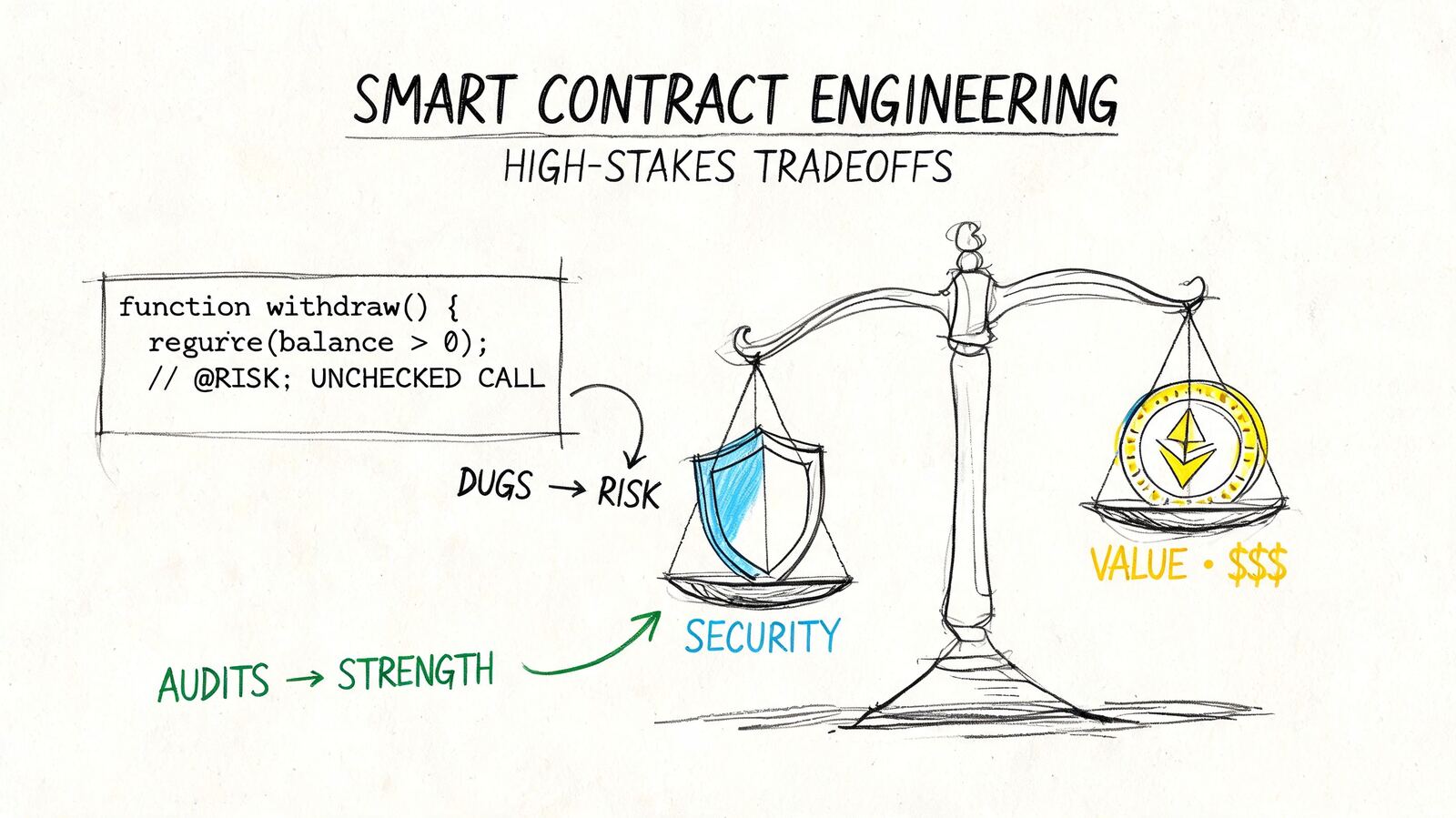
What founders miss is that market growth doesn’t reduce execution risk. It increases it. More capital, more users, and more attention mean higher expectations around architecture, audit readiness, and operational discipline.
If you’re still learning the technical depth involved in developing advanced blockchain contracts, that’s a useful grounding resource. But education alone won’t protect your company. Process will.
Smart contract quality shows up in valuation long before it shows up in revenue. Investors look for architecture discipline, not just shipped code.
A weak partner will deliver a contract that technically runs. A strong partner will help you decide whether the contract should exist at all, what logic belongs on-chain, how upgradeability should work, and what risks must be constrained before deployment. That difference is where startup value gets created or destroyed.
Beyond Code What Smart Contract Services Really Deliver
Most agencies sell smart contracts development services as implementation. Write the Solidity. Deploy the contract. Maybe arrange an audit. That’s not enough for a founder building a serious company.
The deliverable isn’t code. It’s a governed system.
What an elite engagement actually includes
A high-quality smart contract partner should shape decisions across several layers of the product:
-
Business logic design
They translate your business model into enforceable on-chain rules. That includes permissions, settlement conditions, incentives, and failure modes. -
Protocol architecture
They decide what should live on-chain versus off-chain, how contracts interact with wallets, frontends, indexers, and backend services, and how upgrade patterns affect long-term maintainability. -
Economic modeling
Gas costs, token mechanics, fee flows, treasury rules, and user incentives aren’t side topics. They affect adoption and retention. -
Security engineering
They design around attack surfaces from the start, including admin controls, external calls, oracle assumptions, access control, and emergency response paths. -
Operational readiness
They prepare deployment sequencing, contract verification, monitoring, documentation, and support for audit remediation.
A code factory focuses on output volume. A strategic partner focuses on irreversible consequences.
Why smart contracts are different from ordinary startup software
In a normal SaaS product, you can ship rough edges and improve them over time. In smart contract systems, your initial architecture has a much longer shadow. If the protocol logic is flawed, the problem isn’t just technical debt. It can become financial exposure, governance paralysis, or a public loss of trust.
That’s why founders should think in terms of technical assets, not deliverables.
Here’s the distinction:
Model
What you get
What it usually misses
Generic dev vendor
Contract code and deployment
Architecture rationale, gas economics, governance design, risk controls
Strategic engineering partner
Production-grade contract system
Higher upfront rigor, but fewer hidden liabilities later
The right question to ask
Don’t ask, “Can you build this contract?”
Ask, “Can you help me create an investor-ready system where the smart contract strengthens the company instead of becoming a permanent source of risk?”
That question changes the conversation immediately. It pushes the partner to discuss immutability, admin rights, user flows, custody assumptions, and upgrade strategy. If they rush straight into frameworks, libraries, and delivery speed, they’re still thinking like contractors.
Founder’s rule: If a partner talks about features before they talk about failure modes, they’re not ready to architect your protocol.
The best smart contracts development services behave like product architects with security instincts. They don’t just build what you ask for. They pressure-test whether your request survives contact with users, capital, and due diligence.
The Investor-Ready Smart Contract Workflow
A serious smart contract engagement should feel structured from the first call. Not bureaucratic. Structured. There’s a difference.
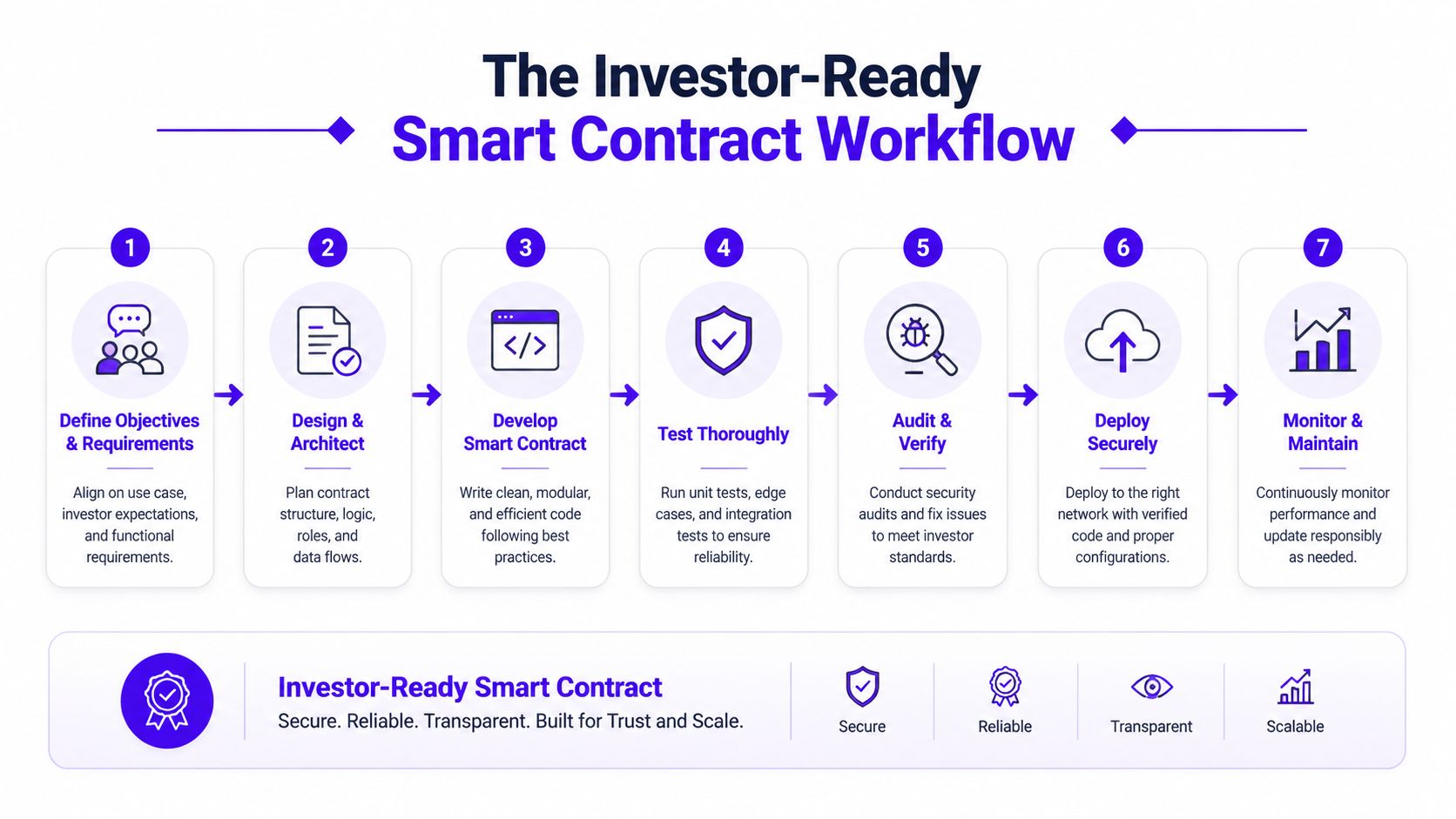
Loose process is expensive in blockchain because errors discovered late force redesigns, delayed audits, redeployments, and trust damage. A disciplined, multi-checkpoint workflow “dramatically reduces the risk of delays, rework, or security incidents”, as described by Exobloc’s smart contract development workflow overview.
Early in the process, you should expect a workflow like this:
Discovery before architecture
A founder usually arrives with a product vision, a token idea, or a workflow they want to automate. The wrong team starts estimating immediately. The right team slows down long enough to identify the actual use case.
They should ask questions like these:
-
What trust problem are we solving
-
What actions must be provably enforceable on-chain
-
What logic should remain off-chain for flexibility
-
Who controls upgrades, pauses, or treasury functions
-
What happens if a dependency fails
This stage often prevents overbuilding. Many founders don’t need “more blockchain.” They need a narrower, cleaner on-chain core.
A useful parallel is how teams approach building an investor-ready MVP. The point isn’t to ship the most surface area. The point is to build the minimum architecture that can survive scrutiny and support scale.
Architecture is where value gets locked in
Once the use case is clear, the work shifts to system design. During this stage, the team chooses data flows, contract boundaries, upgrade paths, permissions, and network assumptions. Economic logic also undergoes testing against product reality.
A mature partner should produce artifacts, not just conversations. Expect architecture diagrams, privilege maps, state transition logic, testing plans, and assumptions around governance and deployment.
Here’s what each stage should produce:
Workflow stage
Business-critical output
Strategic discovery
Clear use case, risk boundaries, on-chain scope
System architecture
Contract map, upgradeability approach, role design
Development sprints
Versioned implementation with review checkpoints
Testing and gas review
Evidence the system behaves predictably under load and edge cases
Audit and remediation
External challenge to assumptions and documented fixes
Deployment and monitoring
Verified contracts, operational playbook, post-launch observability
Development without security theater
Security-first development doesn’t mean talking about audits in every meeting. It means the coding process itself is constrained by review, test coverage, access control discipline, and architectural sanity.
That usually includes:
-
Unit and integration testing tied to specific protocol behaviors
-
Internal security review before external auditors see anything
-
Documentation of privileged functions so there’s no hidden operational ambiguity
-
Deployment rehearsal on test environments before mainnet decisions
If a vendor proposes “agile smart contract delivery” without fixed checkpoints for architecture, testing, and remediation, assume they’re planning to discover problems with your money.
Audits matter, but they’re not the workflow
An audit is one checkpoint, not the product strategy. Founders who rely on post-build auditing as their main safety mechanism usually learn the hard way that auditors can identify issues, but they can’t rescue a badly framed architecture.
The workflow should end with secure deployment and ongoing monitoring because launch isn’t the finish line. It’s the point where your technical decisions become public, capitalized, and hard to unwind.
Architecting for Security Valuation and Gas Economics
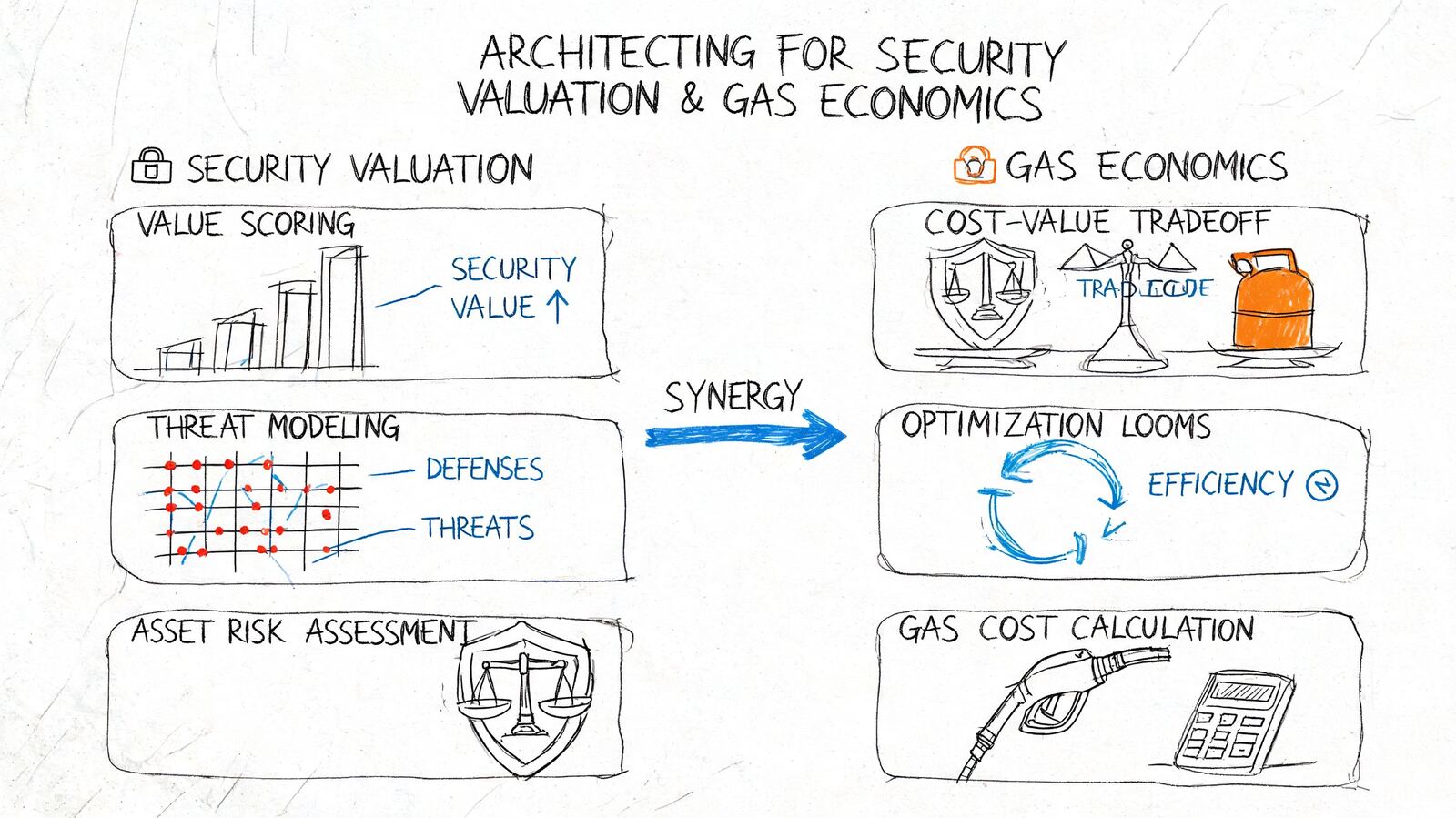
Security and gas efficiency sit at the center of smart contract valuation. Not on the edge of it. If your contract is insecure, the asset is fragile. If your gas profile is bloated, the business model degrades as usage grows.
Founders need to stop thinking like app owners and start thinking like protocol operators.
Security starts before development sprints
Too many teams still treat security as an audit event. That mindset belongs in lower-risk software environments. In smart contracts, the architecture itself creates or removes entire categories of failure.
Founders should insist on early decisions around:
-
Privilege design so admin powers are narrow, visible, and justifiable
-
Upgradeability strategy so you know whether you’re accepting immutability or building controlled change paths
-
External dependency assumptions including oracles, bridges, multisig flows, and token integrations
-
Emergency controls such as pausing, rate limits, or staged rollouts where appropriate
These choices affect investor confidence because they show whether the company understands operational risk. Strong architecture signals stewardship. Weak architecture signals future incident reports.
A practical sign of maturity is whether the team can explain what they’re defending against in plain English. If they hide behind jargon, that’s not sophistication. That’s evasion.
Security isn’t a feature layer. It’s the discipline that determines whether your protocol deserves to hold value.
If you want a compact founder-level primer on what a credible review process should interrogate, a resource like product smart audit can help frame the questions. Use it to sharpen your standards, not to outsource your judgment.
Gas economics are product economics
Founders often underestimate gas because early tests look cheap and manageable. That’s misleading. The economic picture changes when users interact frequently, liquidity grows, or transaction paths become more complex.
According to Blocsys on smart contract development services, expert teams conduct “gas profiling” during development to simulate transaction costs, and the difference between a $0.10 test transaction and a $15+ live transaction at scale can determine whether a protocol reaches product-market fit.
That’s not a minor optimization detail. That’s your margin structure, your user experience, and your adoption ceiling.
What founders should demand on gas
A qualified team should discuss gas in concrete terms during design, not after coding. Ask for:
-
Function-level cost analysis for critical user actions
-
Storage design review because state layout directly affects cost
-
Transaction path simplification to reduce unnecessary complexity
-
Scenario testing across expected user behaviors, not just happy-path demos
Here’s the strategic reality:
Architectural choice
Business implication
Poor gas efficiency
Higher user friction, weaker retention, harder token utility adoption
Strong gas discipline
Better unit economics, cleaner UX, stronger scalability posture
Security bolted on late
More rework, slower launch, weaker diligence narrative
Security designed early
Higher confidence from users, auditors, and investors
Founders raising capital should remember that investors don’t just evaluate what your protocol does. They evaluate whether it can operate safely and economically under stress. Security and gas aren’t engineering side quests. They are central to valuation.
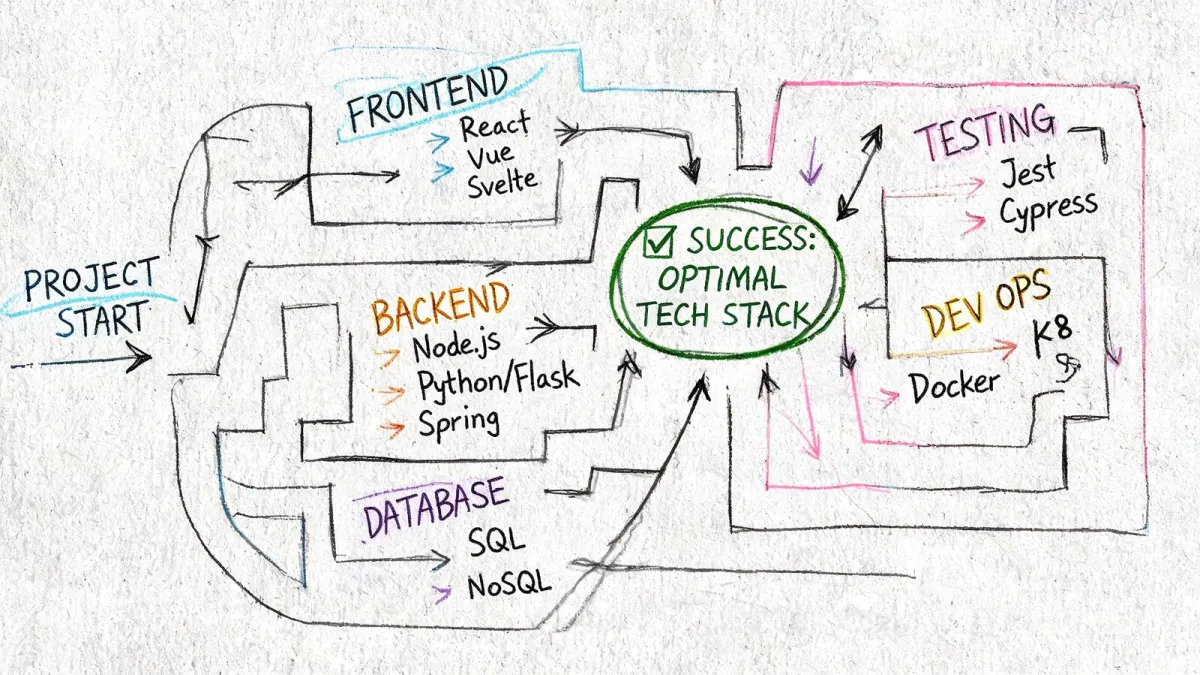
Navigating the Labyrinth of Tech Stacks and Tooling
Your chain choice is a business decision disguised as a technical one. Founders who delegate it too casually often end up with a product built for the vendor’s convenience instead of the company’s strategy.
The current market direction is clear. Public chains held 45.90% market share in 2025, while Layer-2 solutions are projected to be the fastest-growing segment at 28.6% CAGR through 2031, according to Mordor Intelligence on the smart contracts market. That matters because it reflects a practical enterprise move toward infrastructure that balances openness with better cost efficiency.
Ethereum and Layer-2 options
Ethereum remains the default reference point for good reasons. It has mature tooling, broad wallet support, deep ecosystem integrations, and a large pool of Solidity talent. That lowers hiring friction and makes third-party integrations easier.
But Ethereum mainnet isn’t automatically the right answer. For many startups, a Layer-2 path makes more sense because it preserves access to the Ethereum ecosystem while improving fee economics and throughput. If your product depends on frequent user interactions, this can be the difference between a usable protocol and one that only whales tolerate.
Alternative chains and the real trade-off
Chains like Solana or Avalanche may offer attractive performance or ecosystem-specific advantages. But founders should evaluate them through a business lens, not a benchmark screenshot.
Ask your partner to compare options across criteria like these:
Decision factor
What founders should care about
Security posture
How much trust are you placing in the base network
Developer talent
How hard will it be to hire and replace engineers later
Ecosystem maturity
Wallet support, tooling, analytics, custody, integrations
User cost profile
Whether transactions feel affordable enough for your target behavior
Strategic flexibility
How painful migration or multi-chain expansion would be later
A good technical recommendation should connect directly to your user model. Consumer app with frequent actions. Gas sensitivity matters. Governance-heavy product. Tooling and transparency matter. Institutional workflow. Operational control and auditability may matter more than maximal decentralization.
For a broader founder lens on stack decisions beyond blockchain alone, this guide to a startup tech stack is worth reading alongside your protocol architecture discussions.
Don’t let a vendor pick a chain because “that’s what we usually use.” Chain choice affects hiring, UX, cost structure, integration risk, and future fundraising narrative.
Decoding Pricing Models and Project Timelines
Founders always ask two questions early. What will it cost, and how long will it take. Fair questions. But in smart contracts, the quote only matters if you understand what process it buys.
A fixed-price bid sounds safe. It usually isn’t. Fixed bids tend to reward speed over rigor, and rigor is exactly what you’re paying for in smart contracts development services. When a contract is immutable or controls valuable flows, the corners you don’t see are the expensive ones.
How pricing models actually behave
Here’s the practical breakdown:
-
Fixed-price projects
These work only when scope is narrow and architecture is already settled. Otherwise they create pressure to minimize review, documentation, and remediation. -
Time and materials
Better for exploratory builds, but only if the partner runs a disciplined process and gives you visible checkpoints. -
Retainer or embedded partnership
Usually the best fit for serious protocol work because architecture, testing, audit preparation, deployment, and post-launch support rarely fit into a neat one-off package.
What actually drives timeline
The honest answer is that timelines depend less on coding speed and more on decision quality. A token contract is not the same as a lending market, a staking protocol, or a governed treasury system.
Timeline drivers usually include:
-
Protocol complexity
More state transitions and dependencies mean more review cycles. -
Integration load
Wallets, frontends, indexing, treasury operations, and admin tooling all add coordination. -
Audit readiness
Teams that plan for external review move differently from teams that “ship first.” -
Governance and upgrade design
The more carefully you define control and change management, the fewer surprises later.
If a vendor promises speed without discussing architecture, testing depth, or remediation, they’re selling optimism. Not execution.
How to read a quote correctly
A credible proposal should tell you:
Quote signal
What it likely means
Very low price, very fast timeline
Minimal process, limited risk management
Detailed phased proposal
Mature understanding of architecture and delivery risk
Audit mentioned only at the end
Security probably isn’t integrated into the build process
Post-launch support excluded
You may own operational risk too early
The cheapest option often becomes the most expensive after redeployment, delayed launch, or reputational damage. In this category, price discipline matters. Cheapness does not.
Your Vetting Checklist for a Premier Development Partner
By the time you start vendor conversations, you should stop sounding like a buyer and start sounding like an operator. That changes the caliber of answers you get.
Research highlights a critical gap: developers have “no effective way to guarantee the security of smart contract code” during development, which makes a partner’s process for pre-deployment verification a serious differentiator, as noted in the smart contract security research paper by TSE researchers. That gap is exactly where weak vendors hide. They talk about audits because they can’t clearly explain how they reduce risk during active development.
Questions that expose weak partners
Use questions like these in live calls:
-
How do you prevent vulnerabilities during development, not just identify them later
-
What architectural decisions do you force before anyone starts coding
-
How do you decide what belongs on-chain versus off-chain
-
How do you model gas costs against expected user behavior
-
What’s your approach to upgradeability and admin control
-
What happens after an external audit finds issues
-
Who owns all source code, deployment artifacts, and documentation
-
What support do you provide after mainnet deployment
A weak partner gives generic reassurance. A strong one explains review loops, testing discipline, role separation, deployment controls, and remediation commitments.
What to look for in the agreement
The contract matters as much as the pitch. Review for items like these:
-
IP ownership clarity
Your company should own code, specifications, and deployment documentation. -
Audit remediation expectations
If auditors raise issues, the path to fixes should already be covered. -
Post-deployment support
You need explicit language around monitoring, incident response, and maintenance windows. -
Documentation deliverables
Admin procedures, role maps, upgrade processes, and deployment records shouldn’t be optional.
A partner who can’t describe their pre-deployment verification process in operational detail is asking you to trust hope. Hope is not a control system.
The final filter
Before signing, ask one last question: if this contract becomes the most scrutinized technical asset in the company, would you still be comfortable with this team’s process, documentation, and judgment?
That’s the standard. Not whether they can ship. Whether they can ship something your company can safely build on.
If you’re weighing smart contracts development services and want a technical partner who thinks in terms of investor readiness, architecture discipline, and long-term asset value, talk to Buttercloud. We help founders turn risky technical ideas into production-grade systems that stand up to diligence, scale cleanly, and strengthen company valuation instead of undermining it.
Have a product idea to talk through?
We'll show you how we'd approach it — no pressure, just a real conversation.
Book a Discovery Call