Startup Business Consulting Explained

What exactly is startup business consulting?
Think of it less as “consulting” and more as a boutique engineering partnership designed to do one thing: turn your idea into a finished, high-valuation technical asset. It’s about embedding a Senior Partner and Lead Architect’s expertise directly into your startup’s DNA to guide you through the lifecycle of Idea → Investor-Ready MVP → Scalable Product.
This isn’t about getting advice. It’s about ensuring every single decision—from the first line of code to your scaling strategy—contributes directly to your company’s valuation and builds a durable technical moat.
From Idea to Investor-Ready Asset
Imagine you have a vision for a revolutionary product. You know what it should do, but you’re not a seasoned technical architect. A true startup consulting partner is that Mentor-Architect who provides the blueprint, engineering precision, and strategic leadership to ensure your product becomes an investable asset, not a liability.
This is a fundamental shift from traditional advisory roles. We don’t just “build apps”; we engineer high-valuation technical assets. We don’t just give advice; we build with you.
This model was born from a critical gap in the startup ecosystem. Startup founders don’t just need another developer to write code. They need a partner who understands that the real product isn’t just the software—it’s the business itself. The goal is to build a technical foundation that isn’t a prototype to be thrown away, but a core asset that sails through VC technical due diligence and drives your valuation.
The Anti-Outsourcing Model of Consulting
When you hear “consulting,” you might picture a mass-market firm delivering a report and then vanishing. This is the exact opposite.
Elite startup business consulting is an “anti-outsourcing” model. This isn’t a black-box firm where you throw in requirements and hope good code comes out. It’s a transparent, high-touch partnership where the founder is mentored and empowered, not just “served.”
This entire approach is built on a few core distinctions:
-
Audit-Ready Engineering: Every line of code and architectural choice must be defensible in an investor’s boardroom. We build a “technical moat”—a real, sustainable competitive advantage—by eliminating technical debt at the root.
-
Boutique Precision: The focus is on quality over volume. This is about building investor-ready code from the very first commit, acting as a dedicated “Mentor-Architect” for a select group of founders.
-
Strategic Leadership: It goes beyond code. This partnership often includes Fractional CTO services, guiding your technical roadmap and helping you navigate tech team hiring to build your own high-performance culture.
A startup-centric consulting model is fundamentally different from the approach you’d get from a large, traditional firm. It’s about building assets, not just delivering PowerPoints.
Traditional Consulting vs. Startup-Centric Partnership
Focus Area
Traditional Consulting Approach
Startup Business Consulting Model
Primary Goal
Deliver strategic recommendations and reports.
Build a tangible, investor-ready technical asset.
Engagement
High-level, theoretical, and often short-term.
Hands-on, embedded, and focused on long-term value.
Deliverable
Strategy decks, market analysis, process documents.
Defensible code, scalable architecture, a mentored founder.
Mindset
“What should you do?”
“Let’s build this together, the right way.”
The difference is clear: one side gives you a map, and the other gets in the car and helps you navigate the entire journey.
More Than Just Advice, It’s Embedded Expertise
This new breed of hands-on consulting is exploding for a reason. The management consultancy industry is a juggernaut, projected to be worth over $250 billion by 2026. More than 700,000 firms worldwide are now delivering niche expertise because founders know that generic advice doesn’t cut it.
You need specialized guidance to get from a scrappy MVP to a successful Series A.
At its heart, startup business consulting brings together expert guidance in areas like product engineering and comprehensive cloud solution consulting. You aren’t just paying for temporary help; you’re making a direct investment in the architectural integrity and long-term defensibility of your entire company.
Think of your consultant as a co-pilot—a Senior Partner helping you navigate the turbulence of the early stages and land safely with a scalable, valuable product that’s ready to win the market.
The Four Pillars of Technical Startup Consulting
So, what does startup business consulting actually look like in practice? It’s not about vague advice. It is a hands-on partnership built around four key pillars that follow the founder’s journey—from a spark of an idea to a scalable company.
Think of it as the roadmap that guides you from idea to a business with serious valuation. This is how a true partner engineers your success, not just a piece of software.
This map shows how that journey unfolds, turning a raw idea into a structured, valuable asset with the right leadership in place.
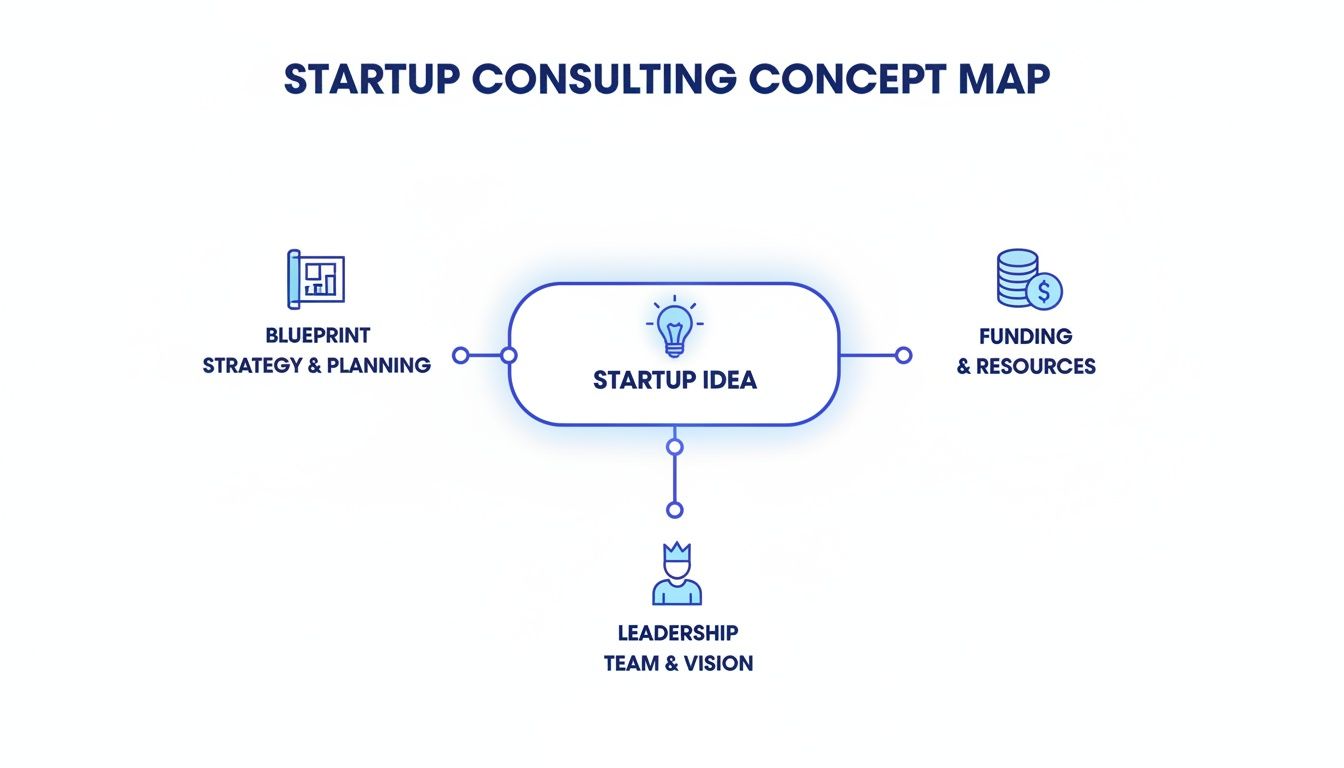
You can see how a simple concept becomes a solid blueprint, which is then built into an asset that investors want to back—all steered by strategic guidance.
Product Design and Discovery
Every great product starts with a solid blueprint. Before a single line of code is written, a deep dive into Product Design & Discovery ensures you’re building the right thing. This is about mapping the transition from idea to blueprint, focusing on user-centric design that defines your product’s competitive advantage.
Your consulting partner acts as a “Mentor-Architect” at this stage. They help you map out user journeys, define must-have features, and translate your business goals into a detailed technical plan. This process turns a fuzzy concept into a clear, actionable guide that gets your entire team aligned and significantly reduces risk.
Investor-Ready MVP Development
Next, it’s time to turn that blueprint into a finished product. But here’s the critical distinction: not all Minimum Viable Products (MVPs) are created equal. Too many founders build a throwaway prototype that collapses under the scrutiny of real users or investor due diligence.
An elite partner focuses on Investor-Ready MVP Development (Native & Web), which means building a “Technical Moat” from day one.
This means your MVP’s code isn’t just a prototype. It’s a core, investable asset built on a clean, scalable foundation using elite native mobile (iOS/Android) and web engineering. It’s designed to sail through VC technical due diligence, which directly increases company valuation.
This approach stops technical debt before it starts—a silent killer for many startups. Instead of facing an expensive, time-consuming rewrite right after your seed round, your MVP becomes the solid ground you build your future on. If you’re building a product, getting expert advice on app development for startups is non-negotiable.
Strategic Leadership and Hiring
With a strong technical asset in hand, the game shifts to strategy. The Strategic Leadership & Hiring pillar brings in the high-level oversight you need, often through a Fractional CTO. A Fractional CTO is a seasoned tech executive who joins your team part-time to guide your technical roadmap, manage engineering, and help you navigate tech team hiring.
This is a game-changer for non-technical founders who need an expert to turn their vision into a technical reality. It’s also invaluable for technical founders who need a veteran architect to gut-check their plans and help them sidestep common scaling traps.
Scaling and Infrastructure
The final piece of the puzzle is ensuring your product can handle success. As your user base grows, your infrastructure must be stable, secure, and ready for anything. The Scaling & Infrastructure pillar focuses on boutique DevOps and managed infrastructure to ensure the product remains stable, secure, and audit-ready as it scales.
This covers the essentials:
-
Automated Deployments: Building CI/CD pipelines to get new features out quickly and reliably.
-
Managed Infrastructure: Ensuring your cloud setup is optimized for cost, security, and peak performance.
-
Audit-Ready Security: Locking down your product and user data with best practices—a non-negotiable for enterprise deals and investors.
This is all about building a product that doesn’t just work today but is engineered to thrive tomorrow. It’s the final step in turning a startup idea into a resilient, high-valuation business.
Recognizing When You Need a Consulting Partner
Knowing when to engage a partner can make or break your startup. It’s not an admission of failure; it’s a strategic decision to accelerate growth and de-risk your venture at the most critical moments.
For most founders, the real question isn’t if you’ll need help, but when that help becomes the difference between stalling and soaring.
The warning signs are often a nagging feeling or a persistent roadblock. Are you spending more time putting out technical fires than building the business? Are you heading into a funding round secretly terrified your MVP won’t hold up under due diligence? Those are the signals.
The cost of waiting is almost always higher than the investment in getting the right expertise. A few months of indecision or a brittle MVP can tank a funding round, force a crippling rewrite, or let a competitor seize the market while you’re stuck fixing bugs.
Key Inflection Points for Founders
Certain moments in the founder’s journey are natural triggers for finding a startup business consulting partner. Recognizing these allows you to act from a position of strength, not desperation. You’re bringing in expertise to build value, not just to put out a fire.
Here are three common scenarios when it’s time to make the call:
-
The Non-Technical Founder with a Vision: You’ve identified a market opportunity and have a brilliant idea, but lack the engineering background to translate that vision into a real, scalable product. You need an architectural partner to lay the foundation correctly from day one.
-
The Technical Founder Needing Senior Oversight: You can write code, but you need a seasoned “Mentor-Architect” to validate your high-level decisions. Someone to prevent over-engineering and ensure what you’re building can scale, not just launch. This is what separates an investable MVP from a brittle prototype.
-
The Seed-Stage Startup Targeting Series A: You’ve got a product and early traction. But your next funding round depends on passing rigorous technical due diligence. You need an expert to audit your code, infrastructure, and processes to get them investor-ready.
Most founders find themselves in different seats at different times. The key is matching where you are today with the specific expertise that will get you to the next stage.
Matching Your Stage to the Right Consulting Need
Startup Stage
Primary Challenge
Ideal Consulting Solution
Pre-Seed / Idea
Translating a great idea into a technical blueprint without an engineering background.
Product Design & Discovery: Define the tech stack, plan the MVP, and create a realistic roadmap.
Seed Stage
Building the MVP quickly and correctly, but lacking senior-level engineering leadership.
Fractional CTO & MVP Development: Get senior guidance and an elite team to build a scalable, native or web MVP.
Post-Seed / Pre-Series A
Scaling the product and team while preparing for investor technical due diligence.
Due Diligence Prep & Scaling: Shore up infrastructure, streamline deployments, and audit the codebase for red flags.
Growth Stage
Managing technical debt, ensuring security, and meeting industry compliance standards.
Boutique DevOps & Tech Team Hiring: Implement best practices for scale and security while building your internal team.
A Self-Diagnosis Checklist for Your Startup
Still on the fence? Ask yourself these questions. If you answer “no” or “I’m not sure” to several, it’s a strong signal a consulting partner could be a game-changer.
-
Codebase Confidence: Are you 100% confident your current code is a scalable asset that would pass a VC’s technical due diligence tomorrow?
-
Strategic Roadmap: Do you have a clear, documented technical roadmap that aligns with your business goals for the next 18-24 months?
-
Team Gaps: Can your current team design and build something complex like a multi-tenant SaaS architecture or an AI-powered feature without senior oversight?
-
Financial Oversight: Do you have a firm grip on your tech costs and a clear plan for your finances as you scale? Many founders bring in specialized financial experts, like fractional CFO services, to manage this without a full-time hire.
-
Technical Debt: Are you proactively eliminating technical debt at the root, or is it piling up with every new feature you ship?
Answering these honestly illuminates the exact gaps an expert partner is built to fill. Engaging a startup business consulting firm isn’t about hiring more coders—it’s about embedding the strategic, architectural, and operational leadership you need to build a high-valuation company.
How AI Is Reshaping Startup Consulting
Let’s be blunt: AI isn’t a futuristic feature to sprinkle on your product. It’s rapidly becoming the foundational layer for any startup wanting to build a high-growth, defensible business. The real challenge for startup founders isn’t just using AI, but engineering it into the company’s core in a way that increases valuation.
This is where the game has changed for startup consulting. The best partners have moved past the hype. We act as hands-on mentor-architects, engineering intelligent systems directly into your business. The goal is simple: turn AI from a buzzword into a powerful engine for efficiency, scalability, and—most importantly—a higher company valuation.

From Gimmicky Features to Intelligent Workflows
Too many startups bolt AI on as a party trick—a clunky chatbot or a basic recommendation engine. A true strategic partner helps you embed AI at the system level to create genuinely intelligent workflows. It’s about re-architecting your operations with AI at the core.
Think about automating backend processes that once required an entire team. Or architecting a multi-tenant SaaS platform where AI handles resource allocation, personalizes user experiences, and flags security threats before a human ever sees them. This isn’t about making things a little faster; it’s about making your entire business smarter and more automated.
The real goal with AI is to build a durable ‘technical moat.’ When AI is woven into your product’s DNA, it becomes incredibly difficult for competitors to copy. That gives you a long-term, sustainable edge that investors notice and value.
This shift from small pilots to full-scale production isn’t just a trend; it’s a massive economic wave. By 2026, AI consulting is set to command 40% of all professional services revenue, a huge jump from just 20% in 2024. This explosion is fueled by insane adoption rates—the use of generative AI in professional services firms shot up from 33% in 2023 to 71% in 2024. You can dig into these professional services industry outlook insights for 2026 to get the full picture.
Building Scalable, AI-Powered Platforms
A classic founder mistake is building an AI feature that’s impressive for ten users but collapses at ten thousand. A huge part of modern startup business consulting is architecting these systems for scale from day one. This goes way beyond just picking the right model.
It’s about the entire system:
-
Data Architecture: Designing rock-solid data pipelines that can collect, clean, and feed high-quality data to your AI models efficiently.
-
Scalable Inference: Building systems that can handle a flood of AI-driven requests without lag or failure. Users expect instant results.
-
Cost Optimization: Running AI at scale is expensive. A strong architectural plan includes strategies to manage cloud computing costs from the get-go.
This kind of architectural foresight is what separates a neat AI-powered app from a truly scalable, high-valuation technical asset.
Connecting AI Strategy to Business Outcomes
Ultimately, any investment in AI must be tied directly to clear business goals. A consultant’s job is to ensure every AI initiative serves a real purpose, whether that’s boosting efficiency, opening new revenue streams, or making your company bulletproof for a fundraising round.
Here’s how we make that connection real:
-
Valuation Boost: We help engineer AI systems that are not just clever, but also well-documented and auditable. This directly increases your company’s valuation during technical due diligence.
-
Operational Leverage: By automating core functions, AI gives a small, lean startup the power to operate like a much larger organization. You can do more with less.
-
Defensible User Experience: AI can deliver hyper-personalized experiences that get users hooked, driving up retention and creating powerful network effects that competitors can’t touch.
AI isn’t a magic wand. It’s a seriously powerful and complex tool. A good consulting partner ensures you’re not just using the tool, but mastering it to build a more valuable, efficient, and defensible company.
Choosing the Right Startup Consulting Partner
Let’s be blunt: picking a technical partner is one of the most make-or-break decisions a founder will face. This isn’t hiring a vendor to write code. You’re choosing the architect of your company’s most valuable assets.
The right partner is a “Mentor-Architect” who accelerates your growth. The wrong one will leave you drowning in technical debt with a product that makes investors run for the hills.
The market is flooded with firms claiming to be startup business consulting experts. The reality is that many are just black-box “dev shops.” They’ll take your money and hand over code, but they won’t provide the strategic partnership you need. Your job is to see through the sales pitches and find a team genuinely invested in your company’s long-term valuation, not just their next invoice.

This means you must look past the price and dig into their core engineering philosophy. Are they building a disposable prototype, or are they laying the foundation for a lasting, valuable asset? That distinction is everything.
Vetting Criteria Beyond the Price Tag
A low bid might look tempting, but it’s often a massive red flag. It signals shortcuts, junior developers, and a lack of understanding of what it takes to build an investable company. Real value comes from a partnership that de-risks your entire venture and multiplies your valuation.
This kind of partner provides more than just code; they bring strategic leadership to the table. It’s a role you can understand better by digging into what a virtual CTO provides to a startup.
Here’s what you should be looking for instead of a low price:
-
Engineering Philosophy: Do they obsess over clean, scalable architecture? Or do they cut corners to hit a deadline, leaving you with a technical time bomb that requires a full rewrite after your first funding round?
-
Focus on Business Outcomes: A great partner connects every technical choice to a business goal. They should be as comfortable discussing your valuation strategy as they are your tech stack.
-
The Anti-Outsourcing Model: You want a high-touch, transparent partner who becomes an extension of your team. Ditch the “black box” firms that keep you at arm’s length. You’re looking for a mentor, not just a service provider.
-
Founder-Centric Mentorship: The best consultants don’t just build for you; they build with you. They empower you to make smarter technical decisions and eventually hire your own internal team with confidence.
These are the things that separate the order-takers from the true strategic partners who help you build a high-valuation technical asset.
Hard-Hitting Questions You Must Ask
Once you have a shortlist, it’s time to be direct. The answers to these questions will reveal a firm’s real priorities. Do not accept vague answers. Demand concrete proof.
The most critical question isn’t “Can you build this?” It’s “How will you ensure what you build will pass rigorous technical due diligence?” This single question cuts to the heart of what matters: building an investable asset, not just a functioning app.
Here are the essential questions to drill into with any potential partner:
-
How do you manage and prevent technical debt?
- What to listen for: A clear, proactive strategy focused on eliminating it at the root. They should discuss code reviews, automated testing, and an architectural approach that prioritizes long-term stability over short-term speed.
-
Show me an example of how you’ve prepared a startup for VC technical due diligence.
- What to listen for: Specific, real-world stories. They should walk you through how they hardened a product’s security, organized documentation, and ensured the codebase was clean and ready for audit.
-
How will you help me, the founder, understand the key technical trade-offs we’ll face?
- What to listen for: A commitment to mentorship. They need to explain their process for breaking down complex technical decisions into plain English that connects directly to business impact.
-
What is your philosophy on building an MVP—is it a throwaway prototype or the foundation for a scalable product?
- What to listen for: The “investable asset” mindset. They should make it clear that while an MVP has a minimal feature set, its underlying architecture must be production-grade and audit-ready from day one.
Finding the right consulting partner is about finding an ally. You need a firm with elite engineering chops, sharp business acumen, and a deep-seated commitment to turning your vision into a valuable, defensible reality.
Choose the partner who thinks and builds like an investor, not just a developer.
The Financial Case for Expert Startup Consulting
Most founders look at the price for expert consulting and see a cost. That’s a mistake. A top-tier technical partnership isn’t an expense; it’s a direct investment in your company’s future valuation.
You’re allocating capital now to de-risk your venture and make it exponentially more valuable to investors later.
When VCs perform due diligence on your startup, they aren’t just buying your pitch. They’re conducting a deep-dive on your technology to see if it’s built to last or destined to collapse. This is where vague promises are exposed and real financial outcomes are decided.
Audit-Ready Engineering and Company Valuation
One of the fastest ways consulting pays for itself is through audit-ready engineering. This means building your product, from day one, to pass the rigorous technical due diligence that every funding round requires. A messy, debt-ridden codebase is a massive red flag for investors, often leading to a lower valuation or a collapsed deal.
Consider the cost of getting it wrong. A failed funding round because your tech wasn’t up to snuff isn’t just a setback; it can be fatal. Conversely, a startup that aces due diligence because its architecture is clean, scalable, and secure always commands a premium. Investors are buying future stability, and they will pay for it.
An investment in a Fractional CTO or an expert engineering partner isn’t just about building an app. It’s about engineering a higher valuation by systematically eliminating the technical risks that scare investors away. This transforms your technology from a potential liability into your most powerful fundraising asset.
De-Risking Your Venture for Investors
At their core, investors are risk managers. A startup business consulting partner, especially one providing Fractional CTO services, is one of the most powerful de-risking tools a founder can have. They bring senior-level oversight that signals to investors that an experienced hand is guiding the technical strategy.
This has very real financial upsides:
-
Increased Investor Confidence: Having a seasoned tech leader on board signals maturity. It drastically reduces the perceived risk of execution failure, making your startup a much safer bet.
-
Prevention of Costly Rebuilds: The dreaded six-figure product rewrite post-funding is a classic startup nightmare. A good partner architects correctly from the start, saving you a mountain of cash and months of lost time.
-
Optimized Operational Costs: A well-architected system runs more efficiently. That translates directly to lower monthly cloud bills and maintenance costs, which improves your burn rate and extends your runway.
The True Cost of Going It Alone
Let’s walk through a real-world scenario. A founder hires a cheap offshore team for $80,000 to build an MVP. It looks fine, but underneath it’s a pile of technical debt. They enter a seed round, but during due diligence, investors discover the code is unscalable and riddled with security holes. The funding round collapses.
Now, picture another founder. She invests $150,000 with a high-end consulting partner to build an audit-ready MVP. Her startup not only secures a $2 million seed round but also receives a 20% higher valuation because the technology was a core, defensible asset. That initial “cost” paid for itself many times over.
When you look at it this way, the financial case is clear. Expert startup consulting isn’t about whether you can afford the help. It’s about realizing you can’t afford the consequences of not having it. It is a direct investment in your company’s defensibility, scalability, and ultimately, its market value.
Frequently Asked Questions About Startup Consulting
Thinking about bringing on a strategic partner? It’s a big decision, and you likely have questions. Let’s get right to the big ones.
What Is the Difference Between a Freelance Developer and a Startup Business Consultant
A great freelance developer is a fantastic resource hired to execute a specific task—build a feature, fix a bug, write code. They are skilled hands for a defined job.
A technical startup business consulting partner, in contrast, is the architect for your entire technical vision. We aren’t just laying bricks; we’re designing the skyscraper to ensure it stands for decades. We engineer your company’s technical foundation, provide high-level strategic oversight (like a Fractional CTO), and ensure the product you’re building is an investable asset.
The consultant’s job is to build business value through technology. A freelance developer’s job is to complete a coding ticket. Both are critical, but they solve fundamentally different problems for a founder.
Is My Startup Too Early-Stage for Consulting
No. In fact, getting strategic advice at the idea or pre-MVP stage is the single best way to eliminate technical debt before it even exists.
Bringing in a Mentor-Architect early ensures your product architecture is solid from day one. This saves massive amounts of time and capital later—no expensive rewrites when you should be scaling. Even better, you walk into investor meetings with a professional, defensible technical strategy that makes your vision ten times more credible.
How Much Does Startup Business Consulting Cost
The cost depends on the engagement, from a project to build your MVP to an ongoing Fractional CTO retainer. It is an investment, but it must be weighed against the devastating cost of getting the technology wrong.
An MVP built on a shaky foundation can be torn apart during due diligence, potentially costing you an entire funding round. By directing a portion of your pre-seed or seed capital toward expert technical strategy, you can multiply your company’s valuation. The focus shouldn’t be on the expense, but on the return on investment.
Ready to turn your idea into an investor-ready technical asset? At Buttercloud, we partner with founders to engineer high-valuation products from the ground up. Let’s build your technical moat together.
Have a product idea to talk through?
We'll show you how we'd approach it — no pressure, just a real conversation.
Book a Discovery Call