
Mastering Tech Strategy Consulting for Business Success
You’re probably in one of two situations right now.
You have a strong product idea and no confidence in the technical decisions that will make or break it. Or you already shipped an MVP, and now every new feature feels slower, riskier, and more expensive than it should.
That’s the point where founders usually make a costly mistake. They hire developers before they establish a technical strategy. They confuse shipping code with building an asset. Then investors ask basic architecture, security, and scalability questions, and the room gets quiet.
Tech strategy consulting exists to stop that spiral early. For a founder, it isn’t a corporate workshop or a stack of slides. It’s disciplined technical leadership that turns product vision into an investor-ready system.
Your Vision Needs a Technical Architect
A founder comes in with a clear market thesis. The pain is real. The buyer is defined. The product story is strong. But the technical questions pile up fast.
Should the first release be native mobile, web, or both? Do you use a monolith to move faster, or design for services now to avoid a rewrite later? How much should you invest in security before you have paying users? What’s the minimum architecture that still survives diligence?
Those questions don’t get answered well by a random dev shop. They get answered by someone who can tie engineering choices to valuation, hiring, speed, and risk.
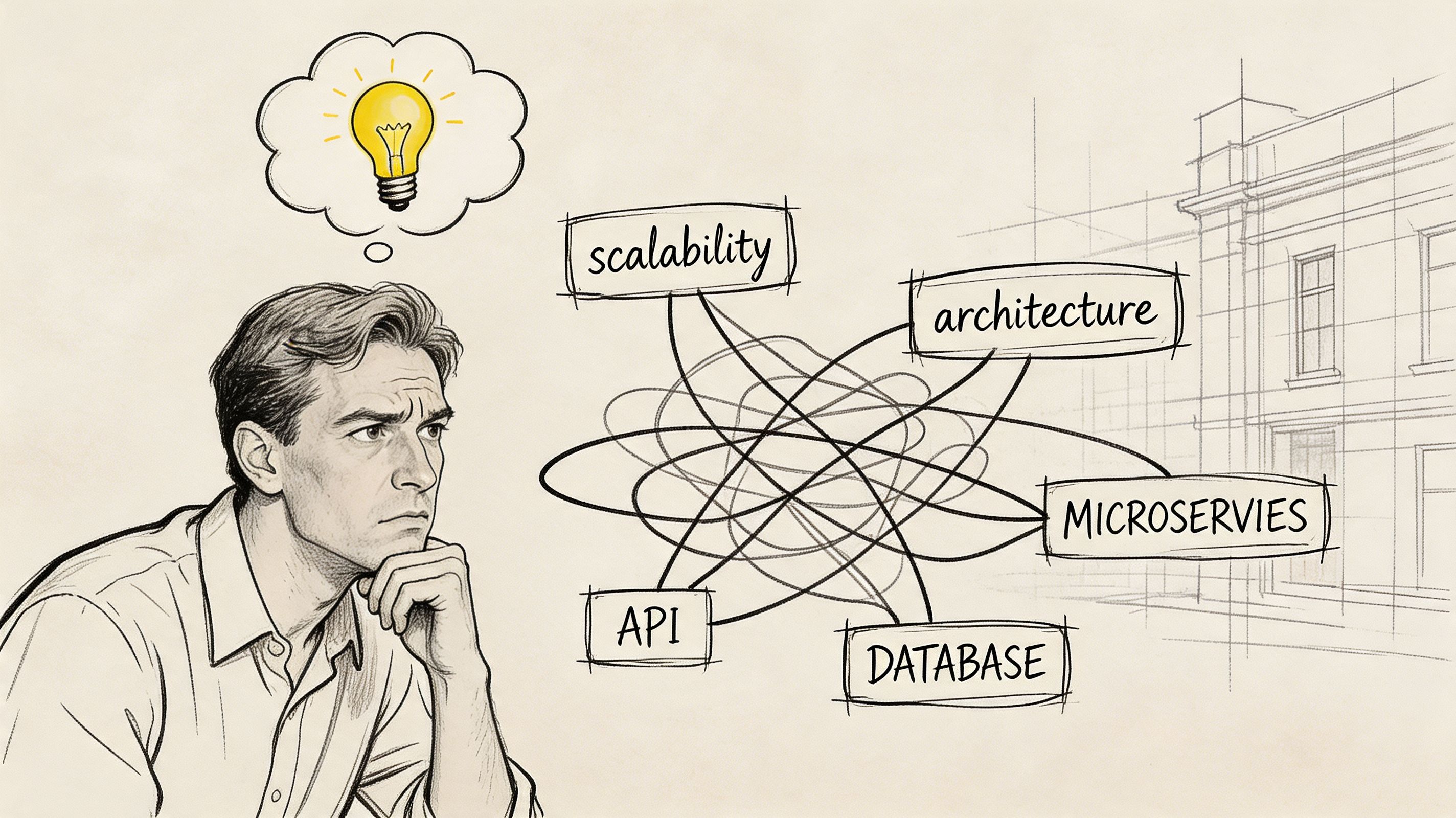
Founders don't need more code. They need direction
Most early-stage teams don’t fail because they lacked effort. They fail because they built in the wrong order. They treated architecture like a cleanup task. They delayed compliance thinking. They hired tactically instead of structurally.
A real tech strategist fixes sequence first.
That means deciding what must be production-grade now, what can stay lean, what should never be outsourced blindly, and what needs executive oversight from day one. The result is clarity. Your team stops debating abstractions and starts building against a roadmap that protects the company.
Tech strategy consulting is the difference between “we launched something” and “we built something that can survive growth, diligence, and handoff.”
This matters more than ever. The global strategy consulting market, which includes tech strategy, is projected to surge by USD 146.1 billion by 2029 at a 23.8% CAGR, according to Technavio’s strategy consulting market analysis. Founders should read that signal correctly. Businesses are paying for guidance because bad technical decisions are expensive, visible, and hard to reverse.
The valuation lens
Investors rarely care that your team worked hard. They care whether the technology is durable.
They want to know if the codebase can scale without a rewrite, whether key workflows are secure, whether your infrastructure is auditable, and whether your product architecture supports future expansion. If you can’t answer those questions, your product starts to look like a liability.
A technical architect gives your company a stronger answer before anyone asks the question.
Defining Tech Strategy for High-Growth Founders
Tech strategy consulting for startups is not enterprise theater. It’s not a six-month committee process. It’s not a generic recommendation to “move to the cloud” or “use AI.”
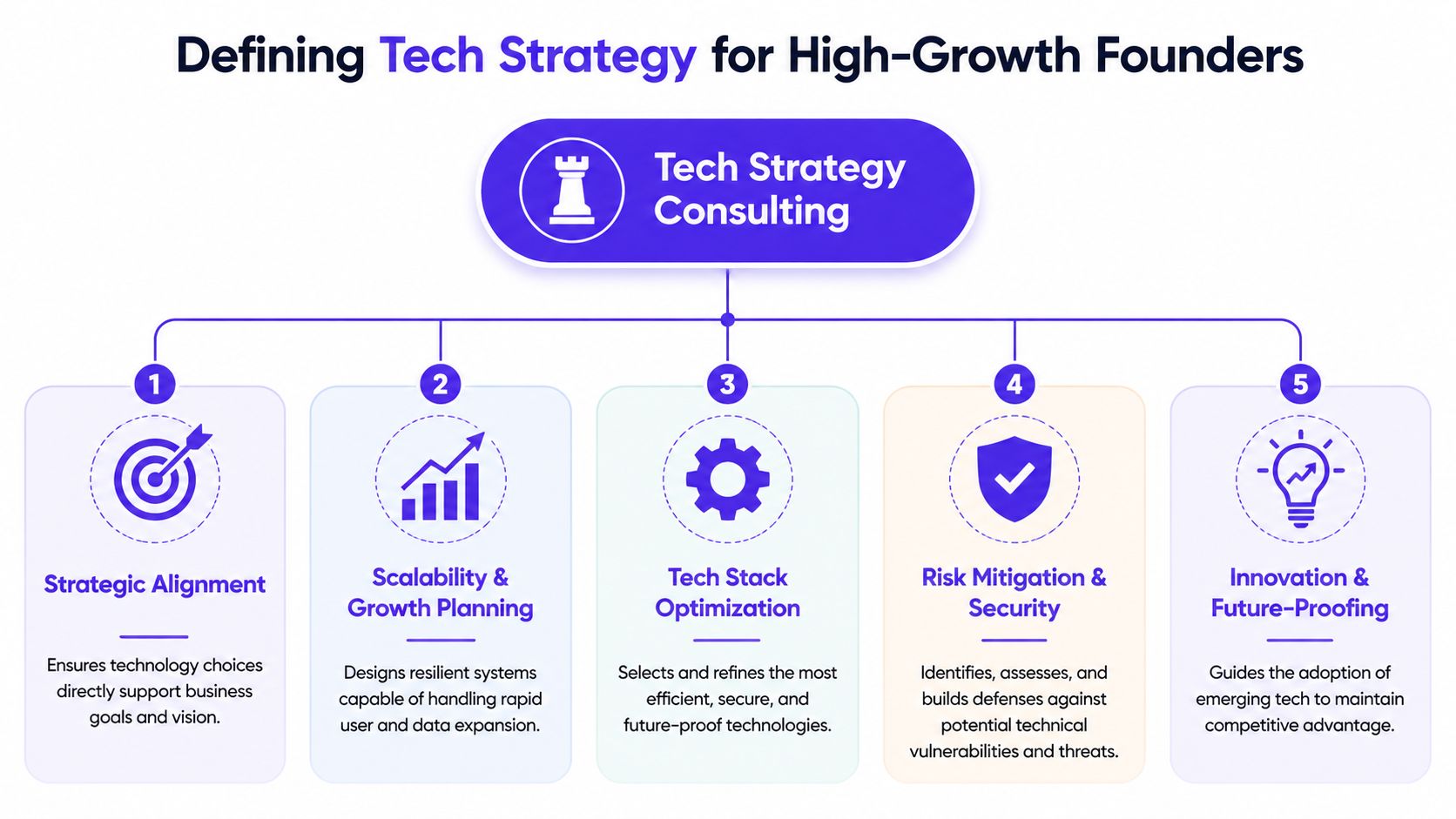
For founders, tech strategy consulting is the discipline of making technical decisions that increase company value. It aligns architecture, product scope, hiring, compliance, infrastructure, and delivery around one goal: building a company that can grow without technical fragility.
What founders usually get wrong
Founders often buy engineering capacity when they need engineering judgment.
A freelancer can build screens. A dev agency can deliver tickets. A strong engineering partner does something else. They decide what should exist, what should wait, and what creates long-term advantage.
That distinction matters.
Technical moat means the product is built as a durable business asset. The architecture, data model, workflows, and infrastructure create defensibility.
Prototype means the product is only good enough to demonstrate a concept. It may help with a demo, but it often creates cleanup work, hidden risk, and weak investor confidence.
The mentor-architect model beats the black box model
If you’re a founder, especially a non-technical one, avoid any partner that hides behind process. You need a mentor-architect, not a black box.
A black box vendor takes requirements, disappears, and returns with code. That setup creates dependency and strips you of context. You can’t defend decisions to investors because you were never brought into them.
A mentor-architect works differently:
They translate business goals into technical priorities so roadmap decisions connect to revenue, retention, and expansion.
They explain tradeoffs in plain English so you can make executive decisions without pretending to be an engineer.
They build with handoff in mind so future internal hires can inherit a clean system.
They challenge weak assumptions instead of saying yes to every feature request.
If you’re building a startup and want a practical example of founder-focused tooling around engineering workflow and visibility, Discover PullNotifier's solutions. The broader point is simple. Founders need systems and partners that reduce blind spots, not add more of them.
What tech strategy consulting actually covers
At the startup level, this work usually includes a tight set of decisions:
Product architecture Choosing the stack, application boundaries, and release plan that fit your current stage.
Infrastructure design Setting up cloud environments, environments strategy, deployment flow, observability, and cost controls.
Security and compliance planning Building controls early enough that security doesn’t become a rewrite project later.
Data and AI readiness Making sure your product data model supports reporting, automation, and future intelligence workflows.
Technical leadership Giving founders an executive layer of oversight before they can justify a full-time CTO.
That last point is often the most important. Founders don’t just need someone to advise the codebase. They need someone to shape the company’s technical posture.
Core Services That Build Your Technical Moat
A founder’s technical moat is not the codebase alone. It is the set of decisions, systems, and operating standards that make the business faster to scale, easier to diligence, and harder to copy.
That is what tech strategy consulting should produce. Clear architecture choices. A delivery plan tied to business milestones. Risk controls that protect valuation instead of slowing the team down.
Technical discovery and roadmap design
The first job is to turn ambition into an engineering plan that survives contact with reality. A strategist should map your business model, product scope, capital constraints, and hiring plan into a staged roadmap with explicit tradeoffs.
That roadmap needs to answer four questions early:
What has to ship now to prove demand
What should wait until usage justifies the cost
What creates expensive rework if postponed
What must be validated before you add headcount
Many startups lose time. They mix product work, infrastructure cleanup, analytics, and security into one noisy backlog. A serious roadmap separates proof-of-demand work from long-term platform work and shows the dependency chain clearly.
Data strategy belongs in that same plan. Kanerika’s data strategy consulting analysis reports a 25 to 35 percent uplift in decision velocity when companies move from fragmented data silos to scalable, AI-ready platforms. If your tracking, event design, and reporting logic are weak at MVP stage, you are not building an investor-ready technical asset. You are building confusion.
Architecture review and codebase pressure testing
This service protects enterprise value.
A proper architecture review tests whether the system can support growth, diligence, and team expansion without forcing a rewrite six months from now. It should examine how the application is structured, how releases move, how data models hold up under new use cases, and where operational risk is already accumulating.
The review should cover:
Application structure including service boundaries, coupling, and maintainability
Deployment model including environment separation, rollback safety, and release process
Data design including tenancy, reporting support, and model flexibility
Security posture including access control, secrets handling, logging, and auditability
Operational resilience including observability, alerting, and recovery paths
One bad architecture choice rarely kills a startup. A stack of avoidable shortcuts does. Founders should expect a strategist to identify technical debt that will reduce delivery speed and complicate future due diligence, then rank what needs cleanup now versus later.
Tool choices matter, but only in context. AWS Cost Explorer can surface infrastructure waste. GitHub Actions, Terraform, Datadog, Sentry, Snowflake, and Kubernetes can all be right choices if they solve a specific delivery, reliability, or compliance problem. Buying modern tools without a clear operating model just creates a more expensive mess.
Fractional CTO leadership
Early-stage companies rarely need a full-time CTO on day one. They do need CTO-grade judgment.
Fractional CTO support closes that gap. It gives the founder a technical decision-maker who can set standards, approve architecture, shape hiring, assess vendors, prepare for investor questions, and step in when engineering stalls.
Role clarity matters. Your fractional CTO should own decision quality and technical narrative. They should leave behind operating discipline, documented standards, and a system your future internal leaders can inherit.
If they only attend standups and translate developer updates, you are not getting strategic value.
Compliance and diligence preparation
Investors and enterprise buyers do not care that your team moved fast. They care whether the asset they are buying is controlled, understandable, and fixable.
That is why diligence preparation belongs inside the core service set, not at the end of the fundraising process. A good consultant will help you document how environments are managed, how access is controlled, how releases are tracked, what dependencies create risk, and which technical liabilities still need remediation.
The output should be practical. A current architecture summary, infrastructure overview, security controls map, SDLC process, incident readiness view, dependency inventory, and a short technical debt register with owners and timelines.
That package changes the conversation. You stop pitching a product. You start presenting a technical asset that can survive scrutiny and compound in value.
Key Signals It's Time to Hire a Tech Strategist
Founders usually wait too long. They bring in tech strategy consulting after the architecture is tangled, the team is frustrated, and the fundraising process is already exposing gaps.
That’s the expensive version.
Signal one is confusion at the top
If you’re a non-technical founder and can pitch the market but can’t confidently explain the product’s technical direction, you need help now. Investors and senior hires both test for this.
There’s a real talent gap here. 68% of tech leaders report talent gaps in strategic oversight, and traditional consulting often fails to give founders specific guidance on building investor-ready MVPs without technical debt, according to Corsica Technologies’ IT strategy consulting perspective. That means your difficulty finding the right support isn’t personal. The market is bad at serving founders at this stage.
Signal two is engineering drift
Your developers are productive, but nobody is steering. Architecture discussions keep reopening. Feature estimates swing wildly. Shipping gets slower with every sprint. No one can tell you whether the team is building toward a durable system or accumulating hidden liabilities.
That’s not a delivery issue. It’s a leadership issue.
A strategist gives the team decision guardrails. They define what “good” looks like, what standards are essential, and where shortcuts are acceptable. Without that layer, teams optimize locally and damage the system globally.
Signal three is product traction exposing weak foundations
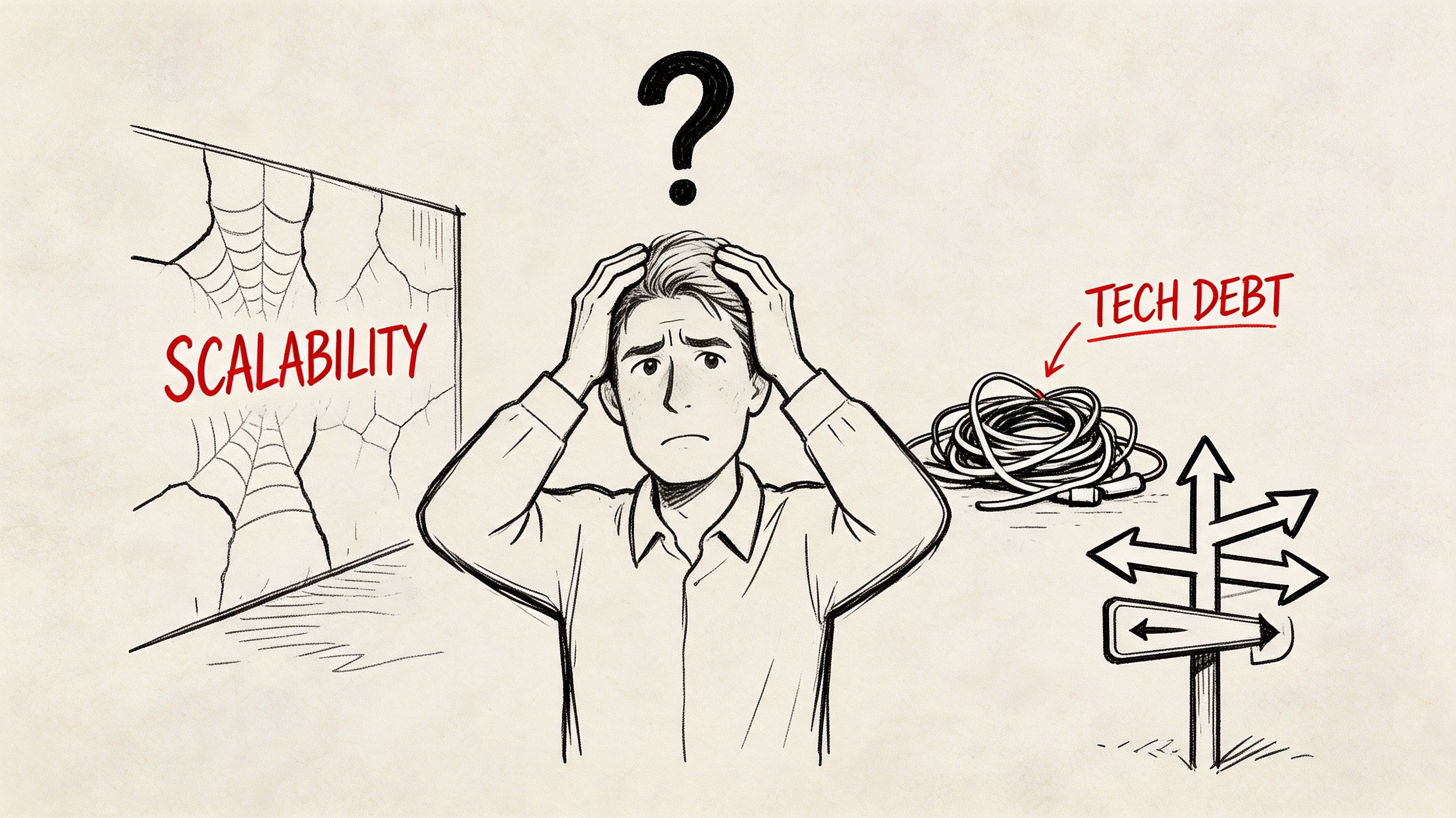
Your MVP worked well enough to validate demand. Then traffic, integrations, and customer expectations increased. Suddenly response times degrade, deployments feel risky, and every bug seems to touch three unrelated parts of the app.
That pattern usually means the product was built as a demo and is now being forced to act like a platform. If you haven’t already read a plain-language breakdown of how this happens, Buttercloud’s guide on technical debt in software development is a useful reference.
Here are the common founder-level triggers:
Fundraising is approaching and you need a technical narrative that survives diligence.
Your first engineering hires need direction and you don’t want culture or architecture to form by accident.
A major rebuild is being discussed but nobody has diagnosed the actual root cause.
Compliance requirements are showing up in customer conversations before your systems are ready.
Vendors are making stack decisions for you because no one internally can challenge them.
You don’t hire a tech strategist because code exists. You hire one because the company now depends on technical judgment.
Anatomy of a Startup Tech Strategy Engagement
A good engagement is structured. It isn’t open-ended advisory drift. It should move from diagnosis to design to execution support, then leave your team stronger than it started.
Phase one is technical audit and founder alignment
The first job is to expose reality.
That means reviewing the product, codebase, infrastructure, team setup, delivery process, vendor footprint, and business priorities in one operating picture. You need to know where the system is fragile, where it’s overbuilt, and where key assumptions are unsupported.
Typical outputs in this phase include:
A current-state architecture view
A risk register
A product-to-platform gap analysis
A delivery bottleneck assessment
A leadership memo for founders and investors
This is also where strategic tensions surface. Maybe the team wants speed, but the current release process makes shipping unsafe. Maybe the founders want enterprise customers, but the product has no meaningful audit trail. Better to see that early.
Phase two is roadmap and architecture design
Once the facts are clear, the next step is to make deliberate choices.
That includes defining target architecture, release sequencing, infrastructure priorities, ownership boundaries, and a realistic path from current state to desired state. At this stage, the work ceases to be abstract.
A strong roadmap usually separates three tracks:
Immediate stabilization Fix the issues that threaten reliability or block shipping.
Core platform decisions Resolve stack, data, tenancy, security, and integration choices that affect the company long term.
Growth preparation Add the capabilities that support hiring, diligence, analytics, and scale.
Startups that engage in tech strategy consulting see 30-40% faster digital transformation outcomes because this process converts ambiguity into a prioritized roadmap and reduces rework, according to SPD Technology’s consulting overview. That’s why the roadmap matters. It removes avoidable decision churn.
Phase three is implementation oversight and team mentorship
Many firms disappear at this stage. They hand over a document and call it strategy. That’s lazy.
Execution support matters because teams interpret plans differently under pressure. A strategist should stay close enough to validate architecture, review critical tradeoffs, support hiring, and keep delivery aligned with the roadmap.
For many founders, a virtual CTO engagement is particularly beneficial. It creates a standing layer of technical leadership without forcing an early full-time executive hire.
A roadmap without implementation oversight turns into aspiration. Strategy only has value when it survives contact with deadlines, constraints, and real team behavior.
Phase four is optimization and handover
The final phase is about independence.
By this point, your team should have cleaner operating standards, better delivery rituals, clearer ownership, and stronger technical documentation. If the engagement did its job, the business is no longer reliant on invisible knowledge living in one contractor’s head.
You should expect a clean handover that includes decision logs, standards, unresolved risks, and clear recommendations on what the next internal technical leader needs to own. That’s how consulting creates advantage instead of dependency.
Choosing Your Partner and Understanding Pricing
Most founders compare partners the wrong way. They compare hourly rates, headcount, or brand recognition. That’s shallow. You should compare how each option handles risk, context, and accountability.
The useful comparison isn't price alone
Large firms can bring process and polish, but they often struggle at founder speed. Freelancers can move fast, but they rarely provide the leadership structure needed for roadmap discipline, investor readiness, and team design.
Boutique consultancies usually sit in the most useful middle. They can stay close to the product, make decisions quickly, and work directly with founders instead of through layers of account management.
That matters because cost control in startups is not just about paying less. It’s about avoiding expensive missteps. Boutique consultancies often outperform large firms with 85% faster deployment for startups, and hybrid DevOps models can cap infrastructure expenses at 15-20% of the engineering budget while preserving audit-readiness for frameworks like PDPL and NCA, according to Nettech’s IT strategy consulting roadmap.
Tech Strategy Partner Selection Checklist
Criterion | Why It Matters for Founders | Red Flag |
|---|---|---|
Audit-ready engineering mindset | You need systems that survive diligence, not just demos that look good in a pitch. | They talk about velocity but never about traceability, security, or handoff. |
Founder mentorship | A strong partner helps you make decisions, not just submit tickets. | They communicate only with engineers and keep founders outside technical reasoning. |
Architecture depth | Early choices affect hiring, scale, and future rebuild risk. | They jump to a stack recommendation before understanding product and business model. |
Operational competence | CI/CD, observability, environments, and release safety protect growth. | They treat infrastructure as an afterthought that can be “cleaned up later.” |
Transparent decision process | You need to understand tradeoffs if you’re going to defend them to investors or hires. | They rely on vague claims, opaque estimates, or proprietary mystery methods. |
Handoff discipline | The company should become stronger, not more dependent. | Documentation is weak and key knowledge stays trapped with the vendor. |
How to think about pricing
The right way to price tech strategy consulting is against avoided loss and increased company readiness.
Ask yourself better questions:
Will this prevent a rewrite?
Will it shorten fundraising friction?
Will it improve technical hiring decisions?
Will it keep infrastructure spend proportionate to stage?
Will it reduce avoidable delivery churn?
If the answer is yes, then the engagement is not overhead. It’s structural risk reduction.
Cheap implementation gets expensive when you have to explain it to investors, replace it under deadline, or rebuild it while customers are already onboarded.
Your Next Move From Founder to Tech Leader
The founder at the beginning of this article doesn’t need more inspiration. They need technical clarity.
That shift is what tech strategy consulting is really for. It moves you from reacting to engineering decisions to leading them. It gives you a defensible roadmap, a stronger product story, and a system that can support diligence, hiring, and growth.
Treat your technology the way serious investors do. Not as a cost center. Not as a pile of tickets. As a core company asset that needs architecture, governance, and executive judgment.
If you’re still making foundational technical decisions without a clear operator in the room, fix that first. Everything gets easier after that. Fundraising gets cleaner. Hiring gets sharper. Product execution gets less chaotic.
That’s how founders stop sounding like they’re building software and start sounding like they’re building a company.
Founder FAQs on Tech Strategy Consulting
Do I need tech strategy consulting before I hire developers
If you’re making stack, scope, architecture, or hiring decisions, yes. Even a short strategy engagement can save you from building the wrong thing in the wrong order.
Is this only for non-technical founders
No. Technical founders need it too, especially when they’re splitting time across product, hiring, customers, and fundraising. The issue isn’t intelligence. It’s bandwidth and decision quality under pressure.
What should I expect in the first few weeks
Expect a sharp diagnostic process. A good advisor will review your product goals, codebase, infrastructure, team structure, analytics model, and release workflow. You should leave with clearer priorities, not more documents for a folder.
How do I know if a partner understands data strategy, not just app development
Ask how they think about event design, reporting trust, governance, and AI readiness. If they only talk about shipping features, they’re thinking too narrowly. If you want a clear primer on the operational side, learn about data governance from Trackingplan.
Should strategy come before compliance work
They should be connected. Compliance without architecture discipline becomes bureaucracy. Architecture without compliance thinking creates expensive retrofits later.
What is the main deliverable I should care about
Decision quality. You want a roadmap, architecture direction, and operating model that your team can execute. The best deliverable is a company that becomes easier to scale and easier to defend.
If you need a technical partner that can help turn an idea into an investor-ready product, Buttercloud provides startup-focused engineering, virtual CTO support, and production-grade product strategy built around valuation, scalability, and technical longevity.