Android App Development for Startups

Founder & CEO, Buttercloud
You have an idea for an Android app. This isn’t just another project; for a founder, it’s the engine of your entire enterprise. The single most consequential mistake you can make is viewing this process as a cost to be minimized. That mindset is a trap.
It’s the fastest way to build something that looks like an app but is really just a fragile prototype, destined to crumble the moment you get a spike in users or an investor’s tech team looks under the hood. The goal isn’t just to “build an app”; it’s to engineer a high-valuation technical asset.
Building an Asset, Not Just an App
For many founders, the plan seems simple: get an app on the Google Play Store as fast and as cheaply as possible. But viewing your app as a simple expense is a dangerous miscalculation. It leads you straight into the “prototype trap”—a brittle app that breaks under pressure and gets torn apart during technical due diligence.
A strategic founder knows the codebase isn’t just a line item; it’s the most valuable asset the company owns. Think of it like this: are you pouring a deep, steel-reinforced foundation for a skyscraper, or are you throwing together a temporary tent? Both provide cover initially, but only one is engineered to last, scale, and generate real, long-term value.
A “technical moat” isn’t just a buzzword. It’s the tangible result of elite engineering—clean, scalable, well-documented code that makes your product incredibly difficult for a competitor to replicate. It’s what proves to investors that your tech is a fortress, not a liability.
The Mindset of Strategic Engineering
This isn’t about cramming in more features. It’s about making deliberate architectural choices today that will pay massive dividends when it’s time to scale or raise your next round. Every decision, from the tech stack you choose to how you structure your database, must be made with one eye on your future valuation.
This focus on quality from day one has real, tangible benefits:
-
Investor Confidence: An “audit-ready” codebase flies through a VC’s technical due diligence. This signals a low-risk, high-potential investment.
-
Eliminated Technical Debt: By building correctly from the start, you won’t waste months and significant capital fixing shortcuts later. Your code becomes an asset, not a growing liability.
-
Faster Scaling: A robust architecture handles massive user growth without constant fires and emergency patches. You can focus on winning the market, not just keeping the servers online.
-
Higher Valuation: A strong technical foundation is a stable, scalable revenue engine. That directly translates to a higher valuation for your company.
From Blueprint to Investable Product
The path from a simple idea to a high-value technical asset is a deliberate one. It begins with the understanding that even your Minimum Viable Product (MVP) must be built to production-grade standards.
Instead of a throwaway prototype, your MVP becomes the solid first version of your real product, ready for immediate iteration the moment you land your first check. To execute this correctly, you can follow a modern Android app development tutorial that walks you through building a truly production-ready application from the ground up.
Ultimately, this mindset is what separates startups that achieve market leadership from those that fizzle out. It’s the difference between building an app that just works and engineering one that’s built to win.
Transforming Your Idea Into an Investor-Ready MVP
So, you have a defensible app idea. Welcome to the starting line. The journey from a concept to a product that attracts serious investment begins here, with the Minimum Viable Product (MVP).
For a founder, this is the make-or-break stage. It’s where you prove your idea has market viability. More importantly, it’s where you lay the technical foundation that will either rocket you forward or bog you down in endless, expensive refactoring later.
Many founders fall into the “prototype trap.” They rush to build a flimsy app that’s all sizzle and no steak—it looks good, but it’s a house of cards underneath. That’s a facade, not an asset. A true MVP for your Android app isn’t a throwaway demo; it’s the first, robust, production-ready version of your product. It must be engineered correctly from day one.
The goal of an MVP isn’t just to see if people will use it. It’s to build a “technical moat.” This is an engineering standard where your codebase is so clean, secure, and scalable that it becomes a genuine competitive advantage and a core part of your company’s valuation.
What Is Audit-Ready Engineering?
Picture this: you’re in the final stages of a funding round. The VC’s technical team requests access to your codebase to perform due diligence. This is where your heart either sinks or soars. Will they find a tangled mess of shortcuts and digital duct tape, or a clean, professional, well-documented asset?
Audit-ready engineering means building your Android app to pass that exact test. It means your code is:
-
Clean and Maintainable: Other engineers can onboard, understand the architecture, and add features without introducing instability.
-
Documented: Critical architectural decisions and complex logic are clearly explained. A new engineer can get up to speed quickly.
-
Scalable: The core structure is built to handle significant user growth without requiring a total rewrite.
-
Secure: Best practices for data security are integrated from the beginning, not as a panicked afterthought.
Building this way actively eliminates technical debt—the future cost of all the “quick-and-dirty” shortcuts you take today. For an investor, seeing low technical debt is a massive green flag. It signals a mature, low-risk operation.
Prototype vs. Production-Grade MVP
It is crucial to understand the distinction between a throwaway prototype and a true MVP. A prototype is built to test a single hypothesis and is often discarded. A production-grade MVP is the first version of your final product, engineered to last and evolve.
This is the mental shift every founder must make—you’re not just writing code; you’re building a business asset.
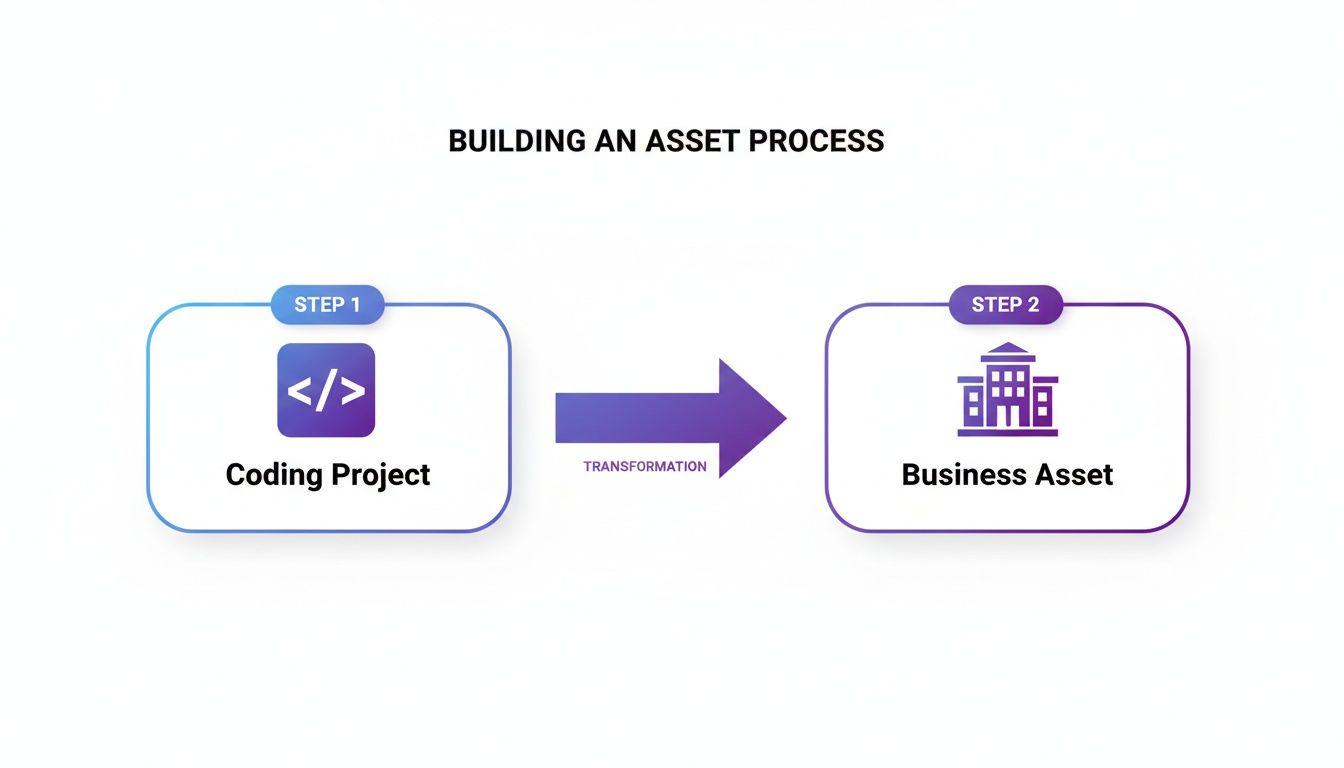
As the diagram illustrates, it’s a process of transforming a project into a valuable system that creates long-term value.
Critical Architectural Decisions for Your MVP
One of the first, and most important, decisions you’ll make is the architecture for your Android app. The main choice boils down to Native vs. Hybrid development. The technical jargon can get dense, but the business impact is crystal clear.
-
Native Development: This means building your app specifically for Android using its native language, Kotlin. It delivers the best possible performance, top-tier security, and full access to all of the device’s hardware and features. It’s the premium path to a fast, slick app that feels like it truly belongs on the device.
-
Hybrid Development: This approach uses a single codebase (with frameworks like React Native or Flutter) to build for both Android and iOS simultaneously. It can seem cheaper upfront, but you often pay for it later with slower performance, a clunky user experience, and a significant maintenance burden.
For founders serious about building a high-value, defensible tech asset, native app development is almost always the superior strategic choice. The buttery-smooth performance and superior user experience lead directly to higher user retention and engagement. Furthermore, the robust architecture holds up far better under the pressure of scaling and investor scrutiny.
We dive deeper into this in our guide on native app development strategies. Getting this choice right is a foundational step in ensuring your MVP increases your startup’s valuation, not puts it at risk.
Assembling Your Android Engineering Team
Your app idea may be brilliant, but it’s the team you assemble that will determine its fate. For a founder, this is one of the highest-stakes decisions you’ll make. A weak team will build a fragile product riddled with technical debt. The right one will engineer a high-valuation technical asset.
Thinking you can simply hire a few junior developers and hope for the best is a common and costly mistake. It’s like trying to build a skyscraper with a general construction crew but no master architect. You’ll end up with a shaky foundation, an unstable structure, and a project at risk of collapsing before it’s even off the ground.
The Core Roles of a High-Performance Team
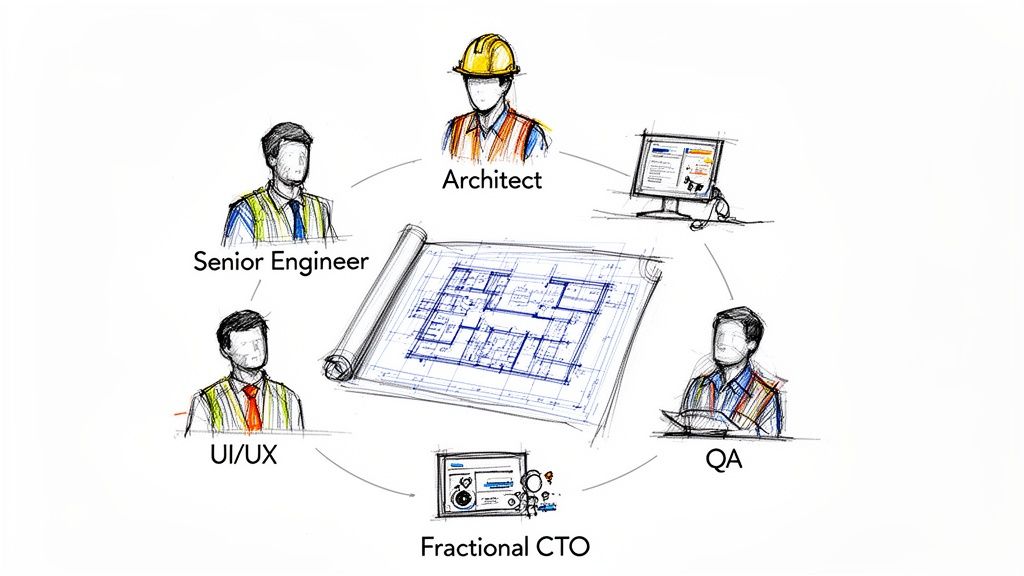
A truly effective team isn’t just a collection of coders. It’s a tight-knit group of specialists, where each individual plays a critical role in executing your vision.
Here’s who you need in the room:
-
Senior Android Engineer: This is your platform expert, a master of Kotlin and the Android SDK. They are responsible for writing clean, scalable code and turning your feature list into a reality.
-
UI/UX Designer: This person is your user’s champion. They are obsessed with creating an app that’s not just functional, but intuitive and genuinely enjoyable to use—a key factor in user retention.
-
QA Specialist: Building a professional-grade product without dedicated QA is not an option. Their job is to find and eliminate bugs across a wide array of Android devices before your users do.
-
Backend Engineer: Unless your app is completely self-contained (which is rare), you need a backend engineer. They build and maintain the server, database, and APIs that act as the central nervous system for your app.
If you skip any of these roles, someone else has to pick up the slack, often in areas where they lack expertise. That’s when corners get cut and product quality suffers.
The Architect vs. The Construction Crew
The single biggest mistake founders make is hiring developers before securing senior architectural leadership. A junior developer can write code, absolutely. But they lack the experience to design the blueprint—the scalable, secure, and maintainable system architecture your entire app depends on.
A Fractional CTO is the master architect for your startup. They provide the high-level strategic oversight to ensure your app isn’t just built to work today, but to pass intense technical due diligence and handle explosive growth tomorrow. Their role is to prevent hundred-thousand-dollar mistakes before a single line of code is written.
Hiring a Fractional CTO or partnering with a boutique firm gives you this critical leadership without the full-time salary of a C-level executive. It’s a way to access top-tier expertise right when you need it most: at the very beginning.
When to Hire vs. When to Partner
As a founder, every dollar counts. Deciding whether to build an in-house team or work with an engineering partner is a major strategic choice.
-
Start with a Partner/Fractional CTO: For most startups, this is the smartest first move. You get immediate access to world-class architectural guidance and a proven development process. This ensures your MVP is built as an investable asset from day one.
-
Hire Your First Full-Time Engineers: Once you’ve found product-market fit and secured funding, it’s time to build out your internal team. Your Fractional CTO can even help you vet candidates and lead tech team hiring to ensure you’re bringing on engineers who fit the high-performance culture you’ve already established.
Starting with a strategic partner isn’t outsourcing; it’s the anti-outsourcing model. It’s a high-touch partnership focused on mentorship and building a rock-solid technical foundation that will increase your company’s valuation for years to come.
Winning With the Android Market Landscape
As a founder, you live and die by the data. When mapping out your mobile strategy, the numbers behind Android aren’t just trivia—they’re a massive, flashing green light pointing to a global opportunity that no smart investor can ignore.
Let’s be blunt: a lot of founders are still stuck on an “iOS-first” playbook from a decade ago. That thinking is now a major strategic blind spot. For any startup with ambitions beyond a single, wealthy continent, ignoring the sheer scale of the Android market is simply bad business.
The Numbers Don’t Lie: An Android-First Strategy Makes Sense
Let’s skip the anecdotes and get straight to the facts. Android’s grip on the global market is absolute, commanding 72.55% of the mobile operating system market share.
Looking ahead, the Google Play Store is on track to hit a staggering 143 billion downloads by 2026. For comparison, Apple’s App Store is projected to see 38 billion. For a founder building a serious MVP, this isn’t just a number—it’s your access pass to billions of potential users. You can dig deeper into these mobile app development trends to build your case.
This data forces a shift in thinking. The question isn’t “Which platform is ‘better’?” It’s “Where is my largest addressable market?” For most startups hunting for explosive growth, the answer is crystal clear.
For a founder, market access is everything. Android’s unmatched global penetration isn’t a feature; it’s a fundamental business advantage. Choosing to neglect the platform is a deliberate decision to limit your startup’s potential reach and, ultimately, its valuation.
How Global Reach Connects to Your Bottom Line
These massive trends aren’t abstract concepts; they translate directly into real-world opportunities for your startup. It’s not about the total number of users—it’s about who they are and where they live.
This has a direct impact on how you grow:
-
Dominance in Emerging Markets: In high-growth regions like Latin America, Southeast Asia, and Africa, Android isn’t just the leader—it’s often the only game in town. If your business model is built to serve these booming economies, a native Android app is non-negotiable.
-
Device Diversity is a Strength, Not a Weakness: The huge variety of Android devices, from high-end flagships to budget-friendly phones, is a strategic advantage. It lets you target different customer segments with tailored features and pricing, reaching markets that are completely off-limits to a single-device ecosystem.
-
A Playground for Innovation: Android’s open platform is a breeding ground for creativity. You can build powerful widgets, integrate deeply with the OS, and explore flexible distribution models—all things that help you acquire and engage users in ways that just aren’t possible on a locked-down platform.
Pitching Your Android Strategy to Investors
Ultimately, your platform choice is a huge part of the story you tell investors. Walking into a pitch with a strategy that deliberately targets the world’s largest mobile ecosystem shows you’re thinking about scalable growth, not just following old trends.
Instead of defending a narrow market focus, you get to present a plan for capturing a global audience from day one. An investment in high-quality Android app development is really an investment in market access. For any founder building a company meant for massive scale, the data is clear: the path to global leadership runs straight through Android.
Budgeting for a High-Valuation Android App
So, what’s the magic number? How much does it really cost to build a production-grade Android app?
It’s the first question on every founder’s mind, and it’s a fair one. But it’s also the wrong way to frame it. A better question is, “What’s the right investment to build an audit-ready technical asset that can actually capture market share?” That small shift in thinking changes everything. It moves app development from a line-item expense to a core investment in your company’s future valuation.
The real answer isn’t found in an hourly rate. The true cost of Android app development is baked into the strategic choices you make long before a single developer starts coding. We’re talking about decisions around architecture, feature complexity, and your team structure—the very things that define not just your launch budget, but the total cost of ownership for years to come.
Beyond Hourly Rates: The True Cost Drivers
Thinking purely in hourly rates is a classic founder trap. It pushes you to optimize for the cheapest option today, which often leads to crippling technical debt tomorrow. An app built on the cheap that can’t scale or fails an investor’s technical due diligence is infinitely more expensive than one engineered correctly from the start.
The real drivers of your investment are:
-
Feature Complexity: There’s a world of difference between a simple content-delivery app and a multi-sided marketplace with real-time data streaming and AI-powered recommendations. More complexity means a higher investment.
-
Architecture & Engineering: This is where you build your “technical moat.” Clean, audit-ready code and a scalable backend aren’t just buzzwords; they’re the result of senior-level expertise and a direct investment in your company’s valuation.
-
Team Composition: The final bill will look very different depending on whether you bring on a Fractional CTO, partner with a specialized firm, or hire a full-time in-house team.
The most expensive app you can build is one that has to be rewritten. Investing in quality engineering from the start isn’t a luxury; it’s a risk-mitigation strategy that protects your valuation and ensures you can pass technical due diligence when it matters most.
A Data-Driven Look at Investment Ranges
To provide a clearer picture of what this investment looks like in practice, we’ve broken down typical costs by development stage. These are not arbitrary numbers; they reflect the resources needed to build a durable, scalable product that can compete and win.
Android App Development Cost Estimates By Stage (2026)
Development Stage
Estimated Cost Range (USD)
Core Focus
Typical Timeline
Proof of Concept (PoC)
$25,000 – $40,000
Validating technical feasibility; testing a core function.
4–6 weeks
Minimum Viable Product (MVP)
$75,000 – $150,000
Solving one core user problem; gathering initial user feedback.
3–6 months
V1 “Investor-Ready” Product
$250,000 – $500,000+
Building a scalable, secure, and feature-rich product for market launch.
6–12+ months
These ranges are designed to help you align your budget with your strategic goals, ensuring you’re investing appropriately for the stage you’re in.
The Market Opportunity Justifies the Investment
Framing this purely around cost also misses the massive opportunity you’re chasing. The global mobile app ecosystem is a behemoth, valued at $378 billion in 2026 and projected to hit an incredible $1.1 trillion by 2034.
For startups targeting the United States, the domestic market alone represents a $40.13 billion opportunity in 2025, which is expected to balloon to $150.72 billion by 2033. This isn’t just about building an app; it’s about carving out your piece of a rapidly growing pie.
To budget accurately, it’s critical to understand the nuances of software development cost estimation and avoid getting blindsided by hidden costs.
For a personalized breakdown, our own cost calculator can give you a much clearer picture based on your unique specs. Check out our guide on how to calculate your app development cost. This will help you turn a vague question about cost into a clear, actionable investment roadmap.
Scaling Your App From MVP to Market Leader
Launching your MVP is not the finish line; it’s the starting gun. The real race, the one where most startups stumble, is turning that initial product into a true market leader. This requires a total shift in mindset, from validating an idea to an obsession with operational excellence.
Think of it this way: you just built a high-performance race car (your MVP). Now you need an elite pit crew—your DevOps and infrastructure strategy—to refuel it and make repairs mid-race without stopping. This is what lets you accelerate when competitors are pulled over on the side of the road.
Building Your Engine for Growth
Scaling isn’t just about handling more users. It’s about keeping your app stable and blazing-fast as you grow. A backend that works for 1,000 early adopters will absolutely melt under the load of 100,000 active users if it wasn’t engineered to scale from day one.
This is why proactive infrastructure management is non-negotiable.
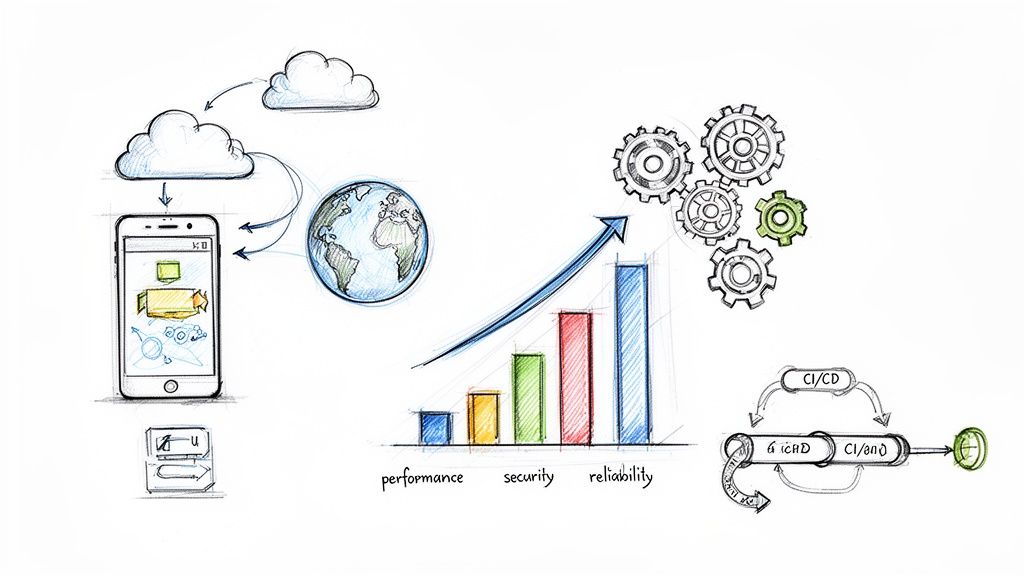
The core of a scalable system comes down to a few key components:
-
A Robust Backend: Your backend must be designed to scale “horizontally”—meaning as user load increases, you can simply add more servers to share the load, avoiding a single point of failure.
-
An Optimized Database: A slow database is the silent killer of user experience. You must get ahead of this with smart indexing and query optimization. As data grows, techniques like read replicas prevent crippling bottlenecks.
-
Performance Monitoring: You can’t fix what you can’t see. Implementing real-time monitoring gives you a dashboard for your app’s health, letting you spot and fix problems before users even notice.
For a founder, scaling is the ultimate test of decisions made months ago. An app built on a solid, audit-ready foundation will handle explosive growth with grace. One built on a mountain of technical debt will buckle, leading to outages, angry customers, and a frantic, costly scramble to rebuild.
The Power of Continuous Delivery
The goal of scaling isn’t just to stay online. It’s to ship value to users faster and more reliably than your competition. This is where a mature CI/CD (Continuous Integration/Continuous Deployment) pipeline becomes your secret weapon.
A well-oiled CI/CD pipeline automates the entire process of testing and releasing code. Every time an engineer pushes an update, it’s automatically run through a gauntlet of tests. If everything checks out, it can be deployed to your users in minutes, not days. This speed is a massive competitive advantage in Android app development.
Security and Compliance as Scaling Tools
As you grow, you go from being a cool new thing to a target. Your user base expands, you’re handling more sensitive data, and you start catching the eye of regulators and competitors. This is where having audit-ready security and compliance isn’t just a “nice-to-have”—it’s a survival tool.
Building with security in mind from day one isn’t just about passing VC due diligence; it’s about earning and keeping customer trust. For a startup, a single major data breach can be an extinction-level event.
Consider the strategic advantages:
-
Enterprise-Ready: Large corporate partners won’t even engage without proof of airtight security and compliance.
-
Investor Confidence: A mature security posture demonstrates you’re a serious, professional operation built for the long haul.
-
Brand Trust: In an age of constant privacy scandals, being the platform users know they can trust is a powerful differentiator that builds loyalty.
Ultimately, scaling is about transforming your technical foundation from a simple structure into a fortified, efficient fortress. It’s this engineering discipline that separates a flash-in-the-pan from a company with real staying power.
Straight Answers for Startup Founders
We partner with founders every day, and the same crucial questions about Android app development always surface. These aren’t just technical queries; they’re high-stakes business decisions that can make or break a startup.
Here are the direct answers you need to turn your idea into a valuable, scalable technical asset.
Should I Build for Android or iOS First?
The old “always build for iOS first” advice is a fossil from a different era. The right answer isn’t a one-size-fits-all trope; it’s a strategic decision based on your target market and business model.
With Android completely dominating the global market, especially in fast-growing regions, an Android-first or native parallel-build approach is often the only path to achieving massive scale. We guide founders to make this decision based on data, not on outdated industry chatter.
What Is the Biggest Founder Mistake in Android Development?
The most common and painful mistake is optimizing for the cheapest possible upfront cost instead of engineering for long-term value.
Founders get lured by a low-ball quote from a mass-market “dev shop,” only to end up with a mountain of technical debt. The product can’t scale, it’s riddled with bugs, and the codebase gets torn apart during investor due diligence.
We call this the “prototype trap,” and it can tank a startup’s valuation before it even gets off the ground. You must treat your code as an investable asset from day one. There is no other way to win.
How Can I Ensure My App Is Investor-Ready?
An investor-ready app is one that screams “this is a real asset, not a liability.” It means your code is clean, well-documented, and built on a scalable architecture. It means your security practices are solid.
You don’t get there by accident. It requires senior-level architectural oversight—often from a Fractional CTO or a specialized partner—and a professional development process obsessed with eliminating technical debt. Your code must tell a story of sustainable growth, not just a quick demo.
Want a real number before you talk to anyone? Our free MVP Cost Calculator gives you a directional estimate for your Android build.
Ready to build a technical asset, not just an app? At Buttercloud, we partner with founders to engineer investor-ready MVPs and scalable products. Let’s discuss your vision.
Have a product idea to talk through?
We'll show you how we'd approach it — no pressure, just a real conversation.
Book a Discovery Call