Application Development Models: A Founder's Guide

Founder & CEO, Buttercloud
You’re probably in the same place most founders reach sooner than expected.
You have a product idea. Maybe even early customer interest. Then your technical options explode into a mess of terms like Agile, Waterfall, Scrum, Kanban, DevOps, monolith, microservices, in-house team, agency, fractional CTO. At that point, many founders make a costly mistake. They treat application development models like an engineering preference.
They aren’t.
Your choice of application development models shapes how fast you learn, how safely you ship, how expensive scaling becomes, and whether your codebase looks like an asset or a liability when investors inspect it. A clean product roadmap with the wrong model underneath can still produce brittle software, missed milestones, and a painful rewrite at the worst possible time.
Founders need to think about this the same way they think about cap tables and hiring plans. The model you choose is a business decision with technical consequences. Not the other way around.
Choosing Your Blueprint for a High-Valuation Company
Most founders don’t fail because they chose the wrong JavaScript framework. They fail because they built the company on the wrong operating model for product development.
That distinction matters. A startup isn’t trying to produce software in the abstract. It’s trying to create a valuable technical asset that can survive customer demand, team turnover, investor scrutiny, and product change.
The history of software development makes that lesson painfully clear. The move from Waterfall to Agile was a genuine inflection point, with Agile emerging as the most preferred model because it handles changing requirements and time-to-market pressure better than older linear approaches, as noted in this research on software development model evolution.
That’s not trivia. It’s the core reason modern founders rarely benefit from rigid, sequential planning.
What founders should optimize for
When you evaluate application development models, use four business filters:
-
Speed of learning: Can your team validate product assumptions quickly?
-
Risk control: Will problems show up early, or only after months of work?
-
Scalability path: Can today’s decisions support tomorrow’s growth without a rebuild?
-
Diligence readiness: Will an investor or acquirer see disciplined engineering or chaos?
A good model doesn’t just help your engineers move. It helps your company make better bets.
Practical rule: If your development model makes it hard to change your mind, it’s probably wrong for an early-stage startup.
The valuation angle founders miss
Investors don’t reward code volume. They reward confidence.
They want to believe your product can ship reliably, your architecture won’t collapse under traction, and your team knows why it built things the way it did. The right model produces that confidence. The wrong one creates invisible debt that surfaces during diligence.
If you want a simple lens, use this: application development models are company design choices. They determine how your product gets built, how your team behaves, and how much future pain you’re purchasing today.
What Are the Four Layers of Application Development Models?
Most founders get confused because people use one phrase, “development model,” to describe several different decisions. That’s sloppy thinking.
You need a cleaner mental model. I recommend treating application development models as four separate layers, like constructing a high-rise. Each layer solves a different problem.
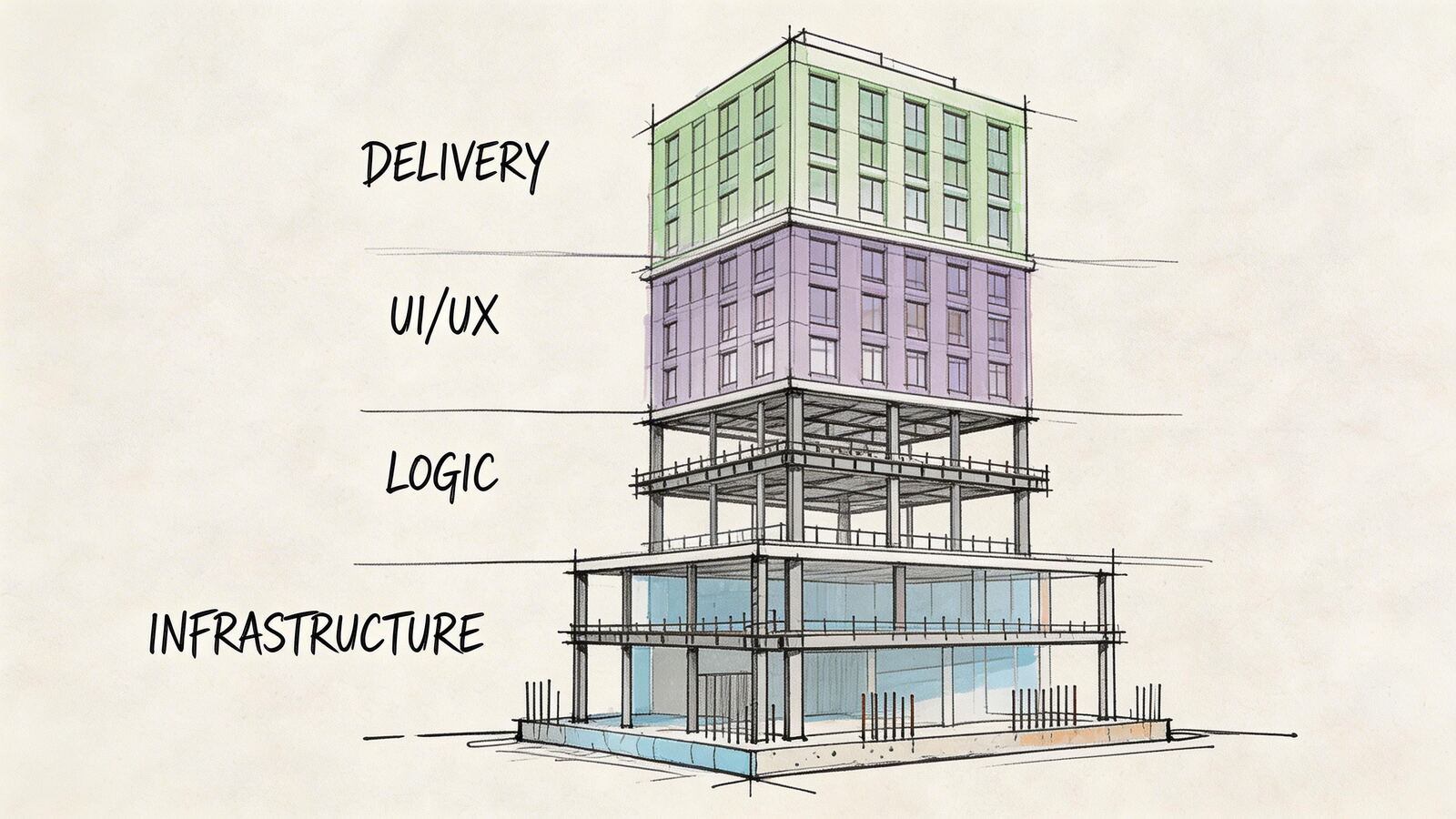
Layer one is methodology
This is your planning and execution philosophy.
It answers questions like these. Do you work in fixed phases or short cycles? Do you lock scope early or adapt as you learn? Do you prioritize prediction or feedback?
Examples include Waterfall, Agile, Scrum, Kanban, and Spiral.
Think of methodology as the architectural philosophy behind the building. It determines how decisions get made and how much change the system can tolerate.
Layer two is delivery
This is the shipping machinery.
Your methodology may say you want fast iteration. Delivery determines whether that’s real. This layer includes testing automation, CI/CD pipelines, release processes, code review standards, and DevOps discipline.
If methodology is the blueprint, delivery is the crane, concrete schedule, and inspection workflow.
Layer three is architecture
This is the structure of the product itself.
Are you building one well-organized application, or a set of distributed services? Are you optimizing for simplicity, isolation, reuse, or scale? Here you make choices like monolith versus microservices, event-driven systems, modular backends, and multi-tenant SaaS design.
A founder who wants better technical decisions should understand how architecture connects to stack selection. This guide to a startup tech stack is useful because it forces the right question. Not “what’s trendy,” but “what structure supports the business you’re trying to build?”
Layer four is engagement
This is the human operating model.
Who’s driving the build? An in-house team? A commodity agency? A staff-augmentation vendor? A strategic technical partner? A fractional CTO with an execution team?
Founders often ignore this layer, then wonder why good plans fail. The same methodology and architecture can produce radically different outcomes depending on who owns decisions, who documents them, and who is accountable when trade-offs appear.
A quick way to separate the layers
Layer
Primary question
Examples
Methodology
How do we plan and adapt?
Agile, Scrum, Kanban, Waterfall
Delivery
How do we ship safely?
CI/CD, testing, DevOps
Architecture
How is the product structured?
Monolith, microservices, modular SaaS
Engagement
Who makes and owns decisions?
In-house, agency, fractional CTO
Founders get leverage when they stop asking for “the best model” and start choosing the right combination across all four layers.
How Do You Build Process Methodologies and Delivery?
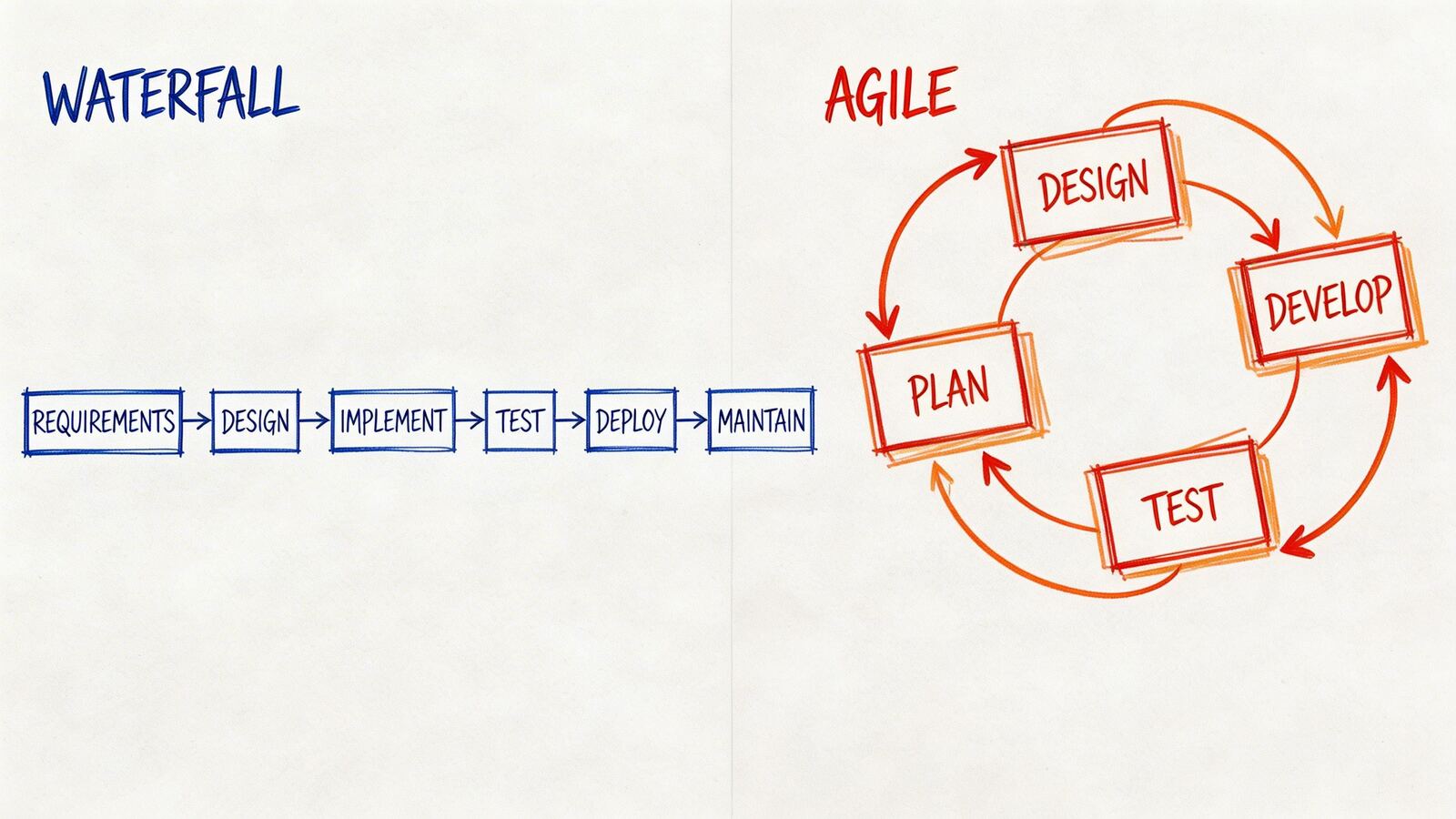
Waterfall still gets romanticized by people who love predictability on paper. Startups don’t live on paper.
They live in changing requirements, incomplete information, customer feedback, and hard deadlines. That’s why the old Waterfall logic fails so often in startup environments. The application development crisis of the 1990s exposed the problem clearly. Projects took an average of three years to deliver, and that delay helped drive the creation of iterative models and later the Agile Manifesto of 2001, according to this history of software development methodologies.
Three years is a death sentence for an early-stage company. Your market will shift, your customer assumptions will change, and your runway won’t wait.
Waterfall is built for certainty
Waterfall assumes you can define requirements upfront, move through fixed stages, and arrive at the right outcome by following sequence.
That can work in environments where change is tightly controlled and outcomes are well understood. It’s closer to building a bridge than building a startup product. Bridges don’t usually pivot after user interviews. SaaS products do.
The problem for founders is simple. You usually don’t know enough at the start to deserve a rigid plan.
Agile is built for learning
Agile wins because it treats software development as a feedback system.
You ship smaller increments. You learn from users earlier. You correct course before the wrong assumptions calcify into architecture and backlog bloat. Agile isn’t just “faster.” It is more honest about uncertainty.
That’s why most startups should default to an Agile mindset, usually implemented through Scrum or Kanban depending on the team’s work shape.
When Scrum fits
Scrum works well when you’re building new product capability with a dedicated team.
Use it when you need:
-
Short planning cycles: A sprint creates focus without pretending the full roadmap is fixed.
-
Clear accountability: Product owner, engineering lead, and team roles are easier to manage.
-
Regular review points: Demos force alignment between business and engineering.
When Kanban fits
Kanban works better when work arrives continuously and priorities shift often.
It’s strong for:
-
Bug fixing and maintenance: Support work rarely respects sprint boundaries.
-
Platform teams: Infrastructure, DevOps, and reliability work often benefits from flow-based management.
-
Operational visibility: Bottlenecks become visible fast when work is tracked properly.
Delivery is where good intentions go to die
Plenty of teams claim they’re Agile. Then they deploy manually, skip regression testing, and treat releases like mini-emergencies.
That isn’t Agile. That’s improvisation.
If methodology is your belief system, CI/CD and DevOps are your enforcement mechanism. Without them, iteration slows down, quality drops, and every release becomes emotionally expensive.
A founder should expect these delivery practices early:
Delivery practice
Why it matters
Version control discipline
Preserves history and supports accountability
Automated testing
Catches breakage before customers do
CI pipeline
Validates changes consistently
CD pipeline
Makes releases repeatable instead of heroic
Environment parity
Reduces “works on my machine” failures
A useful complement here is Test Driven Development (TDD) for reliable and fast software, especially if you want a practical view of how testing discipline supports faster delivery instead of slowing it down.
Fast teams don’t move quickly because developers type faster. They move quickly because their system makes change safe.
My recommendation for the default process stack
For almost every startup, the default process stack should be:
-
Agile methodology
-
Scrum for product delivery or Kanban for flow-heavy work
-
CI from day one
-
Basic CD as soon as releases become frequent
-
DevOps ownership early, even if one person wears that hat
Don’t mistake ceremony for maturity. The right process is the one that helps you learn, ship, and recover without drama.
How Do You Structure Your Product and Team Architecture and Engagement?
Founders love to ask whether they should build a monolith or microservices. The better question is this. What structure gives you speed now without poisoning scale later?
Architecture isn’t ideology. It’s sequencing.
Monolith first is often the smart move
For many MVPs, a well-structured monolith is the strongest choice.
It’s simpler to build, easier to test, easier to deploy, and easier for a small team to understand. When a startup is still searching for product truth, complexity is usually the enemy. A monolith keeps the team focused on user value instead of distributed systems overhead.
That doesn’t mean “throw everything into one codebase and hope.” It means building one application with clean modules, explicit boundaries, and disciplined code ownership.
Microservices later can be the right move
Microservices become useful when different parts of the business need to scale, deploy, or evolve independently.
That usually matters after the company has real usage, a broader team, and clearer operational constraints. If you introduce microservices too early, you often buy complexity without enough business return.
You add service boundaries, more infrastructure, more observability needs, more deployment coordination, and more room for integration failures.
Modularity matters more than hype
The incremental and iterative model becomes strategically important here. It’s ideal for reducing integration risk in modular applications, especially when your product has cleanly separated components. It’s also a poor fit for highly interdependent products, such as ride-hailing apps where core functions must work together from day one, as explained in this overview of software development models.
That’s a critical founder lesson. Not every product can be broken into isolated slices safely.
Good candidates for modular release patterns
-
B2B SaaS platforms: Admin panels, billing, analytics, and permissions often separate cleanly.
-
Internal workflow products: Reporting, approvals, and user management can ship in stages.
-
Marketplace support layers: Seller tools or back-office functions may be released independently.
Poor candidates for modular first releases
-
Real-time interaction apps: Messaging, matching, identity, and payments often depend on each other.
-
Consumer products with tight feature coupling: Partial functionality can destroy the product experience.
-
Systems with heavy shared domain logic: Artificial service separation creates more problems than it solves.
Team model changes the outcome
Architecture and engagement are linked. A monolith with strong technical leadership can outperform a microservices build run by a fragmented vendor setup.
Here’s the practical comparison.
Engagement model
Strength
Risk
In-house team
Strong product context and long-term ownership
Expensive and slow to assemble well
Traditional agency
Can move quickly at the start
Often weak on strategic continuity
Fractional CTO plus execution partner
Senior oversight with flexible execution
Requires clear accountability and founder engagement
If you’re still figuring out hiring shape, this guide on building a team of developers helps frame the capability mix founders need.
If your architecture requires senior judgment and your engagement model gives you only ticket-takers, you’ve designed failure into the company.
My recommendation for engagement model sequencing
Use this sequence unless your product clearly demands something else:
-
Start with a modular monolith
-
Keep boundaries clean enough that services can be extracted later
-
Avoid microservices until independent scaling or deployment is a real need
-
Match the team model to the complexity of the decisions, not just the amount of code
Founders who get this right preserve speed without creating a technical trap.
The Founder’s Decision Framework for Choosing Models
You don’t need a universal answer. You need the right combination for your stage.
That’s how mature founders should think about application development models. Not as labels, but as stage-specific operating choices.
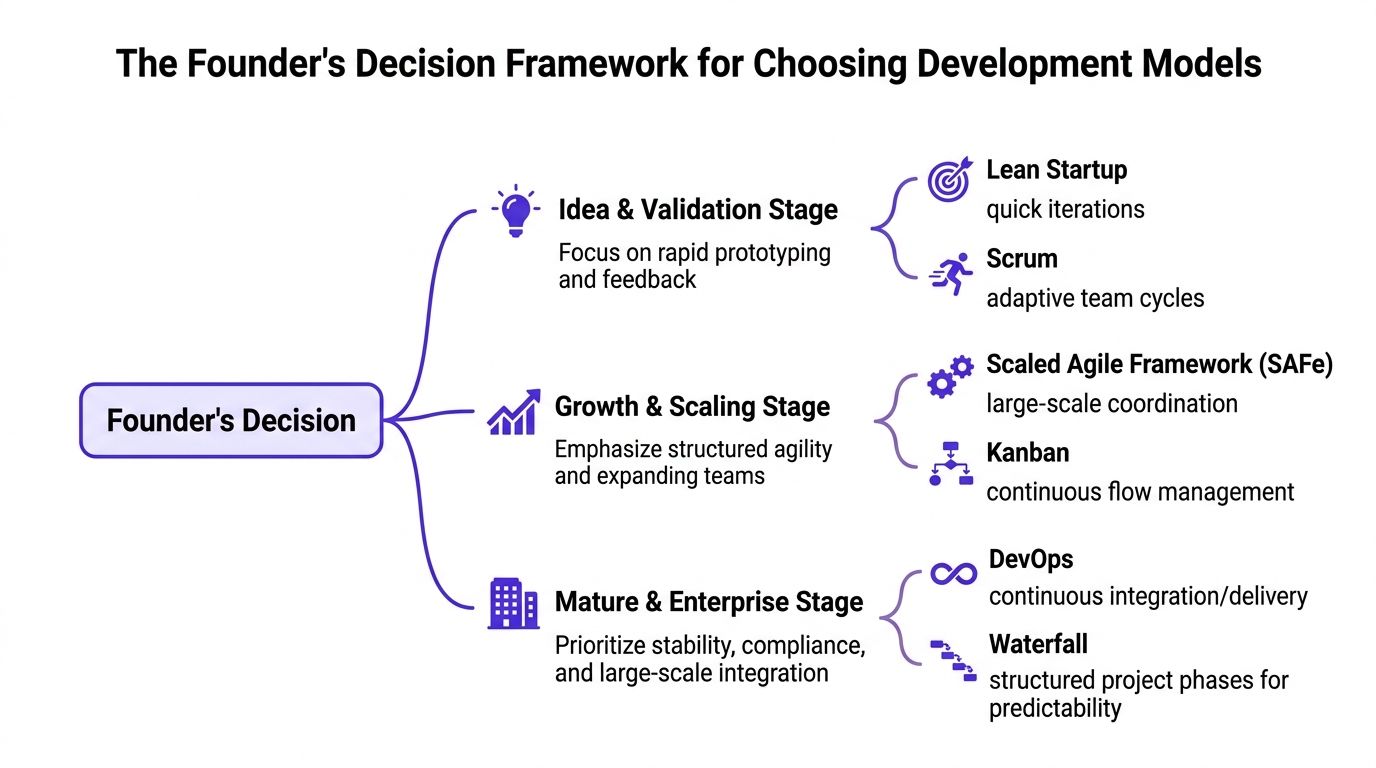
Idea and blueprint stage
At this stage, your biggest risk isn’t scale. It’s building the wrong thing.
You need rapid feedback, tight decision loops, and enough technical discipline to avoid painting yourself into a corner.
Recommended mix
-
Methodology: Agile with lightweight Scrum
-
Delivery: Basic version control, code review, and simple CI
-
Architecture: Modular monolith or prototype-grade architecture that can be hardened quickly
-
Engagement: Strong technical advisor or fractional CTO involvement
What matters here is learning velocity with controlled quality. Don’t overbuild. Don’t under-architect.
Investor-ready MVP stage
Now the bar changes.
Your product doesn’t just need to work in demos. It needs to survive pilot customers, usage spikes, bug fixes, and technical questions from expert outsiders. This is the stage where weak process gets exposed.
Use this decision lens
-
Can your team release regularly without fear?
-
Can someone explain the architecture in plain English?
-
Can you point to standards for testing, documentation, and security?
-
Can the roadmap absorb change without starting over?
If the answer to those questions is no, your model is too fragile.
Recommended mix
-
Methodology: Agile with clearer backlog ownership
-
Delivery: CI plus repeatable deployment workflow
-
Architecture: Modular monolith, with selective service extraction only if justified
-
Engagement: Fractional CTO or senior architect guiding execution and trade-offs
The MVP that raises capital isn’t the one with the most features. It’s the one that gives investors confidence the team can keep building.
Scaling to Series A and beyond
Once revenue, usage, and team size increase, your bottleneck changes again.
Coordination starts to matter more. Release safety matters more. Reliability becomes part of the product experience. You may need more formal workflow separation between platform work, customer delivery, and new feature development.
Recommended mix
Company stage
Methodology
Delivery
Architecture
Engagement
Idea
Agile, lightweight Scrum
Simple CI
Modular monolith
Advisor-led
MVP
Agile, disciplined Scrum or hybrid Kanban
CI and structured releases
Modular monolith with clear boundaries
Senior technical oversight
Scale
Agile with more explicit operating cadence
Mature DevOps and stronger automation
Selective service decomposition where justified
Growing in-house leadership
The founder’s real job
You don’t need to memorize every model. You need to ask sharper questions.
Ask whether the model supports fast learning. Ask whether it creates operational confidence. Ask whether it protects valuation instead of borrowing against it.
That’s the whole game. Choose the simplest model combination that can support your current stage and your next financing milestone.
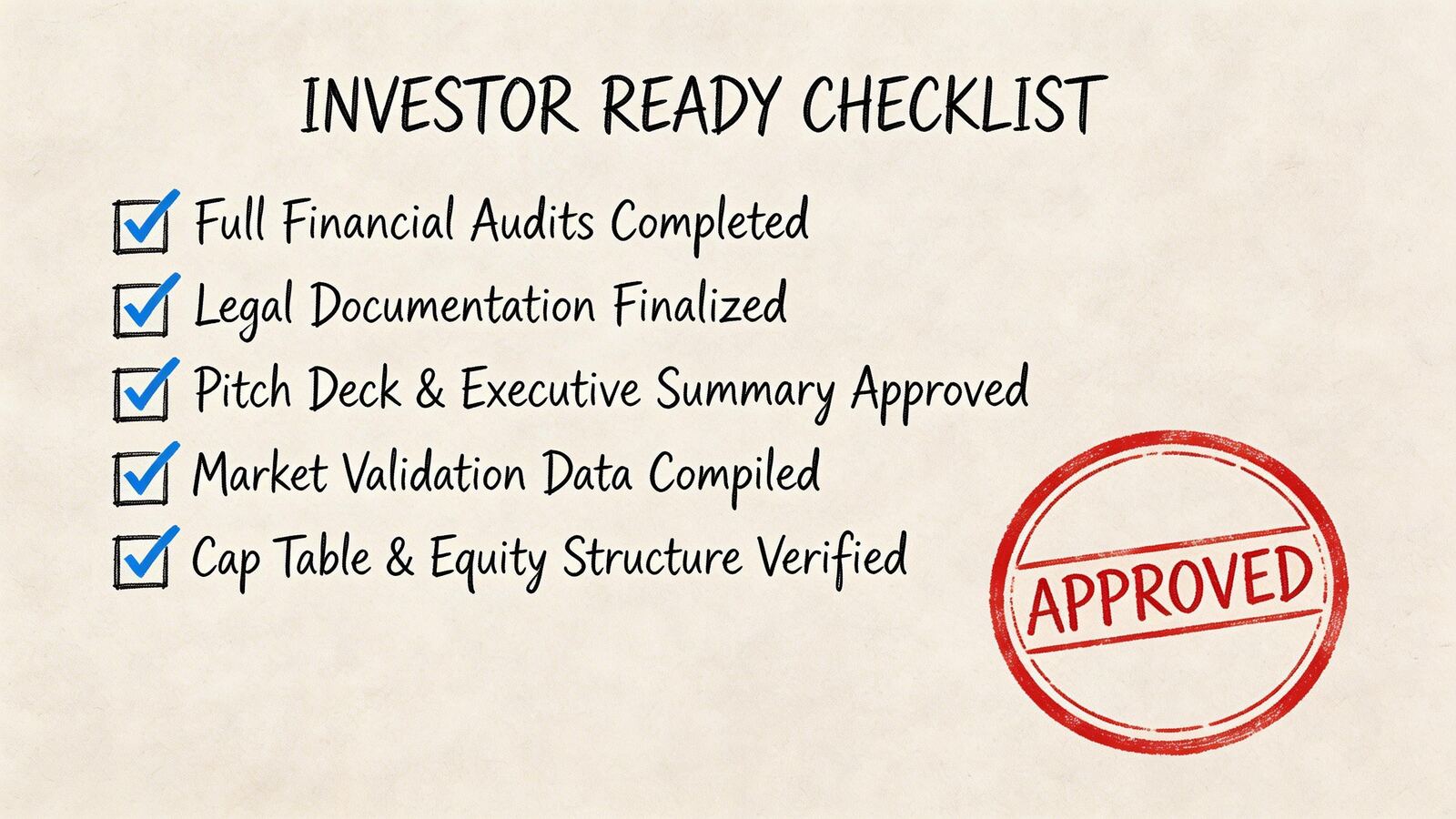
An Investor-Ready Implementation Checklist
A model choice only matters if the team implements it with discipline. Founders should never assume “we’re using Agile” means the product is being built correctly.
It often isn’t.
The practical risk is serious. Recent analyses reveal that 45% of venture-backed SaaS MVPs require full rewrites before Series A due to unaddressed technical debt, and the same analysis argues that this risk can be reduced by integrating production-grade standards from the start with fractional CTO oversight, as described in this review of software development models.
What a founder should require
This isn’t a developer-only checklist. It’s a management checklist.
Product and code quality controls
-
Definition of Done: Every ticket should include code review, testing, documentation, and deployment readiness. If “done” just means “it works on staging,” your team is cutting corners.
-
Source control hygiene: Use Git properly. Protected branches, pull requests, and clear commit history aren’t optional.
-
Testing standards: Require unit tests where logic matters, integration tests where workflows matter, and manual QA only as a supplement.
Delivery and deployment discipline
-
Continuous integration from day one: Every change should run through automated checks before merge.
-
Repeatable deployment process: Even a monolith needs a predictable release path. Manual heroics are not a system.
-
Environment consistency: Development, staging, and production should behave similarly enough to make testing meaningful.
Documentation founders should demand
A clean codebase without context is still risky.
Require these artifacts:
Document
Why it matters
Architecture overview
Helps investors and new hires understand the system fast
Decision log
Shows why important trade-offs were made
API and data flow notes
Reduces team dependency on tribal knowledge
Operational runbook
Makes incidents and releases manageable
Access and security policy
Demonstrates basic governance
A due diligence reviewer is not just judging code quality. They’re judging whether the company can operate its software responsibly.
Non-negotiable security basics
You don’t need enterprise bureaucracy at MVP stage. You do need basic seriousness.
-
Access control: Limit production access and track who has it.
-
Secrets management: Don’t keep sensitive credentials in random files or chat threads.
-
Dependency review: Know what third-party packages and services you rely on.
-
Backup and recovery planning: If production breaks, the team should know what happens next.
A founder who asks for these things early doesn’t slow the team down. That founder reduces the probability of expensive embarrassment later.
What Pitfalls Destroy Startup Valuation?
Most startup technical failures aren’t caused by bad intent. They’re caused by bad fit.
A founder copies a model from a bigger company, hires the wrong kind of team for the chosen architecture, or optimizes for demo speed while destroying long-term advantage. Then diligence arrives and turns those choices into a discount on company value.
Pitfall one is model mismatch
This happens when the parts don’t agree.
You can’t choose microservices, frequent releases, and a rigid sign-off culture that delays every decision. You also can’t claim to run Agile while every meaningful product choice waits for a founder who only checks in once a month.
The system fights itself. Delivery slows. Ownership blurs. Quality becomes inconsistent.
Pitfall two is hype-driven architecture
A startup hears about Kubernetes, microservices, event-driven systems, AI agents, or platform engineering and decides maturity means using all of them.
It doesn’t.
The best early architecture is usually the one your team can explain, test, deploy, and modify without ceremony. Trend-driven complexity creates hidden staffing needs, heavier DevOps load, and more integration failure points.
Signs you’ve fallen into hype-driven development
-
The team can name the tools but not the trade-offs
-
New infrastructure appears before product-market clarity
-
Founders hear more about stack prestige than customer outcomes
Pitfall three is unmanaged technical debt
Some debt is strategic. Most is just avoidance.
Skipping tests, ignoring documentation, hardcoding business logic, and making architectural exceptions without recording them all feel cheap in the moment. Then each shortcut compounds into slower onboarding, scarier releases, and growing rewrite pressure.
The worst technical debt isn’t visible in the sprint board. It shows up when nobody trusts the system enough to change it.
Pitfall four is confusing outsourcing with leadership
A vendor can write code. That doesn’t mean they’re designing a durable business asset.
If nobody owns architectural quality, release discipline, and long-range trade-offs, the product becomes a patchwork of local decisions. Founders often discover this after months of burn, when they try to hire internal engineers and the new team refuses to inherit the mess.
Pitfall five is waiting too long to professionalize delivery
Some teams delay CI, deployment standards, observability, and documentation because “we’re still early.”
That logic backfires. Early is when standards are cheapest to establish. Later, you’re retrofitting process into a system that already has bad habits.
The correction
Founders should challenge every technical choice with three questions:
-
Does this fit our current stage?
-
Can our actual team operate it well?
-
Will this hold up under investor scrutiny?
If the answer to any one is no, stop romanticizing the choice and redesign the model.
Frequently Asked Questions on Development Models
Founders usually ask the same three questions once they move past the basics. Here are the direct answers.
Can I mix different application development models
Yes. You often should.
Different work types need different operating rhythms. A product team may use Scrum for net-new feature development while the platform or support function uses Kanban for operational work. That’s not inconsistency. That’s management.
What you can’t do is mix models randomly. The boundaries must be clear. People should know which workflow applies to which category of work, who owns prioritization, and how work moves between streams.
How do I switch models as the startup grows
Don’t announce a grand transformation. Change the operating layer that’s failing.
If planning is the problem, change methodology. If releases are painful, upgrade delivery. If scaling is blocked by tight coupling, change architecture. If decisions are poor, fix the engagement model.
A stable transition usually looks like this:
-
Diagnose the bottleneck: Don’t change everything at once.
-
Preserve what already works: Keep teams anchored where possible.
-
Document new rules: New workflows fail when expectations stay implicit.
-
Pilot before broad rollout: Test the change on one team or workstream first.
How do AI products change the model choice
AI products increase uncertainty. That means traditional models are often too blunt.
For startups integrating AI, hybrid approaches are often better suited because the work combines classic software engineering with model behavior, data quality, evaluation loops, and product experimentation. Emerging data from 2026 suggests that hybrid AI-development models can reduce time-to-market for investor-ready apps by up to 50%, with GNN+LLM integrations boosting accuracy by 35% in complex applications, according to this PMC article on intelligent decision-making and AI model integration.
That doesn’t mean every startup needs a complex AI-native process. It means AI work benefits from tighter experimentation loops, stronger traceability, and more deliberate validation than many standard feature teams are used to.
For AI-heavy products, require these additions
-
Evaluation criteria: Define what “good model behavior” means before shipping
-
Traceability: Track prompts, model versions, data inputs, and output issues
-
Human review points: Don’t let automation hide product risk
-
Hybrid planning: Blend iterative product delivery with explicit validation cycles
The core principle doesn’t change. Choose the simplest model that can safely support the product you’re building.
Still narrowing down the underlying stack itself, not just the delivery model? Our free Tech Stack Recommender can give you a starting point in a few minutes.
If you’re building from idea to investor-ready MVP and want senior technical judgment without the overhead of building the wrong team first, Buttercloud helps founders turn product ideas into production-grade technical assets. The focus isn’t just shipping software. It’s building code, systems, and delivery discipline that can stand up to customers, growth, and investor due diligence.
Have a product idea to talk through?
We'll show you how we'd approach it — no pressure, just a real conversation.
Book a Discovery Call