Enterprise app development: Investor-Ready Products

Founder & CEO, Buttercloud
Most advice on enterprise app development is wrong for founders.
It tells you to ship fast, test demand, and worry about architecture later. That logic produces demos, not assets. If you are building a startup, your app is not a side project. It is the operational core of the company, the thing investors will inspect when they decide whether your growth is durable or fragile.
Why Build a Business, Not Just an App?
Founders often say, “We just need to get version one live.” I disagree. You need to get the first investable version live.
That is a different standard.
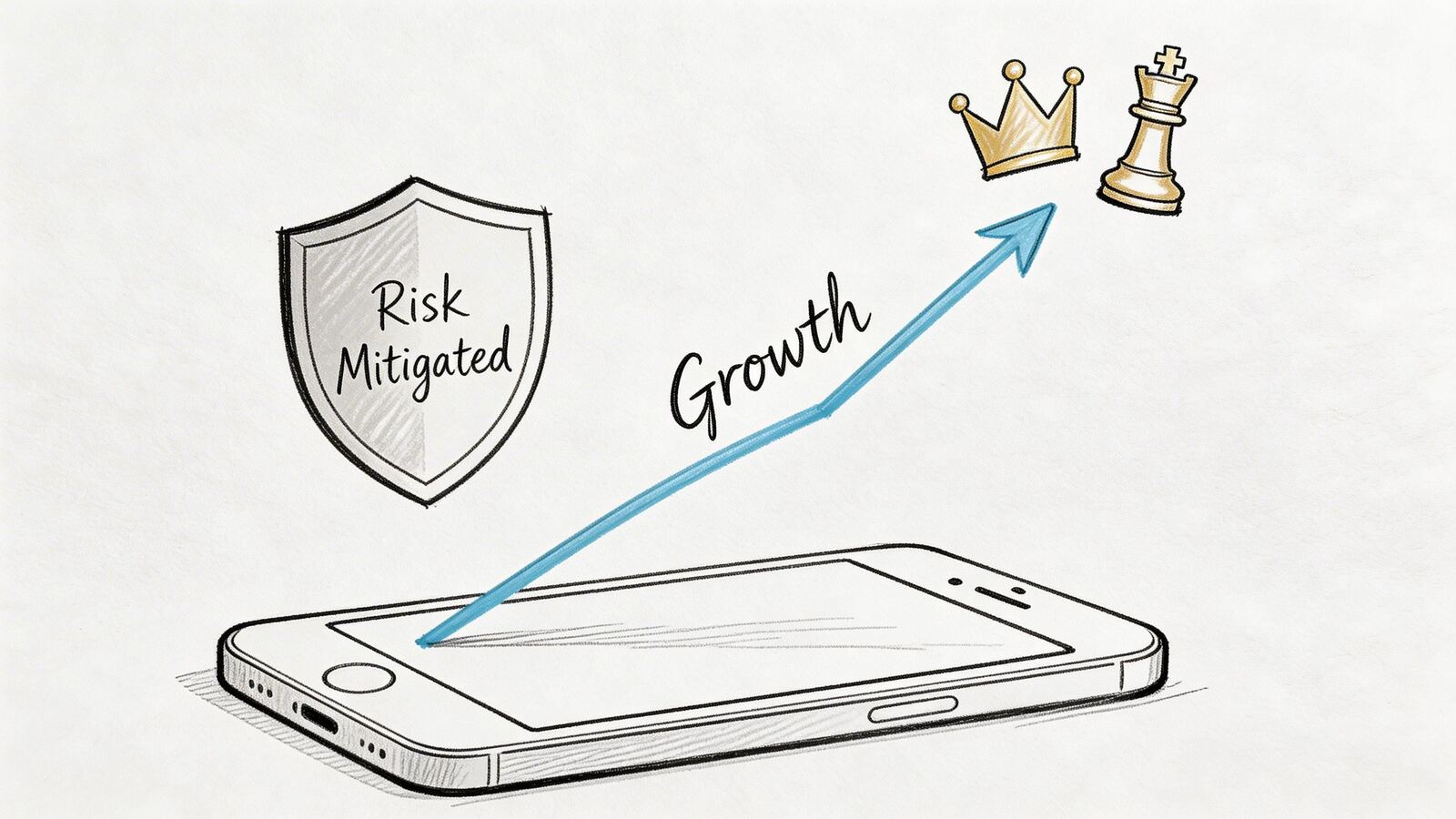
If your product handles internal workflows, business data, approvals, operations, reporting, or cross-team collaboration, you are not building software. You are engineering a technical asset that has to survive scale, scrutiny, and complexity. The market direction supports that view. The enterprise mobile application development market is projected to reach USD 189.22 billion in 2026, up from USD 168.45 billion in 2025, and cloud deployments captured 67.92% of global revenue in 2025, advancing at a 14.12% CAGR according to Mordor Intelligence.
That matters because investors do not fund feature lists. They fund systems that can compound.
Code must map to capital
Every founder should ask four blunt questions before approving any build:
-
Does this architecture scale cleanly if customer adoption spikes?
-
Can this system pass an investor audit without a rewrite story attached to it?
-
Will integrations become a moat or a recurring engineering tax?
-
Does each technical decision protect valuation or erode it?
If you cannot answer those questions, you are not managing product risk. You are accumulating it.
A useful companion mindset comes from operational governance. If you want a founder-friendly view of how leadership teams should think about uncertainty, controls, and exposure, read A Practical Guide to Enterprise Risk Management. Enterprise app development belongs in that same conversation because architecture choices create business risk long before finance notices it.
Shipping is not the goal
Shipping is a milestone. Asset creation is the goal.
That is why generic build shops underperform here. They optimize for delivery. A serious founder has to optimize for valuation, resilience, and strategic advantage.
Build the company’s core system like it will be inspected by a lead investor, a security reviewer, and a future VP of Engineering. Because it will.
If you want a broader view of how founders should think about software as a strategic asset rather than a one-off project, this perspective on https://www.buttercloud.com/blog/custom-software-development is directionally correct. The right question is never “How do we get an app built?” The right question is “How do we build something that appreciates in value and holds up under scrutiny?”
Enterprise vs Consumer Apps A Skyscraper Anology
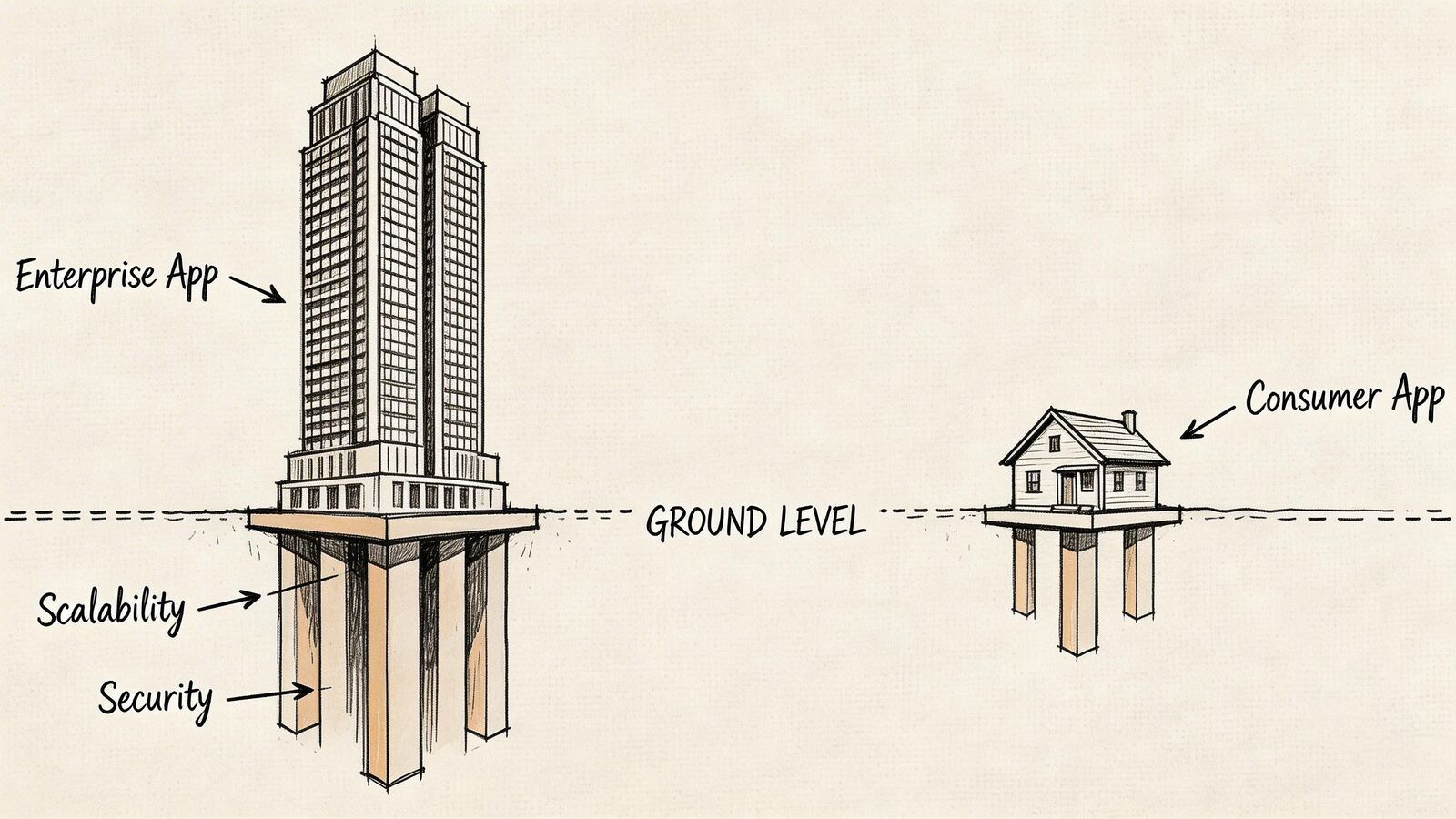
A consumer app is like a custom house.
An enterprise app is a skyscraper.
The house can look beautiful and still function with a simpler foundation. The skyscraper cannot. It needs structural depth, service corridors, fire systems, access controls, elevators, maintenance plans, and load assumptions that hold up under pressure. Enterprise app development works the same way.
What the house does not need
A consumer product can often get away with narrower assumptions:
-
Single user context with limited role complexity
-
Lightweight workflows where failure affects convenience, not operations
-
Minimal integrations with third-party systems
-
Loose governance around audit trails and permissions
If the house has a cracked tile, the owner complains. If the skyscraper’s elevator system fails, the building stops working.
What the skyscraper must support
Enterprise software carries operational weight. It has to support:
Requirement
Why it matters
Role-based access
Different users need different permissions across teams and functions
Audit trails
Leaders need to know who changed what, when, and why
System integrations
ERP, CRM, identity, payments, reporting, and internal tools must connect cleanly
Multi-tenancy
SaaS products serving multiple business customers need isolation and control
Data governance
Sensitive information must be handled consistently and defensibly
Reliability under load
Business processes cannot pause because usage increases
These are not “enterprise features” you sprinkle on later. They shape the foundation.
Hidden systems are the project
Founders often obsess over the visible layer. Screens, flows, onboarding, dashboards.
The hidden layer decides whether the app becomes a platform or a burden.
For enterprise app development, the hidden systems usually include:
-
APIs that let services communicate without brittle workarounds
-
Identity and access controls that keep data segmented
-
Logging and observability so the team can diagnose failures fast
-
Integration architecture so one client request does not turn into a custom engineering mess
-
Tenant-aware data models so growth does not corrupt customer boundaries
A house can be remodeled room by room. A skyscraper punishes bad structural decisions.
If your app supports business operations, assume that every shortcut in permissions, data design, or integration logic will return later as a board-level problem.
Why founders underestimate this gap
They compare enterprise app development to the last app they used as a customer.
That comparison is useless.
Consumer software is judged by delight and retention. Enterprise software is also judged by control, accountability, workflow fit, and operational trust. The buyer is not just asking, “Do users like it?” The buyer is asking, “Can my team rely on it without creating new risk?”
That is why enterprise products need deeper technical planning even when the first release has a modest feature set. You are not building one interface for one user path. You are designing a system that multiple departments, roles, and customers may depend on at the same time.
How Do You Architect for Valuation, Not Just Functionality?
Founders love to talk about features because features are visible.
Investors care about architecture because architecture predicts survival.
A weak product can sometimes improve with better execution. A weak architecture becomes a tax on every future release, hire, integration, and enterprise deal. In enterprise app development, architecture is not a back-office technical concern. It is a valuation instrument.
The technical foundation should be designed from inception to support horizontal and vertical scaling. That typically means API-driven patterns, containerization with Docker and Kubernetes, and cloud infrastructure such as AWS, Azure, or GCP. The point is not technical fashion. The point is controlled growth.
The architecture investors want to see
A serious architecture gives buyers, partners, and investors confidence that the business can scale without chaos.
That foundation usually includes:
-
API-first service boundaries so the mobile app, web app, admin tools, and external integrations are not welded together
-
Containers so deployments are consistent across environments
-
Cloud-native infrastructure so capacity can expand without a redesign
-
Caching layers such as Redis or Memcached for performance-critical workloads
-
Database indexing and query discipline so usage growth does not wreck responsiveness
-
Monitoring and alerting so the team can detect issues before customers escalate them
Those are not luxury items. They are operating requirements.
The cost of pretending architecture can wait
Applications designed without scalable architecture often hit major bottlenecks at 500+ concurrent users, causing 40-60% productivity loss and forcing architectural rewrites that consume 3-6 months of engineering cycles, according to OS-System.
That is the founder trap.
You save time early, then pay for it with delay, distraction, and a painful investor conversation later. No investor wants to hear that the team needs a major rewrite right after funding because the original MVP was not built to carry operational load.
Architecture choices that increase strategic impact
Use this lens when making technical decisions.
API design
If your product logic lives behind stable APIs, you gain flexibility. Mobile clients can evolve. Admin panels can expand. Integrations can plug in without tearing apart the core system.
Bad API design creates duplication and hidden dependencies. Good API design creates optionality.
Containerization
Docker and Kubernetes matter because they impose consistency. The app behaves the same way across development, staging, and production. That reduces deployment surprises and makes scaling less improvised.
A founder does not need to become a platform engineer. But the founder does need to insist on infrastructure choices that reduce operational randomness.
Cloud selection
AWS, Azure, and GCP are all valid. The right choice depends on customer requirements, team expertise, regional constraints, and future integrations.
What matters is that the decision supports:
-
enterprise-grade security controls
-
scalable compute and storage
-
clean CI/CD workflows
-
observability
-
room for compliance hardening
Do not pick a cloud because a freelancer is comfortable with it. Pick it because it fits the company’s long-term operating model.
Your architecture should make future growth cheaper, not more fragile.
What founders should demand in a technical review
Before approving a build, ask the team to show:
Review area
What you need to hear
Scalability plan
How the system handles rising users, tenants, and workflows
Data model
How customer data is isolated, queried, and governed
Deployment model
How code moves safely from development to production
Failure handling
What happens when dependencies slow down or break
Integration strategy
How external systems connect without custom hacks everywhere
If your team cannot explain those clearly, the product is not ready for serious enterprise use. It is not ready to be treated as a premium technical asset.
The Production-Grade MVP Strategy
The usual MVP advice tells founders to build the smallest thing possible.
That advice is incomplete.
You should build the smallest production-grade thing possible. Small scope is smart. Disposable architecture is not.
Prototype MVP versus production-grade MVP
Here is the key tradeoff:
| Approach | What it optimizes for | What it usually creates |
|—|—|
| Prototype MVP | Fast demo velocity | Rework, brittle integrations, weak security posture | Production-grade MVP | Durable learning on a stable base | Slower initial decisions, stronger long-term asset value |
A prototype MVP is often coded to prove a concept. A production-grade MVP is engineered so that the codebase can continue after traction appears. For a startup pursuing enterprise customers or serious funding, the second path is the only one I recommend.
Low-code is useful, but only under adult supervision
Low-code platforms are set to power 70% of new applications by 2025, and 84% of enterprises adopt low-code for speed, but without architectural oversight that speed can introduce technical debt that fails investor audits, according to Chop Dawg.
That is the correct way to think about low-code. It is a strategic tool, not a strategy itself.
Tools in this category can help with internal workflows, admin interfaces, and accelerated MVP delivery. They can also create a mess if the team treats visual builders as a substitute for system design.
Use low-code when it supports a clear architecture. Avoid it when it hides logic, weakens portability, or blocks future control.
What belongs in the first release
A production-grade MVP should include only the features needed to validate the thesis. But the foundation underneath those features must already be serious.
That means:
-
Authentication and permissions designed for future roles
-
A data model that will not collapse when new customers arrive
-
Basic observability so failures are diagnosable
-
A deployment pipeline that can support repeatable releases
-
Documentation discipline so the app is understandable beyond one developer
If you are still framing the MVP as “something we’ll probably rewrite later,” stop. You are planning a liability.
Build fewer features. Build them on permanent ground.
If you need a founder-focused perspective on scoping correctly, this guide on https://www.buttercloud.com/blog/build-an-mvp is worth reviewing. The right MVP is not the cheapest possible version. It is the first version that teaches you something while preserving the codebase as an appreciating asset.
Assembling Your Elite Technical Strike Team
A founder can survive with a scrappy team on a simple consumer app.
Enterprise app development is less forgiving.
The hidden complexity in permissions, integrations, infrastructure, compliance hardening, and operational reliability means the wrong team shape will hurt you before the codebase is large enough to look dangerous. Most startups do not fail here because they lacked effort. They fail because nobody with enough architectural judgment was in charge early.
The team you need
At the beginning, you do not need a bloated org chart. You need a compact team with senior judgment in the right places.
A strong early setup often includes:
-
Product-minded founder or operator who can define workflow priorities clearly
-
Senior engineer or architect who can make durable system decisions
-
Full-stack builders who can execute across frontend and backend without creating silos
-
DevOps support to establish deployment, monitoring, and environment discipline
-
QA discipline built into the process, even if there is no dedicated QA hire yet
What you do not want is a team of implementers waiting for requirements while nobody owns technical direction.
Why a fractional CTO changes the outcome
A key challenge is the shortage of developers skilled in cloud-native design and security. That gap is exactly why fractional CTO leadership matters for non-technical founders building investor-ready codebases, as noted by Coreflex Solutions.
This is the part founders often miss.
A fractional CTO is not just a translator between business and engineering. Done properly, the role creates alignment between:
-
business model
-
technical roadmap
-
hiring plan
-
architecture standards
-
investor due diligence readiness
Without that layer, developers default to local decisions. Local decisions create global problems.
Hire for strategic impact, not activity
Founders tend to overvalue visible output. Commits. tickets. velocity charts.
In enterprise app development, strategic impact comes from judgment.
A senior architect may write less code than a mid-level developer in a given week. That does not make the architect less valuable. It often means the architect prevented the team from building the wrong thing, the wrong way, on the wrong foundation.
Use these hiring filters:
| Role question | Good sign | Red flag |
|—|—|
| Can they discuss tradeoffs clearly | They explain why one approach fits the business better | They hide behind buzzwords | Do they think in systems | They connect product, infrastructure, and operations | They only focus on their layer | Can they document decisions | They leave behind clarity the next hire can use | Knowledge stays in their head | Do they understand enterprise constraints | They ask about permissions, auditability, and integrations early | They jump straight to UI and frameworks |
Your first technical hires should reduce uncertainty. If they only produce code, they are not enough.
What’s the Uncomfortable Truth About Costs and Timelines?
Most founders do not get bad outcomes because enterprise app development is impossible.
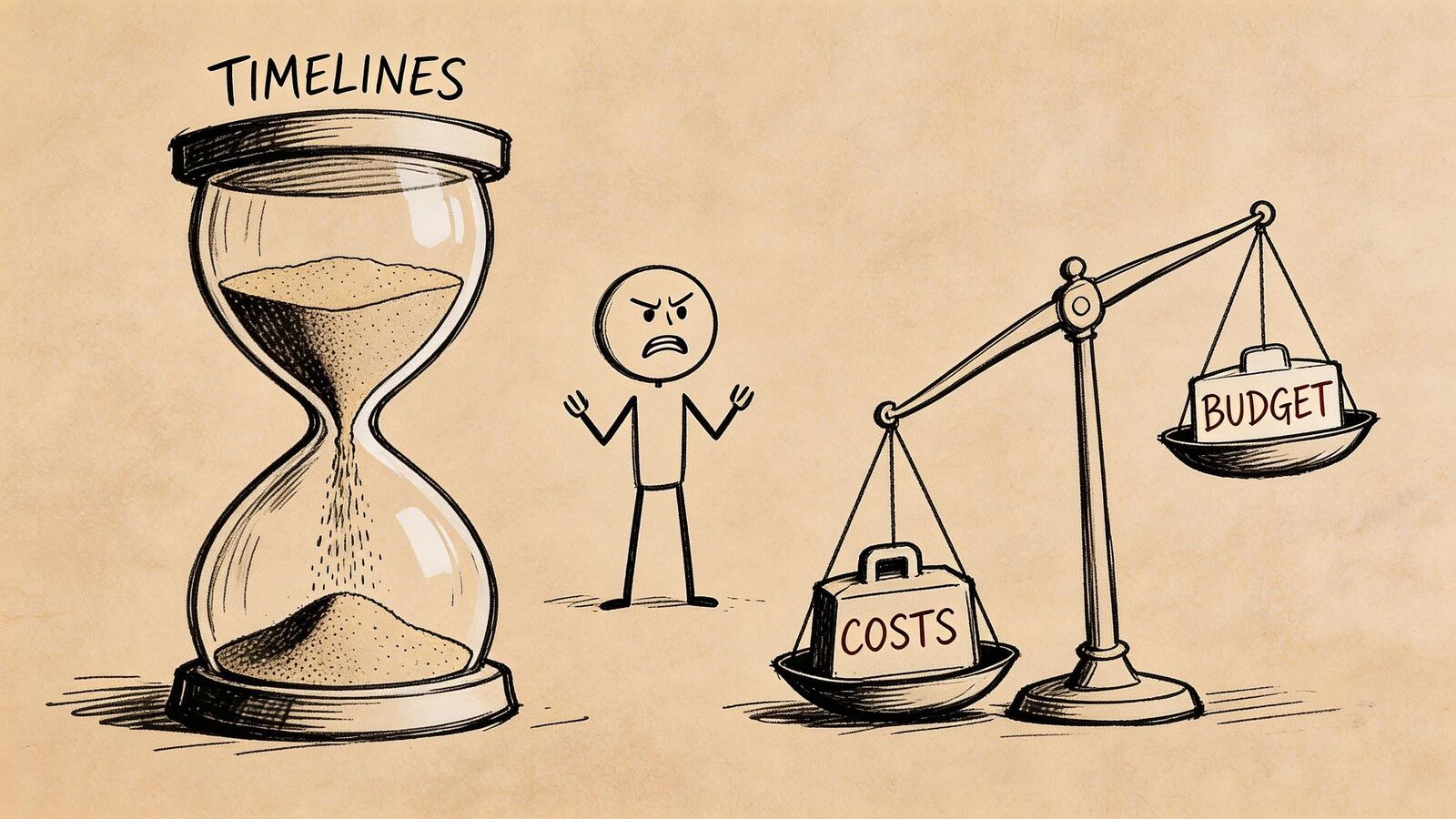
They get bad outcomes because they accept fantasy pricing and fantasy timelines.
Cheap quotes are usually missing the expensive parts. Integration complexity. security hardening. deployment discipline. documentation. observability. environment management. compliance work. Those are the parts that determine whether the product is a technical moat or a brittle prototype wearing a polished interface.
What drives cost
A founder should break cost into categories, not one lump sum.
Cost driver
Why it expands budget
Integrations
External systems rarely behave cleanly and often require custom handling
Permissions and workflow logic
Enterprise users need role-aware behavior, not generic screens
Infrastructure design
Stable environments, CI/CD, monitoring, and backups take real engineering time
Security and compliance
Hardening for data protection and regional requirements is specialized work
Documentation and handoff quality
If it is not documented, you are buying future confusion
A low quote often means one of those categories has been ignored.
Faster deployments are possible, but not automatic
Cloud platforms and DevOps automation can deliver 30-40% faster deployments, but only when an experienced team orchestrates them correctly. Compliance requirements such as PDPL and difficult legacy integrations complicate the path, which is why managed DevOps matters if you want an audit-ready posture, according to Cadabra Studio.
The founder lesson is simple. Tooling does not save you by itself.
You can buy AWS services, GitHub Actions, Docker pipelines, and monitoring tools. None of that guarantees operational maturity. Somebody still has to design the environments, define release discipline, enforce secrets management, and keep infrastructure costs from drifting.
If you are running on AWS, these top AWS cost optimization recommendations are a useful operational reference. Cost control should be built into your delivery process, not treated as cleanup after cloud spend surprises the finance team.
Time is shaped by decision quality
Bad timelines usually come from avoidable confusion:
-
The team starts coding before workflows are clarified
-
Integration assumptions are left untested
-
Infrastructure is treated as a final step
-
Security review happens after core choices are already embedded
-
Nobody owns technical prioritization
That is why senior oversight speeds things up. Not because senior people type faster, but because they reduce wrong turns.
The cheapest build is often the one that avoids the rewrite, not the one with the smallest initial invoice.
If you want a realistic budgeting view, ask any partner to separate feature work from infrastructure, compliance, and operational readiness. If they cannot do that, they do not understand the project well enough to price it responsibly.
What Belongs on the Investor-Ready Enterprise App Checklist?
Investors do not need your app to be perfect.
They need proof that the company is building on solid technical ground.
Use this checklist before any serious fundraising conversation, enterprise sales push, or leadership hire.
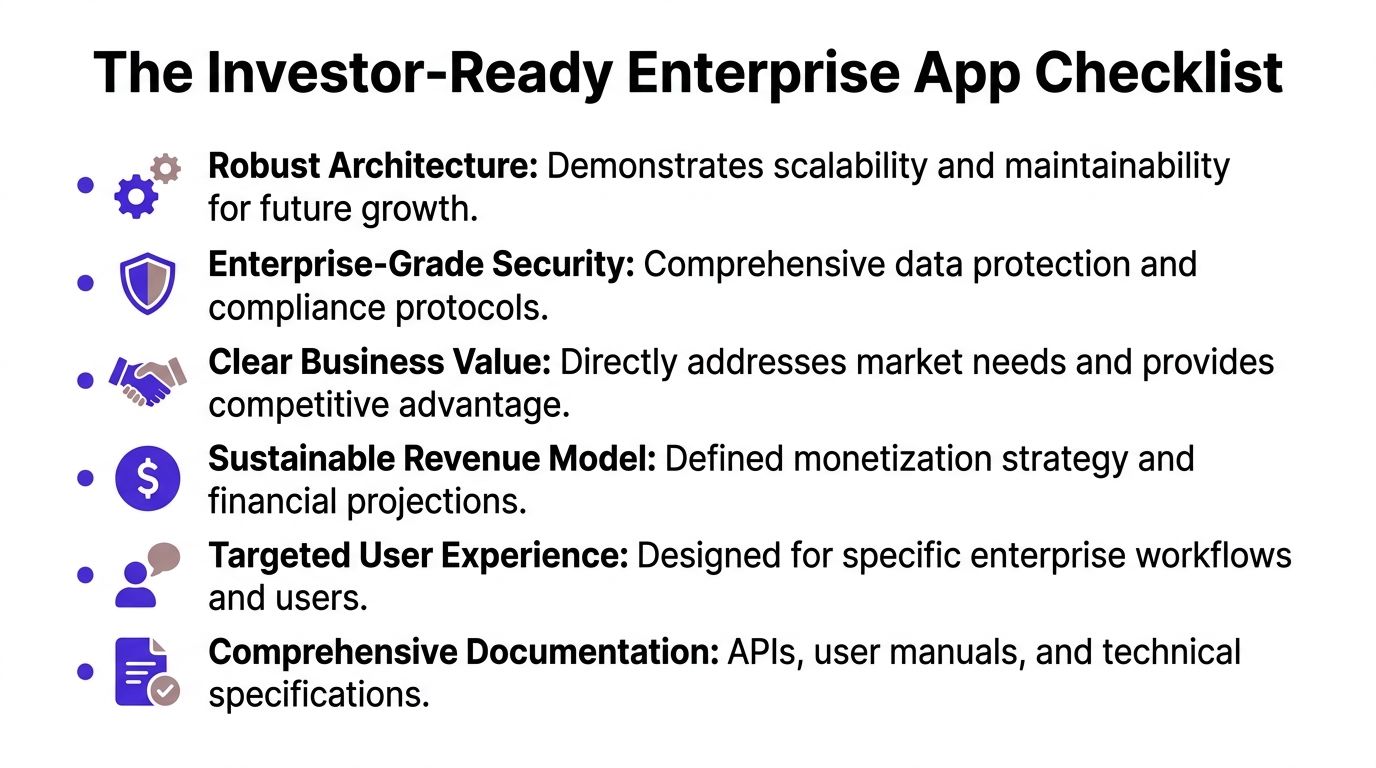
Architecture and scalability
-
Clear service boundaries. The app is not one tangled code blob.
-
A defined scaling plan. The team can explain how capacity grows with users, tenants, and data volume.
-
Stable deployment workflow. Releases are repeatable, controlled, and documented.
Security and compliance readiness
-
Role-based access is intentional. Permissions match business reality.
-
Audit trails exist where they matter. Sensitive actions are traceable.
-
Compliance posture is visible. The team knows what standards and regional obligations apply.
Code quality and operational maturity
-
Critical logic is documented. New engineers can understand the system without oral history.
-
Monitoring is active. The team can detect failures instead of waiting for customers.
-
Technical debt is acknowledged. There is a real list, not denial.
Business value and leadership alignment
-
The product supports a clear revenue logic. The codebase is tied to how the company wins.
-
Integrations are strategic. They strengthen retention, switching costs, or workflow fit.
-
Technical leadership exists. Someone owns the roadmap, the standards, and the hard tradeoffs.
A practical founder test
Walk through these questions with your team:
-
Can they explain the architecture in plain English?
-
Can they name the biggest technical risks without deflecting?
-
Can they show how the current system supports future growth?
-
Can they onboard a new engineer without chaos?
-
Can they defend the codebase in an investor audit?
If the answer to several of those is no, you are not holding a mature technical asset yet. You are holding a promising draft.
Frequently Asked Questions
How do I choose the right enterprise app development partner
Do not start with portfolio screenshots.
Start with architecture judgment. Ask how they handle APIs, role-based access, tenant separation, deployment workflows, observability, and compliance hardening. If they immediately jump to design tools or framework preferences, keep looking.
Should a startup build native, web, or cross-platform first
Choose based on workflow, not fashion.
If your users need device-specific performance or deep mobile behavior, native may be right. If speed, admin functionality, and broad accessibility matter more, web can be the better first asset. Cross-platform can work well when the architecture underneath is strong and the team understands its tradeoffs.
When should I worry about compliance
At the start.
Not because you need every policy finalized on day one, but because early architecture decisions affect data handling, permissions, logging, and infrastructure choices. Retroactive compliance is expensive and messy.
Can I use freelancers for enterprise app development
You can use freelancers for narrow execution tasks.
You should not rely on disconnected freelancers to define enterprise architecture, security posture, and investor-audit readiness. Enterprise products need ownership and continuity.
What should I ask in a technical diligence rehearsal
Ask your team to explain:
-
system architecture
-
deployment process
-
security controls
-
scaling plan
-
integration model
-
known risks
-
documentation quality
If the answers are vague, your investors will notice the same problem.
Scoping the budget for something at this scale? Our free MVP Cost Calculator is a useful starting reference before that conversation.
Buttercloud helps founders turn ideas into investor-ready MVPs and scalable technical assets. If you need a partner who can combine elite product engineering, Fractional CTO guidance, and audit-ready infrastructure, visit Buttercloud.
Have a product idea to talk through?
We'll show you how we'd approach it — no pressure, just a real conversation.
Book a Discovery Call