Market Primary Research for Your MVP

Founder & CEO, Buttercloud

A founder usually reaches the same uncomfortable moment right before real spending begins. The prototype is still a sketch. The feature list keeps growing. An engineer asks the only question that matters. What evidence do we have that this solves a painful problem for a buyer who will pay?
Organizations often respond with secondary evidence. Competitor screenshots. A few market maps. A slide with broad trends. That material has value, but it doesn’t de-risk the build. It only proves that a category exists.
Market primary research is what turns a startup idea into an engineering decision. It gives you direct signal from the people you want to serve. For an MVP, that signal should shape scope, architecture, feature order, onboarding flow, and even what you deliberately refuse to build.
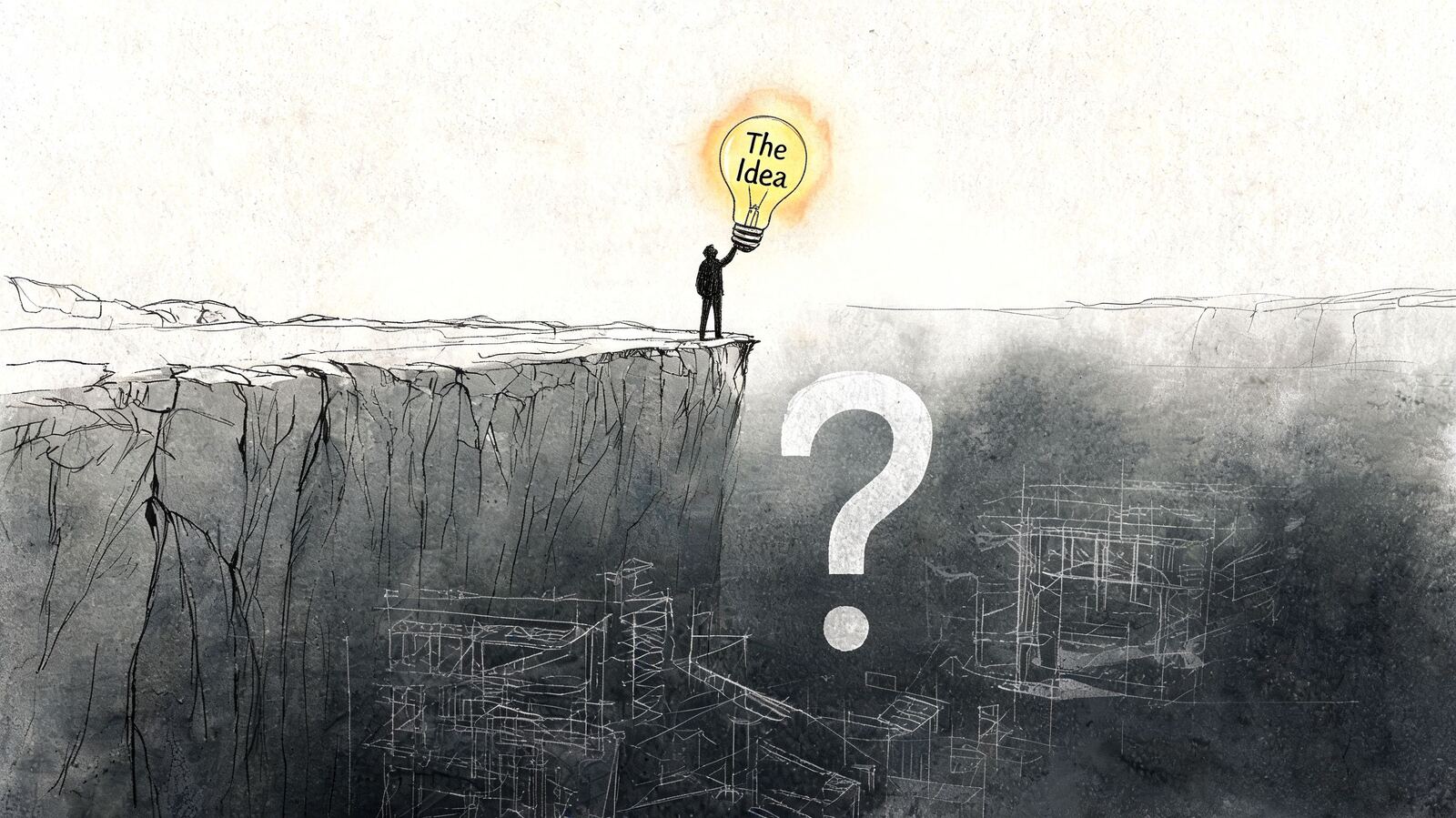
Why Are You Still Building in the Dark?
A founder approves the first sprint. Two engineers start scoping integrations. Design begins polishing screens. Then one simple question stalls the room. Which user will change behavior fast enough to make this MVP worth building?
That question is not a marketing question. It is a build-risk question.
A lot of founders confuse conviction with evidence. Conviction fills a roadmap with plausible features. Evidence narrows the build to the one workflow buyers will switch for, trust first, and pay to keep. That difference shows up in architecture, scope, security requirements, onboarding, and how much custom logic the first release needs.
In Buttercloud-style discovery work, the strongest product decisions happen before tickets exist. If the team still cannot name the buyer, the painful moment in the workflow, and the minimum proof needed to earn trust, engineering should pause and run a proper project discovery process.
Primary research gives founders direct input they can use to make technical decisions with less waste. It helps answer questions that show up in diligence and in sprint planning at the same time:
-
Problem severity: Is the pain frequent and expensive enough to justify a new product?
-
Buyer specificity: Which role owns the problem, feels it first, and has influence over budget?
-
Workflow constraints: What tools, approvals, exports, and handoffs shape the current process?
-
Trust requirements: What has to work on day one before a customer will rely on this product?
-
Roadmap discipline: Which feature gets adoption started, and which ideas only add build cost?
I use a simple test. If a research question cannot change scope, sequencing, architecture, or go-to-market timing, it probably does not belong in early MVP research.
Founders also need clean evidence categories. Interviews, field observations, usability sessions, and direct surveys are primary sources of information because they come from the market itself, not from someone else’s summary of it. That distinction matters when an investor asks how the team knows this wedge is real and why the first version is intentionally narrow.
The practical takeaway is blunt. Investor-ready code starts with investor-ready evidence. Skip that work, and the team still learns. It just learns by burning runway on the wrong build.
Primary vs Secondary Research: Which Should Guide a Founder’s Calculus?
A founder has six weeks of runway before the MVP spec freezes. One path starts with analyst reports, competitor sites, and market maps. The other adds direct calls with buyers, workflow reviews, and prototype reactions from the people who would use or approve the product. Both paths produce documents. Only one gives evidence strong enough to change architecture, scope, and investor answers before code hardens.
Secondary research is useful because it gets a team oriented fast. It helps define the category, identify incumbents, learn the language buyers already recognize, and avoid proposing a product that ignores obvious market constraints. I use it first for context, not for conviction.
Primary research is what I trust when the team has to make expensive decisions. It exposes the friction hidden underneath the category summary: who owns the pain, where procurement slows adoption, what data has to integrate on day one, and which requirement sounds small in a pitch deck but drives major technical complexity in the build.
A clean distinction matters here. Interviews, field observation, usability tests, and surveys are primary sources of information because they come from the market directly. Analyst reports, industry articles, competitor teardowns, and public benchmarks are secondary because someone else has already filtered and framed them.
What secondary research does well
Use secondary material to answer orientation questions quickly.
-
Category framing: How the market defines the problem
-
Competitor inventory: Which vendors cover adjacent use cases
-
Terminology: What buyers, operators, and analysts call the workflow
-
Market baseline: Which assumptions are already common, stale, or weak
That work saves time. It stops a team from walking into interviews with naive language or missing standard expectations in the category.
Where primary research earns the extra effort
Secondary sources summarize what is already visible. Primary research captures what is still emerging inside real workflows. That difference matters in early-stage product work because startups do not win by reproducing consensus. They win by seeing a constraint, buying trigger, or implementation gap before larger vendors package it into roadmap copy.
I have seen this play out in crowded B2B categories. Founders copy the visible feature set from incumbent products, then wonder why pilots stall. The problem is rarely feature count. It is usually a mismatch between what the buyer says publicly and what the operator needs privately to switch. Primary research catches that gap early enough to change the build.
The actual trade-off
This is a capital efficiency decision.
Research type
Best use
Main strength
Main limitation
Secondary research
Market orientation
Fast context
Generalized and often delayed
Primary research
MVP validation
Direct decision-grade evidence
Takes planning, recruiting, and disciplined synthesis
The sequence matters more than the label:
-
Start with secondary research to learn the category and sharpen your hypotheses.
-
Shift to primary research as soon as product scope, workflow design, or technical architecture is on the table.
-
Weight primary evidence more heavily when deciding what to build now, what to defer, and what proof investors will ask for in diligence.
-
Return to secondary research to benchmark your findings against the broader market and refine positioning.
Founders often ask which one is better. That is the wrong question. Secondary research reduces ignorance. Primary research reduces product risk.
If the goal is an investor-ready asset, this distinction is not academic. VCs do not just evaluate whether a market exists. They evaluate whether the team has evidence that the first wedge is real, the MVP is intentionally scoped, and the technical roadmap follows buyer truth instead of founder intuition.
The Lean MVP Research Toolkit
A founder has two engineers, twelve weeks of runway for the next milestone, and a product idea that sounds plausible in pitch meetings. The wrong research method can burn half that time and still leave the hardest decisions unresolved. The toolkit matters because each method answers a different product risk.
Founders do not need a large research function. They need a compact set of methods, used in sequence, with each one tied to a build decision, an architecture choice, or a proof point investors will inspect in diligence.
Three methods that matter most
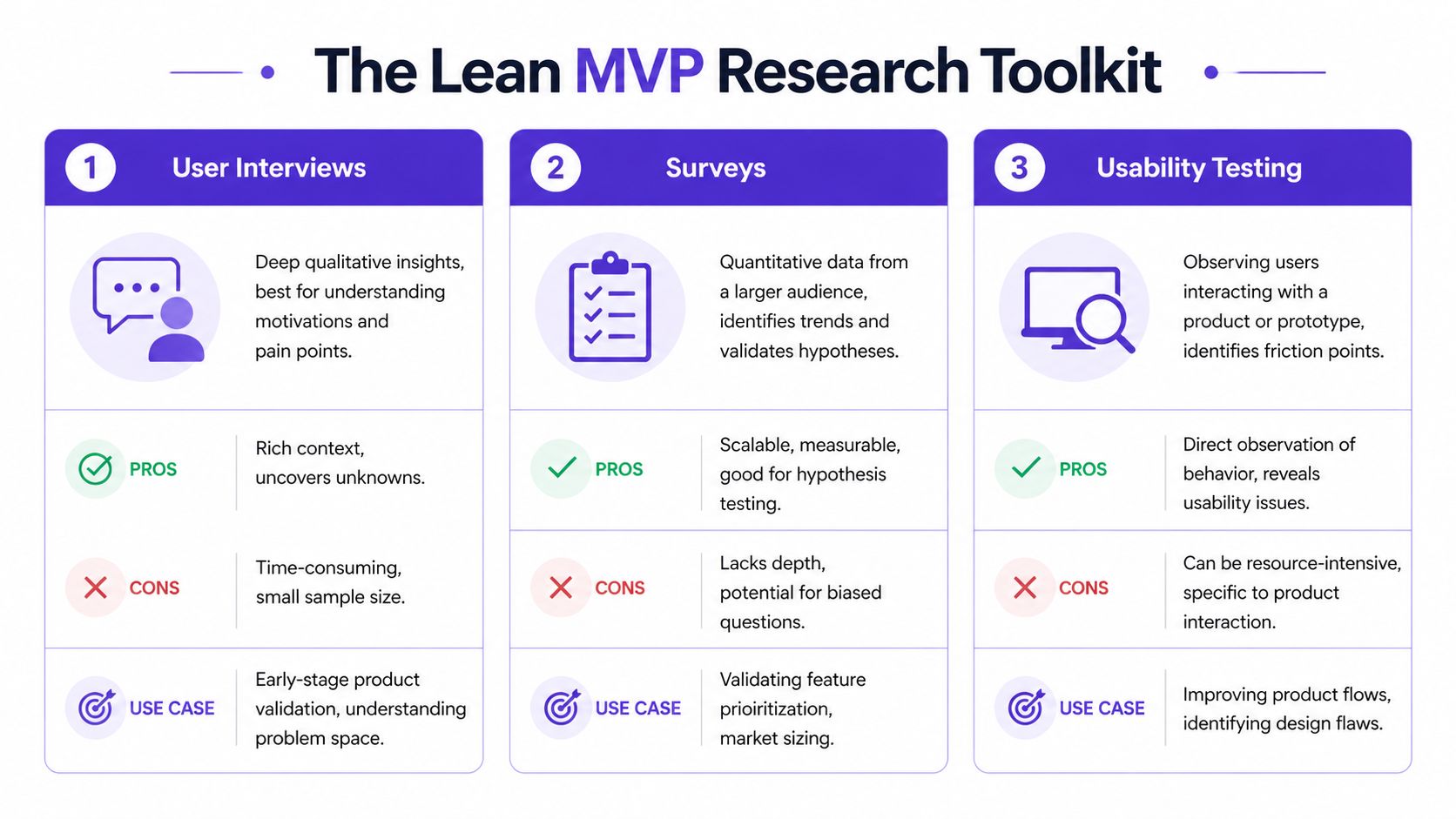
For early MVP work, three methods carry most of the load: interviews, surveys, and observation. Used properly, they reduce different kinds of risk.
User interviews
Interviews are the fastest way to pressure-test whether the problem is painful enough to change behavior. They expose motivation, workflow constraints, budget ownership, internal politics, and the language buyers use when they describe the issue to colleagues.
Use interviews when you need answers to questions like:
-
Is the pain sharp enough to justify a switch
-
Which role feels the problem first and which role approves spend
-
Why current tools, spreadsheets, or manual workarounds still survive
This is not soft insight. It is product input. If interviews show the problem is tolerated rather than urgent, the MVP scope should shrink or the wedge should change. If they reveal that trust, auditability, or approvals matter more than speed, that affects both feature priority and system design.
Surveys
Surveys help after interviews have already exposed the likely patterns. At that point, the job is less about discovery and more about measuring prevalence, ranking priorities, and spotting differences between segments.
Good survey work is disciplined. It tests hypotheses that came from calls, not assumptions lifted from the founder’s roadmap. Teams looking for actionable market research for growth teams often make the same mistake early founders make. They ask broad opinion questions instead of questions tied to an actual decision.
Use surveys when you need to know:
-
Which pain points recur across a defined segment
-
How needs differ by role, company size, or workflow maturity
-
Which proposed capabilities belong in version one versus a later release
Surveys save time in analysis, but only if the question set is narrow. A weak survey gives a false sense of certainty with cleaner formatting.
Observational studies and usability testing
Observation catches what interviews miss. People often describe an idealized workflow. Screen sharing through a live task, a spreadsheet workaround, or a rough prototype shows the sequence, the handoffs, the missing context, and the points where trust breaks.
For an MVP team, this method is especially useful before heavy frontend work or backend integration work. Watching a target user complete a task can prevent weeks of engineering on flows they do not understand, permissions models they do not trust, or automations they will never turn on.
Use observation and usability testing to examine:
-
Workflow friction
-
Comprehension and decision points
-
Hidden dependencies, approvals, and side-channel workarounds
Watch for pauses, workarounds, and requests for reassurance. Those signals usually point to design gaps or system assumptions that will surface later as churn.
Lean Research Methods for MVP Validation
Method
Best For
Key Output
Lean Cost/Time (Est.)
User interviews
Validating problem severity, switching triggers, and buyer language
Pain themes, objections, approval dynamics, purchase context
Low cash cost, moderate founder time
Surveys
Testing pattern strength across a larger sample
Prioritized needs, segment comparisons, structured response data
Low to moderate cash cost, faster synthesis if scoped well
Observational studies or usability testing
Exposing workflow friction and product misunderstanding
Friction map, task failures, trust gaps, redesign priorities
Moderate coordination effort, high product value
What works and what fails
What works:
-
Interviews before broad quant
-
Observation before polish
-
Short research cycles tied to the backlog
-
Questions mapped to one decision at a time
What fails:
-
Long surveys built on untested assumptions
-
Feature wishlists from friendly contacts who will never buy
-
Unmoderated feedback with no segment control
-
Research notes that never change scope, sequencing, or architecture
The practical test is simple. If a method does not help the team decide what to build, what to delay, or what proof to carry into investor conversations, it is overhead. If it changes roadmap priority, narrows the MVP, or prevents avoidable rework, it is doing its job.
Designing a High-Signal Research Study
A founder runs eight interviews, hears polite enthusiasm, and greenlights a feature set. Six weeks later, the prototype still does not fit the buyer’s workflow, and the team has burned sprint capacity on the wrong assumptions. That is what weak study design costs.
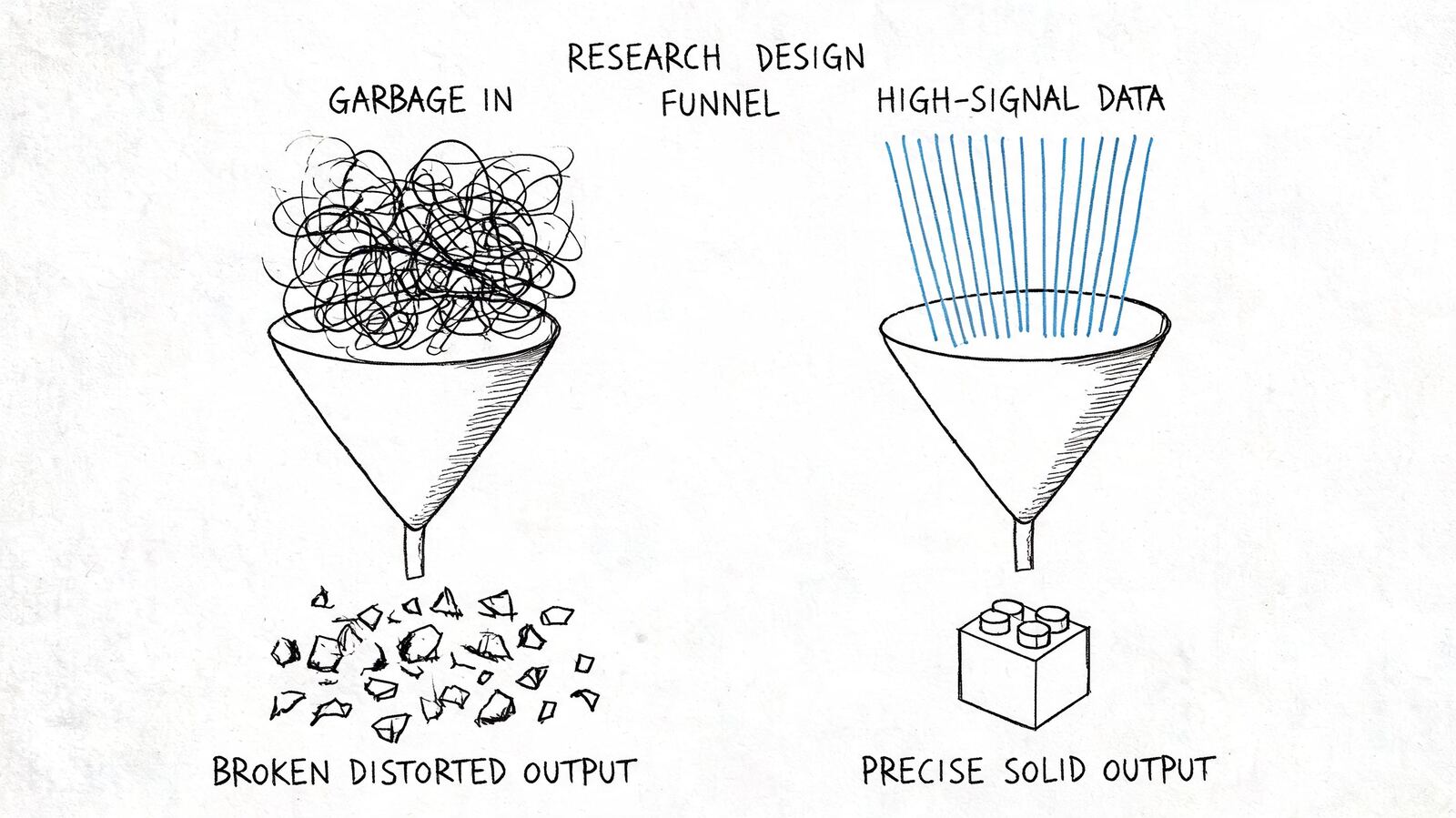
A high-signal study is built to answer one product or engineering decision at a time. If the goal is vague, the output will be vague, and vague research does not help a team choose scope, architecture, or sequencing.
Start with a decision the team can act on this sprint
Anchor the study to a live decision, not a general curiosity.
Good research prompts sound like this:
-
Should the MVP serve operators or managers first?
-
Is the bottleneck data entry, reporting, or approvals?
-
Do early users care more about automation, audit trails, or system interoperability?
-
Will compliance constraints force a different architecture than the team planned?
Each question has an execution consequence. It can change the first user persona, the data model, the integration plan, or the backlog.
“Understand the market better” does none of that.
Write prompts that surface behavior, not approval
Founders often ask questions that invite validation. The participant nods, says the idea sounds useful, and leaves the team with opinion data that cannot survive diligence.
Use prompts that force recall:
-
Walk me through the last time this problem happened
-
What broke first
-
What did you try before looking for a tool
-
Who had to approve a change
-
What made the current workaround unacceptable
Those answers expose trigger events, constraints, and workarounds. That is the raw material for MVP design.
If you want sharper examples, this guide on actionable market research for growth teams is useful because it focuses on question design that produces decision-grade input.
Field note: Once a participant starts describing a real incident with dates, tools, and stakeholders, the interview becomes far more useful to product and engineering.
Build segmentation around risk
Segmentation is not a branding exercise. It is how a startup avoids designing for an average user who does not exist.
MarketResearch.com explains why primary research matters and notes that survey-based primary research can support granular segmentation across factors like age, income, and geography. For MVP work, that is only part of the picture. Demographics may help with market framing, but behavioral and operational differences usually matter more in early product decisions.
Use segments that map to product risk:
-
Demographic or firmographic: role, team size, industry, geography
-
Behavioral: current tools, workflow frequency, switching history, usage intensity
-
Operational context: approval chain, security requirements, compliance burden, budget owner
-
Technical environment: source systems, integration dependencies, reporting stack, data sensitivity
This is how a founder avoids false consensus. A manager at a 20-person startup and an operator inside a regulated enterprise may report the same pain, but they often require very different product choices.
Keep the instrument short enough to preserve signal
Long instruments create fatigue and muddy the data. Early-stage teams do better with studies that are easy to run, easy to review, and tightly linked to one decision.
For interviews, a practical structure is:
-
Start with role and workflow context.
-
Ask for a recent, concrete incident.
-
Probe for consequences, workarounds, and decision criteria.
-
Test reactions to alternative approaches without pitching a finished solution.
For surveys, keep the bar just as high:
-
Use plain language: write in the participant’s vocabulary, not the team’s internal shorthand
-
Keep answer choices clean: remove overlap and vague scales
-
Limit open text: use it where nuance matters, not on every screen
-
Pilot first: send the draft to a small group and fix anything they misread or skip
Tooling should stay lightweight. Google Forms, Typeform, Tally, Calendly, Zoom, Notion, Dovetail, and Airtable are enough for many early studies. Buttercloud can also support user analysis and market review during discovery when research findings need to feed directly into technical scoping. The rule is simple. Use the lightest stack that preserves clean evidence, traceable notes, and fast synthesis into roadmap decisions.
Recruiting Your First 50 Research Participants
Most founders don’t have a research problem. They have a recruitment problem.
They know they should talk to users, but they don’t know where to find the right ones without spamming friends, begging warm contacts, or attracting the wrong audience. The solution is to recruit in layers.
Start with the closest credible access
Your first participants should come from places where trust is already available.
That includes:
-
Warm network edges: former colleagues, founders in your circle, advisors, and customer intros
-
Existing audience: newsletter subscribers, waitlist signups, demo requests, or community members
-
Relevant communities: focused LinkedIn groups, niche Slack spaces, Reddit communities, and industry forums
Warm access is best for the first handful of interviews because speed matters early. You don’t need perfect scale yet. You need fast pattern recognition.
Build a tiered recruitment motion
By the time you need broader signal, move to a more deliberate process.
For the first five participants, ask for direct introductions and keep the ask narrow. A short message with a clear topic gets better responses than a generic “can I pick your brain?”
For the next set, post targeted calls inside communities where your users already trade advice. Explain who you’re looking for, what topic you’re researching, how long it takes, and what they’ll receive in return.
For wider reach, use targeted outreach through LinkedIn or small paid social campaigns pointed at a screener form. The goal isn’t volume for its own sake. It’s fit.
Keep operations simple
Recruitment breaks down when logistics get messy.
Use a simple stack:
-
Scheduling: Calendly or SavvyCal
-
Forms: Tally, Typeform, or Google Forms for screening
-
Consent and note capture: Notion, Airtable, or a lightweight CRM
-
Incentives: gift cards, product access, or direct reimbursement tools such as Tremendous
People will give you better data when you respect their time, explain the purpose clearly, and close the loop after the session.
The first fifty participants don’t need to arrive in one wave. They should come in cohorts. Recruit, learn, adjust your questions, then recruit again. That’s how signal compounds without wasting outreach.
How Do You Turn Raw Data Into a Technical Roadmap?
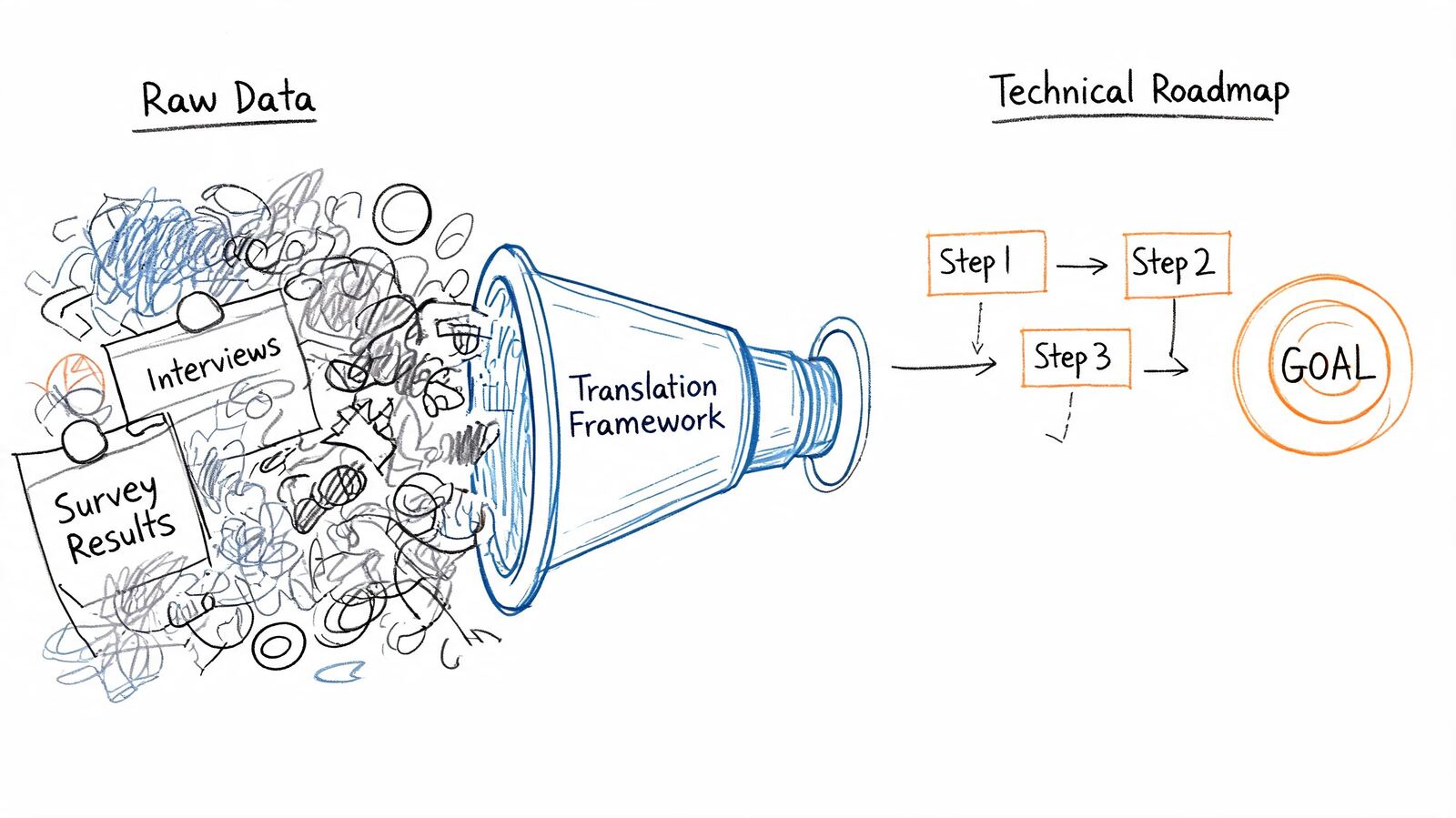
A founder finishes ten interviews, drops the transcripts into Notion, highlights a few sharp quotes, and then the team goes back to arguing about features. That is how research dies. It never reaches architecture, scope, or sequencing.
Primary research earns its keep when it changes what gets built, what gets deferred, and what technical risk gets removed before code hardens into cost.
Start with coding, not summary
Summaries flatten signal. Coding preserves structure.
For interview data, use a simple sheet with fields such as:
-
Pain point
-
Trigger event
-
Current workaround
-
Consequence of failure
-
Desired outcome
-
Mentioned tools or competitors
-
Intensity
-
Buyer or user type
That last field matters. Early-stage teams often overvalue frequency and undervalue fit. If five ideal buyers describe a painful, expensive failure mode, that can matter more than fifteen loose matches describing a mild annoyance.
If your team needs a practical walkthrough for turning transcript chaos into usable themes, this practical guide to analyzing interview data is a solid reference.
Rank findings by engineering consequence
Once patterns show up, sort them by what they mean for the product, not just by how often they appeared.
I usually score each theme across four lenses:
Lens
What to ask
User pain
Does this block adoption, expansion, or retention?
Frequency
Does this happen often enough to deserve product time?
Strategic fit
Does solving it support the wedge you want to own?
Build complexity
Can the team implement it cleanly in the current system without creating avoidable debt?
Founder discipline becomes apparent. A request can be real and still be wrong for the MVP. If the fix requires brittle integrations, custom workflows, or a permissions model you are not ready to support, the right answer is often “later” or “manually for now.”
Convert themes into build decisions
Research is useful only after it becomes a constraint on the roadmap.
Weak translation: “Users want a better experience.”
Useful translation:
-
Import flow must support one-step CSV intake because operations teams do not trust manual re-entry
-
Approval workflow needs visible status states because handoffs disappear between departments
-
Dashboard work should wait because early users care more about exception handling than reporting
-
Auth can start with passwordless email links if procurement is not requiring SSO at MVP stage
Those are engineering decisions. They affect schema design, queueing, audit trails, interface states, and delivery order. They also give investors something they can inspect during diligence: a product scope that traces back to observed demand instead of founder opinion.
Feed the roadmap with live evidence
Digital tools have made primary research easier to collect, tag, and revisit over time, as described in Dovetail’s overview of market research evolution. The practical implication is simple. Post-launch research can run on a tight operating loop instead of a large, infrequent study.
Add lightweight feedback inside the product. Tag support tickets by workflow and failure type. Review onboarding sessions. Run short interview rounds after meaningful releases. Then update backlog priorities, architecture assumptions, and instrumentation based on what users struggled to do.
For teams that need a repeatable method to connect user evidence to sequencing, system choices, and diligence-ready planning, a structured technology strategy consulting approach helps turn research into decisions the engineering team can execute.
If a finding cannot be mapped to scope, sequence, or system design, it may still be interesting. It is not roadmap material yet.
Research Is Not a Phase It Is Your Co-Pilot
The most expensive mistake isn’t skipping research entirely. It’s treating it like a box to check before “real work” begins.
Primary research is real work. It reduces false starts, sharpens scope, and gives your engineering team permission to build less, but build the right less. That’s how strong MVPs become credible assets instead of disposable experiments.
Keep the discipline simple. Run interviews before major roadmap bets. Revisit assumptions after onboarding changes. Watch how users behave, not just what they claim. Use every cycle to improve the next one.
Do one thing today. Schedule your first three conversations.
A simple outreach note works:
Hi [Name], I’m researching how [role] currently handle[s] [specific workflow/problem]. I’m not selling anything. I’m trying to understand what’s broken, what tools people use today, and where the process fails. Would you be open to a 30-minute call next week? Happy to offer a small thank-you for your time.
That email is often the difference between founder mythology and product truth.
Once you’ve got real evidence from those conversations, our free MVP Cost Calculator helps turn scope into an actual budget number.
If you’re building from idea to investor-ready MVP and want research translated into product scope, architecture, and a roadmap that can survive diligence, Buttercloud works as a technical partner across discovery, MVP engineering, and fractional CTO leadership. The focus is simple. Turn market evidence into production-grade decisions.
Have a product idea to talk through?
We'll show you how we'd approach it — no pressure, just a real conversation.
Book a Discovery Call