
Mastering the Project Discovery Phase for MVP Success
Most startup advice on MVPs is still wrong.
“Move fast” became “build before you think,” and founders absorbed the worst version of that message. They rush into design files, sprint plans, and outsourced code before they’ve proved the product deserves to exist, before they’ve tested the model, and before they’ve decided what kind of technical asset they’re creating.
That’s how founders end up with a demo that works, a codebase that doesn’t scale, and investors who walk away after technical diligence.
A project discovery phase is not admin. It is not paperwork. It is not a polite prelude before “real work” starts. It is the point where a startup stops behaving like an idea and starts behaving like a company.
If you want investor confidence, you need more than an MVP that can be shown. You need an MVP that can be defended. Discovery is where that happens. It’s where you turn assumptions into decisions, product ambition into scope, and technical uncertainty into an architecture someone can fund.
Building an Asset Not Just an App
Founders often ask the wrong question at the start.
They ask, “How fast can we build?” The better question is, “What are we building that will still look credible under investor scrutiny?” Those are not the same thing.
A weak discovery process produces an app-shaped object. It may have screens, user flows, and a launch date. But it won’t necessarily have a clear market case, a coherent technical foundation, or a roadmap that survives pressure once users, partners, or investors start asking hard questions.
A disciplined project discovery phase changes the entire outcome. It forces you to define the business problem before you pay to solve it. It narrows the product to the features that matter. It surfaces architectural constraints before your team hardcodes them into the business. It creates evidence that your decisions were intentional.
Practical rule: If your MVP plan can’t explain why this product should exist, who needs it, and how the system should scale, you’re not ready to build. You’re ready to guess.
That distinction matters because valuation isn’t driven by code volume. Investors care about whether the product solves a real problem, whether the team understands the market, and whether the technology can become a durable advantage instead of future cleanup work.
Discovery is where you build that foundation.
Here’s the mindset I want founders to adopt:
Treat scope as a strategic weapon: Smaller, sharper MVPs are easier to validate and easier to defend.
Treat architecture as company value: Early technical choices affect hiring, speed, reliability, and diligence outcomes later.
Treat documentation as an asset: Clear requirements, prototypes, and architecture artifacts reduce ambiguity for both builders and investors.
Treat discovery as a filter: It should kill weak assumptions before they consume capital.
If you skip this stage, you’re not saving time. You’re borrowing risk at a terrible rate.
What Is a Project Discovery Phase Really
The cleanest way to understand a project discovery phase is to stop thinking like a startup operator for a moment and think like an architect.
Nobody sane starts building a skyscraper by pouring concrete and deciding the floor plan later. They produce a blueprint, test assumptions, model constraints, and make sure the structure can stand. Software founders should operate the same way.
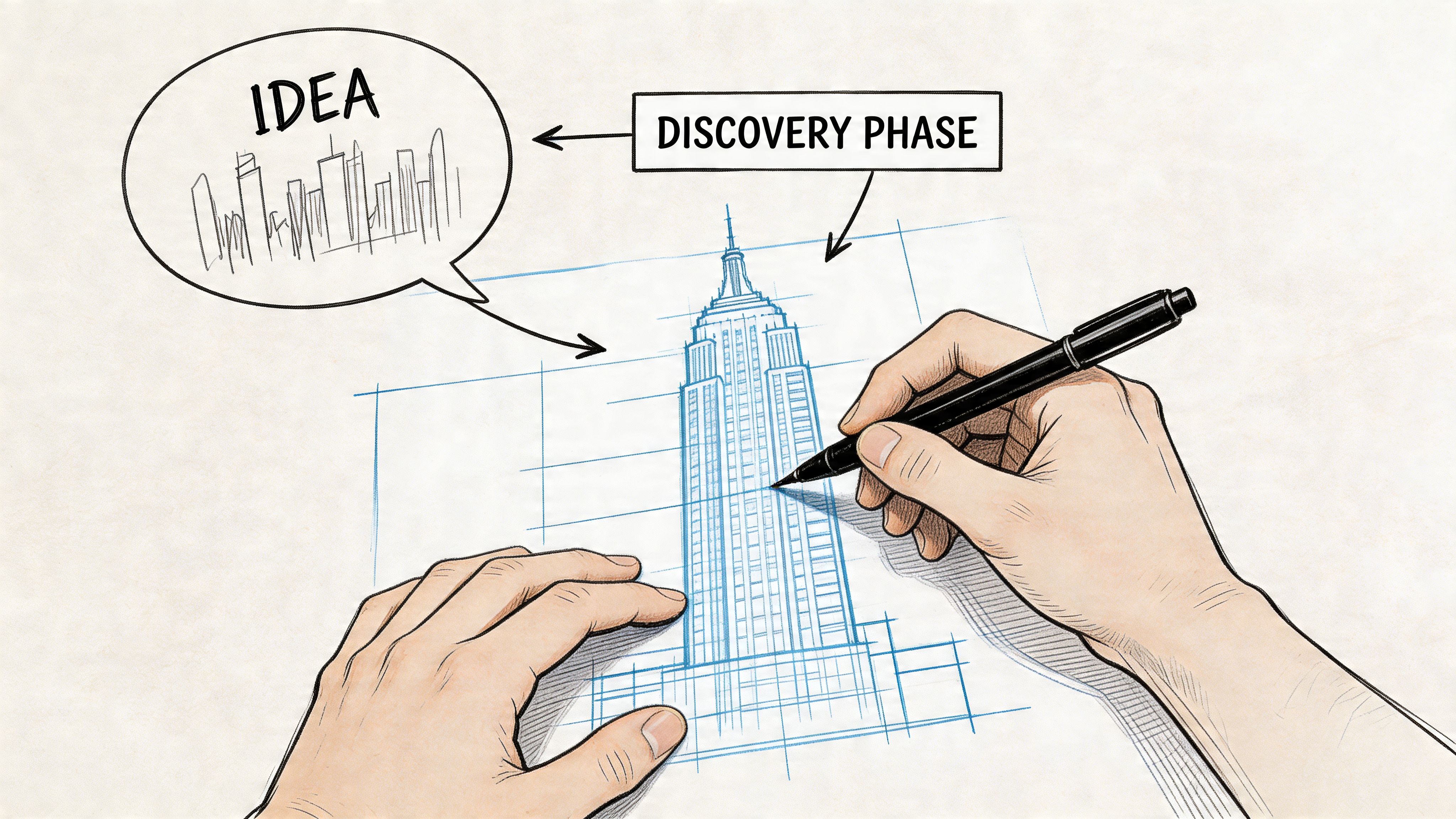
The blueprint behind the product
A real discovery phase translates a founder’s vision into a buildable system. That means more than collecting feature ideas in Notion or writing a loose brief in Google Docs.
It usually includes:
Business clarification: What problem are you solving, for whom, and why now?
User analysis: Which workflow or pain point is urgent enough to change behavior?
Market review: What alternatives already exist, and where is your product differentiated?
Technical definition: What architecture, integrations, and constraints shape the MVP from day one?
Delivery planning: What should be built first, what can wait, and what will it cost in realistic terms?
A lot of founders call this “scoping.” That undersells it. Scoping is only one output. Discovery is the decision system that produces the scope.
Why this phase became non-negotiable
Historically, this phase gained weight because software teams kept learning the same expensive lesson. One example often cited is the 1994 Knight Capital meltdown, where a $440 million loss in 45 minutes followed unvetted code changes, a reminder of what happens when rigor disappears early in the process, as noted in Tekla’s discussion of why project discovery is so vital. The same source notes that by 2018, 42% of startup failures were tied to no market need.
That’s the shift founders need to understand. Discovery started as a way to reduce software failure. In startups, it evolved into something more important: a way to validate whether the company is pointing its capital at a real opportunity.
Discovery is where you decide whether the startup is building a business, or just building software.
If you’re trying to launch a successful SaaS product, this matters even more. SaaS punishes vague thinking. Weak onboarding, poor positioning, rushed architecture, and unclear retention loops don’t stay small problems for long. They become structural weaknesses.
A proper project discovery phase gives founders a much more useful outcome than a generic requirements list. It gives them a blueprint investors can understand, engineers can execute, and the market can respond to.
The Business Case for Discovery From Idea to Investable Asset
Most founders still classify discovery as pre-build overhead. That’s backwards.
Discovery is where you protect capital. It’s where you improve estimate quality. It’s where you stop the company from funding the wrong product, with the wrong scope, on the wrong architecture. If you care about valuation, this is one of the most impactful investments you can make early.
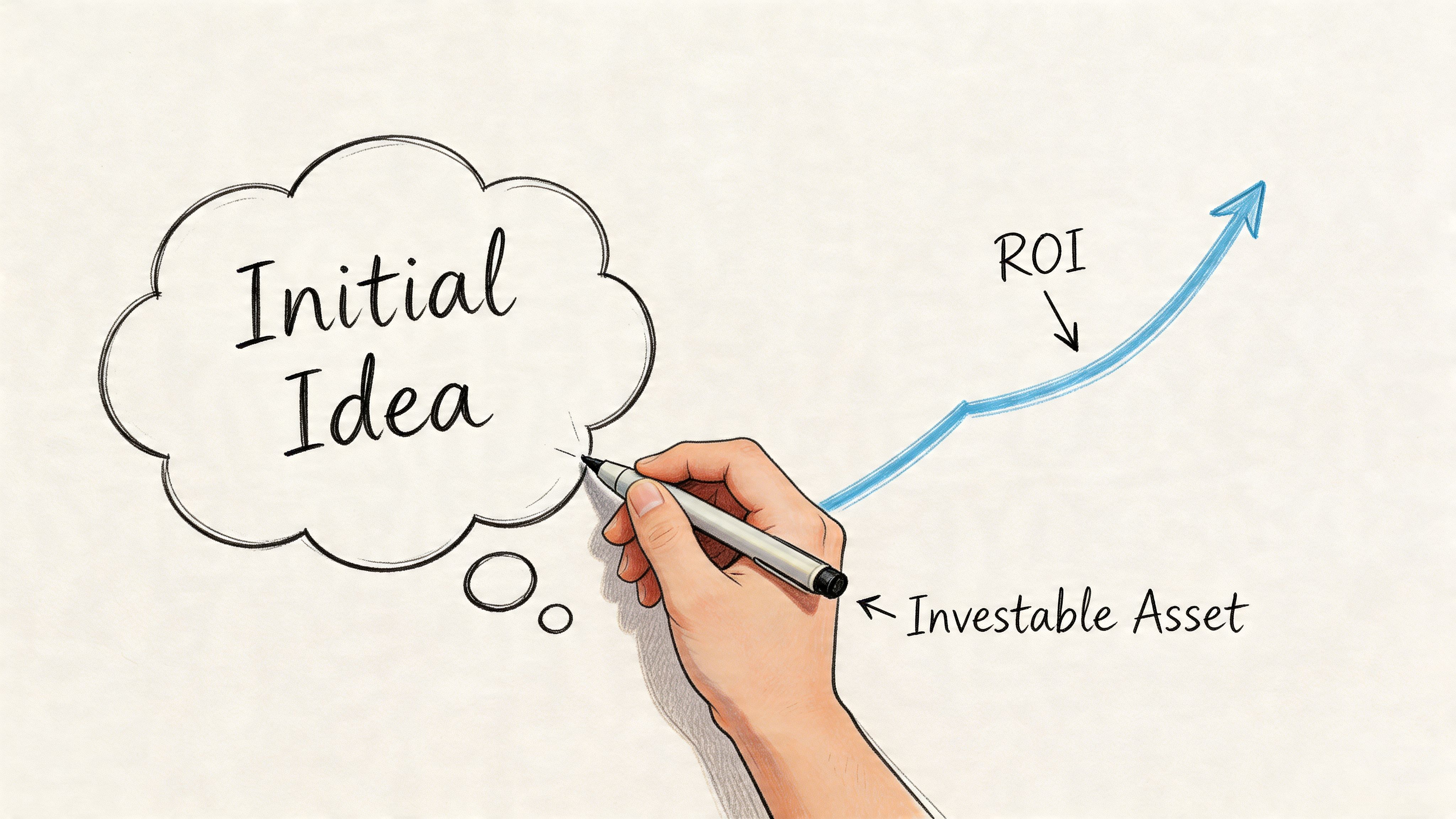
The numbers founders should pay attention to
The strongest financial argument is simple. 35% of new products fail due to lack of market need, and companies that conduct systematic user research during discovery have a 60% higher chance of positive ROI in digital projects, according to Trinetix’s write-up on the project discovery phase. The same source notes that discovery for MVPs often takes 2 to 6 weeks and commonly represents 10 to 15% of the total project budget.
That trade is obvious to me. Spend a controlled portion of budget to avoid funding the wrong build, or save that spend and risk financing failure at full scale.
The estimate side matters just as much. Before discovery, budget projections can be off by up to 50% because of the Cone of Uncertainty. After requirements analysis and risk assessment, that narrows to 10 to 20%. If you’re a founder raising capital, that difference changes how credible you sound in every investor conversation.
What investors hear when your numbers are weak
Investors rarely reject a startup because a founder lacks perfect technical vocabulary. They reject founders when the team signals weak control.
If your timeline feels invented, your scope keeps changing, and your budget can’t survive basic questioning, investors read that as operational risk. They assume one of two things:
You haven’t done the work.
Your team doesn’t know how to turn decisions into execution.
Neither helps valuation.
A disciplined discovery phase fixes that because it creates a coherent business case tied to product reality. If you need help structuring the commercial side of that logic, this business case template is a useful framing tool for connecting problem, solution, cost, and expected return.
Founder test: If an investor asks why this MVP scope is the right one, and your answer starts with “we thought users might want…,” your discovery work isn’t finished.
Discovery changes the quality of the company, not just the project
Founders often separate product planning from company building. That’s another mistake.
Your first technical decisions affect:
Fundraising credibility
Hiring quality
Speed of future releases
Reliability under growth
Confidence during diligence
That’s why I treat discovery as asset creation. A company with validated assumptions, realistic estimates, documented requirements, and clear architecture is worth more than a company with the same idea but none of that discipline.
The market doesn’t reward frantic motion. It rewards defendable progress.
The Four Pillars of a High-Valuation Discovery
A good project discovery phase isn’t one workshop and a backlog export from Jira. It has structure. If you want a product that holds up in market and in diligence, your discovery needs to stand on four distinct pillars.
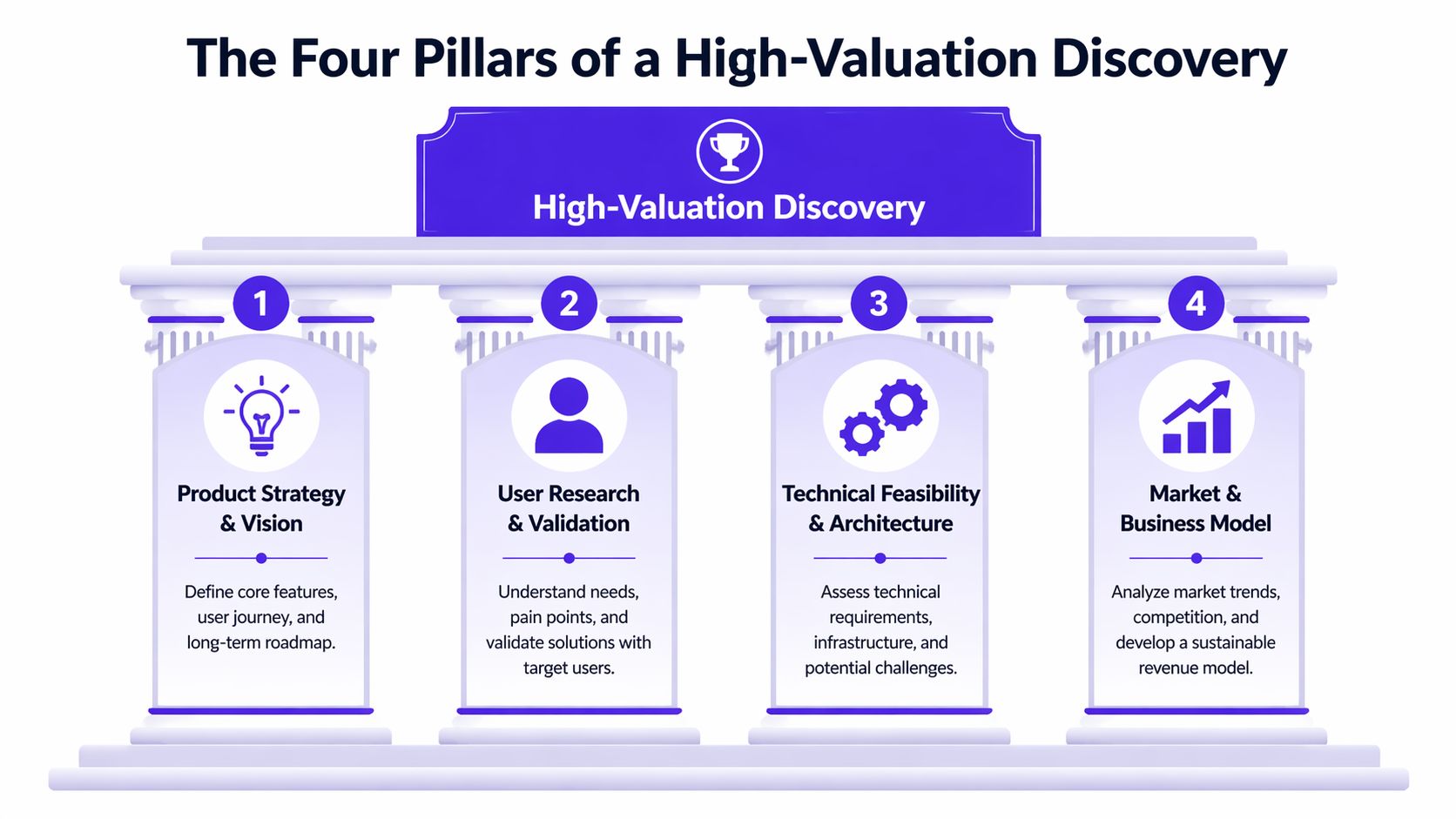
Product and market validation
This pillar answers the hardest question first. Does the product deserve to exist in this form?
You’re looking for evidence of a painful problem, not polite interest. Founders who skip this tend to confuse enthusiasm with demand. Friends say the idea sounds great. Advisors say the market is growing. Nobody commits to changing workflow, paying attention, or replacing the current workaround.
Strong validation work should clarify:
The exact problem: Not a broad category. A specific job, bottleneck, or workflow failure.
The urgency level: Nice-to-have products die slowly. Painkiller products earn attention faster.
The competitive opening: Where incumbents are weak, bloated, slow, or misaligned.
The MVP wedge: The minimum product position that can win a real user’s time.
This is also where many founders start understanding valuation more clearly. Investors don’t value vague potential equally. They value a credible route to adoption. If you need a finance-side framing for that, this guide on understanding the valuation of startup companies helps connect strategic clarity to how startups get assessed.
User research and behavioral validation
User research is not a decorative exercise for design teams. It’s where you find out whether your assumptions about behavior are true.
This means mapping real workflows, objections, handoffs, device contexts, and friction points. It often exposes that the “core feature” a founder wants isn’t the core need. Sometimes the bottleneck is trust. Sometimes it’s onboarding. Sometimes it’s a broken approval chain or an ugly manual process that users tolerate because switching feels risky.
A strong output here usually includes user personas, job stories, user journeys, and prototype feedback. But its true value is sharper than the artifacts. You learn what people will do in practice, not what they say in abstract terms.
Most MVPs don’t fail because the team couldn’t code them. They fail because the team built around a story about user behavior that wasn’t true.
Technical feasibility and architecture
Amateur planning usually collapses during this phase.
Founders often assume architecture can wait until “after launch.” That only works if your MVP has no integrations, no compliance concerns, no scaling path, and no need to survive investor diligence. In other words, it rarely works for serious startups.
Technical discovery should identify what can break before it breaks. Dinamicka’s guide on the project discovery phase in software development notes that early architecture analysis can prevent rework that would otherwise inflate development budgets by 30 to 50%. It gives a practical example: evaluating a third-party API with a 1000 requests per minute cap against a projected 10,000 daily active users can help prevent a 40% latency spike under peak load.
That kind of analysis changes decisions early:
Decision area | Weak discovery outcome | Strong discovery outcome |
|---|---|---|
Third-party integrations | Team assumes service limits are “fine” | Team models rate limits against usage patterns |
System design | Architecture follows developer preference | Architecture follows scale, security, and product goals |
Data model | Database choices happen late | Data structures support future growth and reporting |
Compliance planning | Security is deferred | Security requirements shape the build from the start |
For founders building serious products, this pillar often benefits from senior technical oversight. That may come from an in-house lead, an experienced independent architect, or a partner such as Buttercloud that combines discovery, architecture definition, and production-grade MVP planning.
Risk assessment and mitigation
Every startup has risk. The good ones identify it before it compounds.
Risk work in discovery should cover product risk, delivery risk, technical risk, dependency risk, and founder-side decision risk. You want a list of likely failures and a plan for how to reduce them.
Examples include:
Vendor dependency risk: What happens if a third-party service becomes the bottleneck?
Scope risk: Which features are attractive but non-essential?
Operational risk: Who owns key decisions, approvals, and tradeoffs?
Compliance risk: What obligations affect architecture, data handling, and release planning?
This pillar is where a vague startup plan becomes an executable one. Without it, founders mistake optimism for readiness.
Investor-Ready Deliverables Your Discovery Must Produce
Discovery has to end with artifacts. If it doesn’t, you paid for conversation.
The right deliverables don’t just help your team build. They answer the questions investors and technical diligence reviewers will ask later. That’s the standard. If a document can’t support execution or scrutiny, it’s noise.
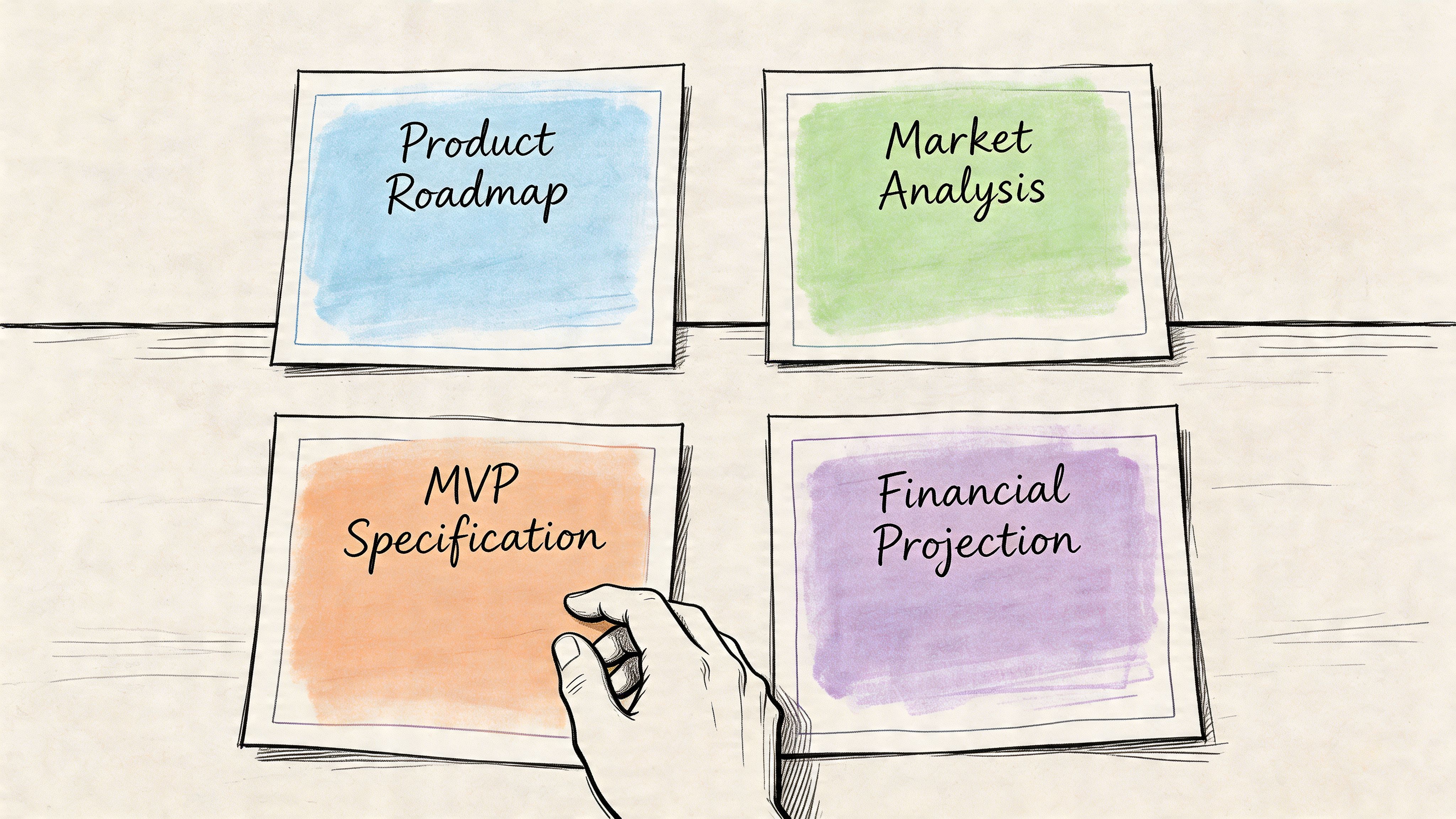
The core documents that matter
Analyses summarized by 42 Coffeecups state that discovery can produce 4 to 7x ROI by averting scope creep, and that production-grade discovery with auditable deliverables correlates with 2.5x higher investor confidence, with those MVPs commanding up to a 30% premium on valuation in their discussion of project phases discovery. That’s why deliverables matter. They are not administrative leftovers. They are valuation assets.
Here’s what I expect a serious discovery engagement to produce.
Product requirements document
This is the operating contract for the MVP.
A strong PRD defines the problem, target users, feature scope, success criteria, business constraints, and non-goals. It should make clear what the team is building now, what it is explicitly not building, and why.
Investors use this to test focus. Engineers use it to avoid ambiguity. Founders use it to stop scope drift from hijacking the product.
User journeys and personas
You need a defensible view of user behavior.
That includes who the primary users are, what triggers their need, how they move through the workflow, where friction appears, and which moments matter most. Good discovery produces these as decision tools, not decoration for a slide deck.
A diligence reviewer reading your materials should be able to answer: does this team understand how adoption happens?
Clickable prototype
A prototype shortens the distance between idea and judgment.
It lets founders test flow, messaging, onboarding, and interaction logic before code turns every change into a cost. It also gives investors and advisors a faster way to understand the product than reading a long memo.
A prototype is not proof that the company can scale. It is proof that the team can make the product legible before committing engineering capital.
Prioritized backlog and release logic
Your backlog should do more than list features. It should express strategy.
That means a ranked sequence tied to user value, technical dependencies, and go-to-market timing. Investors want to see whether the founding team knows how to cut intelligently. A bloated backlog signals weak product discipline.
For founders working toward diligence, our guide to an investor-ready MVP goes deeper on how release scope and technical quality influence perception during fundraising.
Architecture diagram and technical decision record
This is one of the most undervalued deliverables in startup discovery.
Your architecture diagram should show the major system components, integrations, data flows, security boundaries, and expected load considerations. A related technical decision record should explain why key choices were made. Not every investor will read every detail, but a strong technical reviewer will.
Without these, your product looks improvised. With them, it looks governed.
Cost estimate and roadmap
A credible estimate is not just a total. It explains assumptions.
Founders should expect:
Budget logic: What drives cost
Timeline logic: What determines sequencing
Dependency visibility: What could delay release
Milestone clarity: What gets delivered and when
Confidence level: Which assumptions are stable and which still need validation
Here’s a simple way to judge your deliverables:
Deliverable | What it proves in diligence |
|---|---|
PRD | The team knows what it’s building and why |
Personas and journeys | The product is grounded in user reality |
Prototype | The concept has been made tangible and testable |
Prioritized backlog | The founders can focus and stage execution |
Architecture artifacts | The system has a scalable, reviewable foundation |
Roadmap and estimates | The team can plan capital and execution credibly |
If your discovery doesn’t produce this level of clarity, it hasn’t done its job.
Your Playbook for Running an Elite Discovery Phase
Most discovery phases fail for a boring reason. Nobody owns the standard.
Founders book a few meetings, collect opinions, and assume alignment happened because people nodded in a workshop. That isn’t discovery. That’s social activity. A proper process needs clear roles, a tight operating rhythm, and a senior technical voice who can convert ambition into concrete decisions.
Put the right people in the room
A strong discovery team is small but senior. Too many participants create noise. Too few create blind spots.
At minimum, I want these roles involved:
Founder or product owner: Brings business context, urgency, and decision authority.
Product strategist or business analyst: Structures requirements and keeps assumptions visible.
UX designer: Maps flows, friction, and prototype logic.
Lead engineer or architect: Evaluates feasibility, integrations, and system design.
Project lead: Keeps momentum, decisions, and dependencies organized.
Fractional CTO or equivalent senior technical lead: Owns architectural judgment and investor-readiness standards.
That last role matters more than most founders realize. Codebridge’s article on the role of discovery notes that embedding a fractional CTO in discovery yields 30 to 50% more accurate cost estimates and helps startups reach investor audits 25% faster through better upfront architectural decisions, as discussed in the role of the discovery phase for project success.
For non-technical founders, this isn’t optional. Someone has to challenge weak assumptions before they get written into the product plan.
Use a sprint structure, not an open-ended exploration
Discovery should be time-boxed. If it drifts, decision quality drops and founder attention fragments.
For MVP work, I prefer a focused sprint structure. In many cases, discovery for MVPs lands in the 2 to 6 week range, as noted earlier in the article. The exact duration depends on product complexity, integration load, and how much clarity the founder already has.
A practical operating rhythm looks like this:
Week one
Clarify business goals
Define target user
Gather existing assumptions
Identify major constraints
Middle phase
Conduct user and market analysis
Shape the feature set
Build low-fidelity and then clickable prototypes
Test technical options and dependencies
Final phase
Lock MVP scope
Produce architecture and roadmap
Create estimate ranges and milestone plan
Prepare decision records for handoff into delivery
Track output quality, not workshop volume
Founders often ask how to measure whether discovery is “going well.” The answer isn’t meeting count.
Measure whether the process is reducing uncertainty and producing build-ready decisions. I look for signals like these:
Requirement clarity: Can the team describe the MVP in plain language without contradiction?
Scope discipline: Have non-essential features been cut with intent?
Technical coherence: Is the architecture aligned with the business model and growth path?
Estimate confidence: Can the team explain cost and timeline assumptions clearly?
Stakeholder alignment: Are decision-makers actually agreeing, or just deferring conflict?
If your discovery ends with everyone “mostly aligned,” expect trouble. Elite discovery ends with explicit decisions, explicit tradeoffs, and explicit ownership.
Protect the process from founder drift
Founders sabotage discovery when they treat every new idea as urgent. You need rules.
Use one decision-maker for final scope calls. Capture open questions in a live decision log. Don’t let prototype feedback turn into uncontrolled feature expansion. If a new idea appears, rank it against the MVP objective. Most should move to later phases.
This is also where disciplined project management helps. If you want a practical operating model for managing the transition from planning into execution, our article on MVP project management is a useful companion.
End with a build threshold
Don’t leave discovery with “next steps.” Leave it with a yes-or-no threshold for build readiness.
A startup is ready to move when:
The problem is clearly defined
The user flow is understood
The MVP scope is intentionally narrow
The architecture is credible
The roadmap and estimate are grounded
The founders can defend every major decision
If those conditions aren’t met, keep working. Starting development too early feels productive. It usually isn’t.
Common Mistakes That Sabotage the Discovery Phase
I’ve seen founders damage a promising company before a single line of production code shipped. It usually happens during discovery, not development.
The pattern is predictable. They rush the thinking, overvalue speed, underweight architecture, and hire for cheap execution instead of strategic judgment. Then they wonder why the MVP feels expensive, unfocused, and hard to defend.
Treating discovery like a formality
Some teams decide the product before discovery starts, then use the process to rubber-stamp the plan.
That defeats the point. Discovery should change your mind about something. It should cut features, expose weaknesses, and sharpen positioning. If nothing got challenged, the process wasn’t rigorous enough.
Buying the cheapest “package”
Low-cost firms love to sell discovery as a lightweight workshop plus a generic feature list. Founders buy it because it sounds efficient.
What they receive is usually shallow output with no real technical depth, no market pressure-testing, and no documentation that helps during diligence. Cheap discovery often creates expensive development because the ambiguity never went away.
Bad discovery doesn’t save money. It postpones the bill until the team is writing code.
Focusing on features instead of pain
A founder who leads with features usually builds clutter.
Discovery has to start with the user’s problem, current workaround, and switching trigger. Features come later. If the team spends most of its energy discussing dashboards, AI add-ons, or admin settings before it has validated the core workflow, the product is already drifting.
Excluding engineering from early decisions
This is one of the most common startup mistakes.
If engineers or architects aren’t involved early, founders and product people make assumptions about integrations, scalability, security, and data structure that don’t survive contact with implementation. Then the team rewrites plans under pressure.
Bring technical leadership in at the beginning. Not after design. Not after fundraising. At the beginning.
Confusing activity with progress
A packed Miro board is not progress. Neither is a long Notion doc.
Progress in discovery means unanswered questions are disappearing. Decisions are being made. Scope is getting tighter. The team is becoming more precise. If the process creates more artifacts but not more clarity, it’s failing.
Here are the red flags I tell founders to watch for:
Too much agreement too early: Real discovery surfaces disagreement first.
No written tradeoffs: If choices weren’t documented, they’ll be reopened later.
No architecture artifacts: The product still lives as a concept, not a system.
No clear non-goals: The team hasn’t learned how to say no.
No investor lens: The outputs may help builders but not diligence reviewers.
The discovery phase should make the company harder to fool, including by its own founder.
Discovery Is Not a Cost It Is Your Foundation
A strong project discovery phase does one thing better than any other early-stage activity. It turns uncertainty into an asset.
Not a prettier backlog. Not a more impressive workshop. An asset.
When discovery is done properly, you leave with a product thesis, an investor-readable plan, a technical foundation, and a scope that deserves capital. That’s what raises confidence. That’s what improves diligence outcomes. That’s what supports valuation.
Founders who skip discovery usually believe they’re accelerating. Most are just pushing key decisions into the most expensive part of the process.
Build slower at the start so the company can move faster when it matters. That’s how serious startups are built.
If you’re building from idea to investor-ready MVP and want senior technical guidance before expensive mistakes get locked into your roadmap, Buttercloud helps founders run discovery with the standards expected in real technical due diligence.