Decoding Mobile App Development Cost for Founders

Founder & CEO, Buttercloud
Let’s address the question on every founder’s mind: “How much will my app cost?”
A simple app can start at $15,000, while a complex platform can exceed $500,000. But for a founder seeking to build an investable business, the critical range is $50,000 to $150,000 for a high-integrity, “investor-ready” MVP.
However, that number is just the starting point of a much more strategic conversation.
Your App’s True Cost Is an Investment, Not an Expense
Every founder I speak with leads with the cost question. This is a mistake. Focusing on the price tag is the quickest path to building a product with a built-in expiration date.
I’ve seen it countless times: a cheap build leads to crippling technical debt, a system collapse after the first press feature, or a failed due diligence report that kills a funding round.
The question isn’t “how much does it cost?” It’s “what am I engineering?” You can assemble a kit car for a quick ride, but it will never compete in a professional race or attract serious sponsors. Alternatively, you can commission a race car, engineered for peak performance from day one. One is a short-term solution; the other is a high-valuation asset built to win.
From Prototype to Investable Asset
Many development shops build prototypes—apps designed merely to function. This is not our practice. We engineer technical assets—products meticulously architected to be invested in.
This distinction is the chasm between a cheap build and an investor-ready MVP.
An investor-ready product is built on a solid architectural foundation designed for scale. The code is clean, documented, and secure—prepared to pass the rigorous technical due diligence that every sophisticated investor will conduct. A cheap prototype is a ticking time bomb of technical debt, a short-term fix that rapidly becomes a long-term liability.
Your codebase is not just a feature-delivery mechanism; it is a core company asset that directly influences your startup’s valuation. An audit-ready, scalable architecture is a powerful signal to investors that your company is built for longevity.
Understanding the Cost Spectrum
To provide a clearer framework, we’ve outlined typical costs for 2026. This table benchmarks your concept against standard complexity tiers.
Founder’s Quick Guide to Mobile App Costs in 2026
App Complexity Tier
Typical Feature Set
Estimated Cost Range
Simple MVP
Basic user profiles, static content screens, simple forms, email login.
$15,000 - $50,000
Investor-Ready MVP
Social logins, payment processing, user-generated content, basic admin panel, push notifications.
$50,000 - $150,000
Complex Platform
Real-time chat, AI/ML features, custom analytics, third-party API integrations, advanced security.
$120,000 - $500,000+
These figures reflect the engineering rigor required to build genuine, defensible value.
Ultimately, viewing your app’s cost as an investment is a critical mindset shift. This perspective holds true for all software, where the initial price is just the first step in understanding total investment. You’re not just spending money; you are strategically allocating capital to build a durable competitive advantage that’s hard for others to replicate.
When you shift from minimizing cost to maximizing asset value, you are laying the groundwork for a high-growth, venture-backed company.
Decoding the Price Tag: What Really Drives Your App’s Cost?
The final price of your app isn’t a single number; it’s the sum of strategic decisions made throughout the development lifecycle.
Understanding these cost drivers is essential for having intelligent conversations with your engineering partner and ensuring every dollar builds long-term, defensible value. The path you choose determines whether you are building a throwaway prototype or an investor-ready asset engineered to scale.
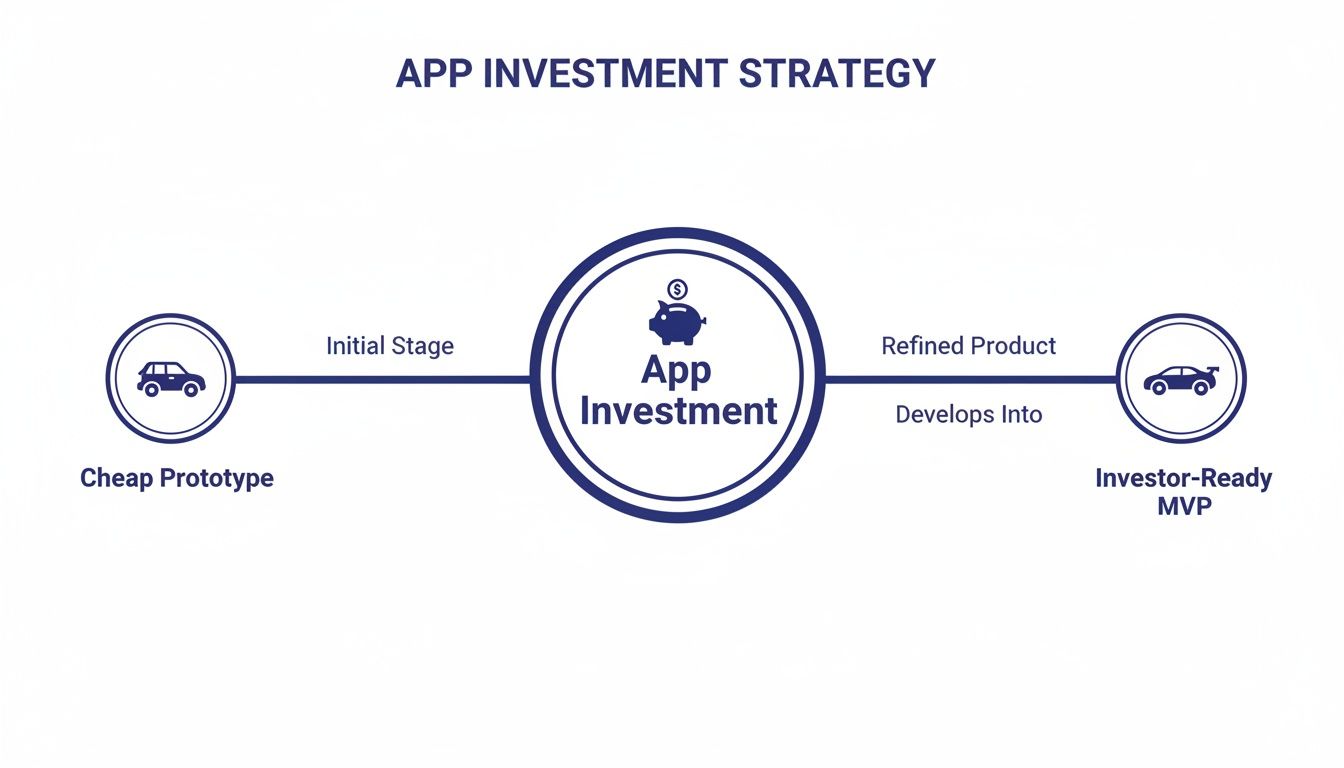
As the diagram illustrates, cutting corners early creates a dead-end product. Let’s break down the three primary decisions that define your budget and your app’s trajectory.
Scope and Complexity: The Feature Game
The most significant lever on your budget is scope. The formula is simple: more features and screens equate to more engineering hours. However, it’s the complexity of those features, not just the quantity, that drives cost.
A simple fitness app for manual workout logging is one level of complexity.
An app that syncs with an Apple Watch, maps runs with GPS, and provides AI-driven coaching is another entirely. It requires sophisticated backend engineering, complex API integrations, and extensive testing to function flawlessly.
Every “simple” feature can hide a world of complexity. This is why we guide founders to ruthlessly define their MVP.
An investor-ready MVP isn’t about cramming in every feature you can imagine. It’s about engineering a single, game-changing feature set so flawlessly that it becomes the unshakable foundation for everything else.
Isolate the one core function your app will perform better than anyone else and build a real advantage around it that’s hard to copy. Everything else is a distraction.
Platform Choice: A Critical Business Decision
Choosing between native (iOS/Android) or cross-platform development is a strategic business decision, not just a technical one. It has profound implications for your budget, user experience, and long-term scalability.
A Founder’s Decision Matrix for Native vs Cross-Platform
This choice must align technology with business objectives. Are you racing to validate an idea, or are you engineering a high-performance asset for the long term?
Factor
Native (iOS/Android)
Cross-Platform (Flutter/React Native)
Speed-to-Market
Slower. Requires two separate, specialized codebases.
Faster. A single codebase accelerates deployment to both platforms.
Upfront Cost
Higher. You are effectively commissioning two distinct products.
Lower. A single codebase and team reduce the initial capital outlay.
Performance
The Gold Standard. Direct access to device hardware delivers maximum speed and reliability.
Very good, but a step behind native. A slight performance overhead is inherent.
User Experience
Best-in-class. The UI feels completely “at home” and intuitive on each respective device.
Good, but can feel generic if not meticulously designed for platform nuances.
Long-Term Scalability
Excellent. The optimal foundation for complex features and massive user bases.
Good, but can present limitations with demanding hardware integrations or high-performance tasks.
Best For…
Investor-ready products where performance, security, and a premium UX are non-negotiable strategic assets.
Rapid idea validation, internal tools, and MVPs where speed-to-market is the primary driver.
Building native apps for iOS (Swift) and Android (Kotlin) is the premium path to engineering a high-valuation technical asset. It delivers unmatched performance and a seamless user experience. Expect costs to range from $50,000 to $250,000 per platform.
Cross-platform frameworks like Flutter or React Native allow for a single codebase for both platforms, often reducing initial development time and cost. This is a viable strategy for getting an MVP to market, with costs typically in the $40,000 to $200,000 range for both platforms combined.
Design and User Experience: The Silent Value-Multiplier
Too many founders view design as a superficial final step. This is a costly misconception.
Exceptional UI/UX design is the invisible layer that transforms a tolerable product into an indispensable one. A thorough Product Design & Discovery phase is not an expense; it is an insurance policy against building the wrong product. This is where we translate an idea into a technical blueprint, defining user journeys and establishing a competitive advantage.
Investing in wireframes, prototypes, and a robust design system ensures that when engineering begins, it is focused on building exactly what your users need and your business requires to win.
Curious about how these factors might add up for your specific idea? Play around with our app development cost calculator to get a ballpark estimate.
How Does the Team You Hire Define Your Company’s Valuation?
The “who” behind your app is more critical than the “what.” The engineering partner you choose will have a more profound impact on your company’s valuation than nearly any other early-stage decision.
You are not merely buying code; you are commissioning the technical foundation of your entire business. The choice is stark: hire a disconnected group of contractors and hope they follow the same blueprint, or partner with a senior technical partner who ensures every component contributes to a valuable, coherent structure.
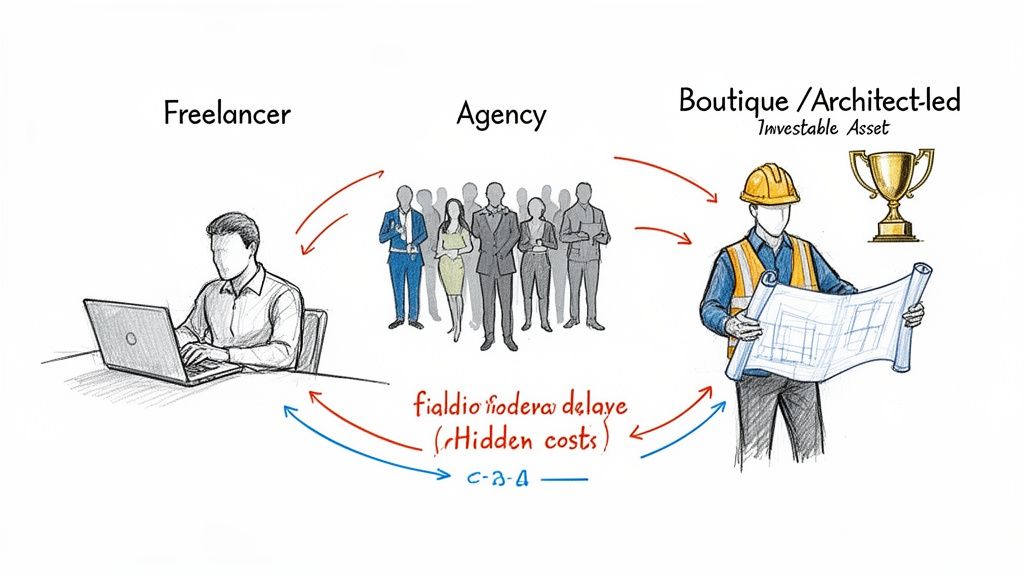
The model you select directly shapes the quality of your technology and, consequently, how seriously investors will evaluate your company.
The True Cost of “Cheap” Labor
The allure of low hourly rates is a dangerous trap for founders. An advertised rate of $20/hour versus $150/hour appears to be a simple choice, but it is a classic false economy.
Opting for the cheapest developers almost always leads to failure.
-
Crippling Technical Debt: Low rates necessitate rushed code and nonexistent architecture. The “savings” are erased tenfold when you are forced into a complete rewrite.
-
Failed Due Diligence: Sophisticated investors conduct technical audits. A messy, undocumented codebase is an immediate red flag that can terminate a funding round.
-
Founder Burnout: When you manage a team of freelancers, you become the de facto project manager, architect, and QA lead. The burden of quality and cohesion falls entirely on you.
A low hourly rate does not build an asset. It accumulates a liability that actively torpedoes your company’s valuation.
From General Contractor to Senior Technical Partner
Founders typically encounter three partnership models, each yielding a vastly different business outcome.
1. The Freelancer Model (The General Contractor): You hire individual specialists and attempt to orchestrate their work. This model promises the lowest initial cost but carries the highest risk, often resulting in a “Frankenstein” app that is impossible to maintain or scale.
2. The Traditional Agency Model (The Volume Builder): Large agencies can operate as a “black box.” You provide specifications, and an app is delivered. While more organized than freelancers, access to senior talent is often limited. Their objective is project completion, not necessarily engineering long-term asset value.
3. The Boutique Engineering Partner (The Architect-Led Firm): This is the anti-outsourcing model. You are not hiring temporary coders; you are embedding a cohesive, senior team that acts as your “Mentor-Architect.” The focus shifts from merely shipping features to engineering an investable asset.
A premium partnership isn’t about paying more for the same service; it’s about investing in a different outcome. The goal is audit-ready engineering that turns your codebase into infrastructure that holds up under real due diligence, directly increasing your startup’s valuation.
This approach integrates strategic leadership, often through a Fractional CTO, ensuring every technical decision aligns with business objectives and future fundraising needs. The premium rate reflects this deep expertise and a shared commitment to building durable enterprise value.
Of course, location plays a big role in these rates. U.S. agencies, for example, typically charge $100–$250/hour, putting total app costs in the $65,000–$150,000+ range, while partners in other regions can offer significant savings. You can explore a full breakdown of these regional rate differences to get a feel for the global market.
Ultimately, the right partner justifies their premium by delivering a product that doesn’t just work—it attracts investment.
Budgeting Beyond Launch for Hidden Scaling Costs
You have budgeted for development and are prepared to launch. If you believe your spending ends there, you are walking into a common and fatal startup trap.
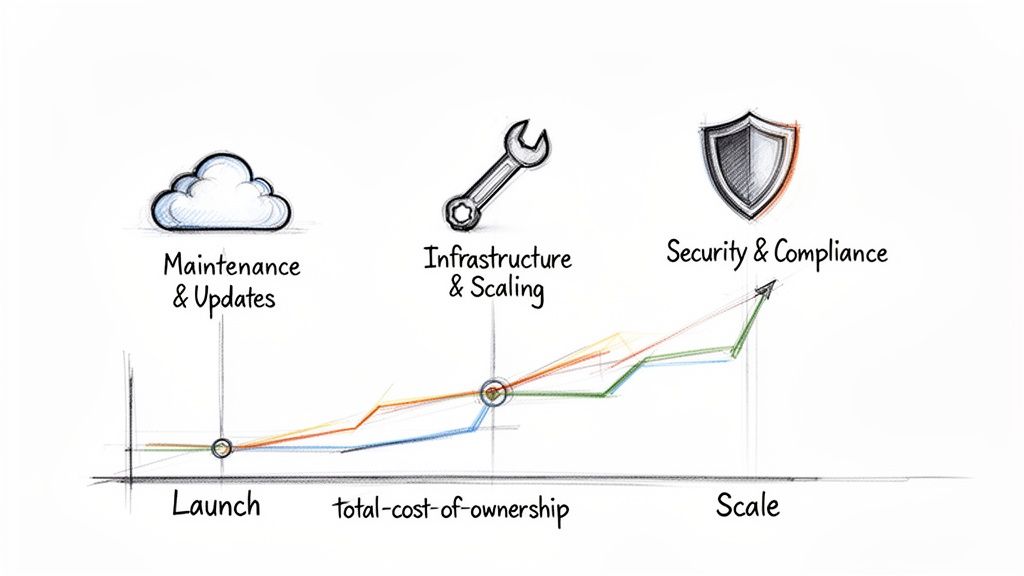
The initial development cost is merely the price of admission. The Total Cost of Ownership (TCO)—the true, ongoing expense of your application—emerges long after you deploy to the App Store. Understanding TCO is the metric that separates startups that scale from those that flame out. Shifting from a one-time project fee to a continuous operational cost is essential for survival and forces the discipline of building a scalable, secure product from day one.
Maintenance and Perpetual Updates
Your app is not a static object; it is a dynamic asset requiring constant upkeep. The moment it goes live, it begins to age. Apple and Google release new OS updates that can break functionality, and new security vulnerabilities emerge daily.
Building a technical asset means budgeting for its future. Post-launch maintenance is not a sign of failure; it’s a planned, strategic investment in the longevity and reliability of your core product.
Ignoring this is akin to buying a high-performance vehicle and never budgeting for fuel or maintenance.
-
OS Updates: Every new iOS and Android version demands compatibility testing and potential code adjustments. This is non-negotiable.
-
Bug Fixes: No matter how rigorous your QA, users will discover new bugs. A dedicated budget for fixes is a necessity.
-
Security Patches: Your app relies on third-party libraries that require constant updates to patch security holes. Failure to keep pace exposes you and your users to risk.
Infrastructure and Scaling Costs
Your app requires a home in the cloud, typically on a provider like AWS or Google Cloud. Initially, your hosting bill may be negligible. But as your user base grows, so will your infrastructure usage and your monthly invoice.
This is not just about server space. It’s about having an architecture that can handle growth without failure. A positive mention in the press is fantastic, but without a scalable infrastructure, the resulting traffic spike can crash your system and destroy your momentum.
This is where boutique DevOps and managed infrastructure become critical. Following sound cloud cost optimization strategies ensures your app scales efficiently, keeping costs predictable and your service reliable as you grow.
Security and Compliance Overhead
The more user data you handle, the bigger a target you become for both malicious actors and regulators. Security and compliance are not features to be added later; they must be engineered into your app’s DNA from inception.
This means being audit-ready from day one. Investors and enterprise clients will demand proof of a secure system and responsible data handling. A codebase unprepared for this scrutiny will kill a funding round or a major partnership.
Smart founders budget for these ongoing costs. A reliable rule of thumb is to allocate 15–20% of the initial development cost annually for maintenance. This can translate to $300 to $5,000 per month for cloud scaling, security updates, and compliance. As you can discover more insights about app maintenance budgets on sparxitsolutions.com, you’ll find this is not an “extra”—it is the baseline cost of running a professional software business.
How Do You Build a Defensible Edge on a Startup Budget?
As a founder, you are not merely trying to build an app cheaply. You are allocating capital to create a high-valuation technical asset that commands investor attention.
This requires moving beyond generic advice like “build fewer features.” It demands founder-centric tactics that carve out a durable competitive advantage — the kind of edge a competitor can’t just copy over a weekend. The objective is to be lean without being cheap, ensuring every dollar spent advances your position for the next funding round and market leadership.
Adopt the Phased MVP Approach
A common mistake is attempting to build an entire grand vision at once. This burns capital on unvalidated features. The smarter strategy is the phased MVP.
This does not mean launching a flimsy, watered-down app. It means launching a single, defensible feature set that is engineered to perfection. This becomes your “wedge” to penetrate the market.
This focused strategy accomplishes three critical goals:
-
Validates the Core Premise: It proves your most critical hypothesis with real user data—a powerful signal to investors.
-
Conserves Capital: It prevents you from wasting money on secondary features before they are validated, extending your runway.
-
Builds a Data-Driven Roadmap: User behavior, not intuition, dictates what to build next, ensuring follow-on investment is laser-focused.
Prioritize Architecture Over Superficial Features
The temptation to add flashy UI animations or “nice-to-have” features to make an app feel complete is a classic founder trap.
Sophisticated investors and their technical partners see through this. They are not evaluating the polish; they are inspecting the plumbing—the underlying architecture.
An MVP built on a flimsy, non-scalable architecture is a liability, no matter how good it looks. An investor-ready product prioritizes clean, documented, and scalable code because the structure is the asset.
Instead of diluting your budget across five superficial features, invest that capital in ensuring your one core feature is built on an audit-ready, scalable framework. This demonstrates technical maturity and foresight, directly boosting investor confidence and your company’s valuation. For founders trying to build a resilient product on a shoestring, checking out a practical playbook for starting a software firm can offer some valuable strategies for getting this right.
Leverage Strategic Technical Leadership
Making the right technology choices is one of the highest-leverage activities a founder can undertake. For those without a deep engineering background, it is also the area most prone to costly mistakes.
This is where a Fractional CTO becomes an invaluable strategic asset.
A Fractional CTO provides the senior-level architectural guidance needed to align technology with fundraising objectives. They ensure you are not just building an app; you are engineering an investable business. This is how we at Buttercloud ensure your $80,000 investor-ready MVP is not a pile of technical debt, but a scalable, audit-ready asset designed for Series A and beyond. It is a strategic decision that transforms development spend into a powerful competitive advantage.
We have deconstructed the numbers behind mobile app development, from platform selection to the hidden costs of scaling.
Let’s zoom out. If you take one principle from this guide, let it be this:
Stop thinking of your app’s budget as a cost. It is the first and most critical investment in your company’s most important asset.
The Most Expensive Mistake You Can Make
I have witnessed this scenario countless times. A founder receives a quote that seems too good to be true and accepts it, believing they have secured a major win.
A cheap app is the most expensive mistake a founder can make.
That low upfront price is almost always subsidized by a hidden mountain of technical debt. The code is disorganized, the architecture is brittle, and the system is held together with digital duct tape. The first traffic spike or feature request causes the entire structure to crumble.
The initial “savings” evaporate. When it is time to raise a Series A, that poorly architected product will not survive technical due diligence. Investors see right through it. You are forced into a costly, soul-crushing rebuild. You lose more than money—you lose momentum and credibility.
Shifting from Cost to Valuation
A true engineering partner reframes the conversation. We don’t ask, “What’s your budget?” We ask, “What valuation are you engineering toward?”
This simple question changes everything. Your development spend is no longer an expense item; it is the engine that builds your company’s value.
An “investor-ready” product isn’t just an MVP with more features. It’s an entirely different class of asset, engineered from day one for scalability, security, and the rigorous scrutiny of a Series A technical audit. It’s the difference between a prototype and a business.
Viewing the project through this lens enables smarter, strategic decisions. It clarifies how to select a team that doesn’t just write code, but engineers a scalable, defensible asset—one that doesn’t crumble under investor scrutiny and becomes the foundation for your company’s future.
This is the approach that excites investors. It is what enables scaling without breaking. It is how you build a durable competitive advantage.
You have the vision. Our mission is to engineer that vision into a solid, investable asset that will secure your next funding round and prepare you for long-term growth.
Ready to build a company asset, not just a cost center? Contact Buttercloud today and let’s discuss engineering your investor-ready product.
A Founder’s Guide to App Development Costs: Straight Answers
Let’s address the funding questions that keep founders up at night. You are trying to build a game-changing product that wows investors while being relentlessly strategic with capital.
We understand. Here are direct answers to the most common questions we hear from founders.
“Can I Just Get a Fixed Price Quote for My App?”
Exercise extreme caution. If a development shop provides a fixed-price quote for an innovative product without a deep discovery process, consider it a major red flag.
Why? It means they are building their profit margin into the project, not your vision. To protect that margin, they will inevitably cut corners on architecture and quality. True innovation is a process of discovery, not a line item on a spreadsheet. A firm offering a blind, fixed price is not structured for that journey.
A genuine engineering partner will insist on a paid Product Design & Discovery phase. This is not a meeting; it’s a collaborative deep dive to de-risk the entire project. We emerge with a validated architectural plan and a defensible feature roadmap. The output is not a guess, but a realistic cost range for an MVP that investors will take seriously.
“Isn’t It Cheaper to Hire a Bunch of Freelancers?”
On an hourly basis? Yes. For a founder’s total investment? No. Chasing the lowest hourly rate is a classic trap. When you hire disparate freelancers, you inadvertently promote yourself to unpaid CTO, project manager, and head of QA. You become solely responsible for architectural integrity and system cohesion.
The money you think you’re saving on hourly rates gets vaporized by the nightmare of managing a scattered team. Worse, you end up with a ‘Frankenstein’ codebase that’s impossible to scale—a huge reason startups get a hard “no” from VCs during due diligence.
Partnering with a boutique firm means you are not just paying for code. You are investing in a cohesive team led by an experienced Fractional CTO. That premium buys an audit-ready, high-valuation technical asset engineered by experts who are strategically aligned.
“Why Does an ‘Investor-Ready’ MVP Cost More?”
A “standard MVP” is often a quick-and-dirty prototype built to prove a concept. It is riddled with shortcuts and technical debt. It’s a movie set—impressive from the front, but with nothing behind it. It is a throwaway product that will require a complete and costly rebuild.
An Investor-Ready MVP is an entirely different class of product. It is engineered from day one for scale, built on a solid architecture with clean, documented code and robust security.
The upfront investment is higher because it is built to withstand the intense technical scrutiny that investors will conduct. This approach transforms your app from a potential liability into a core company asset, increasing your startup’s valuation and paving a much smoother road from Seed to Series A.
Curious what your specific app would actually cost? Our free MVP Cost Calculator gives you a directional estimate in minutes, priced from our real numbers rather than an industry rule of thumb.
At Buttercloud, we don’t just write code. We engineer the high-valuation technical foundations that let successful startups grow without breaking. We act as a partner who thinks like both mentor and architect, guiding you from a spark of an idea to an investable product built for the long haul.
Ready to build a real technical moat for your startup? Schedule your strategic consultation with Buttercloud.
Have a product idea to talk through?
We'll show you how we'd approach it — no pressure, just a real conversation.
Book a Discovery Call