Mobile App Development for Restaurants

Founder & CEO, Buttercloud
Most advice on mobile app development for restaurants is too small-minded. It treats the app like a digital menu with checkout. That’s how founders end up with fragile software, painful integrations, and an asset that scares investors instead of impressing them.
A restaurant app should be built like infrastructure. It’s a revenue channel, a customer data engine, and a due diligence artifact. If you approach it as a cheap add-on, you’ll pay for that decision later in rewrites, failed launches, and technical debt that blocks growth.
Beyond Ordering A Blueprint for Your Restaurant App MVP
The first mistake founders make is starting with features. Ordering. Loyalty. Push notifications. Table reservations. None of that matters until you define what the product is meant to own.
A restaurant app MVP should answer one hard question: why will customers use your direct channel instead of defaulting to marketplaces or doing nothing at all? If your answer is “because we have an app,” you don’t have a strategy. You have a project.
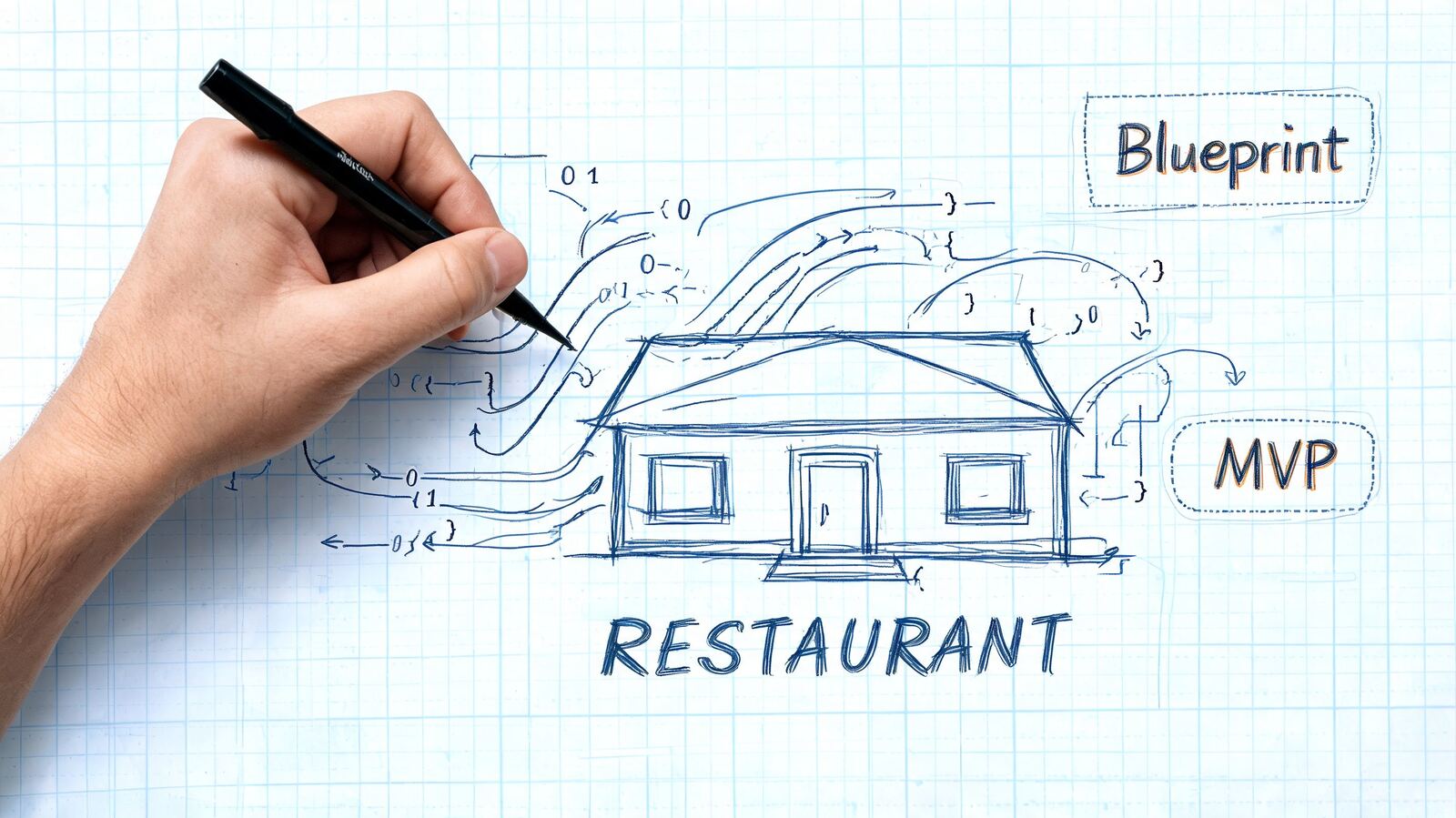
Start with the business model, not the screen flow
The blueprint phase is where valuation begins. A founder who maps the product around margin, retention, and operational efficiency makes better technical decisions than one who starts in Figma.
A useful MVP for mobile app development for restaurants usually serves three audiences at once:
-
The diner: They want speed, confidence, and a checkout that doesn’t fight them.
-
The staff: They need orders to arrive cleanly, sync correctly, and fit existing workflows.
-
The company: It needs first-party data, defensible retention loops, and a platform that can expand without a rebuild.
That last part is where many struggle, and it should change how you define an MVP. Restaurant software accumulates debt faster than most categories because it is integration-heavy from day one: a POS, a payment processor, at least one delivery marketplace, a loyalty ledger, and a kitchen display are all in scope before you have a single retained customer. Every one of those is a contract with someone else’s system, and every shortcut taken at the boundary becomes a thing you cannot change later without coordinating a migration across all of them. If your MVP creates debt the moment it ships, it isn’t minimum viable. It’s maximum regret.
Practical rule: If a feature creates data you can reuse for retention, personalization, or operations, it belongs near the top of the roadmap. If it only decorates the interface, it can wait.
Define the wedge before the roadmap
Founders often ask whether they should build from scratch or use a white-label base. The fundamental answer depends on where your differentiation lives.
If your edge is speed to market and branded direct ordering, reviewing resources like OrderOut’s white label solutions can help you understand what a packaged foundation can cover versus what should remain custom. That comparison matters because some functions are commodity, while your retention engine, operational workflows, and data model often are not.
Use a discovery document that forces decisions in this order:
-
Revenue intent
Is the app meant to increase direct ordering, improve repeat behavior, support pickup, streamline reservations, or unify several channels into one account system? -
Operational constraint
Where do orders break today? POS mismatch, menu updates, kitchen handoff, payment reconciliation, or delivery coordination? -
Retention mechanism
What makes the second, third, and tenth order more likely? Preference memory, targeted offers, convenience, saved baskets, or subscription-style behavior? -
Future moat
Which pieces need to mature into investor-grade assets later? Customer profiles, recommendation logic, merchant admin tools, location management, or logistics orchestration.
Prioritize an MVP that can survive scrutiny
Your first version should be narrow, but it can’t be sloppy. I’d prioritize these foundations:
MVP layer
What it must do
Why it matters
Ordering core
Menu browsing, modifiers, checkout
Generates usable revenue immediately
Identity
Accounts, order history, saved preferences
Creates first-party customer memory
Payments
Secure mobile payments
Reduces checkout friction and supports trust
Integrations
POS and order-status syncing
Prevents operational chaos
Analytics
Event tracking from day one
Gives you evidence for product decisions
If you need a sharper lens for what investors expect from an MVP, Buttercloud’s guide to an investor-ready MVP is the right framing. The important shift is simple. You’re not shipping a demo. You’re creating a codebase, data model, and operating system that someone may inspect under a microscope later.
A restaurant founder shouldn’t ask, “What’s the fastest app we can launch?” The better question is, “What’s the smallest product that increases revenue now and still looks credible in a technical audit later?”
How Do You Engineer Your Restaurant App’s Defensible Edge?
Most founders hear “architecture” and assume it’s a developer concern. It isn’t. Architecture decides whether your app survives a dinner rush, whether new features are cheap or expensive to add, and whether an investor sees advantage or liability.
The wrong stack can still produce a working app. It just won’t produce a durable company.
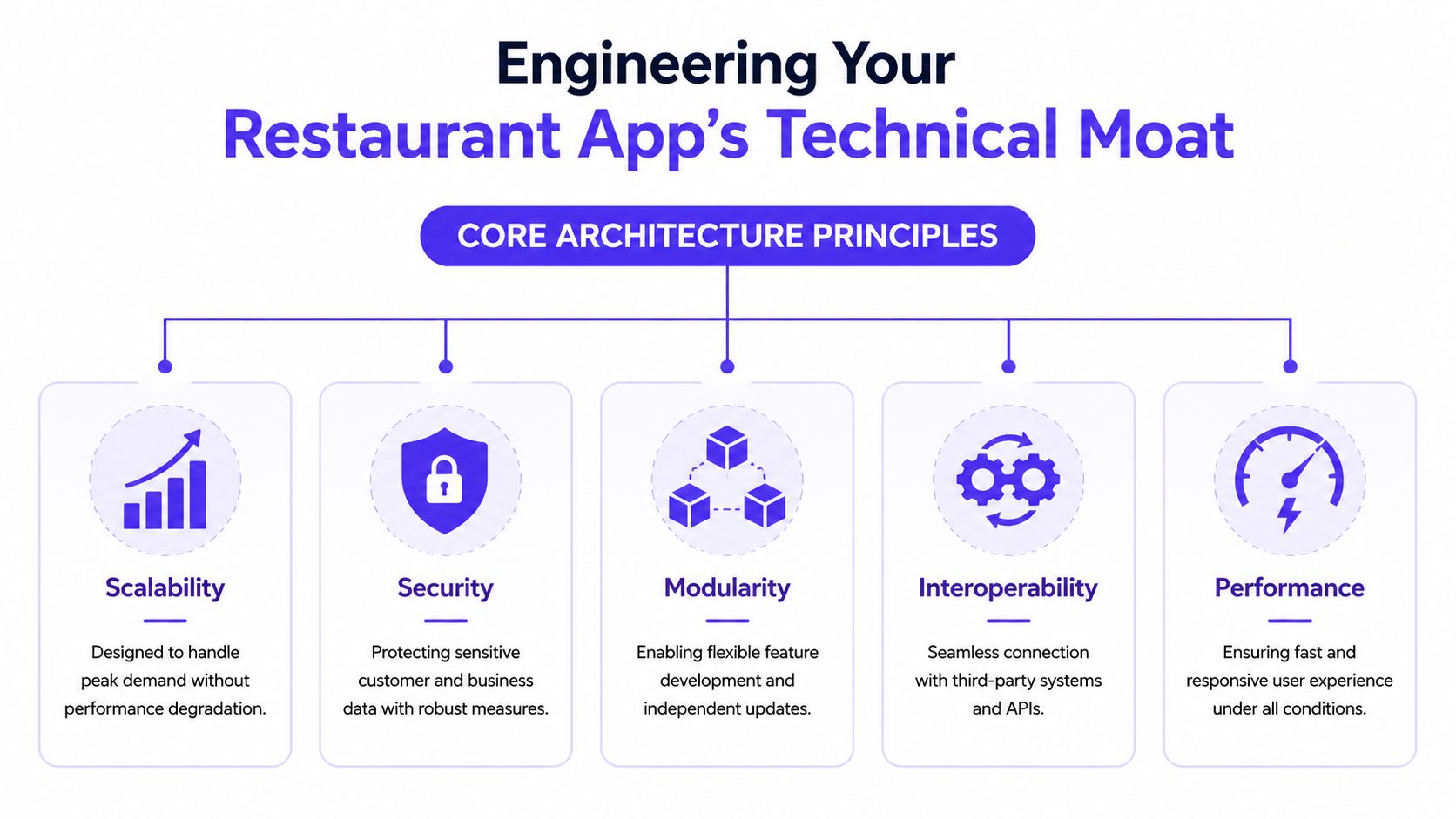
Pick a stack that supports scale before you need it
You don’t need a bloated enterprise system on day one. You do need a stack that won’t force a rewrite when traction hits.
A strong default for mobile app development for restaurants is a cross-platform frontend with a real-time backend. The technical reason is obvious. The business reason matters more. You want fast iteration, one mobile codebase to manage, and infrastructure that can absorb operational peaks without degrading the customer experience.
The constraint that shapes this stack is load shape, not load volume. A restaurant app does not serve steady traffic. It serves two or three violent spikes a day, at the same clock times, when the kitchen is already at capacity and the cost of a failed order is a refund plus a lost customer. That rules out a few things immediately: a single application server you scale by hand, a database doing uncached menu reads on every app open, and any real-time layer that holds state in one process. What it argues for is a cross-platform frontend, a caching layer in front of read-heavy menu and store data, a real-time channel for order status that can be scaled horizontally, and autoscaling that triggers on a schedule you already know rather than reacting after the queue has backed up.
That stack is sensible for restaurants because each layer maps to a business need:
-
Flutter gives you one product surface across iOS and Android while preserving a polished user experience.
-
Node.js with Socket.io supports live order status, kitchen events, and delivery updates without awkward polling hacks.
-
PostgreSQL gives you structured reliability for customers, orders, transactions, and reporting.
-
Redis protects responsiveness when traffic spikes and repeated reads pile up.
-
Auto-scaling cloud infrastructure reduces the chance that success becomes a failure event.
A founder doesn’t need to memorize the stack. The founder needs to understand what each choice protects.
Don’t over-romanticize microservices
Some agencies pitch microservices because it sounds advanced. Early-stage founders then inherit complexity they can’t manage. A giant monolith is also a mistake. The answer is a modular monolith or microservices-ready architecture.
That means one deployable system initially, but with boundaries that match the business:
-
ordering
-
payments
-
menu/catalog
-
customer identity
-
loyalty and promotions
-
delivery orchestration
-
admin and reporting
This structure matters because restaurants evolve fast. A founder may need to replace the loyalty engine, add multi-location support, or connect a new delivery provider without destabilizing checkout.
Build for the audit, not just the launch
Investors don’t only ask whether the app works. They ask whether the system is understandable, documented, secure, and extendable.
Use architecture that makes those answers easy:
Technical choice
Immediate effect
Investor-facing effect
Clear service boundaries
Faster changes with fewer regressions
Easier due diligence review
API-first design
Cleaner integrations and admin tooling
Better extensibility story
Infrastructure as code
Repeatable environments
Lower operational risk
Event logging and monitoring
Faster debugging
Demonstrates engineering maturity
Role-based access controls
Safer operations
Stronger compliance posture
Optimize for ownership, not novelty
You don’t need exotic tools to create a durable advantage. You need disciplined choices and documentation. I’d rather see a clean Flutter and Node.js system with good observability than a trendy architecture nobody on the team can maintain.
If you’re weighing trade-offs between speed, flexibility, and long-term control, Buttercloud’s piece on application development models is a useful framework. The correct model is the one that protects strategic ownership while keeping execution realistic.
Architecture test: If adding a new location, payment provider, or loyalty rule requires major rewrites, the moat isn’t real.
A technical moat in restaurant software isn’t a buzzword. It’s the set of decisions that let you scale users, preserve uptime, ship new revenue features quickly, and defend the codebase during diligence. That’s what founders should be paying for.
How Do You Integrate the Mission-Critical Restaurant Ecosystem?
A restaurant app can look polished and still fail in production because the critical work happens at the edges. Orders must move between systems cleanly. Payments must confirm reliably. Menus must stay current. Refunds, modifiers, fulfillment status, and delivery timing all depend on integrations working under pressure.
A lot of “finished” apps break at this stage.
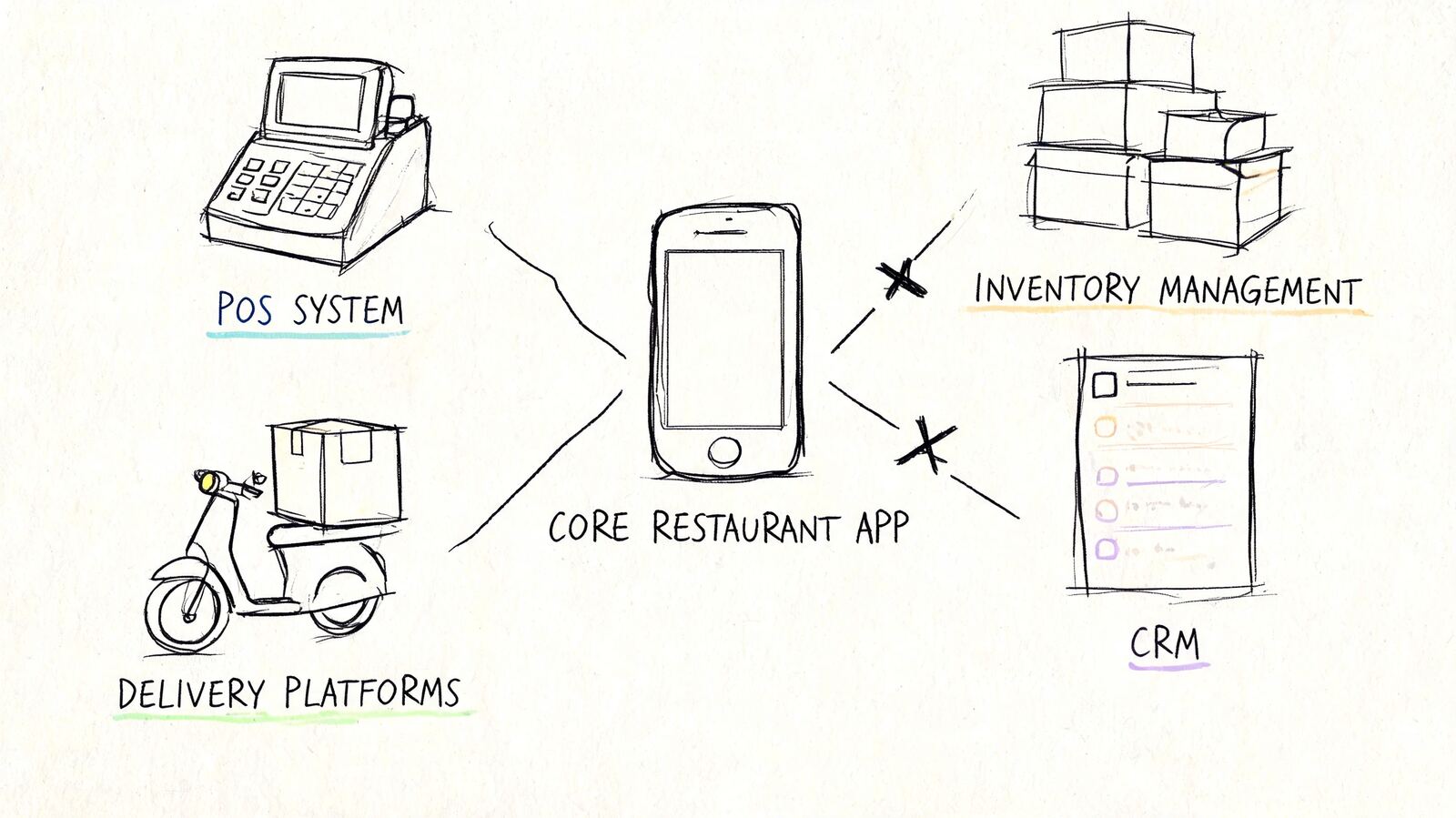
POS isn’t a plugin problem
Many founders treat POS integration like a checkbox. It’s not. It’s one of the highest-risk parts of the system because it touches the order record that operations rely on.
POS integration is the part of the system you control least and depend on most. The POS vendor owns the schema, the rate limits, the sandbox quality, and the release schedule, and none of those were designed around your app. Menus drift between your catalog and theirs. Modifiers map imperfectly. A network blip mid-write leaves an order that exists on one side and not the other. Those failures are not loud — they surface as a diner who paid for something the kitchen never saw, and they surface during service, which is the worst possible moment for a support conversation.
That tells you two things. First, the integration layer deserves senior engineering attention, including idempotent writes, a reconciliation job, and an explicit answer to what happens when the POS is unreachable. Second, testing isn’t cleanup work. It’s product work.
A proper POS integration strategy includes:
-
Order state mapping: The app, backend, and POS must agree on statuses such as created, accepted, in prep, ready, fulfilled, canceled, and refunded.
-
Modifier consistency: Size, add-ons, substitutions, and notes must survive translation across systems.
-
Menu synchronization: Prices, availability, and item structure can’t diverge unnoticed.
-
Retry and reconciliation logic: If a webhook fails or the POS is temporarily unavailable, the system needs a safe recovery path.
Payments and fulfillment need an API-first backbone
Restaurants don’t just process payments. They orchestrate promises. A paid order that never reaches the kitchen is worse than a failed checkout because the customer thinks the order succeeded.
That’s why I recommend an API-first design. Every core capability should expose a clean contract: order creation, payment confirmation, status updates, loyalty application, refund handling, dispatch events. When those interfaces are explicit, your team can change internals without breaking the business.
Here’s the integration hierarchy I’d use:
-
Payments first
Stripe or PayPal SDKs can handle tokenized payment flows. Keep card handling out of your custom surface wherever possible and align implementation with PCI requirements. -
POS second
Don’t launch direct ordering until this path is proven with realistic order scenarios, including edge cases like item removal, partial refunds, and delayed acknowledgments. -
Delivery and logistics third
Use webhooks for real-time updates. Polling is a fallback, not a design philosophy. -
Loyalty and promotions after stability
These features matter, but they should sit on top of a reliable transaction backbone.
If the app can take money but can’t guarantee order integrity, you haven’t built a commerce product. You’ve built a liability.
Test the ugly scenarios
Founders usually test the happy path. One item, one card, one clean order. Real production traffic is messier.
Your QA plan needs scenarios like these:
Scenario
Failure risk
What to verify
Menu item becomes unavailable mid-order
Stale inventory and bad substitutions
User messaging and fallback handling
Payment succeeds but POS acknowledgment fails
Orphaned paid order
Retry queue and staff alerting
Delivery ETA changes after checkout
Broken customer trust
Real-time update propagation
Loyalty reward conflicts with modifier pricing
Incorrect totals
Rule precedence and audit logs
Security and compliance aren’t optional extras
Every integration broadens your risk surface. Payment providers, delivery APIs, CRM tools, and POS vendors all create dependencies. You need tokenized payment flows, access controls for admin tools, secret management, webhook verification, and audit logs that tell you who changed what.
This is also where boutique engineering beats low-cost production. A serious team designs integration boundaries, failure handling, and observability before launch. A cheap team stitches together SDKs and hopes support tickets stay manageable.
For restaurant founders, the integration layer decides whether the app becomes a dependable operating channel or a recurring operational fire. Treat it as core infrastructure, because that’s exactly what it is.
Assembling Your Elite Engineering Team
Most restaurant founders choose their development team the same way they choose a contractor for a renovation. They compare price, timeline, and portfolio screenshots. That’s too shallow for a product tied to revenue, payments, data, and operational uptime.
Your team choice determines how much knowledge stays inside the company, how quickly decisions get made, and whether the product matures into an asset or decays into dependency.
Compare the three real options
There are three practical paths. In-house hiring, mass-market outsourcing, and a boutique partner with strategic leadership.
Model
What works
What breaks
In-house team
Strong control, long-term ownership, deep product context
Slow to assemble, expensive early, hard for non-technical founders to manage
Mass-market agency
Fast staffing, lower apparent upfront cost, broad execution capacity
Weak strategic alignment, handoff problems, uneven code quality
Boutique partner with fractional CTO support
Senior architectural oversight, faster decisions, better founder mentoring
Requires active collaboration and a clear product owner on the business side
What a founder should actually optimize for
If you’re early, don’t optimize for hourly rates. Optimize for decision quality.
A weak team can ship screens. A strong team helps you answer harder questions:
-
Should this be native, cross-platform, or partly web-based?
-
Which integrations are launch blockers versus later enhancements?
-
Where should the data model anticipate multi-location growth?
-
What documentation will an investor or acquirer expect to see?
-
Which hires should be internal later, and which functions can remain external?
That’s why many founders benefit from a Fractional CTO model early on. It gives you senior technical judgment before you can justify a full-time executive hire. Above all, it prevents junior execution from setting irreversible architecture.
Hire for architecture and judgment first. Headcount is secondary.
Don’t confuse service with partnership
A founder building a serious restaurant app doesn’t need a vendor who just “takes requirements.” You need people who challenge weak assumptions, explain trade-offs, and transfer knowledge as the system grows.
The anti-pattern looks like this:
-
the agency owns all infrastructure access
-
product decisions live in chat threads, not specs
-
no one documents architecture
-
testing is opaque
-
the codebase becomes difficult to transition later
That model creates dependency, not an advantage.
A better setup gives you shared visibility across repos, infrastructure, tickets, analytics, and release workflows. It also creates a hiring path. As the company matures, you can bring product, engineering, or DevOps roles in-house without replacing the entire foundation.
The right team shape changes by stage
A pre-seed or seed founder usually needs a compact team shape:
-
Product-minded technical lead or fractional CTO
-
One or two strong application engineers
-
A designer who understands commerce flows
-
QA and DevOps support embedded into delivery
That’s often enough to build and launch a serious first version if the architecture is disciplined.
The key is simple. Don’t buy labor. Build capability. The team you choose should leave your company with better systems, cleaner documentation, and more strategic control than you had before. If they can’t do that, they’re not helping you build an investable product.
The Path to a Flawless Production Launch
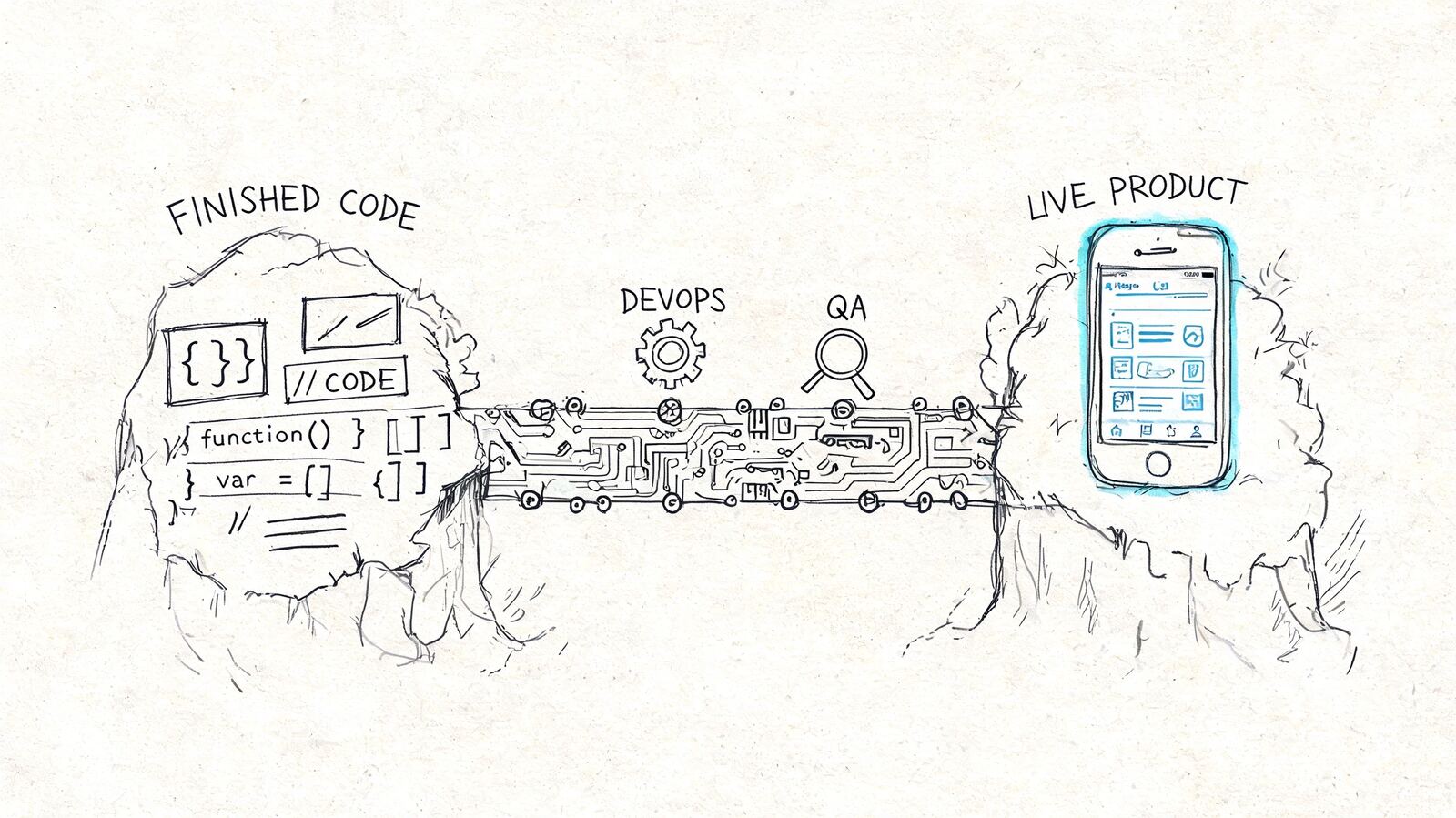
A launch isn’t the moment your code goes live. It’s the moment your systems prove they can handle real customers, real failures, and real revenue pressure without collapsing.
Too many restaurant apps reach the store with unfinished operational discipline. The code may be functional, but the release process is manual, testing is shallow, rollback plans are vague, and no one has rehearsed what happens when a payment edge case appears during peak traffic.
Harden the release pipeline before the public sees the app
Chop Dawg’s 2025 overview of restaurant app development notes that digital channels drive 67% of total revenue across quick-service, fine dining, and delivery segments, and that ensuring 99.99% uptime through hardened DevOps is critical.
That’s the business case for CI/CD. Continuous integration and continuous deployment aren’t engineering vanity. They reduce human error, standardize releases, and make every change easier to verify.
A launch-ready pipeline should include:
-
Automated test gates before code reaches staging or production
-
Environment parity so staging behaves like production
-
Rollback capability when a release introduces regressions
-
Secrets management that keeps credentials out of local improvisation
-
Monitoring and alerting tied to user-impacting events, not just server health
QA should attack the system, not admire it
Good QA doesn’t ask, “Does the app work?” It asks, “How does it fail?”
Your testing plan should include several layers, each with a different purpose.
Unit testing
This protects business logic. Pricing rules, loyalty calculations, tax handling, and order state transitions should never rely on manual verification alone.
Integration testing
This validates the dangerous seams. Payments, POS, notifications, and delivery status updates belong here. If these tests are weak, production becomes your test environment.
Performance testing
Restaurant traffic is uneven. Lunch and dinner create bursts. You need to know whether checkout, search, menu retrieval, and status updates remain responsive when activity spikes.
Security testing
Token handling, admin access, webhook validation, and data exposure need explicit review. Security debt compounds unnoticed and gets expensive fast.
Launch confidence comes from rehearsed failure, not optimistic demos.
Use staged rollout instead of all-at-once bravado
I’d rarely advise a broad release on day one. Roll out in controlled phases. Start with internal staff, then a limited customer cohort, then a wider release once the telemetry looks clean.
This rollout pattern lets you verify:
Launch phase
Primary goal
What you watch
Internal pilot
Validate operational workflow
Order accuracy, staff feedback, POS sync
Controlled beta
Expose real user behavior
Checkout friction, crash reports, event tracking
Regional or store-by-store launch
Test scale safely
Infrastructure load, support issues, release stability
Full release
Expand confidently
Retention signals, uptime, transaction integrity
Production readiness is mostly operational discipline
A founder should ask the team these questions before launch:
-
Can we deploy safely without manual heroics?
-
Can we detect checkout failures quickly?
-
Can support and operations see what happened to a specific order?
-
Can we roll back a broken release fast?
-
Can we trace the cause of a failed integration event?
If the answer to any of these is no, the app isn’t ready.
One option founders use for this stage is Buttercloud, which provides product engineering plus startup-focused DevOps and fractional CTO oversight. That matters when the gap isn’t coding effort but release discipline, infrastructure hardening, and investor-ready technical operations.
The strongest restaurant apps don’t win because they launched first. They win because they stay stable while weaker products leak trust during the moments that matter most.
What Fuels Post-Launch Growth and Company Valuation?
Launch day is the start of the valuation story, not the end. Once the app is live, your job shifts from shipping software to compounding customer behavior.
Many founders often go passive. They watch downloads, celebrate the release, and assume the product will now “run.” It won’t. A restaurant app becomes valuable when the team uses product data to improve retention, increase order frequency, and strengthen direct-channel economics.
Own the relationship or rent it forever
The strongest argument for mobile app development for restaurants isn’t design. It’s ownership.
According to RSUN Beat Software’s 2025 restaurant app market summary, 71% of consumers favor ordering directly through restaurant-branded apps over third-party platforms, which allows restaurants to bypass 15-30% commissions and retain control over customer data for personalized marketing and retention efforts.
That should shape your growth plan after launch. The app’s value isn’t just that it processes orders. It captures identity, preferences, timing, basket history, and behavioral patterns you can use to improve the business.
Focus on signals that change decisions
Don’t drown in dashboards. Track what informs action.
Good post-launch questions include:
-
Which step of checkout loses the most users?
-
Which menu categories drive repeat behavior?
-
Are pickup and delivery users behaving differently?
-
Which offers bring people back without training them to wait for discounts?
-
Are power users engaging with loyalty, subscriptions, bundles, or reorder flows?
A restaurant app becomes a valuation asset when product analytics start driving operational and marketing decisions.
Build the first 180 days around iteration
Your post-launch roadmap should be disciplined, not reactive.
Use a cadence like this:
-
Stabilize
Clean up real-world friction, support issues, and operational bottlenecks. -
Instrument
Make sure key flows are measurable. If behavior isn’t tracked, it can’t inform strategy. -
Optimize
Improve onboarding, reorder flows, offer targeting, and convenience features based on actual usage. -
Expand
Add higher-impact capabilities only after the core loop is stable. That may include loyalty refinement, multi-location controls, or deeper personalization.
The founders who win with restaurant apps think like operators and investors at the same time. They use the product to increase direct demand, improve margins, and create a cleaner strategic story for the next round or the next stage of growth.
If you’re building a restaurant app and want it engineered as an investor-ready product instead of a disposable MVP, Buttercloud works with founders on product design, production-grade app development, fractional CTO leadership, and startup DevOps. The goal is simple: build software that supports growth now and stands up to diligence later.
Have a product idea to talk through?
We'll show you how we'd approach it — no pressure, just a real conversation.
Book a Discovery Call