A Founder's Guide to Product Design for Startups

Founder & CEO, Buttercloud

For a founder, product design isn’t about making things “look pretty.” It’s the architectural blueprint for an investable company. It is the strategic work that transforms a concept into a technical asset that passes rigorous VC due diligence and secures investor confidence from day one.
Your Blueprint For Investor-Ready Product Design
Every decision is an investment of capital. Burning that capital on a product that doesn’t solve a real problem, can’t scale, or accumulates a mountain of technical debt is the quickest path to failure.
This is where elite product design for startups becomes your competitive advantage. It’s not about aesthetics; it’s about business longevity and engineering a resilient, high-valuation technical asset.
This strategic mindset is what separates a disposable prototype from an investor-ready MVP. A prototype is a tool to test a single idea. An investor-ready MVP, on the other hand, is the foundation of your company’s long-term competitive defense. It’s code engineered as an investable asset from its first line—built to be a strategic advantage, not a temporary fix.
The Design-Valuation Connection
Investors don’t fund good ideas; they fund good businesses. Strategic product design is the discipline that translates your idea into tangible business value that can be measured, audited, and ultimately, invested in.
This is where a senior, architectural perspective is non-negotiable. We move beyond “what should this look like?” to ask the critical questions:
-
Is this scalable? Will this design choice force a costly refactor in six months when we hit 10,000 users?
-
Is this audit-ready? How does this feature impact our data security and compliance posture for future technical due diligence?
-
Does this build a moat? Is the user experience so seamless and effective that it becomes a genuine competitive advantage?
The path from a raw concept to a higher company valuation is paved with these strategic design decisions.
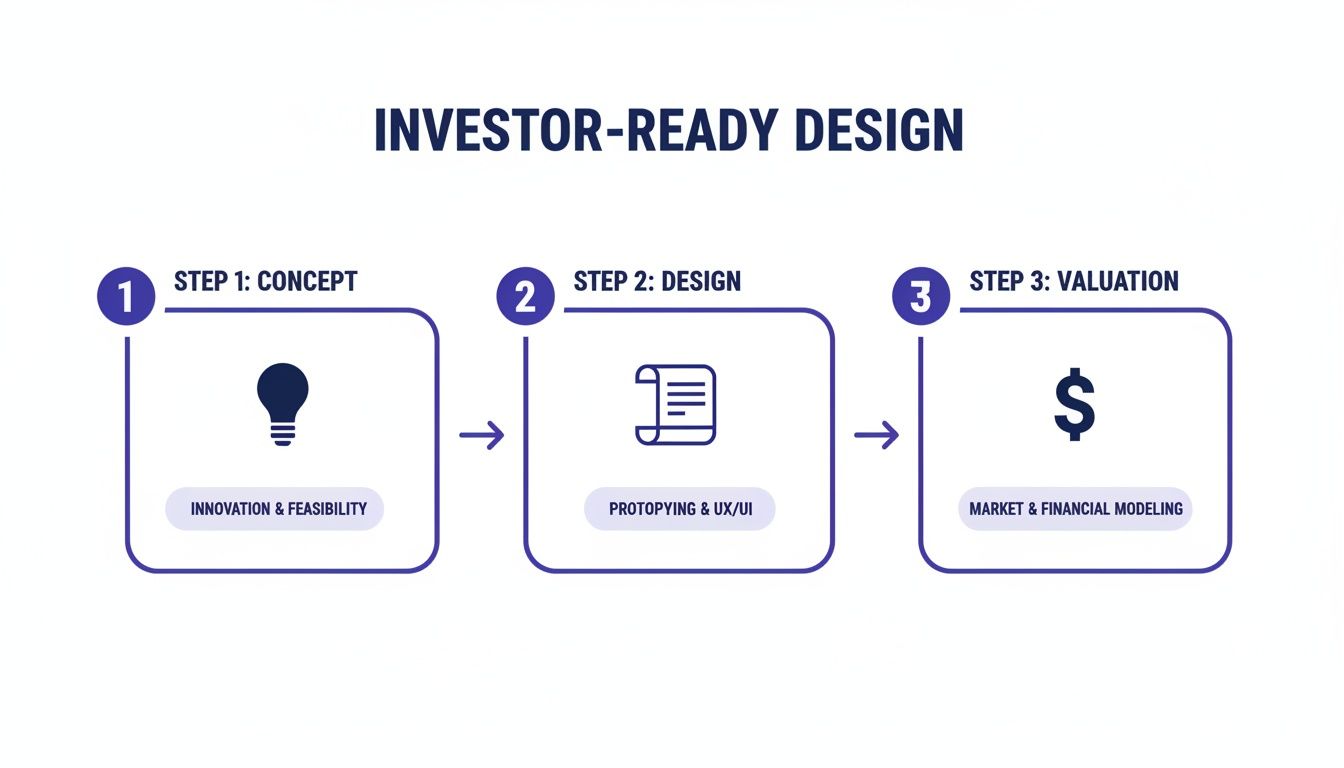
As you can see, design isn’t an isolated step you check off a list. It is a core business function that directly builds and proves the asset value of your product.
Prioritizing design isn’t a “nice-to-have”—it produces tangible business outcomes that investors demand. The data paints a clear picture.
Design-Centric Startups Vs The Rest
Metric
Design-Centric Companies
Industry Average
Revenue Growth
32% faster
Standard
Shareholder Returns
56% higher
Standard
User Activation & Churn
Higher activation, lower churn
Higher friction & drop-off
The bottom line: a commitment to elite design translates directly to the health of your P&L and your cap table.
The Anti-Outsourcing Mentality
Traditional outsourcing treats design like a commodity—a set of screens delivered from a black box with no strategic context. For a founder, this model is a disaster. It creates a massive gap between the founder’s vision and the technical execution, leading to features nobody wants and architectural dead ends.
As a boutique partner, we operate as mentor-architects. Our goal is to guide founders, providing the transparency and strategic leadership needed to make sound technical decisions. We build with you, not just for you.
This high-touch partnership ensures every design choice is intentional and directly tied to the long-term goal of increasing your company’s valuation. To build a product that attracts capital, you must understand what investors are looking for. Start by analyzing the latest trends among Top Product Design United States Investors.
Ultimately, your success hinges on building an investable company. This guide is your playbook for doing exactly that, starting with the most critical piece of the puzzle: product design.
How Do You Get From Problem Discovery to a Validated MVP?
Your initial idea isn’t what investors are betting on. They’re betting on your ability to prove that idea solves a real, painful problem for a market that will pay for a solution.
This is where we move from concept to validated product, without burning through your precious runway. It’s about building a rock-solid case, backed by evidence, that you’re building the right thing.
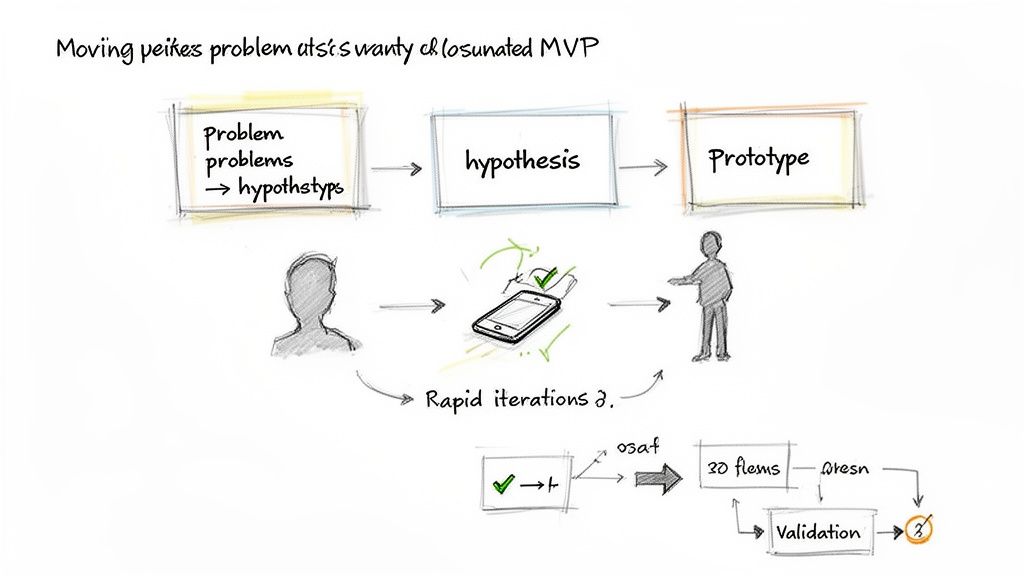
This isn’t a linear path. It’s a tight, disciplined loop of learning, building, and measuring that systematically de-risks your entire venture. Each cycle produces more of the hard data required to command an investor meeting.
Uncovering The Real Problem With Lean Research
Too many founders fall in love with their solution before they intimately understand the problem. You must resist this instinct. The antidote is lean, direct user research.
This isn’t about expensive focus groups. It’s about getting on the phone or grabbing coffee with your target customers and listening.
The goal is to dig for past behaviors, not future promises. People are notoriously bad at predicting what they’ll do. Instead of asking, “Would you pay for an app that does X?”, ask, “Walk me through the last time you dealt with X. What was that like? What did you try to do?”
These stories reveal actual pain points and the clunky workarounds they already use. That is your goldmine.
From Insights to Action With User Journey Mapping
Once you have a firm grasp of the core problem, it’s time to map it out. A user journey map is an essential tool here. It is a simple visualization of the steps your customer takes to get from their initial problem to their desired outcome.
This forces you to see the world from their perspective. More importantly, it becomes your blueprint for defining your Minimum Viable Product (MVP). You can look at the map and ruthlessly cut anything that doesn’t directly solve a critical pain point in that primary journey. Those “nice-to-have” features can wait.
The purpose of an MVP isn’t to build a cheap, stripped-down version of your dream product. It’s to build the fastest possible version that delivers core value, so you can test your most critical assumptions with real users.
This focus is everything. It’s how you get to market quickly and start learning from actual user behavior. For a deeper dive on the strategy and engineering behind this stage, consult our full guide on building an investor-ready MVP.
Mitigating Risk With Rapid Prototyping
Before a single dollar is spent on production code, you must test your proposed solution. Rapid prototyping is the most capital-efficient way to do this.
We’re talking about everything from paper sketches to interactive mockups in tools like Figma. Get something tangible in front of real users and observe their reactions. The goal isn’t to hear, “Wow, that’s great!” The goal is to find the flaws.
Every piece of confused or negative feedback is a gift. It’s a free lesson that saves you from writing thousands of lines of code for a feature nobody understands or wants. In the high-stakes world of startups, where new product failure rates can hit 90%, this is not optional. It’s why 85% of product managers state that prototyping and MVPs are non-negotiable for testing ideas.
By combining sharp research, a focused user journey, and relentless prototyping, you turn a guess into an evidence-backed concept. This is the foundation for an MVP that isn’t just software—it’s a true business asset that proves to investors you know how to build a company that lasts.
Designing for Production and Due Diligence
You launched. The celebratory post is live, and users are trickling in. But a few months later, the cracks appear. The app slows down, new features are a nightmare to implement, and your first big technical hire quits in frustration.
What happened? You built a great-looking MVP, but its foundation was quicksand. Those “move fast and break things” design choices have piled up into a mountain of technical debt. This isn’t just an engineering problem—it’s a valuation killer that sends investors running during due diligence.
This is where product design must be more than user flows. It needs to be an architectural game plan, focused on building a high-value technical asset from day one, not a disposable prototype.
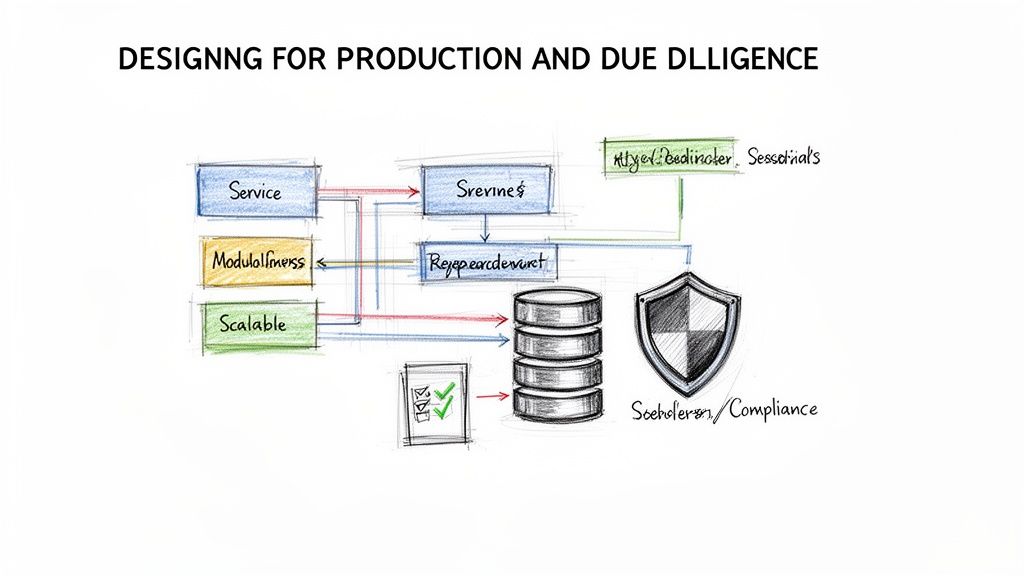
Think Like a CTO During Design
Most designers focus on the user experience, which is essential. But for a startup, it’s only half the story. You need an engineering architect’s perspective—the kind a Fractional CTO provides—integrated into your design process.
This means every design decision gets a reality check. A designer dreams up a real-time analytics dashboard. The architect in the room immediately fires back:
-
Scalability: What is the plan when 10,000 concurrent users hit this? Will the entire system grind to a halt?
-
Cost: What will this cost to run? Are we signing up for expensive cloud services that will torch our runway?
-
Maintainability: How many engineers will this tie up for the next three months? Is it distracting from shipping other critical features?
This constant dialogue between design and architecture separates a product that can grow from one that will collapse. You can dive deeper into this essential partnership in our guide on app development for startups and see how it aligns with your strategic goals.
Building for the Due Diligence Gauntlet
Sooner or later, you’ll be in a room with a potential investor or acquirer. Their technical team will look under the hood, and a messy, insecure, or poorly documented system can end the conversation. You must design for that moment from the beginning.
We eliminate technical debt at the root. Our builds are designed to pass rigorous VC technical due diligence and increase company valuation. This isn’t an afterthought; it’s our starting point.
Building an “audit-ready” product isn’t about gold-plating everything. It’s about making smart, forward-thinking decisions on three core pillars long before your engineers write a single line of code.
The Three Pillars of an Audit-Ready Product
1. Data & Compliance: Think hard about where user data will live and how it’s structured. A casual decision to lump all data together can become a massive liability when you need to comply with GDPR or CCPA. Designing for compliance from the start saves you from a world of hurt later.
2. Security by Default: Security is not a feature you bolt on at the end. It must be woven into the fabric of your design. Simple things like password reset flows or how your API exposes data can create massive vulnerabilities if not designed with a security-first mindset.
3. Scalable Infrastructure: Your design directly influences your infrastructure. A monolithic app designed for 100 users will require a complete, and very expensive, re-architecture to handle 100,000. By designing with a modular, service-based approach, you can scale individual parts of your application as you grow, not the whole thing at once.
Worrying about this at the design stage is the hallmark of a team building for the long haul. It’s how you ensure the product you launch today can carry you to Series A and beyond without the crushing cost of a total rewrite.
How Should You Leverage AI in Your Product Design Workflow?
By 2026, viewing AI as a shiny toy for your product team is a surefire way to be left behind. It’s not a novelty; it’s a core part of the machine. Startups that integrate it correctly will move faster, iterate with more intelligence, and build competitive moats others cannot cross.
The point isn’t to replace designers. It’s to give them superpowers—turning a lean team into a high-output force that punches far above its weight.
This is about more than speed. It’s about building a fundamentally smarter, more responsive product. When you weave AI-driven features into the heart of your experience, you’re not just adding bells and whistles. You’re engineering a competitive edge that becomes incredibly difficult to replicate.
Augmenting Design with Intelligent Tools
Think of AI as a junior partner for every person on your design team. It excels at processing the repetitive tasks that bog down the creative process. This frees your human talent to focus on what they do best: high-level strategy and solving complex problems.
This is how you get the output of a much larger company without burning through your runway at the same rate.
The sharpest teams use AI across the entire design lifecycle:
-
Generative User Research: AI can analyze raw interview transcripts, instantly surfacing critical pain points. It can generate first-draft user personas and journey maps, accelerating you out of the starting blocks.
-
UI Component Creation: Tools can now spin up high-quality, consistent UI elements from text prompts or by referencing your design system. This dramatically accelerates wireframing and prototyping.
-
Automated Usability Testing: Imagine an AI that watches user session recordings, automatically flagging moments of friction. You get data-driven insights for the next iteration without manual review.
The impact here is quantifiable. 93% of designers report using AI tools in their workflow, and 58% say AI helps them produce more output with the same team size—exactly the velocity investors want to see, since it shows up as shipping speed rather than headcount. You can dig into more data on how AI is reshaping the industry with these product design and efficiency statistics.
From Workflow Efficiency to Technical Moat
Using AI to speed up your internal process is a huge win. But the real game-changer is designing AI into your product. This is where you graduate from a productivity hack to building a formidable technical asset.
Picture a SaaS platform that uses an AI model to personalize the entire onboarding flow for every new user, tailored to their role. This isn’t a “nice-to-have” gimmick.
With every user interaction, that model learns. It gets progressively smarter at predicting what a new user needs to see to find that “aha!” moment and stick around. Your user experience becomes stickier, activation rates climb, and churn drops. This self-improving personalization loop, fueled by your proprietary data, becomes a core part of your product’s value and a massive barrier to entry.
We don’t just “build apps”; we engineer high-valuation technical assets. An AI-powered personalization engine is a perfect example. It’s a system designed from day one to increase user retention and, by extension, company valuation.
To execute this efficiently, you must stay on top of the latest advancements. Exploring the top AI tools for product management can provide a serious advantage. It’s about using the sharpest instruments available to build that competitive edge.
The key takeaway for founders is to view AI through two lenses. First, it’s a force multiplier for your team, making you more capital-efficient. Second, it’s a strategic ingredient for building a smarter product that learns and adapts, creating a moat that protects your business and drives long-term value. This dual approach is at the center of modern, investor-ready product design for startups.
Building Your Lean Product Design Practice
As a founder, you’re not just building a product; you’re building the machine that builds the product. The operational side of design is where many great ideas lose momentum, bogged down in process. The goal is to build a lean, data-driven system that works.
This isn’t about throwing money at a huge design team. It’s about building a high-performance engine for continuous improvement that directly increases your company’s valuation. This is how you run that system.
Hiring Your First Product Designer
Your first design hire is one of the most important decisions you’ll make. It sets the tone for your product culture. Too many founders get wowed by a slick portfolio of beautiful but shallow UI concepts. It’s a classic trap.
You don’t need a pixel-pusher. You need a product partner.
Look for a designer who spends the interview grilling you—about the business model, user pain points, the tech stack, the market. They should care more about the “why” than the brand colors.
A senior partner mindset is non-negotiable. You want a designer with strong opinions backed by even stronger reasoning from user research and a deep understanding of the product vision. Their real value isn’t in their Figma files; it’s in their ability to push the team forward and challenge assumptions.
Find candidates who obsess over user workflows and can draw a straight line from their design decisions to real business outcomes. This type of designer doesn’t just make things look pretty; they make the product work better.
Structuring a Seamless Handoff Process
The handoff from design to engineering is where speed is won or lost. A clunky, vague process is a recipe for friction, rework, and a demoralized team. The goal is a seamless, high-context flow of information that feels less like a baton pass and more like a continuous conversation.
This process boils down to two things:
-
Clarity: Designs must come with detailed specs, user flow diagrams, and notes on edge cases. An engineer should never have to guess what the designer was thinking.
-
Context: Engineers who understand the “why” behind a feature build a better product. Pull them into the design process early for their take on feasibility and scalability. This is a strategic move to head off future technical debt.
A great handoff isn’t a single meeting. It’s a living dialogue. The designer should remain involved through the development cycle, giving feedback and answering questions to ensure the final build nails the strategic intent. This constant feedback loop separates good teams from great ones.
Defining Metrics That Actually Matter
What gets measured gets managed. But tracking vanity metrics like page views will send you sprinting in the wrong direction. For an early-stage startup, you must be laser-focused on the KPIs that prove you are creating real value and building a durable business.
These are the numbers investors really care about during due diligence:
-
Activation Rate: What percentage of new users complete the key “aha!” moment action? A low activation rate is a red flag pointing to a broken onboarding or value proposition.
-
User Retention: How many people are still around after 7, 30, or 90 days? Strong retention is the single best signal of product-market fit.
-
Time-to-Value (TTV): How fast does a new user get to that “aha!” moment? Your design should be obsessed with crushing this number. A shorter TTV is directly tied to higher retention.
-
Feature Adoption Rate: Are people actually using that new feature? This metric tells you if you’re solving a real problem or just adding bloat.
When you rally your design practice around these core metrics, you align everyone with what truly matters: building a product users love and a business that’s investable. You move from opinions to evidence. And that’s how you build a company that cannot be ignored.
Founder FAQs on Product Design
We spend our days in the trenches with founders. We’ve heard every question and late-night panic about turning a great idea into a real, investor-ready product.
Here is our direct advice, pulled from that experience.
How Much Should a Startup Budget for Product Design?
Let’s reframe the question. Instead of “cost,” think “investment” and “risk mitigation.” Founders often hear a 10-20% rule of thumb—dedicate that slice of your pre-seed technical budget to design. This is a misleading way to look at it.
A smarter approach is to see design as the ultimate way to de-risk your entire venture.
Putting real capital behind an expert partner to nail down the core problem, map the right MVP, and design for scale will save multiples of that investment down the road. It helps you dodge the two most expensive mistakes a startup can make: building something nobody wants, or building something that crumbles at the first sign of traction.
Cheap design is the most expensive line item on a failed startup’s P&L. It leads to building a technical liability, not an asset, which gets eviscerated during due diligence.
A good Fractional CTO can help you map this out. They’ll tie these early design and engineering investments directly to your fundraising goals, pitching it to VCs as a strategic move to build a high-valuation technical asset from day one.
When Do I Need a Full-Time Designer vs. a Partner?
This is about capital efficiency. For nearly every founder in the idea-to-MVP stage, bringing on a specialized partner is more effective than hiring.
A boutique partner gives you the brainpower of an entire senior product team—strategy, research, UX/UI, and engineering leadership—without the heavy lift of recruiting, six-figure salaries, and long-term overhead. You get a focused team obsessed with one thing: getting your product built, validated, and ready for investment.
The time to hire your first full-time Head of Design is after you’ve hit product-market fit and closed a solid funding round, like a Series A. At that point, the game changes. You have a validated roadmap and need to build an internal team and culture for the next phase of growth. That is when a design leader makes perfect sense.
What Is the Biggest Design Mistake Startups Make?
By far, the biggest mistake is confusing a pretty user interface (UI) with great product design. We see it constantly. A founder hires a freelance designer to create “beautiful screens” without doing any of the hard, foundational work first.
This is a catastrophic error.
Great product design for startups is about solving a painful problem. It’s the tough, often invisible work of user research, systems thinking, and interaction design that makes a product usable, valuable, and technically sound. A beautiful UI draped over a useless or broken product is worthless.
The second-biggest mistake? Racking up “design debt.” This happens when you make a series of small, “ship-it-fast” compromises on the user experience. One or two might seem harmless, but they pile up, creating a messy, inconsistent product that becomes a nightmare to fix. It’s a hidden tax on your future growth.
At Buttercloud, we are more than just engineers; we are the strategic partner that guides founders through the entire lifecycle of turning an idea into a scalable, high-valuation technical asset. We build the investor-ready foundation your startup needs to succeed.
Turn your vision into an investable product with Buttercloud.
Have a product idea to talk through?
We'll show you how we'd approach it — no pressure, just a real conversation.
Book a Discovery Call