
MVP Meaning in Software Development: The Founder's Guide
Most advice about MVPs is wrong in the way that matters most to founders. It treats the MVP as a cheap draft you rush into the market, learn from, and replace later. That mindset burns time, capital, and credibility.
The MVP meaning in software development is simpler and more demanding. An MVP is the first version of your company’s technical asset. It should validate demand, yes. It should also stand up to scaling, diligence, and the scrutiny that comes when investors ask whether your product is real or fragile.
The MVP Misconception Holding Founders Back
Founders hear “minimum viable product” and focus on the word minimum. That’s the trap. A weak MVP is not lean. It’s expensive, because you pay for it twice. First when you build it badly, then again when you rebuild it under pressure.
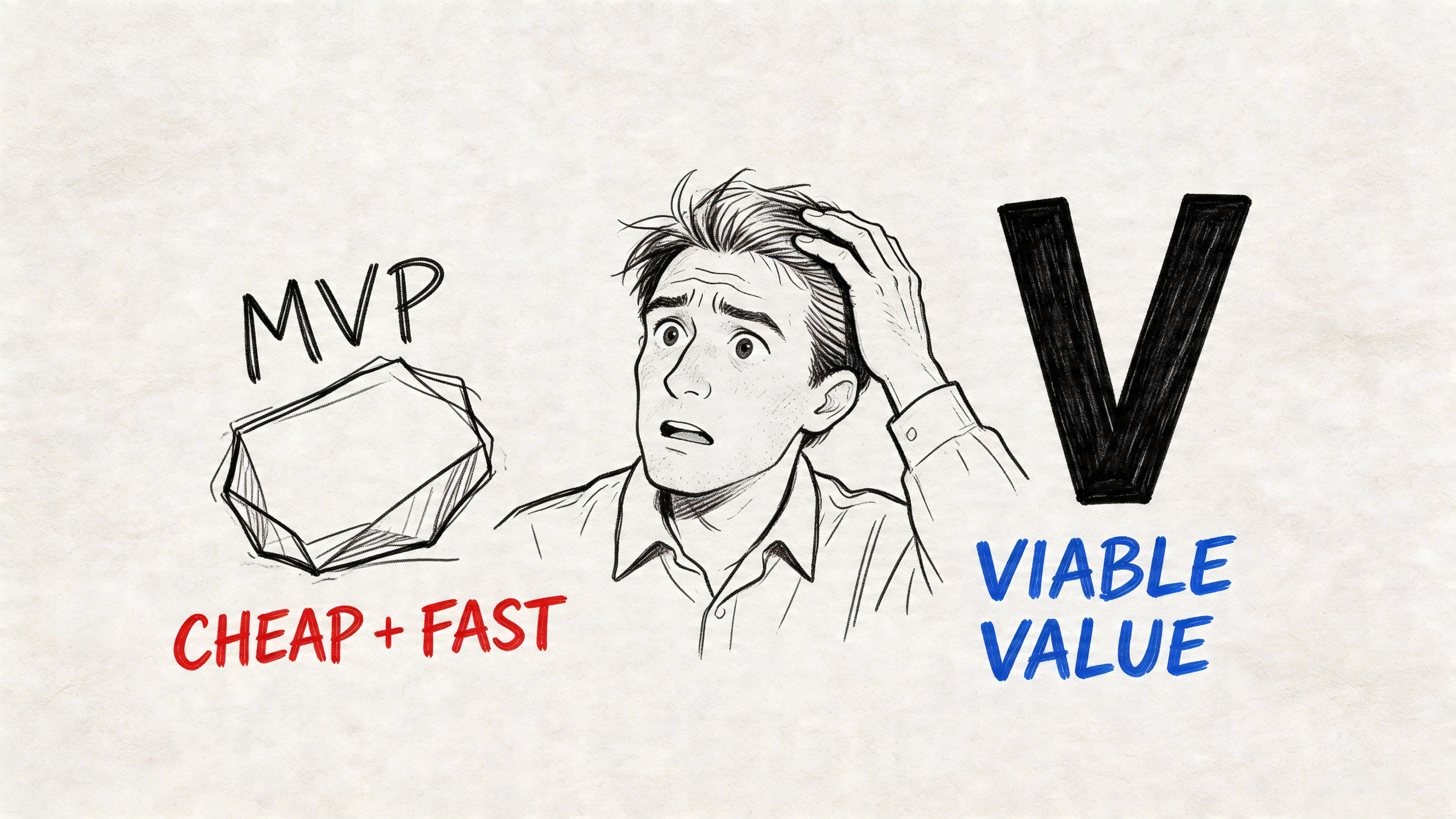
The market has already decided that MVPs matter. Approximately 72% of startups worldwide employ the MVP approach in software development because it helps validate market demand and user needs early, according to startup survival statistics on MVP adoption. If most startups are using the same tool, your edge doesn’t come from using an MVP. It comes from building the right kind.
Viable should mean investable
A product is not viable because it technically works. It’s viable when early users get enough value to change behavior, and when the codebase gives you room to iterate without collapse.
That changes the founder’s question from “How cheaply can I launch?” to “What is the smallest product that proves demand and preserves future valuation?”
Practical rule: If your MVP creates urgency to rewrite the system before growth, you didn’t build an MVP. You built a temporary demo with production consequences.
The cost of the wrong definition
A rushed MVP creates hidden liabilities:
Architecture debt: Core decisions get locked in before anyone thinks about scale.
Investor risk: Technical diligence exposes shortcuts that looked harmless during launch.
Team drag: Every new feature takes longer because nobody trusts the foundation.
Strategic confusion: Founders mistake user interest in the idea for readiness of the product.
The founders who win don’t worship speed in isolation. They use speed with discipline. They build the smallest product that can learn fast, survive scrutiny, and expand cleanly.
That is the only useful definition.
Deconstructing the Minimum Viable Product
Founders get the term wrong because they take it too much at face value. They hear minimum and start cutting quality. They hear viable and settle for a weak signal. They hear product and ship something that cannot survive real usage or investor scrutiny.
That is how a cheap MVP becomes an expensive rewrite.
Minimum means constrained scope, not compromised foundations
Minimum defines the business problem you solve first. It does not justify fragile architecture, sloppy data models, or a codebase your next engineer will want to replace.
Set the scope around one urgent job, one primary user, and one core workflow. Keep the surface area small. Keep the underlying system disciplined. If your first release needs authentication, payments, permissions, or audit trails, build those correctly the first time. Founders who treat infrastructure as optional usually pay for it twice, once during launch and again during diligence.
Use a simple test. If removing a feature still lets the user reach the promised outcome, cut it. If removing a technical safeguard creates operational risk, keep it.
Viable means strong enough to create trust
Viable is a business standard, not a product adjective. The product has to deliver enough value that users complete the key action, come back, and trust the system with real work.
That standard changes your prioritization. Do not ask which features fit the sprint. Ask which capabilities make the product credible in the hands of an actual customer. A bare interface with broken edge cases is not viable. Neither is a polished flow that fails on permissions, data accuracy, or response time.
Prioritization frameworks can help, but founders often misuse them as permission to strip the product to the point of irrelevance. Use them to rank tradeoffs, not to excuse low standards. The right MVP is small in scope and serious in execution.
Product means operational software with consequences
Product is the word that carries the most weight.
A product accepts real inputs, produces dependable outputs, handles failures, and gives users a reason to trust it again tomorrow. It has monitoring, clear ownership of core workflows, and enough stability that customer feedback reflects market demand instead of preventable defects.
This matters far beyond launch. Investors are not buying your current feature set. They are judging whether the asset underneath it can compound. If your MVP depends on manual fixes, hidden scripts, or brittle logic, your valuation takes the hit later.
A real MVP lets you measure customer behavior on a system you can keep building on.
That is the standard founders should use.
A definition worth using
Here is the version that holds up under growth and diligence:
Minimum: the smallest scope that proves one high-value use case
Viable: enough reliability and usefulness to earn credible user behavior
Product: production-grade software that can be maintained, extended, and reviewed without embarrassment
Miss any one of those, and you do not have an MVP. You have a test artifact.
A strategic MVP is smaller than a full product, but it is still an asset. Build it that way.
Clearing the Confusion MVP vs Prototype vs POC
Founders burn budget when they fund the wrong artifact. They ask for an MVP to answer a feasibility question. They approve a prototype when the true risk is adoption. Then they get a deliverable that looks productive but leaves the core business question unresolved.
The fix is simple. Match the artifact to the risk.
Say you are building an electric vehicle company.
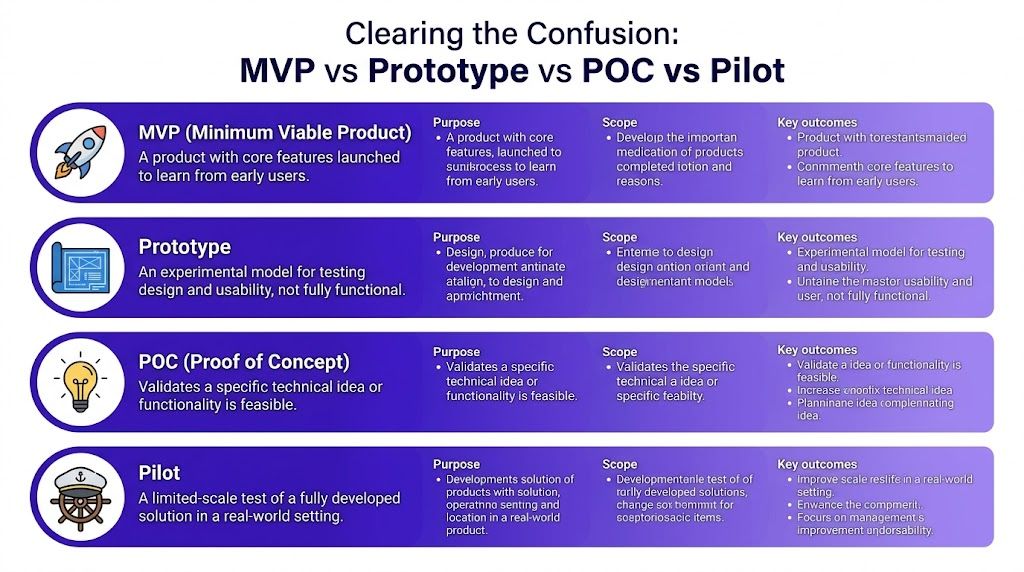
A POC tests whether the battery chemistry works in a lab. A prototype shows the shape, controls, and user experience. An MVP is a working vehicle that real customers can drive and judge. A pilot puts that vehicle into a controlled commercial rollout with real operating constraints.
Those are not interchangeable steps. Each one exists to remove a different kind of risk.
What each artifact is really for
Use this frame to keep the team honest:
Deliverable | Core question | What it looks like | Who it’s for |
|---|---|---|---|
POC | Can this technically work? | Focused technical experiment | Engineers, architects, technical founders |
Prototype | Does this design make sense? | Mockup, wireframe, interactive concept | Users, designers, investors during early pitches |
MVP | Will people use and pay for this? | Working product with one meaningful workflow | Early adopters, market, founding team |
Pilot | Can this run reliably in a live environment? | Limited deployment of a near-ready solution | Customers, operators, enterprise stakeholders |
That third row matters most.
A strategic MVP is not a prettier prototype and not a dressed-up POC. It is production software built to generate credible market evidence. If users adopt it, you should be able to keep the codebase, extend it, and survive diligence on how it was built. If you cannot do that, you did not build an asset. You built a disposable test.
Where founders usually go wrong
A non-technical founder often asks for a product when the blocker is still technical feasibility. That calls for a POC, not a launch plan.
A design-led team can spend months refining screens before proving that anyone needs the workflow. That is a prototype doing the job of product strategy.
A startup with early traction can still fail inside a customer account because the hard part is deployment, permissions, compliance, or uptime under real conditions. That calls for a pilot.
Choose the artifact based on the uncertainty you need to remove, not the label that sounds most impressive.
This is also where technical discipline starts to affect valuation. If your MVP is the chosen path, treat it like infrastructure for the company you want to build, not a throwaway experiment. Release carefully. Gate incomplete functionality. Follow feature flags best practices so you can test in production without turning the product into a reliability problem.
Why the distinction saves capital
Each artifact has a job. A POC should answer one hard technical question cheaply. A prototype should clarify usability and concept fit before engineering commits to architecture. A pilot should prove live operability with a narrow customer group.
An MVP carries a heavier burden. It has to test demand on software that people can trust enough to use more than once. That is why founders should be stricter with MVPs than with any earlier artifact. Small scope is smart. Fragile execution is expensive.
Teams do use prioritization frameworks such as MoSCoW or impact versus effort scoring to cut scope. That helps only after you choose the right deliverable. Prioritization cannot rescue a category mistake.
A fast decision filter
Use this checklist before approving budget or writing a spec:
Choose a POC when the core risk is technical feasibility.
Choose a prototype when you need feedback on flow, UI, or concept clarity.
Choose an MVP when you need real usage, retention signals, and evidence that the product can become a durable asset.
Choose a pilot when the product works, but you need controlled validation inside a real customer environment.
Founders who label the work correctly make better technical decisions. Founders who do not usually pay twice. First for the wrong build, then again to replace it with something the business can use.
Four Strategic MVP Approaches for Founders
Not every MVP should be coded first. The right approach depends on the risk you need to remove.
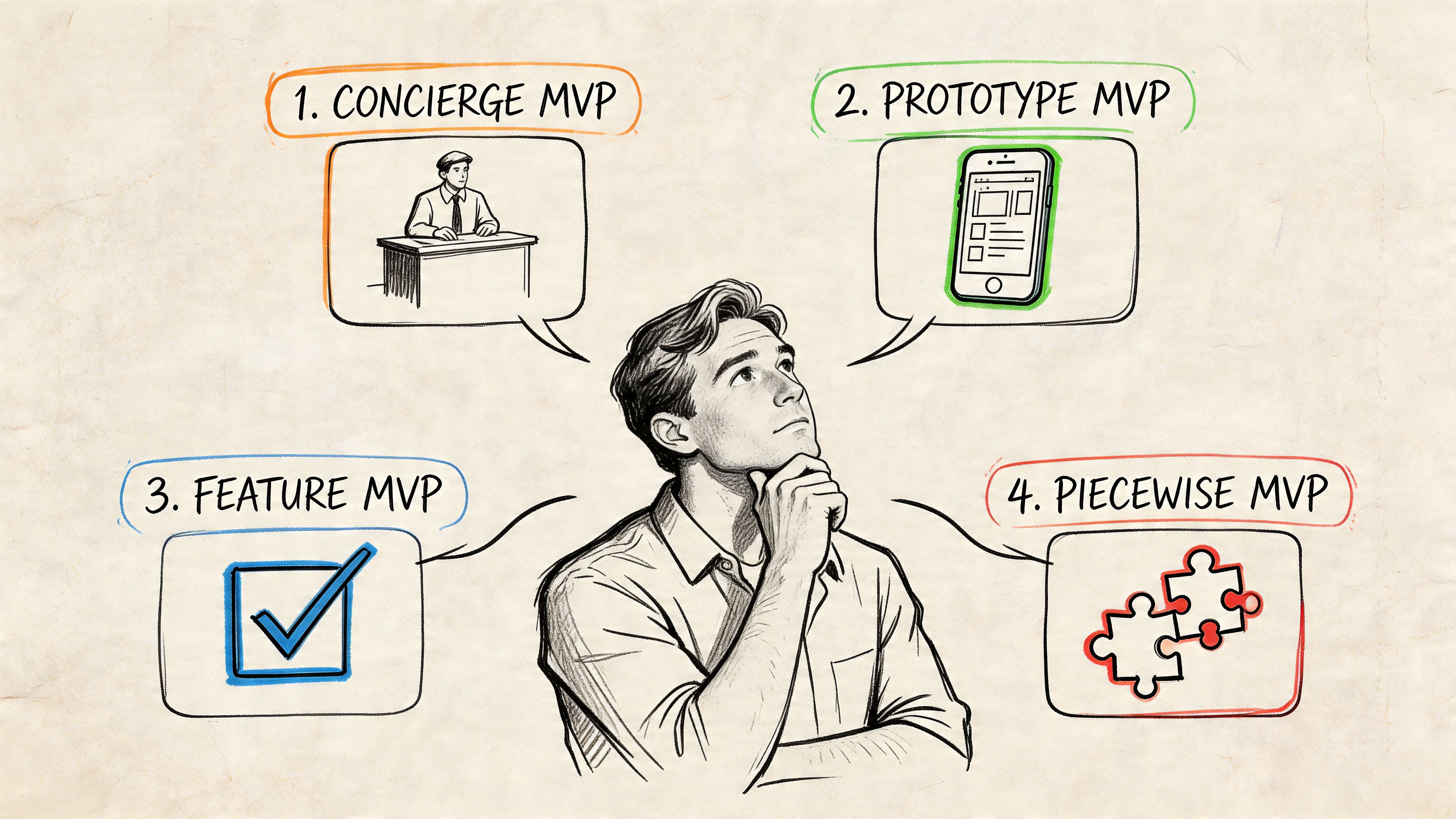
Concierge MVP
This is the right move when you need to validate the service outcome before you automate it.
You manually deliver the value behind the scenes. If you’re building a recruiting platform, don’t start with a full matching engine. Interview candidates yourself, shortlist them manually, and learn what employers pay for. This approach exposes demand, objections, and workflow complexity before engineering locks in the wrong assumptions.
Use it when the business model is uncertain but the service can be delivered by human effort.
Landing page MVP
This tests message-market fit before product-market fit.
You create a clear value proposition, a landing page, and a conversion path such as a waitlist, demo request, or application flow. This does not validate a full product. It validates whether people understand the problem you solve and care enough to respond.
It’s useful when the biggest question is positioning. It’s weak when founders pretend lead capture equals usage validation.
Wizard of Oz MVP
This model gives users a polished front-end experience while your team handles the hard work manually behind the curtain.
It works well for AI products, workflow automation, and marketplaces where the back-end logic is still evolving. The user thinks the system is fully automated, but your team is controlling key steps manually. That lets you test the user experience before you commit to expensive infrastructure.
A smart addition here is disciplined release control. If you want to expose features to small user groups without destabilizing the product, study these feature flags best practices. They’re useful when staged rollout matters more than broad release.
Production-grade MVP
This is the model serious venture-scale founders should default to once they’ve confirmed the problem is worth solving in software.
A production-grade MVP is still narrow in scope, but it’s built with durable architecture, operational discipline, and code you intend to keep. You are not simulating a company. You are building the first reliable version of one.
Use this when:
You expect investor diligence: The codebase needs to withstand scrutiny.
You operate in regulated or sensitive workflows: Security and data handling can’t wait.
You know the product will need iteration, not replacement: Rewrites destroy momentum.
You’re building a platform, not a one-off tool: The foundation matters immediately.
Which one should you pick
Here’s the blunt recommendation.
Start with a Concierge MVP if the service itself is still ambiguous. Use a Landing Page MVP if your category and positioning are still fuzzy. Use Wizard of Oz if the interaction matters more than the automation. Build a Production-grade MVP when software is already the business and you need the first version to become an enduring asset.
Founders don’t need one universal MVP model. They need the correct instrument for the current risk.
Building an Investor-Ready Technical Asset
The “quick and dirty MVP” is one of the most expensive ideas in startup culture. It sounds efficient because it postpones discipline. In practice, it pushes cost into the worst possible moment, right when traction appears or diligence begins.

The numbers are ugly. 70% of startups face significant technical debt problems post-MVP, which can burn 2-3x more capital to fix before Series A, while production-grade MVPs reduce long-term costs by 40%, according to this analysis of MVP debt and long-term cost.
That should change how you think about early engineering. Your first version is not just a market test. It is the base layer investors, future hires, and later customers will inherit.
What production-grade actually means
This is not about overbuilding. It’s about building cleanly.
A production-grade MVP usually includes:
Modular architecture: Core services can evolve without forcing a rewrite of the whole stack.
Disciplined code standards: Naming, testing, review, and documentation are handled as engineering fundamentals.
Basic security hardening: Authentication, permissions, secrets handling, and data boundaries are designed, not patched in later.
CI/CD from the start: Shipping should be repeatable, not dependent on one developer’s memory.
Operational visibility: Logging, monitoring, and error reporting exist before customers start finding issues for you.
Investors rarely care whether your first release had extra polish. They care whether your system can survive growth without becoming a liability.
Why this changes valuation
A clean codebase does more than reduce engineering pain. It impacts business advantage.
When your system is understandable, testable, and scalable, you can ship faster after launch. You can hire into it. You can survive diligence. You can respond to customer requests without destabilizing the product. That lowers execution risk, and execution risk is one of the first things serious investors evaluate.
If you’re already preparing outreach, it helps to understand how investors segment early-stage software opportunities. A practical starting point is to browse investors on Gritt.io and compare who funds concept-stage products versus teams with operational traction.
The founder checklist for an investable MVP
Ask your team these questions before writing the first production line:
Question | Why it matters |
|---|---|
Can this architecture survive successful adoption? | Growth should not trigger a rewrite crisis |
Do we know which parts are temporary and which are foundational? | Not every component deserves equal permanence |
Can a new engineer understand the system quickly? | Hiring friction becomes scaling friction |
Do we have deployment discipline? | Unreliable release processes kill momentum |
Are we building a test product or a company asset? | The answer changes every technical decision |
A founder who can’t get clear answers here is not managing risk. They’re postponing it.
The practical build path
The most sensible process looks like this:
Run discovery hard. Clarify user workflows, assumptions, constraints, and technical unknowns.
Scope narrowly. Build only the workflow that proves value.
Design for change. Separate volatile logic from durable foundations.
Ship with operating discipline. Testing, deployment, and observability aren’t optional.
Iterate on signal, not founder preference.
For founders comparing delivery options, Buttercloud’s startup MVP development perspective is one example of how a partner can frame MVPs as investor-ready technical assets rather than disposable prototypes.
That’s the standard to hold. Not “Can we launch fast?” but “Will this product still help us six months after launch, under pressure, in front of investors?”
Measuring Success and Planning Your Next Move
Most founders measure the wrong things after launch. They celebrate sign-ups, page views, and polite compliments. None of those tell you whether the product deserves more capital.
Measure behavior around the core workflow. If your product solves a real problem, users should move through activation, return for the same job, and show patterns that justify deeper investment.
What to track after launch
Start with a small set of metrics tied directly to product value:
Activation: Did users reach the first meaningful outcome?
Retention: Did they come back because the product mattered?
Workflow completion: Did they finish the job the product was built for?
Qualitative friction: Where did they get confused, hesitate, or abandon?
Revenue quality: If applicable, are customers paying for the core value or for services around it?
Don’t confuse attention with validation. Interest is cheap. Repeated use is harder to fake.
Why architecture still matters after launch
Post-launch learning is only useful if your system can absorb change. A well-defined architecture phase matters because it reduces wasted effort later. In MVP software development, architecture design can reduce initial development time by 40-60% by focusing on modular components while still planning for future performance benchmarks such as sub-200ms API response times, according to this guide to MVP architecture and delivery.
That point matters after launch because iteration speed depends on the quality of your foundation. If every improvement requires patching brittle code, your feedback loop collapses.
Good architecture doesn’t slow learning. It protects it.
Signals that justify scaling
You can move beyond the MVP when several conditions are true at the same time:
Users complete the intended journey without heavy intervention
The same user segment keeps returning
Feedback clusters around enhancements, not basic confusion
Your team can ship changes without destabilizing the product
The economics of acquisition and delivery look sustainable enough to test at greater volume
That last point is where founders often overreact. Don’t scale because you’re excited. Scale because the product is producing repeatable behavior and your system can handle the next layer of demand.
If your team needs a tighter operating cadence around scope, delivery, and feedback loops, this guide to MVP project management for startups is a useful reference point.
Common mistakes after the MVP launch
A few errors keep repeating:
Scaling too early: You add infrastructure and team size before proving repeatability.
Ignoring interviews: User conversations explain friction that dashboards can’t.
Protecting the original idea: Founders cling to the first solution instead of the underlying problem.
Treating engineering as secondary: Product insight means little if the team can’t implement clean changes.
Launch is not the finish line. It’s the start of a sharper decision cycle. Learn fast, but learn from the right evidence.
Conclusion From Idea to Investable Asset
Founders damage company value when they treat the MVP as a throwaway build. MVP meaning in software development is smaller scope with serious intent. You are creating the first version of a technical asset that investors, acquirers, and future hires will judge.
A weak MVP does more than slow product progress. It creates rewrite costs, raises diligence concerns, and limits how confidently you can scale the business. An investor-ready MVP should validate demand, support iteration, and hold up under real operational pressure, with architecture, data handling, and code quality that can survive the next stage of growth.
Precision matters more than speed theater.
After launch, the quality of your decisions depends on the quality of your feedback loop. Founders who build a disciplined process for collecting valuable MVP feedback make better product bets, protect engineering time, and avoid expensive roadmap drift.
A strong MVP is your first proof that the business can become a durable company, not just a promising demo.
If you're building from idea to investor-ready product, Buttercloud helps founders shape discovery, architect production-grade MVPs, and turn early software into a technical asset that can survive diligence, scaling, and real market pressure.