Outsourced App Development: A Founder's Guide

Founder & CEO, Buttercloud
Let’s be direct. When most founders hear “outsourced app development,” they picture handing their vision to a mass-market firm and hoping for the best. For a startup, that is a fundamentally broken model—a recipe for disaster.
Success isn’t about finding the lowest bidder; it’s about engaging a strategic partner who engineers a high-valuation technical asset, not just a disposable app.
Why Does the Traditional Outsourcing Model Fail Startups?
The term “outsourcing” has a negative connotation for a reason. It evokes images of opaque contracts, painful time-zone mismatches, and a codebase that crumbles under the scrutiny of an investor’s technical due diligence.
As a founder, every dollar must build a competitive advantage. Every decision impacts your valuation. The traditional outsourcing model is a direct path to burning your two most valuable resources: time and capital. It’s time to adopt a new framework.
Your goal isn’t just to “get an app built.” The real mission is to transform your idea into an investor-ready MVP and, ultimately, a scalable product. This requires more than just programmers for hire; it demands elite engineering leadership.
From Code Monkeys to Strategic Technical Partners
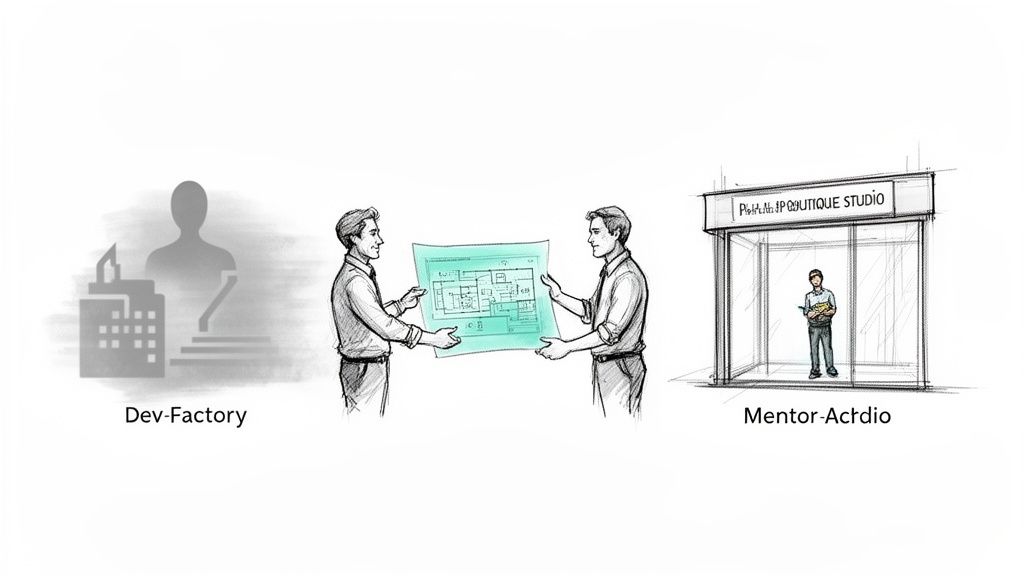
Here’s the most critical mistake I see founders make: they treat their development partners as task-takers. You don’t need a “dev shop” that blindly follows a spec sheet. What you need is a senior technical partner who thinks like both mentor and architect—a boutique partner who guides you through the complexities of building a tech company.
This partnership is the antithesis of the mass-market outsourcing factory. It is defined by:
-
Building a Defensible Advantage: Your code must be a strategic asset. This means clean, documented, and scalable architecture designed from day one to pass rigorous VC technical due diligence. A disposable prototype is a liability; an investable asset is the objective.
-
A Transparent Partnership: The “black box” model where you toss requirements over a wall and receive code is broken. A true partner provides a high-touch, transparent process. You are mentored, not just managed. You will understand the why behind every technical decision.
-
Strategic Leadership (Fractional CTO): Most founders are not technical experts, and that is an advantage when paired correctly. An elite engineering partner acts as your Fractional CTO, helping you craft a robust technical roadmap, make correct architectural decisions, and even navigate tech team hiring when you’re ready to build your internal culture.
For a startup, the choice of an engineering partner is not a vendor decision; it is a co-founder-level decision. The right partner elevates your vision, protects your valuation, and builds an asset that can scale. The wrong one delivers a product that requires a complete rebuild, wasting your two most precious resources—time and capital.
Why Audit-Ready Engineering is Non-Negotiable
Picture this: you are in a Series A pitch. The VC’s engineering team initiates a technical due diligence audit on your app. What they discover is a messy, undocumented codebase drowning in technical debt.
Instantly, your company is recategorized as a high-risk investment. In their minds, the cost to scale has just skyrocketed. This can obliterate your valuation—or kill the deal on the spot.
That is the hidden price of choosing a low-cost outsourcing option.
Audit-ready engineering is not a “nice-to-have”; it is a foundational requirement. It means your partner is obsessed with eliminating technical debt at the root, ensuring your product is not only functional today but is built on a foundation that investors will value and that can support massive growth tomorrow. This guide is designed to help you find such a partner—one as focused on your company’s valuation as you are.
Picking the right engineering partner is one of the most critical decisions you will make in your startup’s early days. Get it right, and you fast-track your journey to an investor-ready MVP. Get it wrong, and you are left with a mountain of technical debt that craters your valuation during due diligence.
This isn’t about finding a “vendor.” It’s about finding an engineering partner who thinks and acts like a strategic co-founder.
The search must go far beyond a glossy portfolio. You need to scrutinize their core philosophy, their battle-tested processes, and how they approach technology as a business asset. A slick UI on a public-facing app reveals nothing about the architectural integrity underneath.
Vetting Beyond the Portfolio: The Hands-On Technical Leadership Litmus Test
Anyone can showcase a finished product. A true engineering partner, however, can demonstrate how they build, document, and prepare that product to survive the brutal scrutiny of a venture capital tech audit. This is precisely where mass-market agencies fail and boutique partners excel.
Your evaluation must zero in on three areas that directly impact your startup’s future valuation and scalability:
-
Approach to Technical Debt: Do they view it as an unfortunate byproduct, or is it an adversary to be eliminated from day one? A partner who champions “audit-ready engineering” understands this. They know clean, scalable code isn’t a luxury—it’s the very foundation of an investable company.
-
Fractional CTO Capability: Can they deliver more than just code? Your ideal partner must provide strategic leadership, guiding you through complex architectural decisions and preparing you to eventually build your own high-performance team.
-
Experience with Investor Due Diligence: Have they been in the trenches? Demand specific, detailed examples of how they’ve prepared a startup’s codebase for a Series A technical review. Their response will differentiate the coders from the business strategists.
The most dangerous partner is the one who says “yes” to everything. A true hands-on technical partner will challenge your assumptions, push back on features that don’t drive core value, and focus relentlessly on building a lean, powerful, and scalable technical asset. Their job is to protect your valuation, even from your own feature creep.
Probing Questions to Ask on a Discovery Call
Forget generic questions like, “What’s your tech stack?” Instead, ask questions that compel them to reveal their methodology and mindset. Their answers will quickly separate the task-takers from the strategic partners.
Here are the questions you must ask:
-
“How do you ensure our code is audit-ready for a VC’s technical review?” Listen for answers that include disciplined CI/CD pipelines, automated testing, comprehensive documentation, and a zero-tolerance policy for technical debt. If they cannot speak this language fluently, they are not equipped to build an investor-ready asset.
-
“Describe your process for transitioning a project to an in-house team post-Series A.” A great partner plans for their own obsolescence. They should discuss mentorship, knowledge transfer documentation, and helping you define the roles for your first key technical hires.
-
“Walk me through a time you advised a founder that their idea was technically unfeasible or strategically flawed. What was the outcome?” This is a test of integrity. You want a partner who provides honest, expert counsel, not one who will cash your checks to build something they know is doomed to fail.
This level of rigorous vetting is non-negotiable. App development is now one of the most strategically outsourced services on the planet, with three in five organizations turning to external partners. The financial services sector is even more aggressive, with 72% outsourcing app development to grab speed and expertise. This trend just underscores the need to find a partner offering boutique precision and transparent mentorship, not just a spot in a development factory queue.
Ultimately, you are looking for a firm that operates on an anti-outsourcing model—one where you are mentored, not just “served.” Your ideal partner is a boutique firm that prioritizes quality over volume, acting as a dedicated hands-on technical partner for a select group of founders. For more details on building the right team structure, check out our guide on how to hire app development teams.
Structuring Your Partnership for Success
Let’s address the operational details that can either make or break your startup: contracts and engagement models. Getting this right is not just a legal formality; it is the foundation of your partnership.
Get it right, and you will have a transparent, aligned team building a high-value technical asset. Get it wrong, and you are headed for friction, missed deadlines, and a product that will make investors run for the hills.
Signing a boilerplate contract without deep strategic consideration is one of the worst mistakes a founder can make. Your agreement must be a strategic playbook, not just a list of deliverables.
Choosing the Right Engagement Model
For an early-stage startup building an innovative product, the chosen engagement model sets the rhythm for the entire development process. The options are not created equal. Your choice directly impacts budget, agility, and the quality of collaboration.
-
Fixed Price: This model appears attractive due to its cost certainty. However, it demands a perfectly defined, rigid scope from day one—an impossible standard for innovative MVP development. This model inherently punishes iteration and almost always leads to disputes over change requests and a product that meets the contract but fails with users.
-
Time & Materials (T&M): Here, you pay for the actual hours your team invests in the project. It offers superior flexibility and is perfectly suited for MVP development, where requirements are expected to evolve with user feedback. The key is to pair T&M with a trusted partner committed to complete transparency, detailed progress reports, and open communication.
-
Dedicated Team: This model provides a full-time engineering squad that acts as a natural extension of your company. It offers the highest level of integration and is ideal for long-term projects or when you require deep, continuous technical guidance. You get the flexibility of T&M with the focus of an in-house team.
For founders, a Fixed Price contract is a trap. It forces you to predict the future and penalizes the very agility that makes a startup competitive. A T&M or Dedicated Team model, especially when paired with a partner who provides that kind of hands-on technical leadership, creates the environment you need to build a truly investor-ready product.
The Non-Negotiable Contract Clauses
Your Statement of Work (SOW) and Service Level Agreement (SLA) are your primary tools for risk management. As you vet engineering partners, understanding the basics of third-party risk management is essential for navigating the potential pitfalls of working with external vendors. Your contracts must be airtight on a few key points.
This decision tree shows how filtering for VC-readiness and CTO-level mentorship guides you toward an ideal engineering partner.
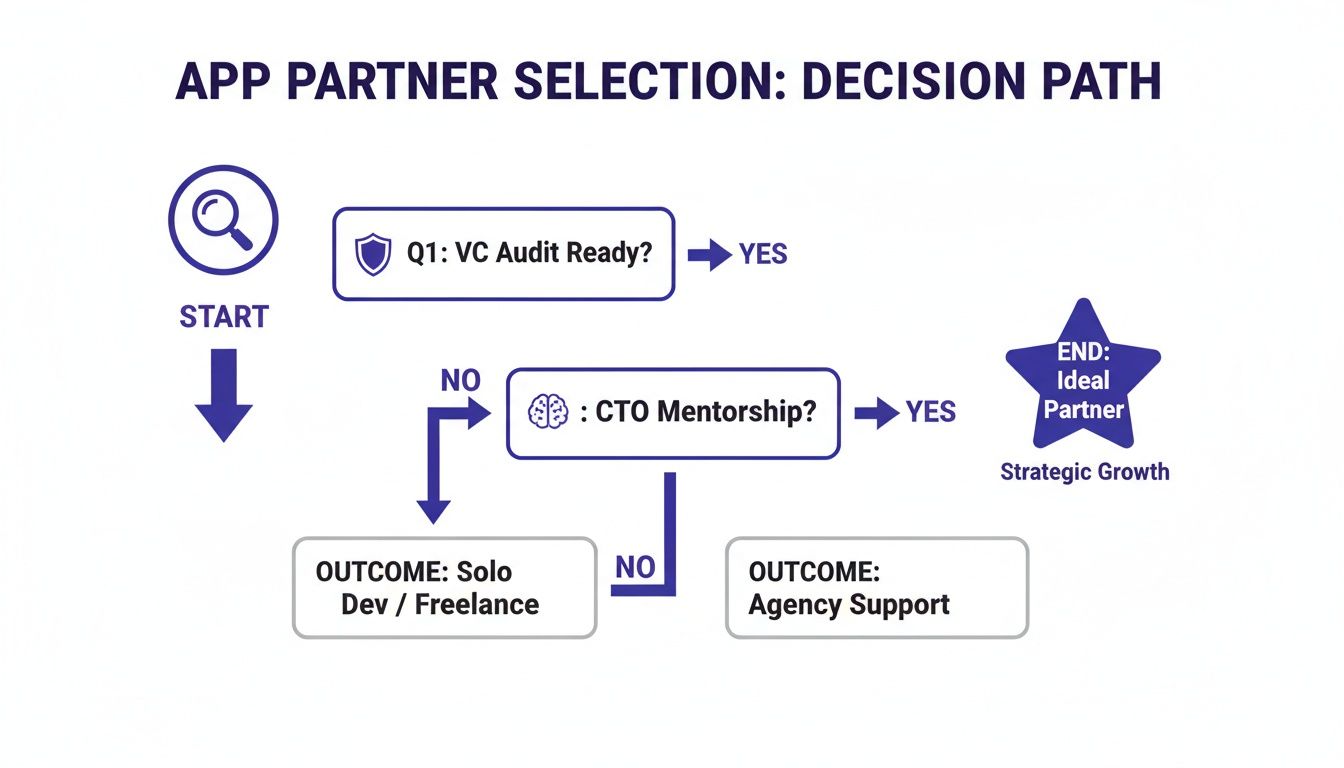
As you can see, optimizing for short-term cost savings instead of long-term asset value is a path that leads founders away from a truly strategic partnership.
Ensure your legal agreements explicitly cover these four areas:
-
Intellectual Property (IP) Ownership: This is a non-negotiable. The contract must state, without ambiguity, that 100% of all code, designs, and documentation belongs to your company from the moment of creation. No exceptions.
-
Code Quality and Audit-Readiness: Your SOW must specify code quality standards. This includes requirements for documentation, automated testing coverage, and adherence to established best practices. This is how you contractually ensure your codebase is built to pass technical due diligence.
-
Security Protocols: The contract should mandate specific security measures, such as secure coding practices, regular vulnerability scans, and compliance with key regulations. Your product must be hardened from day one, not as an afterthought.
-
Transparent Communication and Reporting: Define the cadence and method of communication. Will there be weekly sprint reviews? To which project management tools will you have access? This prevents the “black box” problem and keeps you firmly in control.
Structuring your partnership isn’t just about finding someone to build your app. It’s about building a framework of shared goals and trust that empowers both you and your engineering partner to create something scalable, valuable, and built to last.
Building Your Investor-Ready MVP
This is where your vision materializes into a tangible asset. But let’s be clear: the objective isn’t merely to launch something. It is to build something competitors can’t easily replicate—a solid, scalable foundation that protects your competitive advantage and commands investor attention.
Anyone can assemble a disposable prototype for initial feedback. An investor-ready Minimum Viable Product (MVP), however, is what secures funding.
This process is a delicate balance between speed and disciplined engineering. Rushing to market with a hastily assembled product only accumulates technical debt that will inevitably surface—usually during a critical investor audit. A true engineering partner helps you build an asset, not just a feature list.
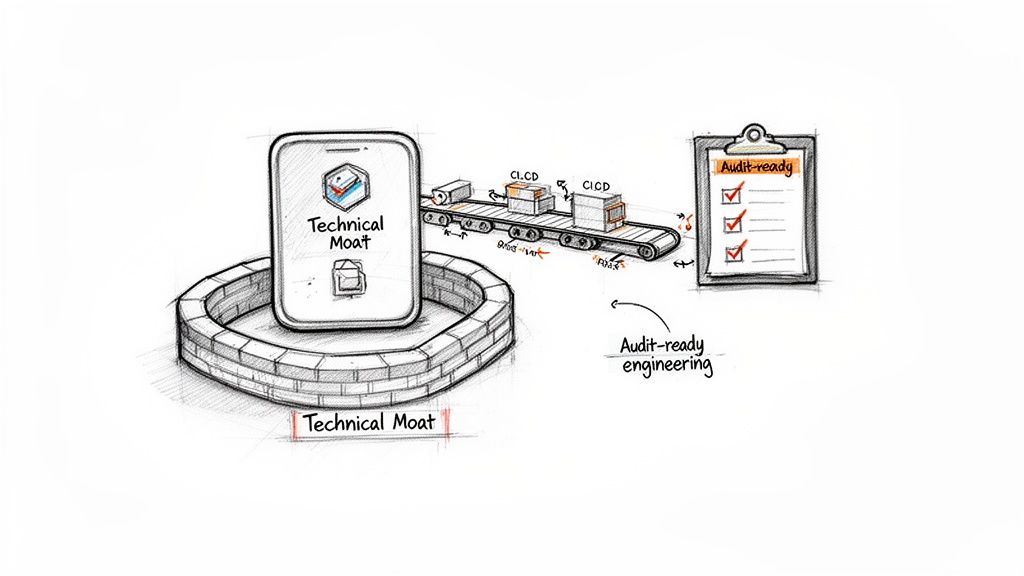
We operate on a philosophy of “audit-ready engineering.” This isn’t a buzzword; it’s a commitment to writing clean, well-documented, and rigorously tested code from the very first line.
From Idea to Blueprint: The Product Design & Discovery Phase
Before a single line of code is written, your idea requires a robust blueprint. This is the Product Design & Discovery phase—arguably the most critical stage of the entire project. A superficial discovery process invariably leads to a flawed product.
A partner who thinks like both mentor and architect won’t just ask what features you want. They will challenge you, dig deep to define the core problem you are solving, and identify precisely who you are solving it for. This should feel less like a Q&A and more like an intense, collaborative strategic workshop.
Here’s what that looks like in practice:
-
User Persona & Journey Mapping: We don’t guess. We construct detailed profiles of your ideal users and map every interaction they will have with your product. This ensures every decision is user-centric.
-
Competitive Analysis: This is about strategy, not imitation. We identify market gaps to define your product’s unique competitive advantage.
-
Wireframing & Prototyping: We first build a low-fidelity skeleton of the app. This allows us to validate the user experience and workflows before committing capital to full-scale development.
Skipping this blueprinting phase is like attempting to build a skyscraper without an architect. You might get walls up, but the foundation will be compromised, and the structure is destined for collapse.
Engineering a Defensible Asset, Not a Prototype
With a solid plan in place, we proceed to construction. This is where the concept of an investor-ready MVP truly manifests. A prototype is built to be discarded. An MVP is engineered to be scaled. The difference lies in engineering discipline.
As you prove your concept, you must anticipate what VCs will scrutinize. They will place your technology under a microscope, guided by a good ultimate VC startup due diligence checklist. Your engineering partner must build with that reality in mind from day one.
A prototype answers the question, “Can we build it?” An investor-ready MVP answers the question, “Can this business scale?” Your engineering partner should be obsessed with the second question.
That obsession is demonstrated through several non-negotiable practices:
-
Robust CI/CD Pipelines: Continuous Integration and Continuous Deployment are not optional. These automated pipelines test and deploy code constantly, enabling us to catch bugs early and maintain product stability.
-
Comprehensive Test Coverage: Your partner must layer on multiple forms of testing—unit, integration, and end-to-end. This is an insurance policy against future failures.
-
Scalable Architecture: The initial architecture must be designed for growth. This means selecting cloud services and databases that can handle a massive user influx without requiring a complete rewrite.
Your Role as The Founder During Development
Your partner is the architect and builder, but you are the visionary. Your role is to provide clear, timely feedback and strategic direction—not to micromanage code. You hired experts for a reason; trust them and their process.
To be an effective collaborator, you must:
-
Attend Sprint Reviews: These meetings are your opportunity to see tangible progress, interact with new features, and provide critical feedback. Your active participation is essential.
-
Be Decisive: When the team presents a question about a feature or priority, provide a clear answer. Indecision is a project killer.
-
Focus on the “What” and “Why”: Your job is to articulate what the product needs to do for the business and why it is important. Let your engineering partner determine the how.
This rhythm maintains project momentum and ensures the final product is not just a collection of code, but a valuable, investable asset that truly reflects your vision. To dive deeper into creating an MVP that investors will value, you can learn more about our MVP development process.
How Do You Manage Costs and Maximize Your ROI?
As a founder, you live and die by your cash flow. Every dollar spent must build valuation. When it comes to outsourced app development, let’s be unequivocally clear: chasing the lowest hourly rate is a catastrophic error.
This is not a conversation about cost; it is a conversation about ROI. It’s about building a real, valuable technical asset that propels you to your next milestone, not just a pile of code.
That low-cost dev shop might appear tempting on paper, but it is a trap. What you don’t see are the hidden costs: a mountain of technical debt, an expensive future refactor, and the most lethal of all, a failed investor audit that can tank your valuation or kill a funding round entirely.
Shifting Focus From Cost to Valuation
A true engineering partner does not sell hours; they build your company’s value. This is why a higher initial investment in a quality firm delivers a manifold return.
Consider this: are you building a skyscraper or a garden shed? The shed is cheaper today, but it will collapse the moment you attempt to build your true vision upon it.
Investing in quality, audit-ready engineering from day one delivers tangible returns:
-
Reduced Long-Term Costs: Clean, well-documented code means you avoid a time-consuming and expensive rewrite immediately after closing your first funding round.
-
Accelerated Time-to-Market: A disciplined partner with battle-tested CI/CD and QA processes builds faster and more reliably. You get your MVP into users’ hands sooner.
-
Increased Company Valuation: A codebase that sails through technical due diligence is a massive asset. Investors see a low-risk, scalable business, not a ticking time bomb requiring a complete overhaul.
The question is not “What is the cost of this MVP?” The real question is, “What is the cost of not building this to be investor-ready from day one?” A failed technical audit can cost you millions in lost valuation—a hit far greater than the premium for an elite engineering partner.
Financial Modeling for Your Engineering Partnership
Budgeting for an outsourced team requires a different calculus. Stop looking at developer rates. Instead, model the total cost of ownership and the value returned. When you engage a premium firm, you are acquiring more than just code.
You are funding:
-
Fractional CTO Leadership: The strategic guidance to shape your technical roadmap and make intelligent architectural choices.
-
Product Strategy: A partner who helps ensure you are building the right features to achieve product-market fit.
-
Audit-Ready Engineering: A disciplined process that prepares your business for the intense scrutiny of investors.
This is precisely why smart outsourcing remains such a powerful strategy. When executed correctly, it can deliver cost savings of up to 40% compared to building a comparable in-house team from scratch, all while accelerating your time-to-market by up to 50%. We’ve seen projects deliver an average ROI of 2.8x within 12-18 months, driven purely by development velocity and faster product releases. For more data, check out these software development outsourcing statistics from sqmagazine.co.uk.
A Real-World Scenario: The ROI of Quality
Consider two founders, Alex and Ben.
Alex chooses the bargain option—a mass-market firm for $50,000. The app is built quickly, but it’s a tangle of bugs and undocumented code. Predictably, it fails the VC’s technical audit. Alex is now forced to spend another $150,000 and six agonizing months rebuilding the app from scratch, missing a critical market window and alarming his investors. His total cost: $200,000 and a massive strategic setback.
Ben, on the other hand, partners with a boutique firm built around hands-on technical leadership for $150,000. The process is more involved, including deep product discovery, and the result is a rock-solid, audit-ready MVP. The app sails through due diligence, helping him secure a strong valuation and a swift funding round. His total cost: $150,000 for a win that accelerates his entire business.
Ben’s initial investment was higher, but his ROI was exponentially greater. Alex tried to save money upfront and ended up with a devastating financial and strategic loss. This is the simple truth of managing outsourcing costs—investing in quality engineering is not an expense; it is the single best investment you can make in your company’s long-term value.
Your Burning Questions About Outsourced App Development
Even with a solid plan, a founder’s mind is filled with questions when considering an engineering partner. Let’s address the most pressing ones from the perspective of building an investable asset.
How Much Should I Expect to Pay for a High-Quality MVP?
This is always the first question, but focusing solely on cost is a trap.
A true, investor-ready MVP engineered with a top-tier partner generally falls in the range of $75,000 to $250,000+. The final investment is determined by the complexity of your product.
But what are you actually buying? Not just lines of code. You are funding a cohesive technical strategy, user-centric design, and a clean codebase architected to sail through investor due diligence.
I have seen it countless times: a low-cost option delivers a flimsy prototype that requires a complete rebuild after the first round of user feedback. That ultimately costs far more in the long run and puts your entire technical audit in jeopardy.
Think of this as an investment in your company’s core asset, not an expense for a “first version.” The upfront premium for quality is your insurance policy against a failed technical audit that can slash millions from your valuation.
What’s the Real Difference Between a Freelancer and a Boutique Agency?
The difference is everything. A freelance developer is hired for a singular function: to code. A boutique engineering partner, by contrast, is engaged to build company value alongside you.
A freelancer is a task-taker, excellent for small, well-defined jobs. A boutique partner becomes an extension of your founding team.
Here is what that partnership entails:
-
Fractional CTO Leadership: You gain the high-level technical guidance necessary to build a scalable roadmap and make critical architecture choices, without the full-time salary.
-
Integrated Product Strategy: We help sharpen your vision, ensuring you are building a product that solves a real problem, not just executing a feature list.
-
Investor-Ready Architecture: Every component is engineered with an eye on passing rigorous technical audits, ensuring every decision contributes to your company’s valuation.
We don’t just “build your app.” We engineer the technical foundation of your business and serve as your guide, connecting every engineering decision back to your long-term success.
How Do I Protect My Intellectual Property When Outsourcing?
This is a critical, non-negotiable point. IP protection must be secured in your contract before any work begins. Any reputable partner will not only agree to this—they will insist on it.
Your contract requires a crystal-clear clause stating that 100% of the intellectual property—all source code, designs, and documentation—is exclusively yours from the moment of its creation. Our agreements are structured to provide you with complete, unencumbered ownership of the asset we build together.
Never work with a partner who shows any hesitation on this point. It is the most significant red flag you can encounter.
When Should I Transition to an In-House Team?
The transition from an outsourced partner to your own in-house team is not an abrupt switch, but a strategic evolution. This typically becomes logical after a Series A fundraise or when your product has achieved significant market traction and requires a larger, dedicated team for rapid scaling.
An elite partner does not simply build your app and hand over the keys. They actively facilitate this transition.
Our model is designed to make us obsolete—in the best way possible. This involves:
-
Mentoring on tech team hiring: We help you write job descriptions, screen candidates, and establish your own high-performance engineering culture.
-
Providing Fractional CTO services: We can remain to offer strategic leadership and guide your new team.
-
Ensuring a seamless handoff: Knowledge transfer is a planned process, involving comprehensive documentation, paired programming sessions, and deep-dives into the architecture.
The goal is perfect continuity. Your new team should be able to assume ownership of the codebase without missing a beat.
Comparing what an outsourced build would actually run you? Our free MVP Cost Calculator gives you a real number to weigh vendor quotes against.
At Buttercloud, we don’t just build apps; we engineer the high-valuation technical assets that become the foundation of successful startups. We act as the Mentor-Architects that founders need to navigate the journey from Idea to Investor-Ready MVP to a truly Scalable Product.
Ready to build your technical moat? Partner with us.
Have a product idea to talk through?
We'll show you how we'd approach it — no pressure, just a real conversation.
Book a Discovery Call