Software Development RFP: A Founder's Playbook

Founder & CEO, Buttercloud
Most advice on a software development rfp is built for procurement teams buying a predictable service. That advice will hurt a startup.
You aren’t buying office furniture. You’re choosing the people who will shape your product architecture, delivery velocity, security posture, hiring path, and investor diligence story. If your RFP reads like a shopping list, you’ll attract vendors who sell shopping-list output. Cheap screens. Fast commits. Fragile systems.
Founders need a different standard. The document has to filter for a true engineering partner who can turn product vision into an investable technical asset. That means the RFP must reveal how a team thinks, how they ship, how they manage risk, and whether they can build code that survives growth, audits, and funding scrutiny.
Why Do Traditional RFP Methods Fail Startups?
The standard RFP process is broken for startups.
Some organizations report taking 18 months to 2 years to finalize an RFP and hire a developer, according to Golden Shovel Agency’s discussion of slow traditional RFP processes. For a startup, that timeline isn’t inefficient. It’s destructive.
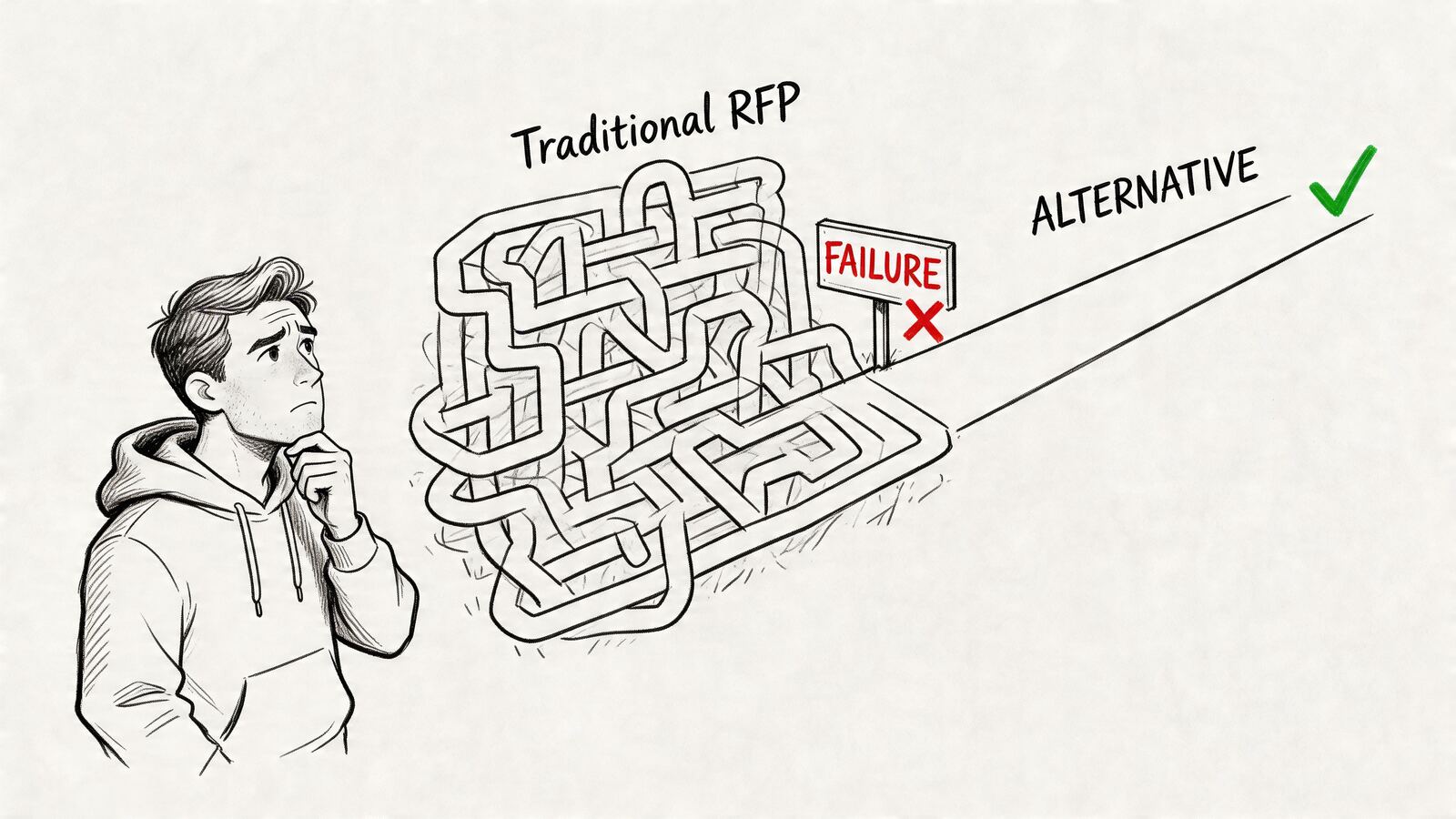
A founder needs feedback loops, not committee theater. You need to test assumptions, ship product, learn from users, and adjust before your runway gets thinner. Traditional RFP mechanics favor caution, bureaucracy, and lowest-common-denominator comparisons. Startups win with speed, signal, and architecture quality.
Why generic RFPs attract the wrong vendors
Bad RFPs create bad vendor pools.
When you ask for a feature list, timeline, and price, you invite firms that know how to price labor, not teams that know how to shape product outcomes. Those firms often optimize for proposal volume. They promise a stack, a sprint plan, and a delivery date. They rarely show you how they make technical decisions under uncertainty.
That creates three predictable problems:
-
You compare cost, not capability. A lower bid can hide weak engineering judgment, poor QA discipline, and shallow product thinking.
-
You reward compliance theater. Vendors learn to mirror your language instead of challenging weak assumptions.
-
You inherit technical debt early. The app may launch, but the codebase won’t support growth, hiring, or diligence.
A startup RFP should not ask, “Who can build this cheapest?” It should ask, “Who can help us build this right without slowing the company down?”
The real purpose of a software development rfp
Your RFP isn’t a procurement form. It’s a filtering instrument.
It should help you identify whether a team can do four things:
-
Understand the business model, not just the backlog.
-
Translate ambiguity into architecture without overengineering.
-
Build production-grade systems from the start.
-
Communicate like owners, not ticket processors.
That changes how you write the document. Instead of over-specifying cosmetic features, define the business stakes. Instead of asking vendors to estimate screens, ask them to explain tradeoffs. Instead of rewarding a polished sales deck, reward clarity around implementation, risk, and system design.
Founders should optimize for partner quality
A startup can recover from a delayed feature. It rarely recovers quickly from a weak codebase and the wrong partner.
The smart move is to treat the software development rfp as a strategic brief for high-quality firms. Strong boutique teams don’t want vague RFPs any more than you want generic proposals. They want enough signal to determine if the project is serious, whether leadership is aligned, and whether the relationship can work.
If your RFP does that, you stop attracting code factories. You start attracting teams that care about architecture, delivery discipline, and long-term product value.
Laying the Foundation Your Pre-RFP Strategic Brief
Don’t start by writing the RFP.
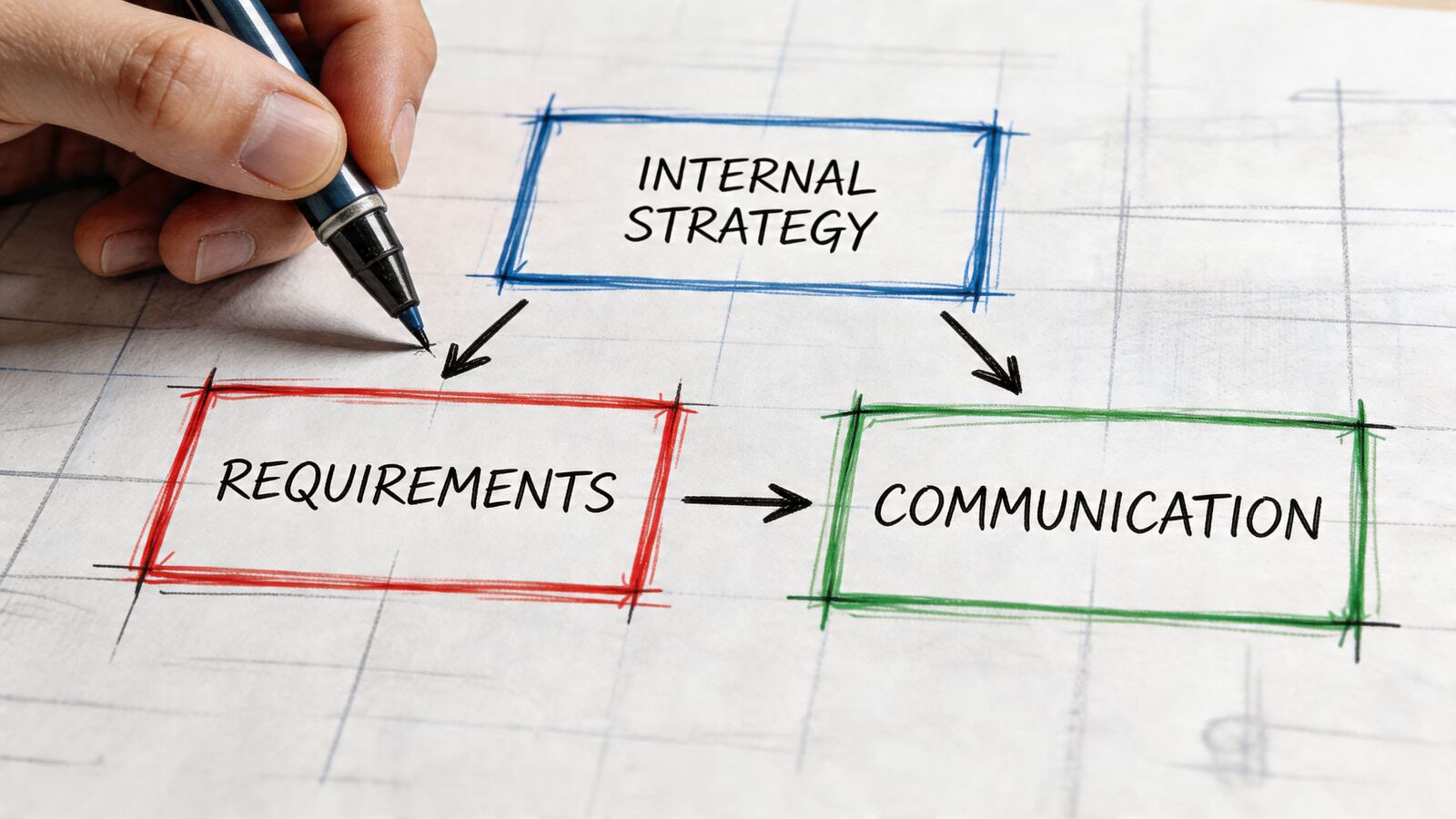
Start by writing the internal document that makes the RFP possible. I call it the strategic brief. This is the source of truth for your own team. If you skip it, your RFP becomes a public version of your internal confusion.
The market is becoming more professionalized. The global RFP software market is projected to reach USD 1.86 billion by 2035 with an 18.1% CAGR, according to Business Research Insights on the RFP software market. That matters because your vendors are getting better at producing polished responses. A vague founder loses to a clear one.
What belongs in the strategic brief
This document should be short, sharp, and brutally honest. If it turns into a manifesto, you’ve lost the plot.
Include these components:
-
Business problem: State the pain in plain English. Not “build a mobile app.” State the operational or market problem the product fixes.
-
User definition: Identify the primary user, the buyer if different, and the internal operator if the system has back-office workflows.
-
Value proposition: Explain why this product deserves to exist. What changes for the user after launch?
-
Core workflows: Name the few journeys that matter in version one.
-
Commercial model: Clarify whether the product drives revenue, retention, internal efficiency, or some mix.
-
Constraints: List regulatory, integration, timing, staffing, and budget realities.
-
Decision ownership: Name who approves product scope, design decisions, and architecture choices.
The brief should force hard decisions
Most founders avoid decisions by calling them assumptions. Don’t.
A strategic brief should lock in what matters now and explicitly defer what doesn’t. That discipline protects you later when vendors start asking questions.
Use a structure like this:
Strategic brief area
What good looks like
Product thesis
One paragraph that explains the business bet
User scope
One primary persona and one secondary at most
MVP boundary
Clear line between must-have and later
Success definition
Outcomes you can observe after launch
Technical constraints
Existing systems, compliance needs, platform choices
Team model
What your side owns versus what the partner owns
Practical rule: If your team can’t explain the product in one page, no vendor can scope it well in fifty.
What founders usually get wrong
They confuse features with strategy.
A founder says, “We need chat, admin, payments, analytics, and AI.” That’s not a strategy. That’s a pile. A real brief explains why those capabilities matter and which one provides an advantage first.
They also skip internal alignment. Sales wants enterprise workflows. Operations wants automation. The founder wants investor optics. Product wants speed. If those tensions aren’t resolved before the software development rfp goes out, vendors will answer different questions and you’ll compare proposals that aren’t even aimed at the same target.
Questions to answer before the RFP exists
Answer these internally first:
-
What must be true after launch for this project to count as a win?
-
What technical shortcuts are unacceptable?
-
What can wait until phase two without harming the business?
-
What kind of partner do we need? Product-thinking shop, pure engineering executor, or strategic technical leadership.
-
Where do we expect the partner to challenge us?
That last one matters. If you want a real partner, your RFP should invite disagreement backed by reasoning. Founders don’t need more yes-men. They need technical adults.
How Do You Architect the RFP Document’s Structure and Content?
A strong software development rfp should read like a serious operating document, not a recycled template.
The structure matters because it tells vendors how to think about the opportunity. If the opening pages scream procurement, you’ll get procurement-style responses. If the document shows product clarity, technical seriousness, and realistic collaboration expectations, better firms will lean in.
The sections that actually matter
You don’t need a bloated document. You need the right sections.
Company vision and product context
Open with why the company exists, what the product changes, and why now matters.
This section should help a serious engineering partner understand whether the mission is worth engaging with. Good teams want context. They make better decisions when they know the commercial and product stakes.
Write this like a founder memo, not a boilerplate backgrounder.
Problem statement and outcome target
State the problem in operational terms. Then state the outcome you want.
For example, don’t write “build a customer portal.” Write something like: customers currently rely on fragmented manual workflows, internal teams can’t track status cleanly, and leadership needs a system that supports self-service and clean operational visibility.
That tells a vendor what they’re solving, not just what they’re drawing.
Scope and boundary line
Founders need discipline.
Use two lists:
-
In scope now: Critical workflows, integrations, platforms, and operational requirements.
-
Out of scope for this phase: Nice-to-haves, speculative features, and future modules.
The quality of your scope section directly affects proposal quality. Ambiguous boundaries produce padded estimates or dangerously optimistic ones.
Ask questions that expose thinking
Most RFP questions are useless. They ask vendors to list tools, years of experience, and generic methodology claims.
Ask questions that force judgment.
Use prompts like these:
-
How would you sequence this build if the business needed a usable launch quickly without creating rework later?
-
What assumptions in our brief would you challenge first, and why?
-
Where do you see the highest implementation risk?
-
What would you deliberately not build in version one?
-
How do you document architecture decisions and change requests?
-
How do you handle a founder who changes priorities mid-sprint?
These aren’t trick questions. They’re signal questions.
Required proposal components
Make vendors respond in a consistent format. Otherwise you’ll compare narrative style instead of delivery capability.
Require each proposal to include:
Proposal section
What you want to see
Solution summary
Their understanding of the business problem
Implementation approach
Phases, deliverables, team roles, and dependencies
Architecture view
System design principles, integrations, and scaling posture
Team composition
Named roles and who does what
Delivery model
Meetings, sprint rhythm, decision flow, escalation path
Pricing model
Clear assumptions and what changes cost
Risk register
The problems they already see before work starts
Language that filters out low-quality vendors
Use direct language in your RFP. It helps.
Say things like:
We are not looking for a prototype that will be rebuilt later. We are looking for a production-grade foundation that can support growth.
And this:
We expect the selected partner to challenge weak assumptions, identify technical risks early, and explain tradeoffs in business terms.
That scares off the wrong vendors. Good.
Defining Production-Grade Technical Requirements
Most startup RFPs typically fall apart here.
Founders usually describe features and skip the architecture qualities that determine whether the product survives real usage. The result is predictable. You get proposals for a functioning app, not a resilient system.
Most RFP templates ignore what startups need for scalable, secure products. They also miss how to specify investor-audit-proof engineering, such as multi-tenant SaaS architecture or DevOps hardening. One cited claim in startup-oriented RFP commentary is that 70% of VCs cite codebase quality as a major factor in funding decisions, highlighted in this discussion of gaps in startup technical RFP guidance.
Functional requirements are only half the job
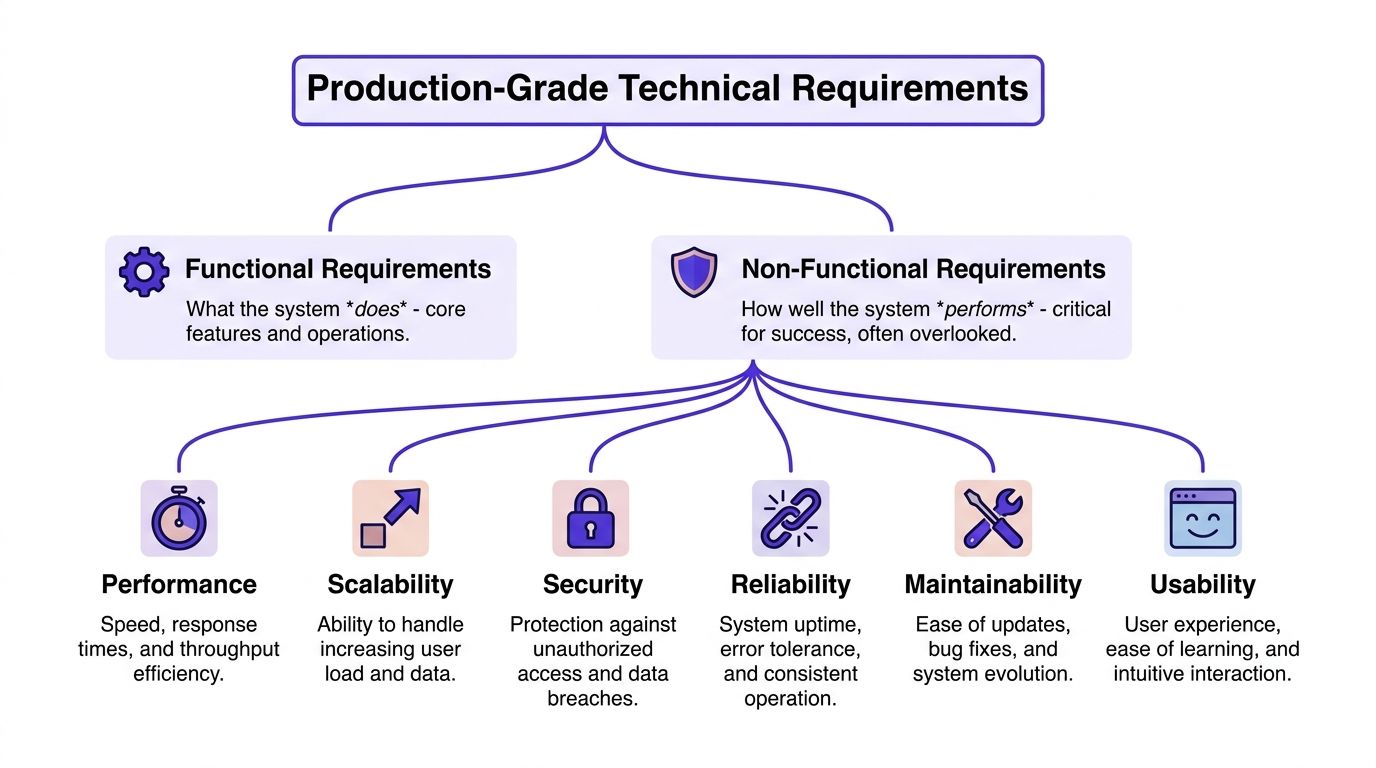
Yes, you should list product features. User onboarding, admin controls, payments, reporting, document workflows, notifications. Fine.
But those are functional requirements. They tell the vendor what the system does. They don’t tell the vendor how well the system must operate under stress, growth, or change.
Your RFP needs both.
The non-functional requirements founders can’t afford to skip
This is the layer that determines whether your MVP becomes an asset or a rewrite candidate.
Include explicit expectations around:
-
Scalability: Can the system support growth in users, customers, tenants, or data volume without architectural collapse?
-
Security: How will the team handle auth, access control, secrets, audit trails, and secure coding practices?
-
Reliability: What happens when a third-party API fails, a job queue backs up, or a deployment goes wrong?
-
Maintainability: Can another engineer join later and understand the codebase quickly?
-
Observability: Will your team have logs, alerts, and health visibility when something breaks?
-
Deployment discipline: Is there CI/CD, rollback planning, environment separation, and infrastructure consistency?
If a vendor can’t explain how they build for failure, they aren’t building for scale.
What to actually ask for in the RFP
Non-technical founders often know they need “good architecture” but don’t know how to request it. Use plain language.
Ask vendors to describe:
System design choices
Request a high-level architecture proposal. Not a final blueprint, but a view into how they think.
Have them explain:
-
data model assumptions
-
tenancy model if you’re building SaaS
-
integration strategy
-
background jobs and asynchronous processing
-
file storage approach
-
admin and support tooling
Delivery and infrastructure standards
Ask how they handle:
-
source control workflow
-
code review
-
automated testing
-
deployment automation
-
staging and production environments
-
backup and recovery expectations
Security and compliance posture
If your market has compliance pressure, state it directly. If you don’t know the exact standard yet, say you need a system that can support audit readiness and structured access control.
A founder who needs a practical reference point can review Buttercloud’s perspective on custom software development, especially around building systems that aren’t just feature-complete but structurally ready for growth.
A simple requirements split that works
Use a table like this inside your RFP:
Requirement type
Example prompt
Functional
Describe how users create, edit, approve, and track records
Performance
Explain the expected responsiveness of core workflows
Security
Describe access roles, authentication approach, and auditability
Reliability
Explain failure handling for key external dependencies
Maintainability
Describe coding standards, documentation, and handoff practices
Scalability
Explain how the architecture would support future expansion
The founder mindset shift
Don’t ask for “an app.”
Ask for a technical foundation with these properties:
-
usable now
-
stable under load
-
secure by design
-
legible to future hires
-
defensible in diligence
That single shift improves the quality of every proposal you receive.
How Do You Create an Evaluation Rubric and Selection Process?
Most founders choose a vendor the wrong way. They read the proposals, take a few calls, compare prices, and trust their gut.
That’s lazy decision-making dressed up as instinct.
A better approach is to define your scoring model before the first proposal lands. Enterprise teams often weight technical fit at 40% and cost at 30%, according to Inventive AI’s overview of RFP evaluation weighting. For a startup, that baseline is useful, but you should adapt it. Implementation quality and startup-specific judgment often matter more than a small price gap.
Build the scorecard before you send the RFP
If you create the rubric afterward, you’ll unconsciously tailor it to whoever impressed you most. That’s how founders rationalize bad picks.
Use weighted categories that reflect startup reality.
Here is a practical model.
Sample Startup RFP Evaluation Rubric
Evaluation Criterion
Weight (%)
Description
Technical fit
35%
Architecture quality, system thinking, and ability to translate business needs into sound engineering decisions
Implementation approach
25%
Delivery plan, sequencing, risk management, clarity of milestones, and adaptability under startup conditions
Startup experience
20%
Evidence that the team understands MVP tradeoffs, iteration speed, and founder communication
Communication and collaboration
10%
Responsiveness, clarity, decision hygiene, and willingness to challenge assumptions constructively
Cost
10%
Pricing realism, transparency of assumptions, and change management structure
This is intentionally not cost-heavy. Cheap software is expensive when you need to rebuild it.
Score proposals in layers
Don’t run the process as one giant impressions contest. Break it into rounds.
Round one screening
Cut obvious misfits fast.
Reject vendors if they:
-
ignored your response format
-
gave generic copy-paste answers
-
failed to identify risks
-
submitted a vague team structure
-
treated architecture as an afterthought
Round two weighted scoring
Now score the serious candidates against the rubric.
Have multiple reviewers score independently. Then compare notes. That reduces founder bias and surfaces where the proposal was strong or weak.
Round three live validation
Here, you confirm the team behind the proposal exists.
Ask finalists questions like:
-
Walk me through a project where requirements changed hard midway. What did you change in process and architecture?
-
What part of our RFP do you think is underspecified?
-
If you inherited this codebase in a year, what decisions would you want documented now?
-
Who will lead technical decisions day to day?
-
What kind of founder behavior makes your best projects succeed?
Selection rule: Don’t let the sales lead win the deal if the delivery lead can’t defend the approach.
Use implementation detail as a proxy for maturity
One of the most useful signals in any software development rfp response is the implementation approach.
A mature partner should be able to explain:
-
project phases
-
named roles
-
likely challenges
-
mitigation plans
-
stakeholder communication rhythm
-
what success looks like at each stage
When a proposal stays abstract, that’s usually not sophistication. It’s avoidance.
What not to reward
Don’t overvalue pretty decks, famous logos, or jargon density.
A founder should be suspicious of:
-
total certainty in a messy product space
-
estimates with no assumptions attached
-
“yes, we can do anything” energy
-
teams that won’t challenge your scope
-
pricing that looks clean because major work is hidden in change requests
The winning vendor shouldn’t just answer the RFP. They should reveal how they’ll help you make better decisions after the contract starts.
Partnership Due Diligence and Contracting
Winning the RFP doesn’t make someone the right partner. It just earns them deeper scrutiny.
Average RFP win rates are around 45%, according to Loopio’s RFP win rate data. That tells you the process is competitive. It also means a polished proposal is normal. Once you’ve picked a finalist, stop evaluating marketing. Start evaluating the working relationship.
Due diligence is about people and operating habits
Founders often check references and call it done. That’s not enough.
You need to know how the team behaves when things get messy, because they will.
Probe for:
-
Decision cadence: Who decides product tradeoffs, and how are those decisions recorded?
-
Escalation style: What happens when delivery slips or requirements change?
-
Team continuity: Will the people you met stay on the project?
-
Transparency: Do they surface problems early or wait until they become expensive?
-
Founder compatibility: Can they work with urgency without creating chaos?
Ask for a live session with the people who will run the build. Not just account leads.
A contract can’t rescue a low-trust operating relationship. It can only limit the damage.
Contract terms that matter more than founders think
A software contract isn’t admin paperwork. It’s the control system for the relationship.
Review these areas carefully:
-
IP ownership: Your company should own the codebase, documentation, and project-specific deliverables.
-
Access control: Make sure repos, infrastructure, analytics, and cloud accounts don’t sit entirely under vendor control.
-
Termination rights: You need a workable exit if the relationship fails.
-
Handoff obligations: Define what happens to documentation, credentials, code, and environments at transition.
-
Change management: Clarify how new work gets scoped and approved.
-
Warranty and defect handling: Define the post-launch support expectation.
-
Confidentiality and data handling: Especially important if customer or operational data is involved.
If you want a plain-English view of clauses founders often overlook, this guide to a web site development contract is a useful reference point.
Don’t outsource judgment
A founder should understand the commercial consequences of the engagement model. Fixed price can create defensive behavior. Time and materials can work well if scope discipline is strong. Hybrid structures are often healthier when the product still has unknowns.
If you’re weighing whether a partner model or a commodity shop makes more sense, Buttercloud’s article on outsourced app development is a useful comparison point for thinking through tradeoffs in control, speed, and long-term code ownership.
The right contract doesn’t create trust. It formalizes aligned incentives and gives both sides a clean operating framework.
Frequently Asked Questions About Software Development RFPs
Founders usually ask the same few questions once they start drafting a software development rfp. Here are the blunt answers.
FAQ
Question
Answer
Do I always need a formal software development rfp?
No. Early-stage startups often don’t. If you’re selecting from a tightly curated shortlist and the project still has major unknowns, a strategic brief plus structured interviews can beat a formal RFP. Use an RFP when you need comparison discipline, internal alignment, or board-level defensibility.
How detailed should the RFP be?
Detailed on business context, critical workflows, technical constraints, and delivery expectations. Not detailed on every screen and edge case if you haven’t validated them yet. Precision matters. Fake precision hurts.
Should I include budget in the RFP?
Include budget guardrails if you have them. Hiding the budget often wastes everyone’s time and attracts proposals aimed at the wrong level of ambition.
What if I’m non-technical?
Then your job is to define outcomes, risks, constraints, and decision rights. You don’t need to design the architecture yourself. But you do need someone credible to assess whether vendors are proposing a real engineering foundation or a fast demo.
How many vendors should I invite?
Fewer, better. A bloated vendor list creates noise and drains your team’s attention. Invite firms that fit your product stage, domain, and working style.
Should I prioritize local teams?
Prioritize communication quality, technical maturity, and operating overlap. Geography matters less than clarity, accountability, and access to the actual builders.
What’s the biggest RFP mistake founders make?
They ask for a build without defining the asset they want to own. That leads to feature output with weak architecture, poor documentation, and a hard-to-scale codebase.
When should I skip the RFP entirely?
Skip it when speed matters more than procurement formality, when the project is still being shaped, or when you’ve already identified a high-trust strategic partner and need a discovery phase more than a bid contest.
Before you send an RFP out and start comparing vendor bids, get your own ballpark first with our free MVP Cost Calculator — a useful reference point for evaluating whether a vendor’s number is realistic.
If you’re preparing a software development rfp and want technical leadership before you commit to the wrong build, Buttercloud helps founders define the right scope, pressure-test vendor proposals, and structure products as investor-ready technical assets instead of disposable MVPs.
Have a product idea to talk through?
We'll show you how we'd approach it — no pressure, just a real conversation.
Book a Discovery Call