What Is Enterprise Application Integration?

Founder & CEO, Buttercloud
Your startup already has an integration problem, even if you haven’t named it yet.
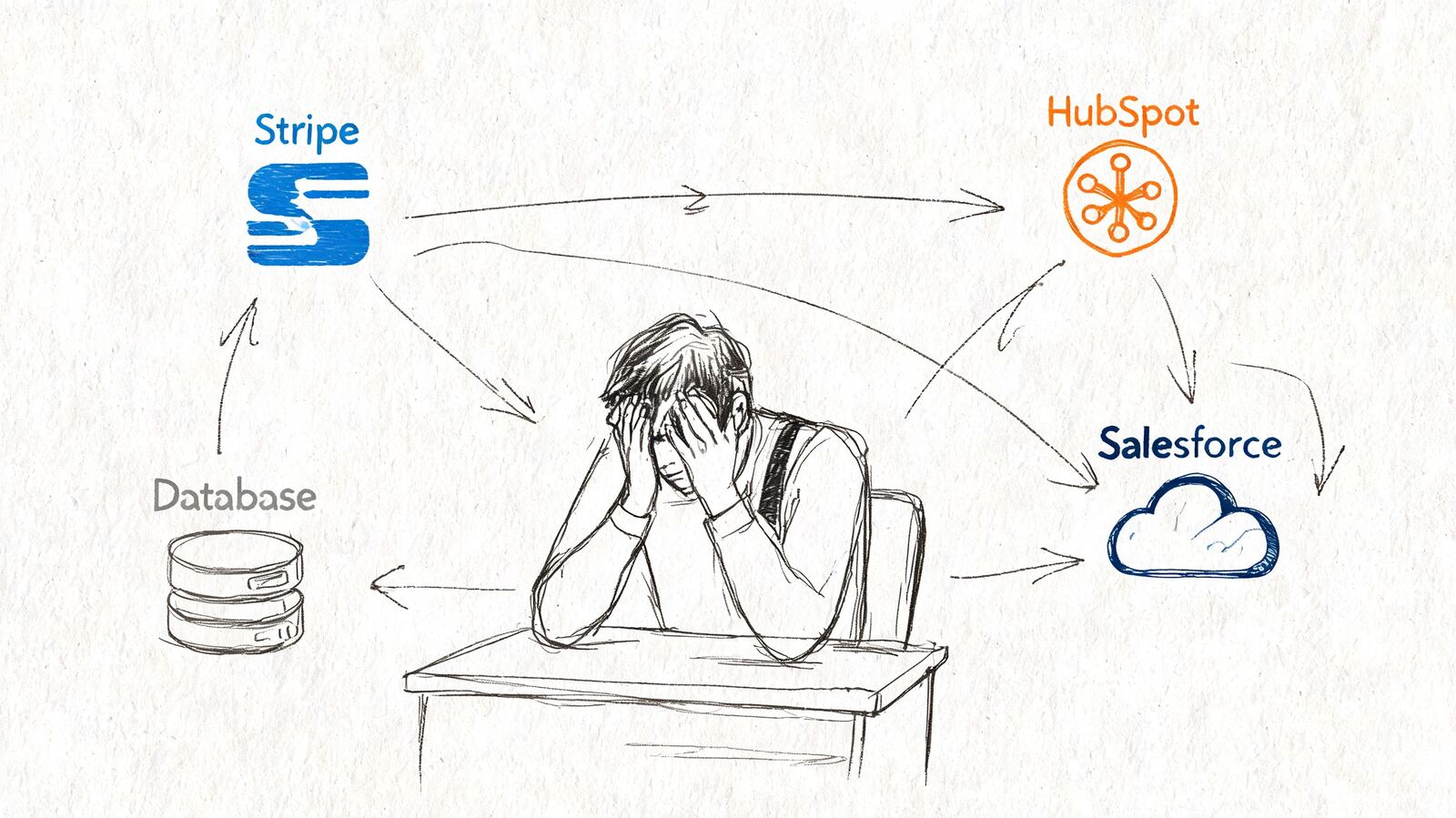
Stripe knows who paid. HubSpot knows who filled the form. Salesforce knows who the sales team spoke to. Your product database knows who uses the product. Finance exports one report. Growth exports another. Nobody fully trusts either. So your team starts doing what early-stage teams always do when systems don’t talk. Manual CSV exports, one-off Zapier flows, Slack messages asking which dashboard is “right,” and a growing layer of silent operational risk.
That’s the moment founders should start asking what is enterprise application integration. Not because you’re becoming an enterprise. Because you’re trying to avoid building a fragile company.
Most organizations already live inside this mess. They average 897 applications, but only 28% are integrated, which creates data silos that slow operations and block innovation, according to enterprise integration adoption data from Integrate.io. Startups feel the same pain with fewer tools. The difference is that a startup’s bad integration choices get baked into the product earlier, and investors notice them sooner.
If you’re operating in regulated or multi-system markets, it’s useful to see how teams approach unified data for Middle East enterprises, because the core problem is the same. Disconnected systems don’t stay a back-office annoyance. They become a growth constraint.
Why Does Integration Actually Define Your Startup’s Value?
A founder usually notices integration pain in one of three moments.
The first is revenue confusion. Sales says a customer is active. Product says the account never onboarded. Finance says payment failed. All three systems are technically “working,” but the business is flying blind.
The second is operational drag. A smart operator on your team becomes the human API between Stripe, HubSpot, Notion, and your app admin panel. That person looks productive. In reality, they’re compensating for weak architecture.
The third is investor diligence. Somebody asks a simple question like, “How does customer lifecycle data move from acquisition to billing to retention?” If the answer is five tools, two spreadsheets, and one engineer who knows the workaround, your product stops looking like an asset and starts looking like a repair project.
The real problem isn’t tooling
Founders often think the issue is that they picked the wrong CRM or analytics stack. Usually, that’s not the root cause. The core issue is that each system became a separate source of truth.
EAI matters because it turns scattered software into a coordinated operating model. It connects systems so data moves intentionally, consistently, and in a way your team can govern. That isn’t an IT housekeeping exercise. It’s architecture that determines whether your company scales cleanly or collapses under exception handling.
Practical rule: If your team manually reconciles core business data every week, you don’t have a reporting problem. You have an integration problem.
Integration is valuation infrastructure
A buyer or investor doesn’t just evaluate features. They evaluate whether the business can support growth without breaking. Clean integration answers hard questions fast:
-
Revenue confidence: Can the company reconcile payment, contract, and product usage data?
-
Operational resilience: Can the business add new tools without rewriting half the backend?
-
Compliance readiness: Can the team trace where sensitive data moved and why?
-
Leadership confidence: Can a new engineer understand the system without tribal knowledge?
That’s why I treat EAI as infrastructure for trust. Founders who get this right build a company that can move faster with less chaos. Founders who ignore it build a company that looks bigger on the outside than it is underneath.
What Does EAI Actually Mean, the Buttercloud Way?
Most definitions of EAI are too academic to be useful. Founders don’t need a glossary entry. They need a decision lens.
Enterprise application integration is the central nervous system of your business. It carries signals between the systems that run growth, operations, support, finance, and the product itself. If that nervous system is weak, every decision gets slower and less reliable. If it’s well designed, the company responds like one organism instead of five disconnected tools.

Build an asset, not a patchwork
There are two ways founders approach integration.
The first approach is tactical. “Just connect it.” Add a Zap. Write a webhook fast. Push data directly from one app into another. Keep going until something breaks. This feels fast because the pain is deferred.
The second approach is architectural. Define where core data should live. Decide which systems publish events, which systems consume them, and which workflows deserve automation. Isolate integration logic so your product doesn’t become dependent on third-party quirks.
Only one of these approaches creates a technical asset.
A useful way to think about it is this:
-
APIs are the pipes
-
Connectors are the adapters
-
Transformation rules are the translators
-
Governance is the traffic control
-
EAI is the blueprint for the whole city
Without the blueprint, you don’t have a platform. You have plumbing.
Why investors care more than founders expect
Sloppy integrations create hidden liabilities. They make data inconsistent, complicate debugging, and increase the cost of every future product decision. That eventually shows up in diligence.
The surface area is growing, not shrinking. IBM’s overview of enterprise application integration cites Gartner findings that 74% of businesses currently use microservice architecture, with another 23% planning to — every one of those services is another thing that has to talk to something else — and Fortune Business Insights data that 80% of businesses still build at least some of their integrations in-house. Those in-house connections are rarely anybody’s product. They’re side projects, written quickly, documented thinly, and inherited by whoever is unlucky enough to be nearby when one breaks. That’s the cost of treating integration like a side task instead of a strategy.
A founder can survive an ugly admin panel. It’s much harder to survive a system nobody can trust.
The outcome you actually want
Good EAI doesn’t mean every tool is tightly coupled. It means every critical workflow is intentional.
You want:
-
One authoritative flow of business data, so product, sales, and finance stop arguing over reality.
-
Replaceable components, so changing one vendor doesn’t trigger a backend rewrite.
-
Operational visibility, so your team sees failures before customers do.
-
Scalable patterns, so the architecture improves as the company grows instead of calcifying.
That is what “investor-ready” should mean technically. Not shiny diagrams. A system that can take pressure without improvisation.
Core EAI Components and Architectural Patterns
Most founders don’t need to become integration architects. They do need to recognize the patterns before they accidentally buy the wrong one.
At the component level, EAI is built from a small set of moving parts. The complexity comes from how you combine them.
The components that actually matter
APIs are contracts. They define how systems exchange data and commands.
Connectors are practical bridges into tools like Stripe, HubSpot, Salesforce, NetSuite, or a warehouse database. They save time, but they also hide assumptions. A prebuilt connector is useful only if you understand what it syncs, when it syncs, and what happens when it fails.
Transformation logic converts one system’s shape into another’s. One app calls a customer an “account.” Another calls it a “user.” One stores dates one way. Another expects something else. Transformation logic is where integration quality often lives or dies.
Orchestration decides sequence. When a payment succeeds, should you create a user, update CRM lifecycle stage, trigger onboarding, and notify finance. In what order. With what fallback.
Observability tells your team whether the integration did what you think it did. If you can’t trace failures, you don’t have automation. You have delayed surprises.
Pattern one point to point
Point-to-point is the founder default. One system talks directly to another. It works fast at the beginning, because speed matters and the setup feels obvious.
Then the mess compounds. In point-to-point models, connecting n applications requires n(n-1)/2 connectors. With 10 applications, that becomes 45 connections, according to AWS’s explanation of enterprise application integration. Every new app increases the tangle.
This is the extension-cord architecture. Fine for one lamp. Dangerous for the whole house.
Pattern two hub and spoke or ESB
A hub-and-spoke model introduces a central integration layer. Systems connect to the hub instead of each other. An Enterprise Service Bus, or ESB, is the classic version of this pattern.
This is a power strip. Cleaner than cables running everywhere. Easier to govern. Better for standardization. But it can become rigid if you pour too much business logic into the hub.
Hub-and-spoke is often a strong transitional model for companies that have outgrown direct integrations but aren’t ready for deeper event-driven design.
Pattern three event driven architecture
Event-driven architecture is the professional electrical system. Systems publish events like “user_created,” “subscription_renewed,” or “invoice_failed.” Other systems subscribe when they care.
That design is usually a better long-term fit for startups building products that need to evolve quickly. It reduces tight coupling, supports asynchronous workflows, and keeps the product from becoming hostage to one vendor’s data model. If you’re thinking through service boundaries and deployment maturity, this breakdown of microservices on Kubernetes is useful context for where event-driven architecture starts to make operational sense.
Comparison of EAI architectural patterns
Pattern
Best For
Scalability
Risk Profile
Buttercloud’s Take
Point-to-point
Very early MVPs with a few critical connections
Poor as systems grow
High risk of fragility, duplication, and hidden dependency chains
Use sparingly and isolate it so you can replace it
Hub-and-spoke / ESB
Startups entering operational complexity and needing central governance
Good when managed carefully
Moderate risk if the hub becomes a bottleneck or logic dump
Strong transitional architecture when discipline is high
Event-driven
Products expected to scale, evolve, and integrate across many workflows
Excellent for growing platforms
Lower architectural coupling, but requires stronger engineering discipline
Usually the right destination for serious software companies
If an integration pattern makes future change expensive, it isn’t saving time. It’s borrowing it at bad terms.
The Double-Edged Sword Benefits and Risks of EAI
The market is moving toward integration because the upside is real. Mordor Intelligence sizes the global enterprise application integration market at USD 20.39 billion in 2026, growing at a 15.42% CAGR to USD 41.79 billion by 2031. Companies don’t spend on this because it sounds impressive. They spend because disconnected systems are expensive.
That said, EAI can either increase your advantages or amplify your mistakes.
Where EAI creates leverage
The first benefit is operational clarity. Your team stops re-entering data and stops debating whose spreadsheet is right. Workflows become repeatable.
The second is faster product execution. When integrations are modular, engineers can add new tools, swap vendors, or launch new workflows without surgery on the core application.
The third is valuation protection. A clean integration architecture tells investors your product can survive growth. It also tells senior hires they won’t spend their first six months untangling brittle dependencies.
A healthy integration layer becomes a moat because competitors can copy features faster than they can copy disciplined systems.
Where founders get hurt
The biggest risk is over-engineering too early. Some teams hear “enterprise application integration” and start designing a cathedral for a business that still needs a shack. That’s a mistake. A pre-seed MVP doesn’t need a giant orchestration layer.
Another risk is vendor dependency. iPaaS tools can accelerate delivery, but if the team buries core business rules inside a proprietary visual workflow tool, the company becomes dependent on that tool’s constraints. Convenience today can become lock-in tomorrow.
Security is the third risk, and it’s the one founders consistently underestimate. Every integration expands your attack surface. Every credential, webhook, connector, and sync job is a trust boundary.
What good judgment looks like
Founders need to ask three blunt questions before adding integration complexity:
-
Is this solving a repeatable business problem, or just today’s inconvenience
-
Can we replace this tool later without rewriting our core product
-
Will this connection make the system easier to reason about, or harder
The point isn’t to avoid EAI. The point is to treat it like capital allocation. Every connection should improve the company’s future options. If it narrows them, it’s probably the wrong implementation.
How Do You Secure Your Connections for Compliance and Governance at Scale?
Most founders think about integration as a speed problem. At scale, it becomes a trust problem.
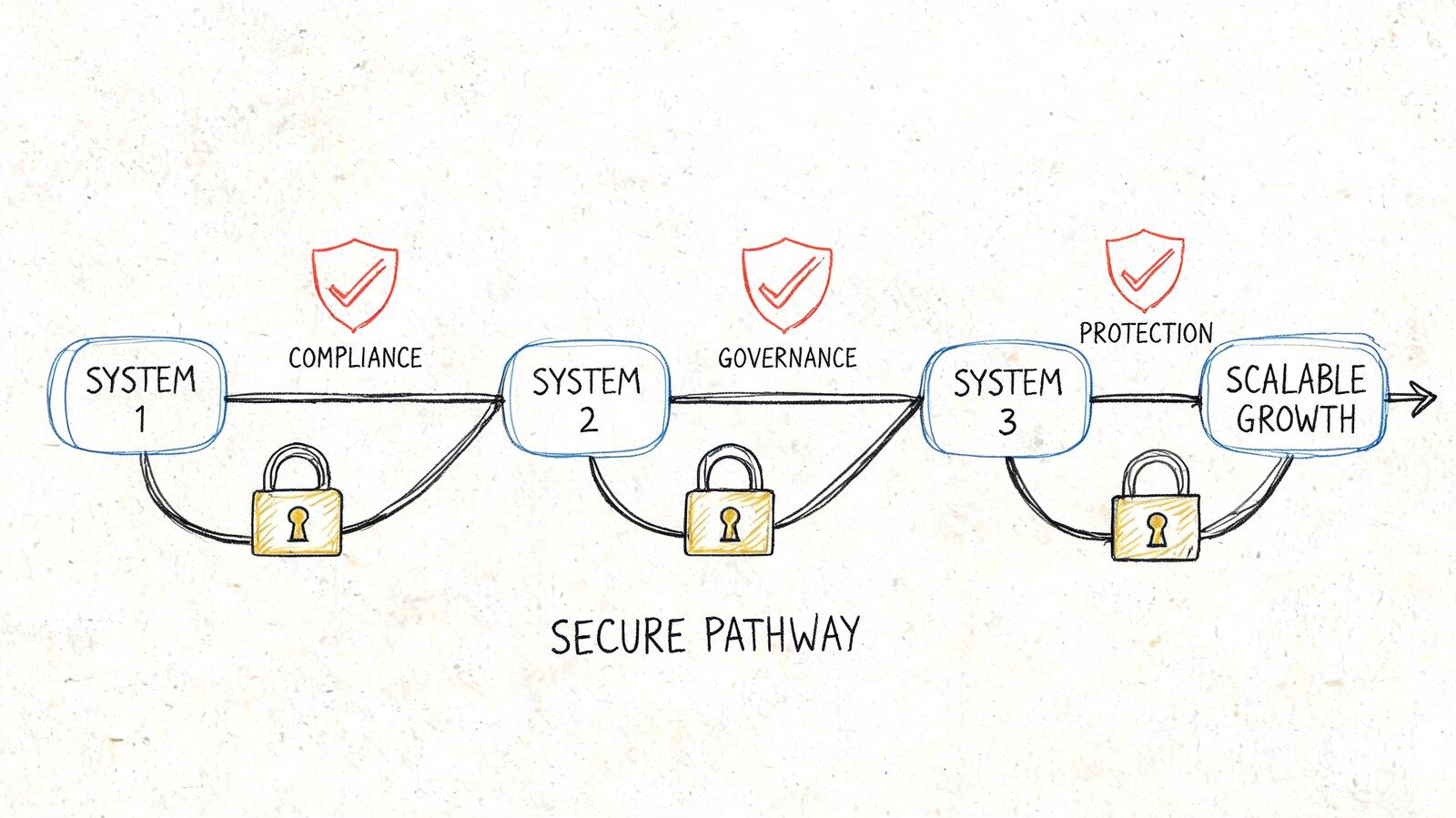
The question isn’t just whether data moves between systems. It’s whether you can prove who moved it, why it moved, what changed, and whether access was controlled the whole time. That proof matters to enterprise customers, auditors, and investors.
Security failures in EAI are expensive
The evidence points straight at the seams between systems. Verizon’s 2025 Data Breach Investigations Report found that “third-party involvement in breaches has doubled to 30%” — nearly a third of breaches now arrive through somebody else’s system, which is precisely what an integration layer connects you to. IBM’s 2025 Cost of a Data Breach report puts the global average cost of a breach at USD 4.44 million, and found that among breached organizations that suffered an AI-related security incident, 97% “lacked proper AI access controls” — the same failure of access discipline that sinks ordinary integrations, just on a newer surface.
Founders don’t need another lesson on why breaches are bad. They need to understand where integrations fail.
It usually isn’t the concept. It’s the execution.
-
Credentials get scattered across scripts, dashboards, and team laptops
-
Permissions stay too broad because nobody narrowed scopes after launch
-
Logs are incomplete, so incident response becomes guesswork
-
Data moves without policy, which turns compliance into theater
Governance is part of the architecture
Compliance frameworks like SOC 2, GDPR, NCA, and PDPL all reward the same behavior. Controlled access. Traceable actions. Repeatable processes. Verified change management.
That means your integration layer should support:
-
Authentication and authorization discipline
Every system connection needs explicit identity and least-privilege access. -
Encryption in transit and at rest
Sensitive data shouldn’t be readable merely because it crossed an internal boundary. -
Audit trails
You need logs that explain what happened, not just whether a job ran. -
Change control through CI/CD
Integration updates shouldn’t happen through mystery clicks in production. If you care about regulated growth, this perspective on compliance for fintech is directly relevant even outside fintech, because the control patterns carry across industries.
The fastest way to fail diligence is to say, “We think the data is secure.” You need to show it.
What founders should insist on
Ask your team to demonstrate one critical customer-data workflow end to end. Not explain it. Demonstrate it.
Can they show where the request enters, where the payload is transformed, where credentials are managed, where errors are logged, and how access is restricted? If not, the architecture isn’t audit-ready, no matter how modern the stack sounds.
Security inside EAI isn’t extra engineering polish. It’s part of the product’s credibility.
The Founder’s Decision Framework From MVP to Scalable Platform
Most founders make integration decisions at the wrong time. They either ignore the problem until it hurts revenue, or they overbuild before the business has earned the complexity.
A better approach is stage-based. Your integration strategy should evolve with the company, not outrun it.
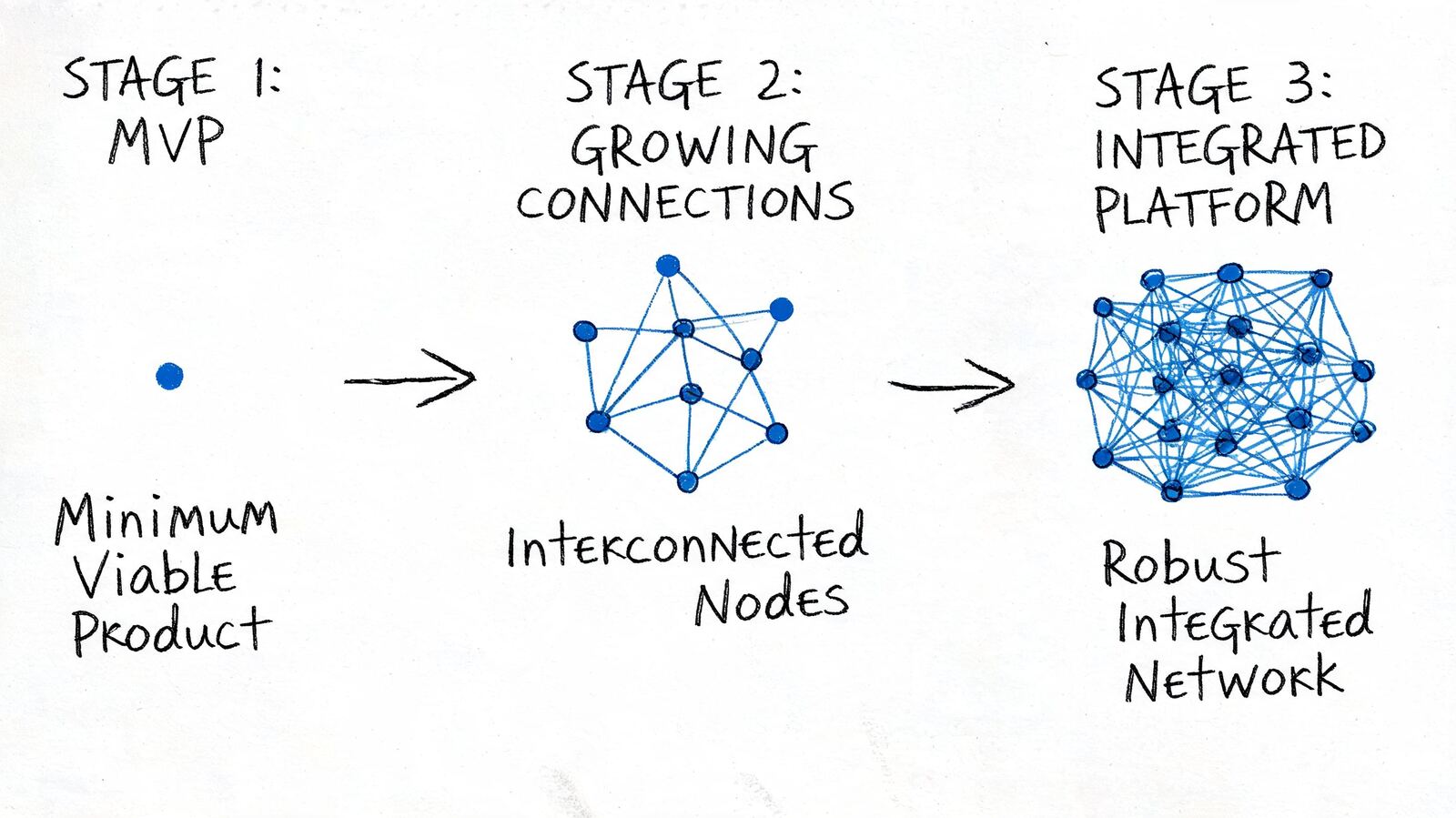
Stage one pre MVP and early MVP
At the beginning, speed beats elegance. That’s normal.
Use simple tools. Zapier, Make, lightweight webhooks, manual reviews, and clear operational checklists are acceptable if they’re supporting learning rather than pretending to be final architecture. Your goal isn’t perfect integration. Your goal is validated demand.
But put boundaries around the shortcuts:
-
Keep core business logic out of no-code automations
-
Document every external dependency
-
Avoid creating multiple systems of record for the same entity
-
Name an owner for each critical workflow
The mistake at this stage isn’t simplicity. It’s hiding complexity where nobody can govern it later.
Stage two investor ready MVP
At this juncture, many startups should change posture.
Once you’re preparing for diligence, enterprise sales, or serious scale conversations, stop building random direct connections. Start designing for replaceability. Build API-first interfaces around your own product. Isolate integration logic into dedicated services or modules. Define canonical data models for customers, subscriptions, accounts, and billing events.
If you’re modernizing around older systems during this phase, the trade-offs often look a lot like classic rehost, refactor, or rebuild strategies. The right choice depends on whether the current system is just inconvenient or structurally dangerous.
This is also the point where architecture should answer business questions cleanly. If an investor asks how onboarding, billing, CRM updates, and product access connect, the answer should be visible in design and code, not trapped in one engineer’s memory.
Founders don’t need the most advanced integration architecture. They need one that survives scrutiny and growth.
Stage three post funding and operational scale
After funding, the integration layer becomes a platform capability.
A central orchestration layer, event bus, or mature iPaaS becomes relevant. The structural case for hub-and-spoke is straightforward math: point-to-point integration between 50 systems requires up to 1,225 individual connections, while a hub-and-spoke model needs only 50 — each fewer connection is one less thing that can silently break. That’s valuable once your environment is heterogeneous. Not before.
At this stage, I want founders thinking in terms of design rules, not one-off projects:
Stage
Primary Goal
Recommended Approach
Avoid
Pre-MVP
Learn fast
Simple automations, manual checkpoints, minimal custom integration code
Complex central integration platforms
Investor-ready MVP
Prove durability
API-first design, isolated integration services, defined data ownership
Hardcoding vendor-specific assumptions into product logic
Post-funding scale
Improve resilience and governance
Event-driven flows, hub-and-spoke where appropriate, stronger observability and controls
Letting the integration layer become a dumping ground
Signals that it’s time to level up
You should upgrade your approach when these signals appear:
-
Different teams trust different systems
-
A new customer workflow requires touching too many apps manually
-
One vendor change threatens product stability
-
Compliance questions take too long to answer
-
Your engineers avoid integration work because it’s too brittle
Those are architectural signals, not just operational annoyances.
Conclusion Your Next Move as a Technical Founder
Founders usually ask what enterprise application integration is as if they’re asking for a definition. That’s the wrong question.
The better question is this: are your systems helping the company compound, or are they subtly turning growth into rework?
EAI is not a legacy enterprise concern. It’s the discipline of making your product, your operations, and your data behave like one company. If you get it right, you build a technical asset that supports scale, compliance, and diligence. If you get it wrong, you build hidden drag into every team and every future roadmap decision.
The practical answer is simple. Don’t bolt systems together blindly. Don’t bury critical business logic inside temporary automations. Don’t wait for diligence to expose architectural weakness you could’ve addressed months earlier.
Build the next connection as if someone will inspect it under pressure, because eventually someone will.
A strong startup architecture doesn’t need to be oversized. It needs to be intentional. That’s what separates a product that can grow from a product that only looks busy.
Ask yourself one sharp question before your team ships the next integration: is this connection a stepping stone toward a durable platform, or a stumbling block you’ll pay to remove later?
Founder FAQs on Enterprise Application Integration
Is Zapier the same as EAI
No. Zapier is a tool. EAI is a strategy.
Zapier can be useful early, especially for low-risk workflows and fast validation. But if your company depends on it for core product logic, billing truth, or compliance-sensitive workflows, you’ve probably pushed a convenience tool beyond its job description.
When should a founder bring in senior technical oversight for integrations
Bring in senior oversight when integrations start affecting revenue, customer access, reporting trust, compliance posture, or investor diligence. That’s usually earlier than founders expect.
If one integration failure can block onboarding, misstate revenue, or expose customer data, you don’t need another freelancer. You need architectural judgment.
Are APIs and EAI the same thing
No. An API is one mechanism for system communication. EAI is the broader discipline of deciding how systems should communicate, what data should move, who owns it, how it’s secured, and how the whole model scales.
An app can have APIs and still have terrible integration architecture.
What’s the biggest founder mistake with EAI
Treating every connection as a local fix instead of part of a system. That’s how integration debt forms. One shortcut rarely kills a startup. A dozen unmanaged shortcuts often do.
If you’re building an MVP that needs to survive technical diligence, compliance pressure, and real scale, Buttercloud helps founders turn fragile product ideas into investor-ready technical assets. The right integration strategy isn’t overhead. It’s part of the moat.
Have a product idea to talk through?
We'll show you how we'd approach it — no pressure, just a real conversation.
Book a Discovery Call